Chapter 23
ANSWERS TO QUESTIONS
1. What does it mean when we say that the inflation gap is negative?
2. “If autonomous spending falls, the central bank should lower its inflation target in order to
stabilize inflation.” Is this statement true, false, or uncertain? Explain your answer.
3. For each of the following shocks, describe how monetary policymakers would respond (if at
all) to stabilize economic activity. Assume the economy starts at a long-run equilibrium.
a. Consumers reduce autonomous consumption.
b. Financial frictions decrease.
c. Government spending increases.
d. Taxes increase.
e. The domestic currency appreciates.
4. During the global financial crisis, how was the Fed able to help offset the sharp increase in
financial frictions without the option of lowering interest rates further? Did the Fed’s plan
work?
5. Why does the divine coincidence simplify the job of policymakers?
The divine coincidence exists when policies that are appropriate to achieve price stability also
6. Why do temporary negative supply shocks pose a dilemma for policymakers?
7. In what way is a permanent negative supply shock worse than a temporary negative supply
shock?
8. Suppose three economies are hit with the same temporary negative supply shock. In country
A, inflation initially rises and output falls; then inflation rises more and output increases. In
country B, inflation initially rises and output falls; then both inflation and output fall. In
country C, inflation initially rises and output falls; then inflation falls and output eventually
increases. What type of stabilization approach did each country take?
9. “Policymakers would never respond by stabilizing output in response to a temporary positive
supply shock.” Is this statement true, false, or uncertain? Explain your answer.
10. The fact that it takes a long time for firms to get new plants and equipment up and running is
an illustration of what policy problem?
11. If someone told you, “Congress and the Senate couldn’t vote themselves out of a phone
booth,” what type of policy lag would that person be referring to?
This refers to the legislative lag (of fiscal policy).
12. Is stabilization policy more likely to be conducted through monetary policy or through fiscal
policy? Why?
13. “If the data and recognition lags could be reduced, activist policy probably would be more
beneficial to the economy.” Is this statement true, false, or uncertain? Explain your answer.
14. Why do activists believe that the economy’s self-correcting mechanism works slowly?
15. If the economy’s self-correcting mechanism works slowly, should the government necessarily
pursue discretionary policy to eliminate unemployment? Why or why not?
16. Suppose one could measure the welfare gains derived from eliminating output (and
unemployment) fluctuations in the economy. Assuming these gains are relatively small for the
debate?
17. Given a relatively steep and a relatively flat short-run aggregate supply curve, which curve
would support the case for nonactivist policy? Why?
18. “Because government policymakers do not consider inflation desirable, their policies cannot
be the source of inflation.” Is this statement true, false, or uncertain? Explain your answer.
19. How can monetary authorities target any inflation rate they wish?
20. What will happen if policymakers erroneously believe that the natural rate of unemployment
is 7% when it is actually 5% and therefore pursue stabilization policy?
21. How can demand-pull inflation lead to cost-push inflation?
22. How does the policy rate hitting a floor of zero lead to an upward-sloping aggregate demand
curve?
23. Why does the self-correcting mechanism stop working when the policy rate hits the zero
lower bound?
24. What nonconventional monetary policies shift the aggregate demand curve, and how do they
work?
ANSWERS TO APPLIED PROBLEMS
25. Suppose the current administration decides to decrease government expenditures as a means
of cutting the existing government budget deficit.
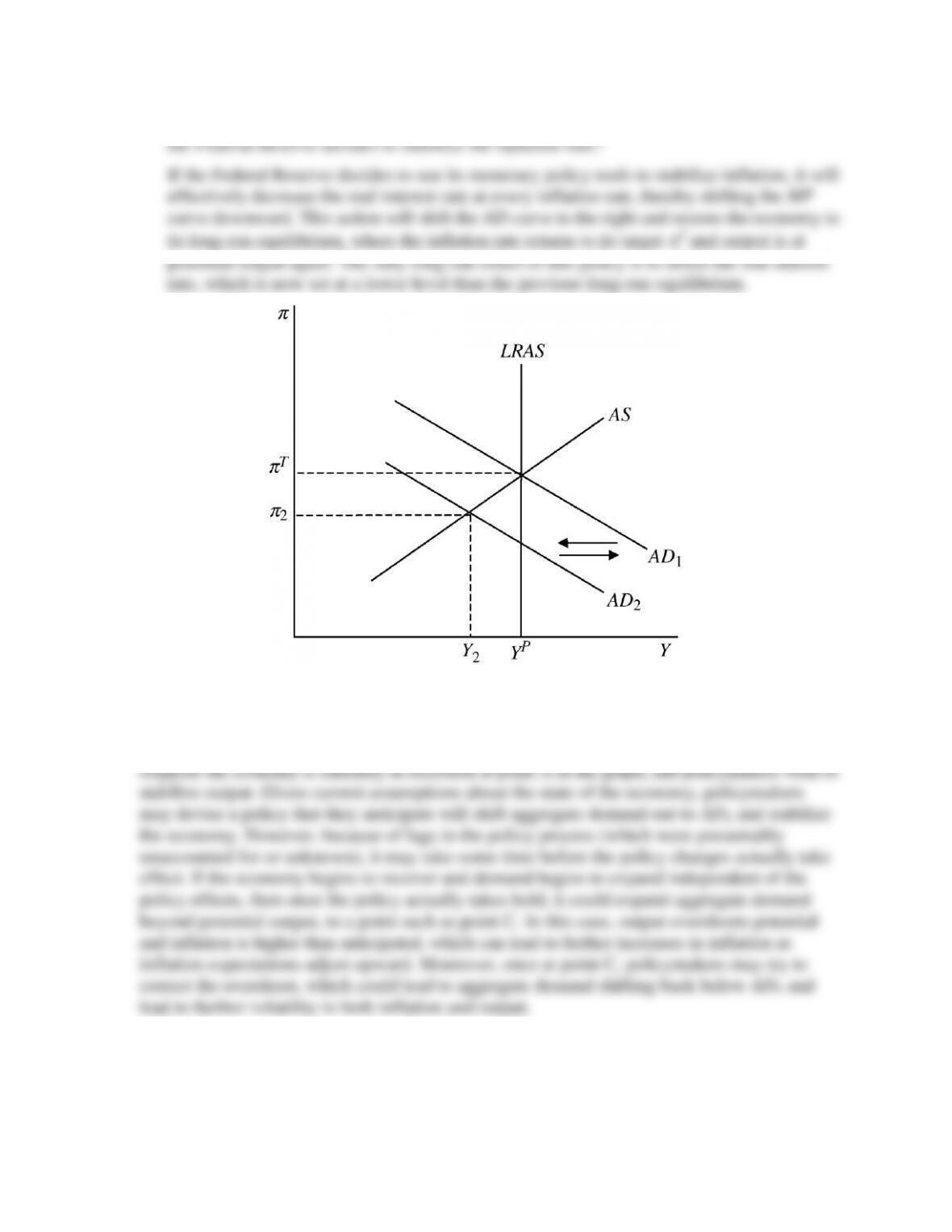
b. What will be the effect on the real interest rate, the inflation rate, and the output level if
26. Use a graph of aggregate demand and supply to demonstrate how lags in the policy process can
result in undesirable fluctuations in output and inflation.