Chapter 21
ANSWERS TO QUESTIONS
1. When the inflation rate increases, what happens to the federal funds rate? Operationally,
how does the Fed adjust the federal funds rate?
2. What is the key assumption underlying the Fed’s ability to control the real interest rate?
3. Why does the MP curve necessarily have an upward slope?
4. If = 0, what does this imply about the relationship between the nominal interest rate and
the inflation rate?
5. How does an autonomous tightening or easing of monetary policy by the Fed affect the MP
curve?
6. How is an autonomous tightening or easing of monetary policy different from a change in the
real interest rate caused by a change in the current inflation rate?
7. Suppose that a new Fed chair is appointed and that his or her approach to monetary policy
can be summarized by the following statement: “I care only about increasing employment.
Inflation has been at very low levels for quite some time; my priority is to ease monetary
policy to promote employment.” How would you expect the monetary policy curve to be
affected, if at all?
8. “The Fed decreased the fed funds rate in late 2007, even though inflation was increasing.
This action demonstrated a violation of the Taylor principle.” Is this statement true, false, or
uncertain? Explain your answer.
False. Even though current inflation was relatively high, the Fed’s distaste for inflation
9. What factors affect the slope of the aggregate demand curve?
10. “Autonomous monetary policy is more effective at changing output when is higher.” Is this
statement true, false, or uncertain? Explain your answer.
11. If net exports were not sensitive to changes in the real interest rate, would monetary policy
be more or less effective in changing output?
12. How does an autonomous tightening or easing of monetary policy by the Fed affect the
aggregate demand curve?
13. For each of the following situations, describe how (if at all) the IS, MP, and AD curves are
affected.
a. A decrease in financial frictions
b. An increase in taxes and an autonomous easing of monetary policy
c. An increase in the current inflation rate
d. A decrease in autonomous consumption
f. The new Federal Reserve chair begins to care more about fighting inflation.
14. What would be the effect of an increase in U.S. net exports on the aggregate demand curve?
Would an increase in net exports affect the monetary policy curve? Explain.
15. Why does the aggregate demand curve shift when “animal spirits” change?
16. If government spending increases and taxes are raised to keep the budget balanced, what
happens to the aggregate demand curve?
17. Suppose that government spending is increased at the same time that an autonomous
curve?
18. “If
f
uncertain? Explain your answer.
ANSWERS TO APPLIED PROBLEMS
19. Assume that the monetary policy curve is given by r = 1.5 + 0.751
.
a. Calculate the real interest rate when the inflation rate is 2%, 3%, and 4%.
b. Draw a graph of the MP curve, labeling the points from part (a).
c. Assume now that the monetary policy curve is given by r = 2.5 + 0.751
. Does the new
monetary policy curve represent an autonomous tightening or loosening of monetary
policy?
Since
r
increases, this represents an autonomous tightening of policy.
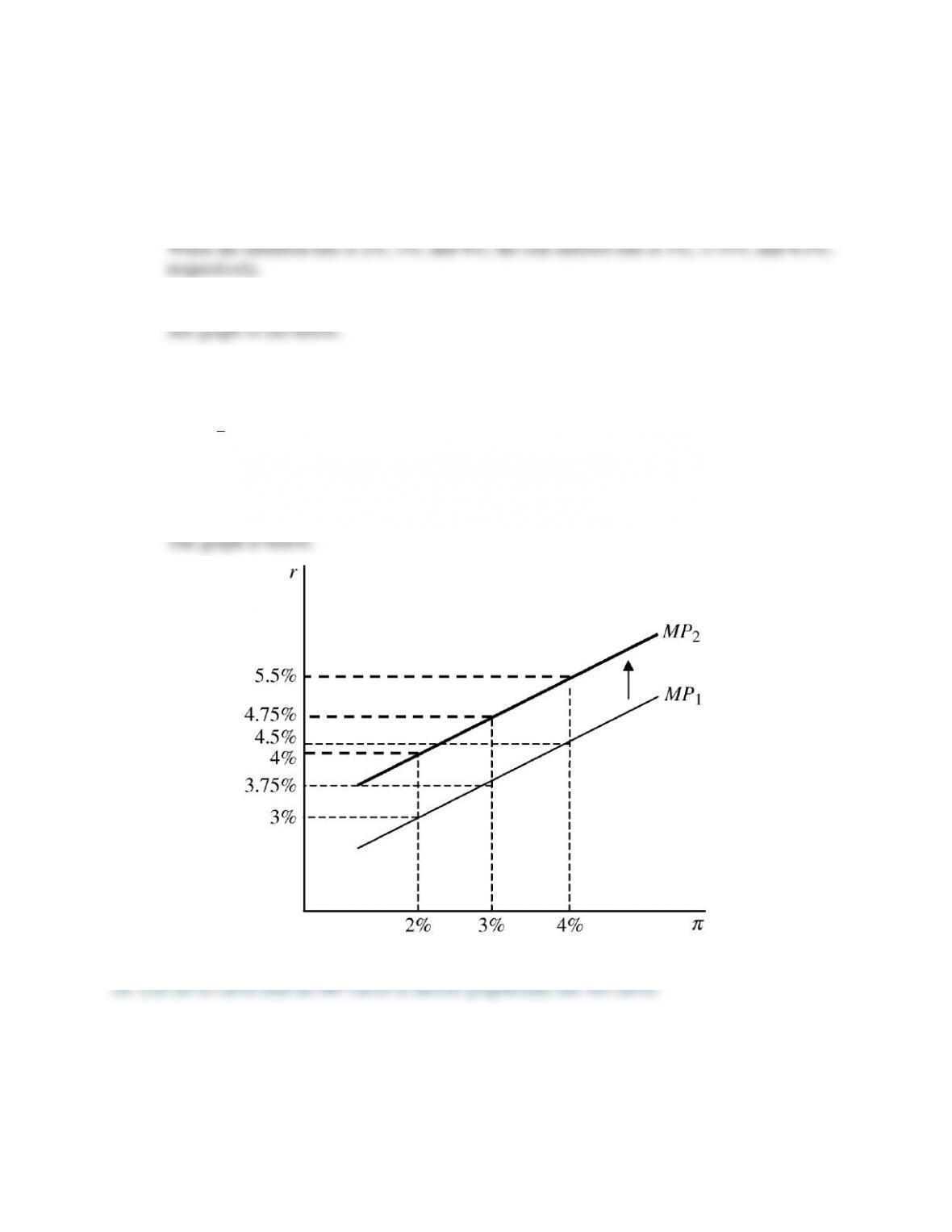
d. Calculate the real interest rate when the inflation rate is 2%, 3%, and 4%, and draw the
new MP curve, showing the shift from part (b).
When the inflation rate is 2%, 3%, and 4%, the real interest rate is 4%, 4.75%, and 5.5%.
See Figure 4 in the textbook.
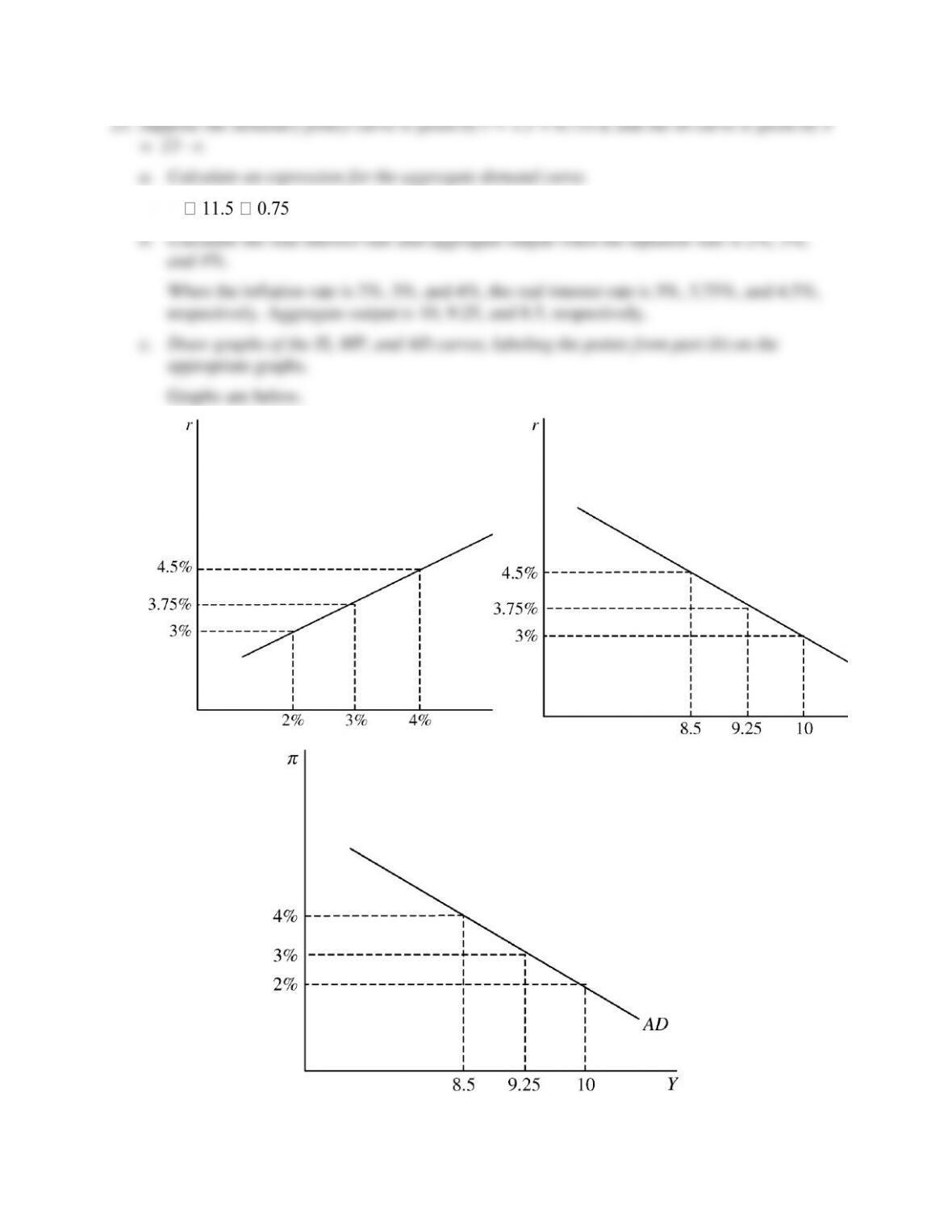
Y
.