Chapter 4
ANSWERS TO QUESTIONS
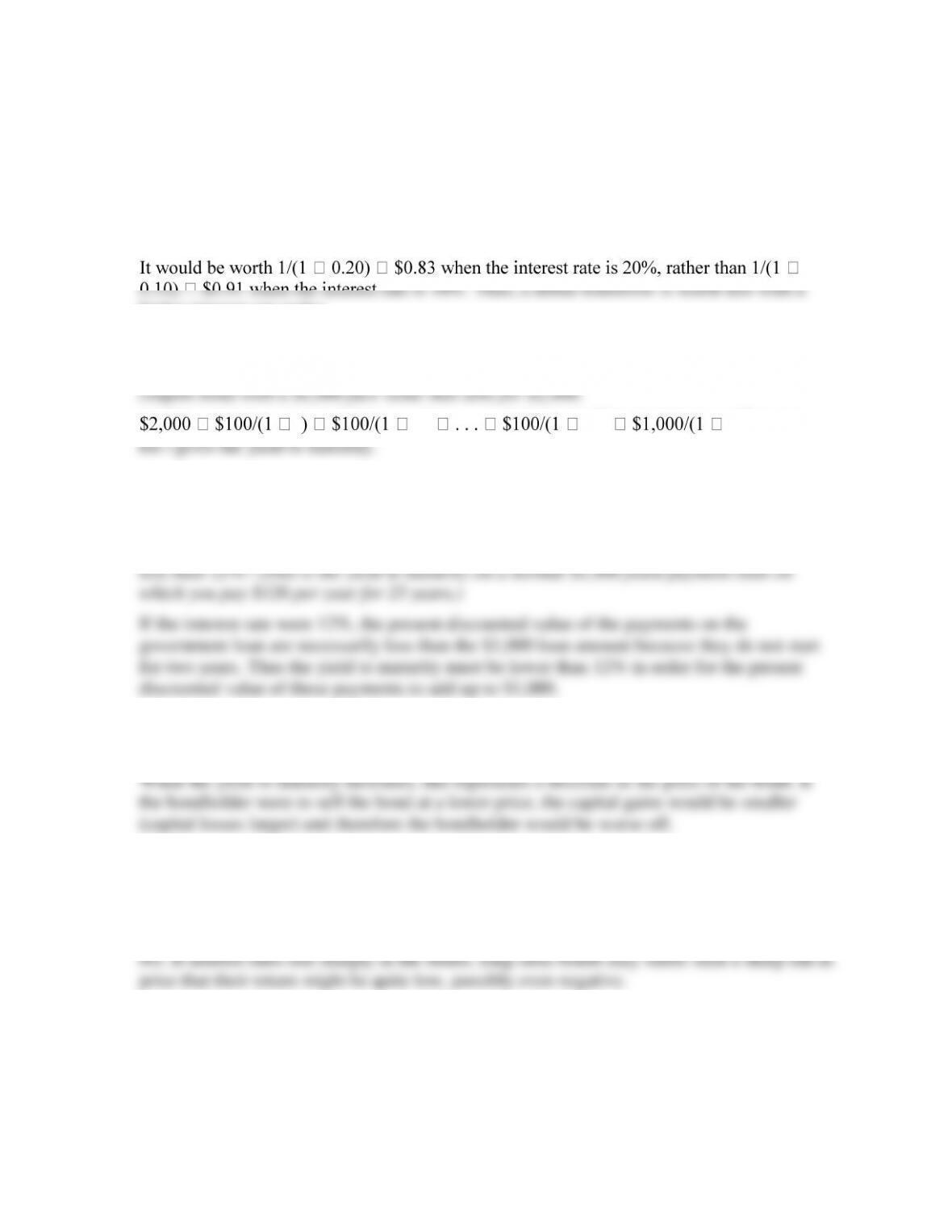
1. Would a dollar tomorrow be worth more to you today when the interest rate is 20% or when
it is 10%?
higher interest rate today.
2. Write down the formula that is used to calculate the yield to maturity on a twenty-year 10%
i i)2 i)20 i)20. Solving
3. To help pay for college, you have just taken out a $1,000 government loan that makes you
pay $126 per year for 25 years. However, you don’t have to start making these payments
until you graduate from college two years from now. Why is the yield to maturity necessarily
4. Do bondholders fare better when the yield to maturity increases or when it decreases? Why?
5. A financial adviser has just given you the following advice: “Long-term bonds are a great
investment because their interest rate is over 20%.” Is the financial adviser necessarily
right?
6. If mortgage rates rise from 5% to 10% but the expected rate of increase in housing prices
rises from 2% to 9%, are people more or less likely to buy houses?
7. When is the current yield a good approximation of the yield to maturity?
8. Why would a government choose to issue a perpetuity, which requires payments forever,
instead of a terminal loan, such as a fixed-payment loan, discount bond, or coupon bond?
9. Under what conditions will a discount bond have a negative nominal interest rate? Is it
possible for a coupon bond or a perpetuity to have a negative nominal interest rate?
10. True or False: With a discount bond, the return on the bond is equal to the rate of capital
gain.
11. If interest rates decline, which would you rather be holding, long-term bonds or short-term
bonds? Why? Which type of bond has the greater interest-rate risk?
12. Interest rates were lower in the mid-1980s than in the late 1970s, yet many economists have
late 1970s. Does this make sense? Do you think that these economists are right?
13. Retired persons often have much of their wealth placed in savings accounts and other
interest-bearing investments, and complain whenever interest rates are low. Do they have a
valid complaint?
ANSWERS TO APPLIED PROBLEMS
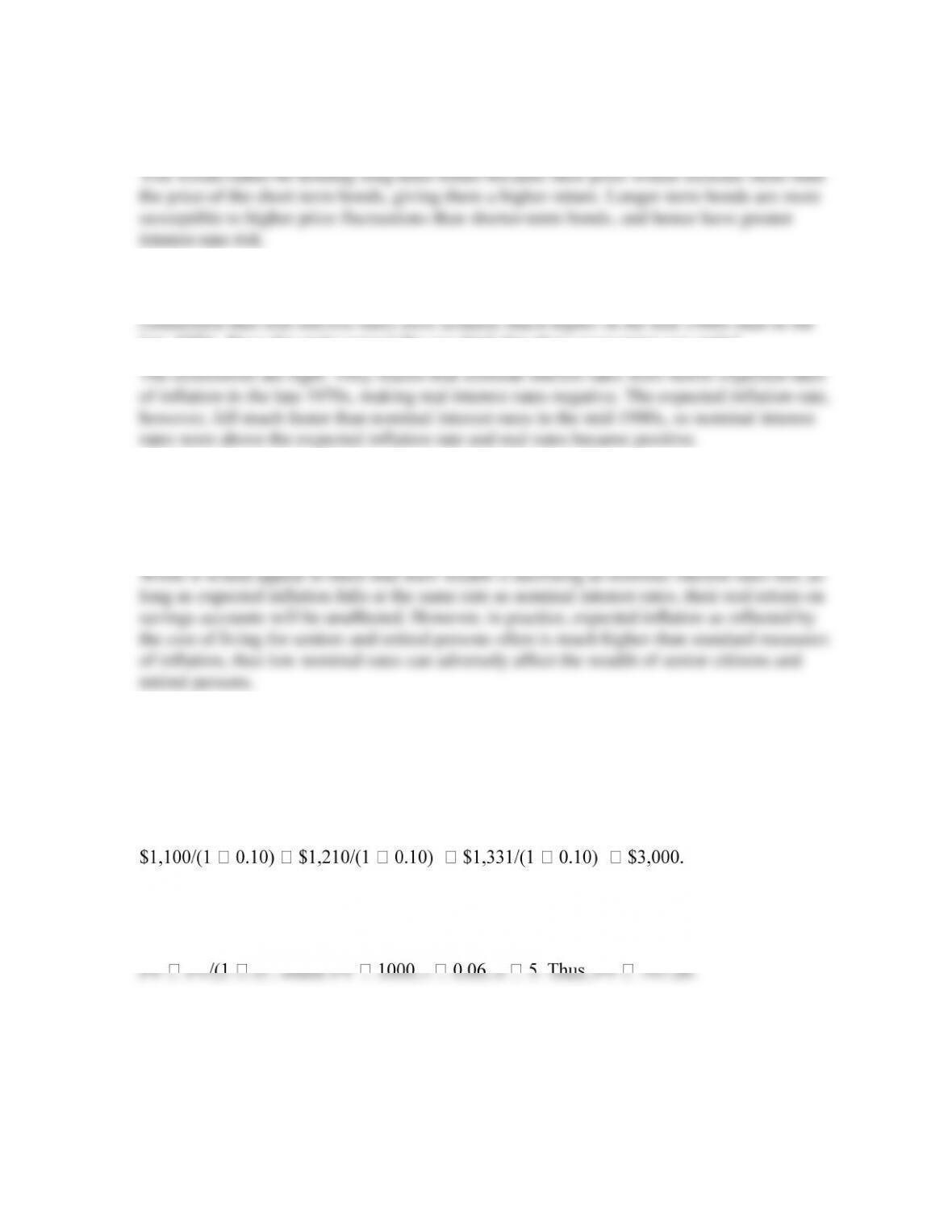
14. If the interest rate is 10%, what is the present value of a security that pays you $1,100 next
year, $1,210 the year after, and $1,331 the year after that?
2 3
15. Calculate the present value of a $1,000 discount bond with five years to maturity if the yield
to maturity is 6%
16. A lottery claims its grand prize is $10 million, payable over 5 years at $2,000,000 per year. If
the first payment is made immediately, what is this grand prize really worth? Use an interest
rate of 6%.
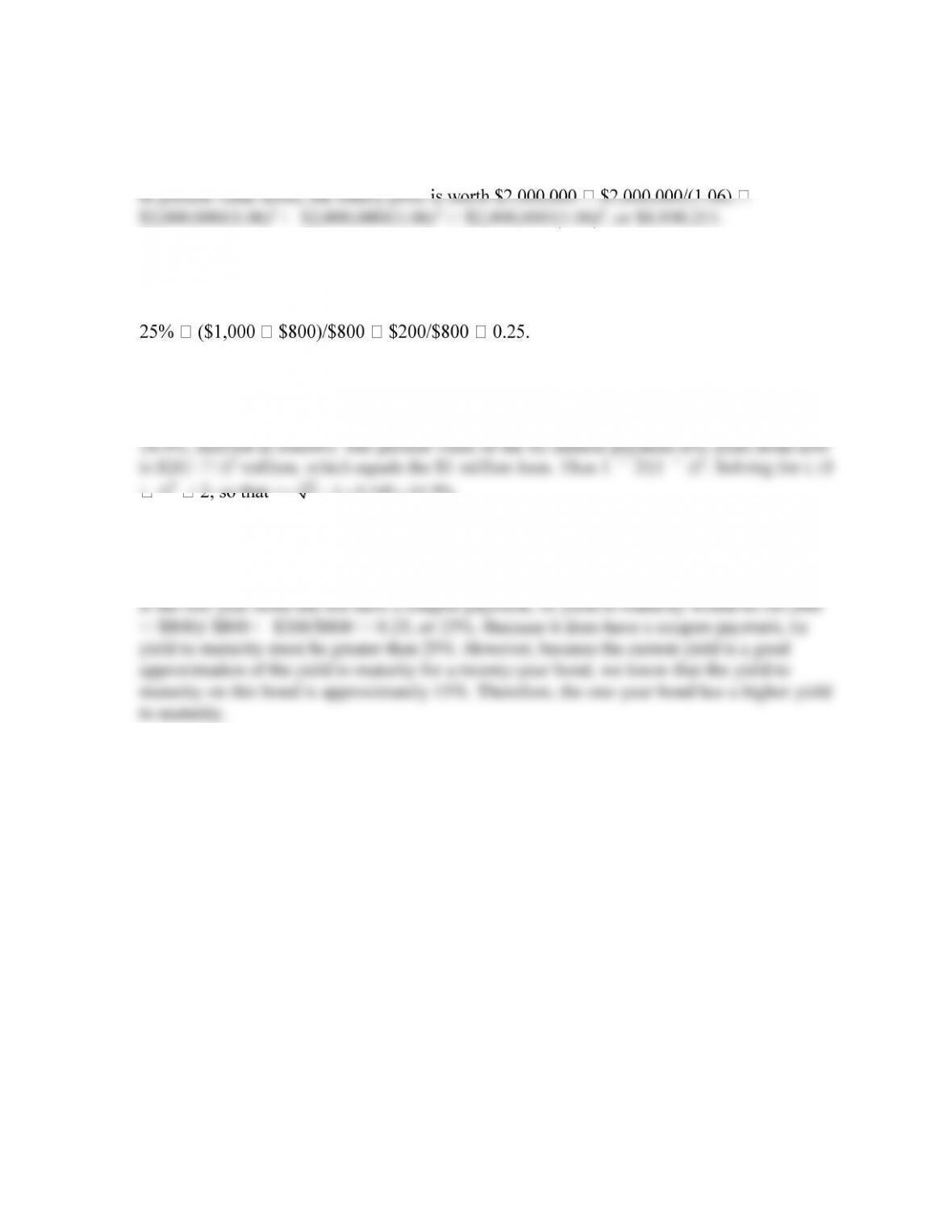
17. What is the yield to maturity on a $1,000-face-value discount bond maturing in one year that
sells for $800?
18. What is the yield to maturity on a simple loan for $1 million that requires a repayment of $2
million in five years’ time?
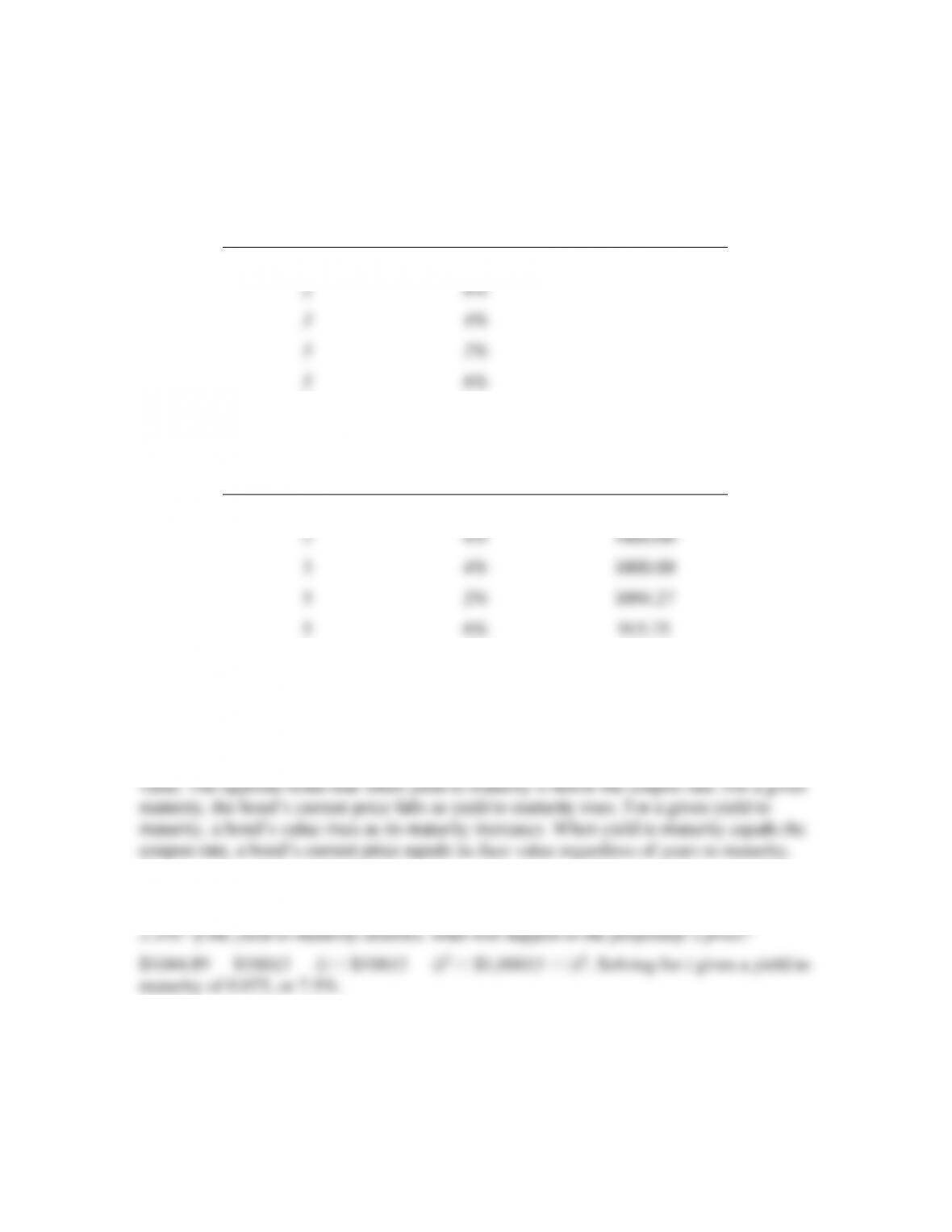
20. Consider a bond with a 4% annual coupon and a face value of $1,000. Complete the
following table. What relationships do you observe between years to maturity, yield to
maturity, and the current price?
Years to Maturity
Yield to Maturity
Current Price
2
2%
2
4%
3
4%
5
2%
5
6%
Years to Maturity
Yield to Maturity
Current Price
2
2%
1038.83
2
4%
1000.00
3
4%
1000.00
5
2%
1094.27
5
6%
915.75
21. Consider a coupon bond that has a $1,000 par value and a coupon rate of 10%. The bond is
currently selling for $1,044.89 and has two years to maturity. What is the bond’s yield to
maturity?
When yield to maturity is above the coupon rate, the bond’s current price is below its face
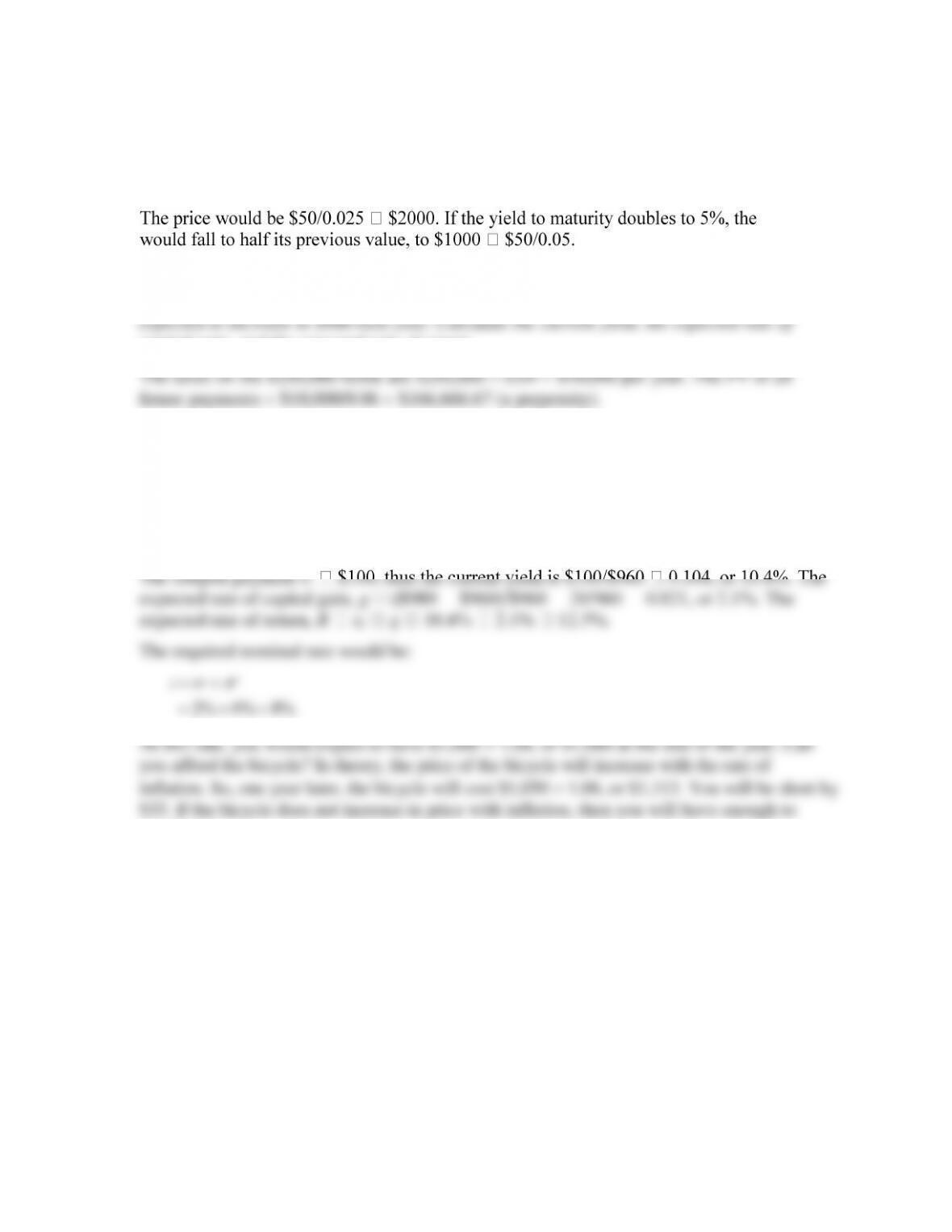
22. What is the price of a perpetuity that has a coupon of $50 per year and a yield to maturity of
23. Property taxes in a particular district are 4% of the purchase price of a home every year. If
you just purchased a $250,000 home, what is the present value of all the future property tax
payments? Assume that the house remains worth $250,000 forever, property tax rates never
change, and a 6% interest rate is used for discounting.
price
24. A $1000-face-value bond has a 10% coupon rate, its current price is $960, and its price is
capital gain, and the expected rate of return.
25. Assume you just deposited $1,000 into a bank account. The current real interest rate is 2%,
and inflation is expected to be 6% over the next year. What nominal rate would you require
from the bank over the next year? How much money will you have at the end of one year? If
you are saving to buy a fancy bicycle that currently sells for $1,050, will you have enough
money to buy it?
ANSWERS TO DATA ANALYSIS PROBLEMS
1. Go to the St. Louis Federal Reserve FRED database, and find data on the interest rate on a
four-year auto loan (TERMCBAUTO48NS). Assume that you borrow $20,000 to purchase a
new automobile and that you finance it with a four-year loan at the most recent interest rate
given in the database. If you make one payment per year for four years, what will the yearly
payment be? What is the total amount that will be paid out on the $20,000 loan?
2. The U.S. Treasury issues some bonds as Treasury Inflation Indexed Securities, or TIIS, which
are bonds adjusted for inflation; hence the yields can be roughly interpreted as real interest
rates. Go to the St. Louis Federal Reserve FRED database, and find data on the following
TIIS bonds and their nominal counterparts. Then answer the questions below.
a. Following the Great Recession of 2008–2009, the 5, 7, 10, and even the 20-year TIIS
yields became negative for a period of time. How is this possible?
b. Using the most recent data available, calculate the difference between the yields for each
of the pairs of bonds (DGS5 – DFII5, etc.) listed above. What does this difference
represent?
c. Based on your answer to part (b), are there significant variations among the differences
in the bond-pair yields? Interpret the magnitude of the variation in differences among the
pairs.
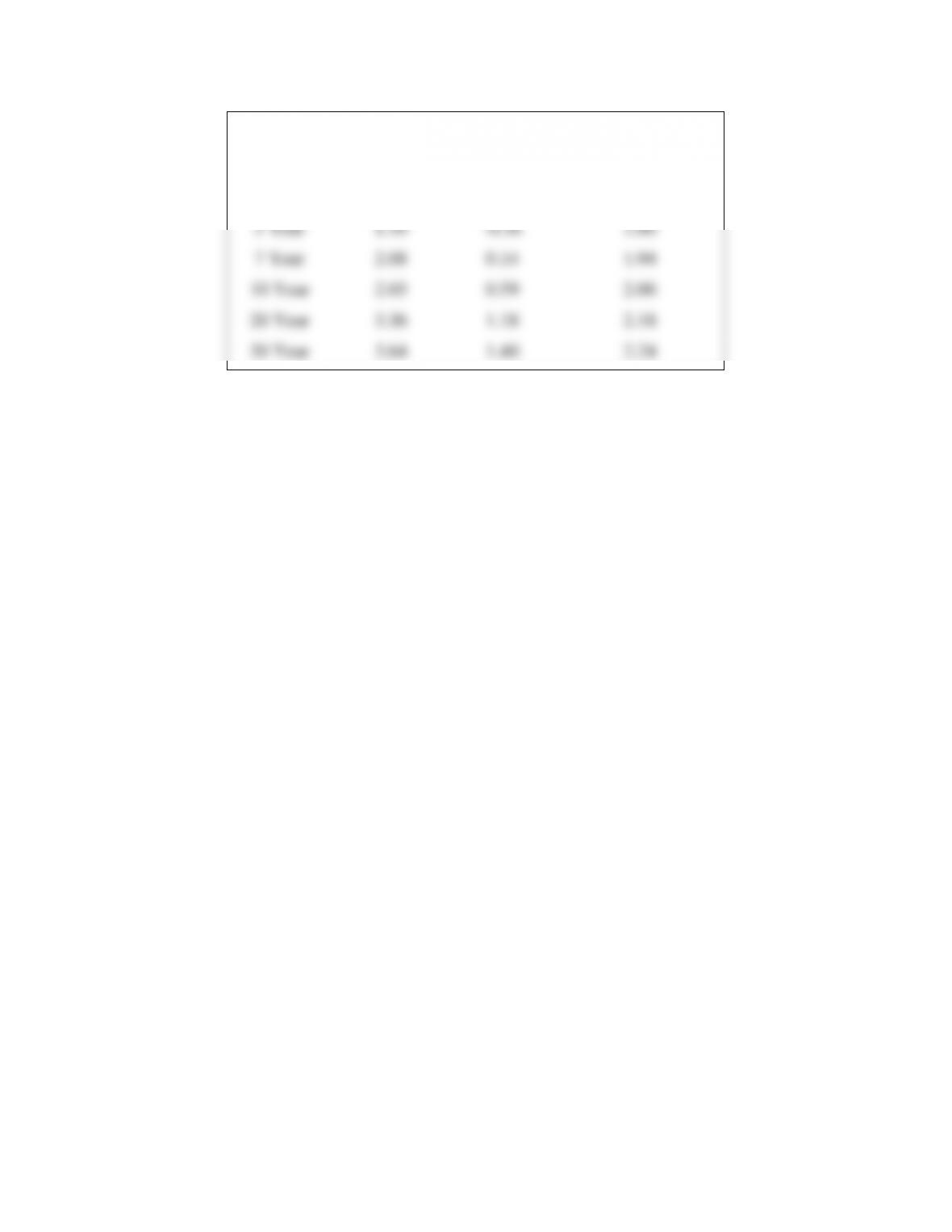
9-Jul-13
Nominal
TIIS
Difference
(Inflation
Expectations)
5 Year
1.50
-0.36
1.86
7 Year
2.08
0.14
1.94
10 Year
2.65
0.59
2.06
20 Year
3.36
1.18
2.18
30 Year
3.64
1.40
2.24