Chapter 17
ANSWERS TO QUESTIONS
1. When the euro appreciates, are you more likely to drink California wine or French wine?
2. “A country is always worse off when its currency is weak (falls in value).” Is this statement
true, false, or uncertain? Explain your answer.
3. When the U.S. dollar depreciates, what happens to exports and imports in the United States?
4. If the Japanese price level rises by 5% relative to the price level in the United States, what
does the theory of purchasing power parity predict will happen to the value of the Japanese
yen in terms of dollars?
5. If the demand for a country’s exports falls at the same time that tariffs on imports are raised,
will the country’s currency tend to appreciate or depreciate in the long run?
6. When the Federal Reserve conducts an expansionary monetary policy, what happens to the
money supply? How does this affect the supply of dollar assets?
7. From 2009 to 2011, the economies of Australia and Switzerland suffered relatively mild
effects from the global financial crisis. At the same time, many countries in the euro area
were hit hard by high unemployment and burdened with unsustainably high government
debts. How should this have affected the euro/Swiss franc and euro/Australian dollar
exchange rates?
8. In the mid- to late 1970s, the yen appreciated in value relative to the dollar, even though
Japan’s inflation rate was higher than America’s. How can this be explained by
improvements in the productivity of Japanese industry relative to American industry?
9. Suppose the president of the United States announces a new set of reforms that includes a new
anti-inflation program. Assuming the announcement is believed by the public, what will happen
to the exchange rate on the U.S. dollar?
The dollar will appreciate. Because expected U.S. inflation falls as a result of the
10. If the British central bank lowers interest rates to reduce unemployment, what will happen to
the value of the pound in the short run and in the long run?
The pound depreciates, declining in both the short run and the long run. Consider Britain to
be the domestic country. The lower domestic interest rate on pound assets lowers the
11. If the Indian government unexpectedly announces that it will be imposing higher tariffs on
foreign goods one year from now, what will happen to the value of the Indian rupee today?
12. If nominal interest rates in America rise but real interest rates fall, predict what will happen
to the U.S. dollar exchange rate.
13. If American auto companies make a breakthrough in automobile technology and are able to
produce a car that gets 200 miles to the gallon, what will happen to the U.S. dollar exchange
rate?
The dollar will appreciate. The increase in U.S. productivity raises the expected future
14. If Mexicans go on a spending spree and buy twice as much French perfume and twice as
happen to the value of the Mexican peso?
exchange rate.
15. Through the summer and fall of 2008, as the global financial crisis began to take hold,
international financial institutions and sovereign wealth funds significantly increased their
purchases of U.S. Treasury securities as a safe haven investment. How should this have
affected U.S. dollar exchange rates?
16. In September 2012, the Federal Reserve announced a large-scale asset-purchase program
(known as QE3) designed to lower intermediate and longer-term interest rates. What effect
should this have had on the dollar/ euro exchange rate?
ANSWERS TO APPLIED PROBLEMS
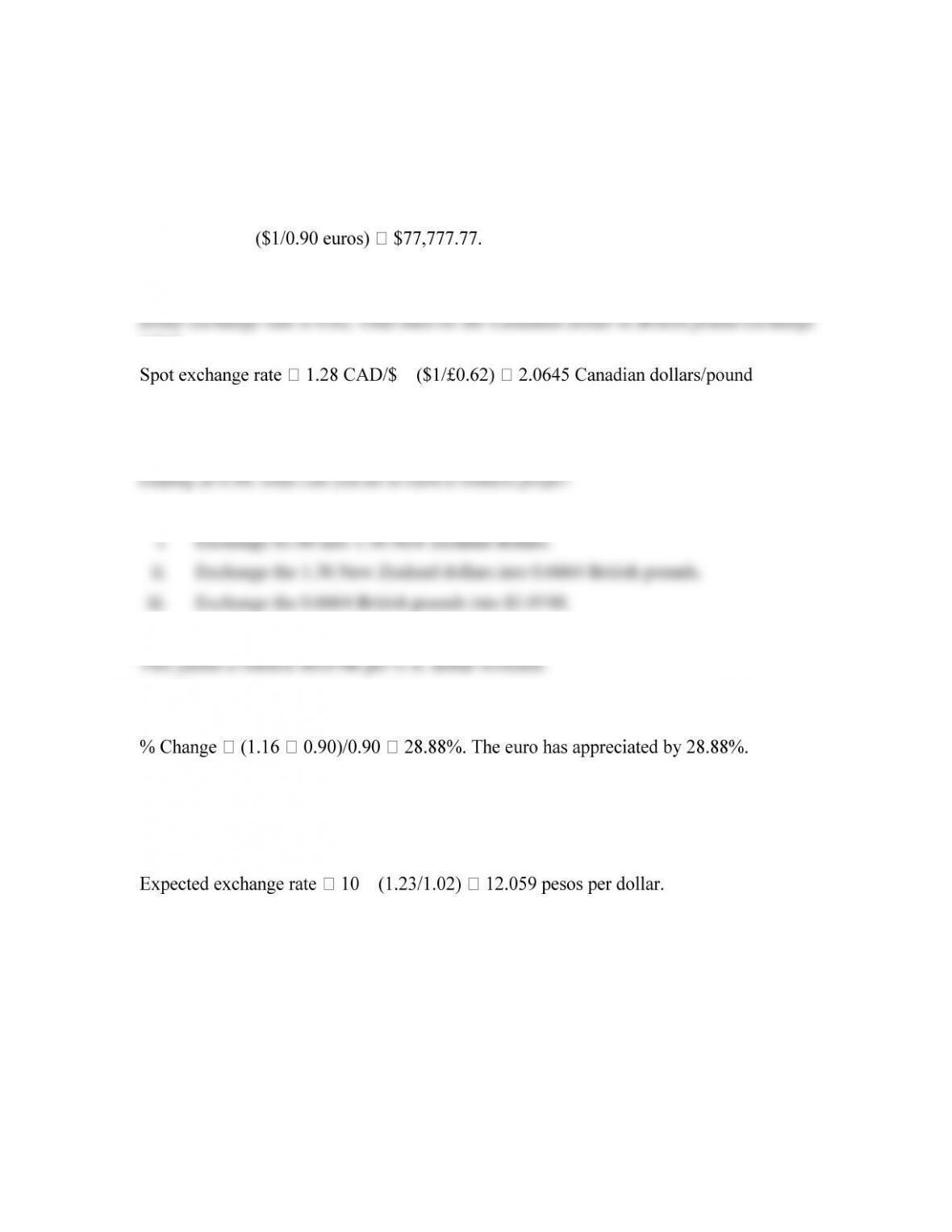
17. A German sports car is selling for 70,000 euros. What is the dollar price in the United States
of the German car if the exchange rate is 0.90 euro per dollar?
70,000 euros
18. If the Canadian dollar to U.S. dollar exchange rate is 1.28 and the British pound to U.S.
rate?
19. The New Zealand dollar to U.S. dollar exchange rate is 1.36, and the British pound to U.S.
dollar exchange rate is 0.62. If you find that the British pound to New Zealand dollar is
Complete the following transactions simultaneously:
20. In 1999, the euro was trading at $0.90 per euro. If the euro is now trading at $1.16 per euro,
what is the percentage change in the euro’s value? Is this an appreciation or a depreciation?
21. If the price level recently increased by 20% in England while falling by 5% in the United
States, by how much must the exchange rate change if PPP holds? Assume that the current
exchange rate is 0.55 pound per dollar.
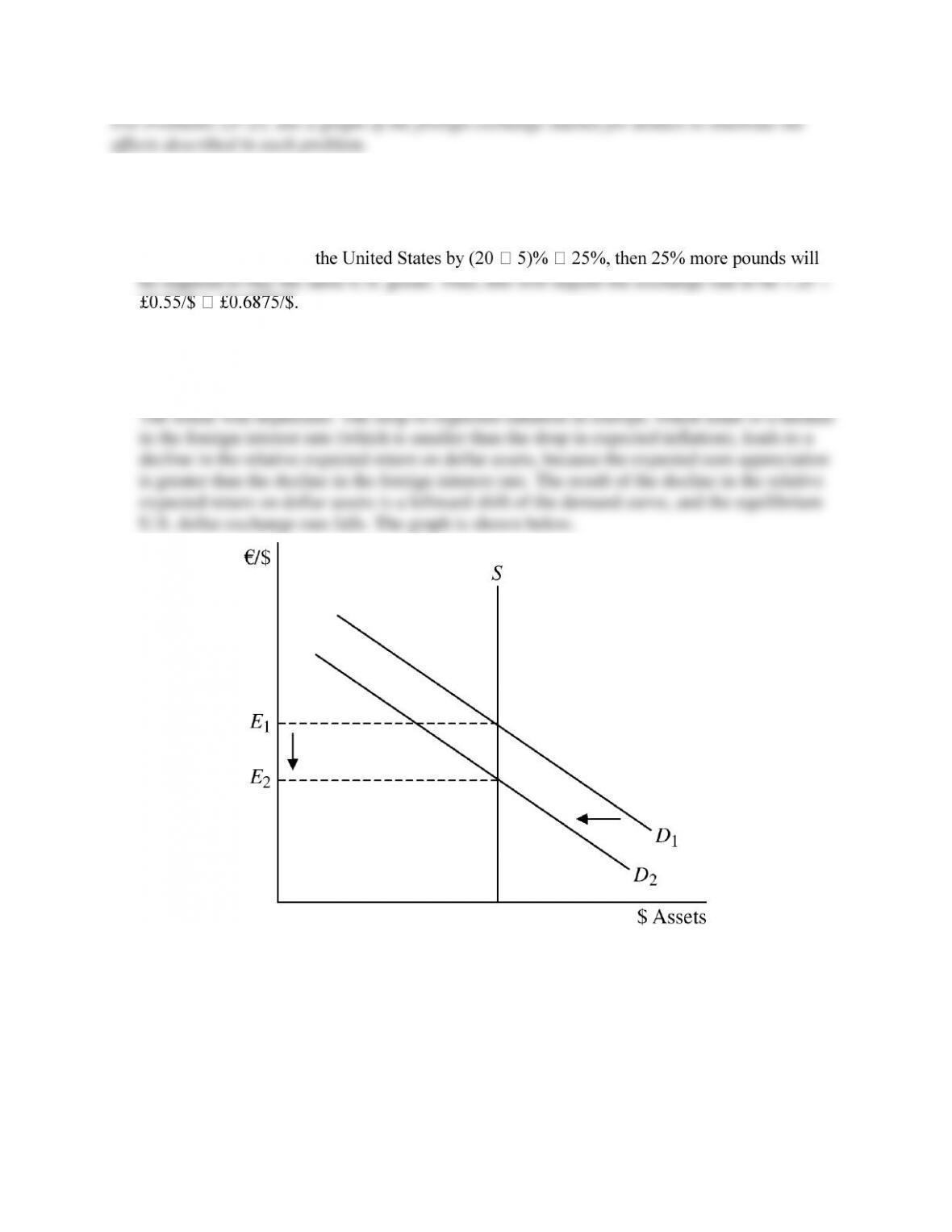
22. If expected inflation drops in Europe, so that interest rates fall there, what will happen to the
exchange rate on the U.S. dollar?
If prices rise relative to
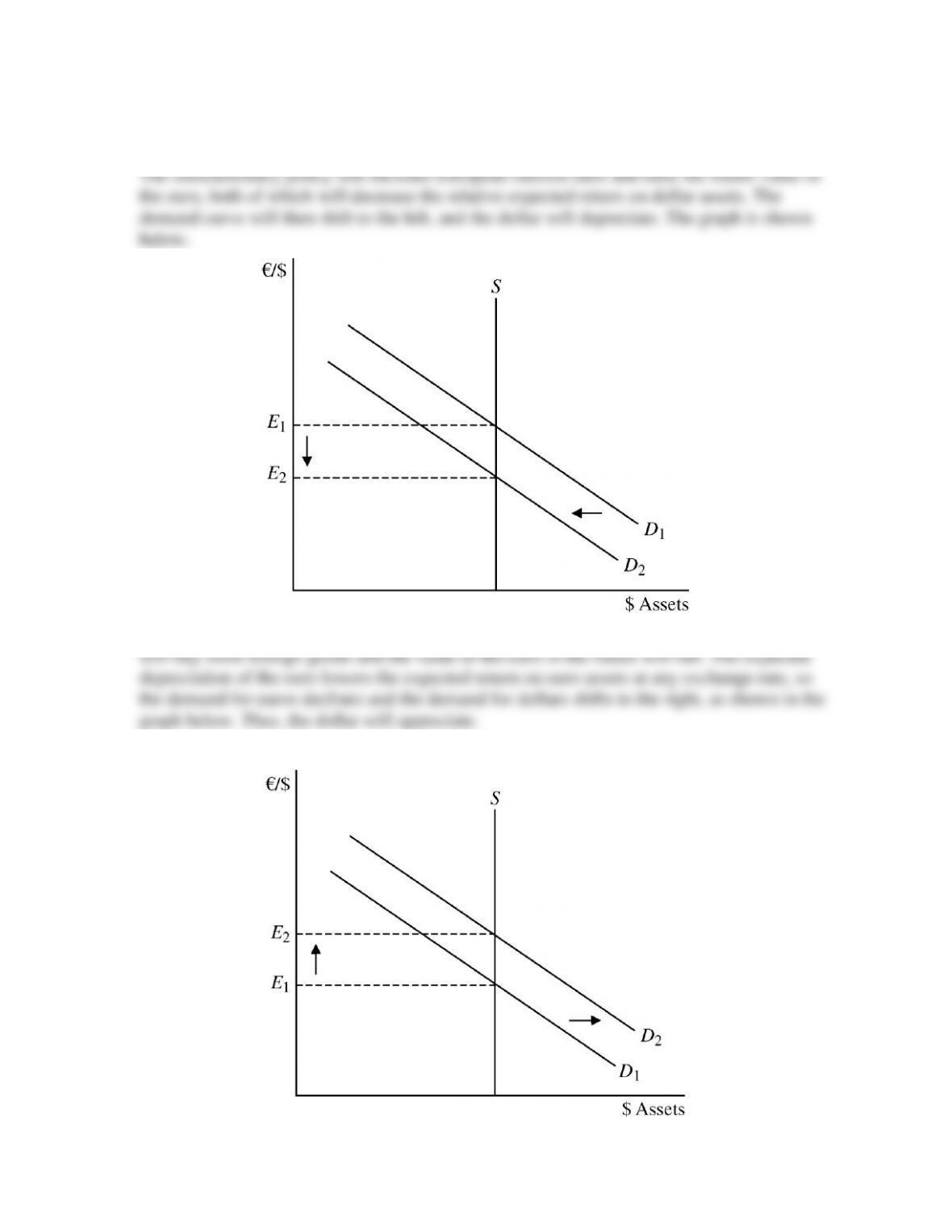
23. If the European Central Bank decides to pursue a contractionary monetary policy to fight
inflation, what will happen to the value of the U.S. dollar?
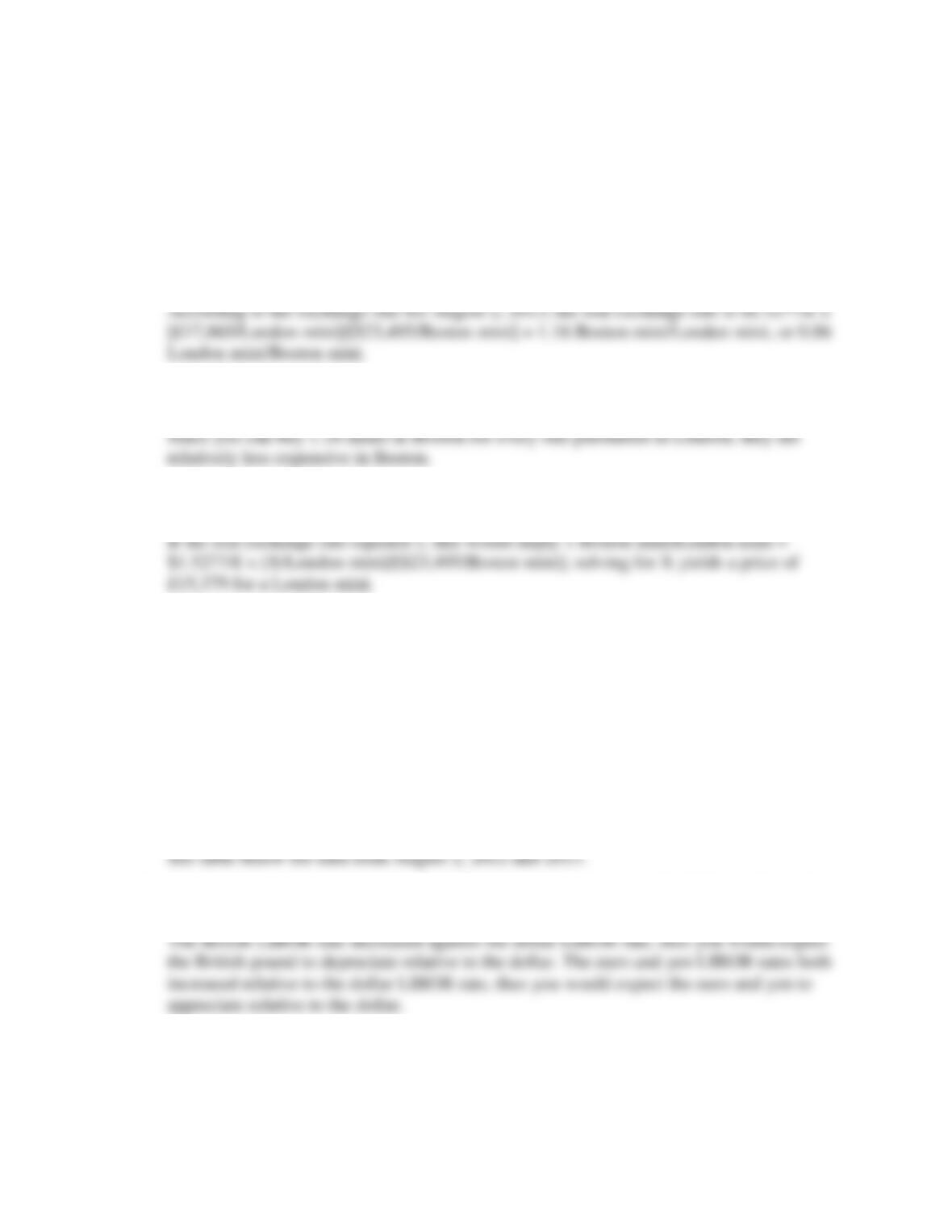
24. If a strike takes place in France, making it harder to buy French goods, what will happen to
the value of the U.S. dollar?
Consider France to be the domestic country. Because it is harder to get French goods, people
ANSWERS TO APPLIED PROBLEMS
1. Go to the St. Louis Federal Reserve FRED database, and find data on the exchange rate of
U.S. dollars per British pound (DEXUSUK). A Mini Cooper can be purchased in London,
England, for £17,865 or in Boston, United States, for $23,495.
a. Use the most recent exchange rate available to calculate the real exchange rate of the
London Mini per Boston Mini.
b. Based on your answer to part (a), are Mini Coopers relatively more expensive in Boston
or in London?
c. What price in British pounds would make the Mini Cooper equally expensive in both
locations, all else being equal?
2. Go to the St. Louis Federal Reserve FRED database, and find data on the daily dollar
exchange rates for the euro (DEXUSEU), British pound (DEXUSUK), and Japanese yen
(DEXJPUS). Also find data on the daily three-month London Interbank Offer Rate, or
LIBOR, for the United States dollar (USD3M-TD156N), euro (EUR3MTD156N), British
pound (GBP3MTD156N), and Japanese yen ( JPY3M-TD156N). LIBOR is a measure of
interest rates denominated in each country’s respective currency.
a. Calculate the difference between the LIBOR rate in the United States and the LIBOR
rates in the three other countries using the data from one year ago and the most recent
data available.
b. Based on the changes in interest rate differentials, do you expect the dollar to depreciate
or appreciate against the other currencies?
c. Report the percentage change in the exchange rates over the past year. Are the results
you predicted in part (b) consistent with the actual exchange rate behavior?
See table below. The British pound depreciated and the euro appreciated according to
prediction. However, the Japanese Yen actually depreciated, despite having relatively
Date
USD
LIBOR
GBP
LIBOR
EUR
LIBOR
JPY
LIBOR
2012-08-02
0.44185
0.73375
0.24821
0.19571
2013-08-02
0.26660
0.51125
0.15357
0.15571
USD –
GBP
LIBOR
USD –
EUR
LIBOR
USD – JPY
LIBOR
8/2/2012
-0.29190
0.19364
0.24614
8/2/2013
-0.24465
0.11303
0.11089
One
Year
Change
0.04725
-0.08061
-0.13525
Date
USD per
GBP
USD per
EUR
JPY per
USD
2012-08-02
1.5500
1.2149
78.22
2013-08-02
1.5277
1.3268
99.04
GBP
depreciated
EUR
appreciated
JPY
depreciated