Chapter 8
ANSWERS TO QUESTIONS
1. For each of the following countries, identify the single most important (largest) and least
important (smallest) source of external funding: United States; Germany; Japan; Canada.
Comment on the similarities and differences among the countries’ funding sources.
2. How can economies of scale help explain the existence of financial intermediaries?
3. Describe two ways in which financial intermediaries help lower transaction costs in an
economy.
4. Why are financial intermediaries willing to engage in information collection activities when
investors in financial instruments may be unwilling to do so?
5. Suppose you go to your local bank, intending to buy a certificate of deposit with your
savings. Explain why you would not offer a loan, at an interest rate that is higher than the
rate the bank pays on certificates of deposit (but lower than the rate the bank charges for car
loans), to the next individual who enters the bank and applies for a car loan.
6. Wealthy people often worry that others will seek to marry them only for their money. Is this a
problem of adverse selection?
7. Do you think the lemons problem would be more severe for stocks traded on the New York
Stock Exchange or for those traded over-the-counter? Explain.
8. Would you be more willing to lend to a friend if she had put all of her life savings into her
business than you would be if she had not done so? Why?
9. What specific procedures do financial intermediaries use to reduce asymmetric information
problems in lending?
10. What steps can the government take to reduce asymmetric information problems and help the
financial system function more smoothly and efficiently?
11. How can asymmetric information problems lead to a bank panic?
Even though banks are well suited to overcome the adverse selection and moral hazard
12. In December 2001, Argentina announced it would not honor its sovereign (government-
issued) debt. Many investors were left holding Argentinean bonds priced at a fraction of their
previous value. A few years later, Argentina announced it would pay back 25% of the face
value of its debt. Comment on the effects of information asymmetries on government bond
markets. Do you think investors are currently willing to buy bonds issued by the government
of Argentina?
13. How does the free-rider problem aggravate adverse selection and moral hazard problems in
financial markets?
14. Would moral hazard and adverse selection still arise in financial markets if information were
not asymmetric? Explain.
15. How do standardized accounting principles help financial markets work more efficiently?
16. Which firms are most likely to use bank financing rather than issue bonds or stocks to
finance their activities? Why?
17. How can the existence of asymmetric information provide a rationale for government
regulation of financial markets?
18. “The more collateral there is backing a loan, the less the lender has to worry about adverse
19. Explain how the separation of ownership and control in American corporations might lead to
poor management.
21. Gustavo is a young doctor who lives in a country with a relatively inefficient legal and
financial system. When Gustavo applied for a mortgage, he found that banks usually
required collateral for up to 300% of the amount of the loan. Explain why banks might
require that much collateral in such a financial system. Comment on the consequences of
such a system for economic growth.
ANSWERS TO APPLIED PROBLEMS
22. You are in the market for a used car and decide to visit a used car dealership. You know that
the Blue Book value of the car you are looking at is between $20,000 and $24,000. If you
believe the dealer knows as much about the car as you do, how much are you willing to pay?
Why? Assume that you care only about the expected value of the car you will buy and that the
car values are symmetrically distributed.
23. Refer to Problem 22. Now you believe the dealer knows more about the car than you do.
How much are you willing to pay? Why? How can this asymmetric information problem be
resolved in a competitive market?
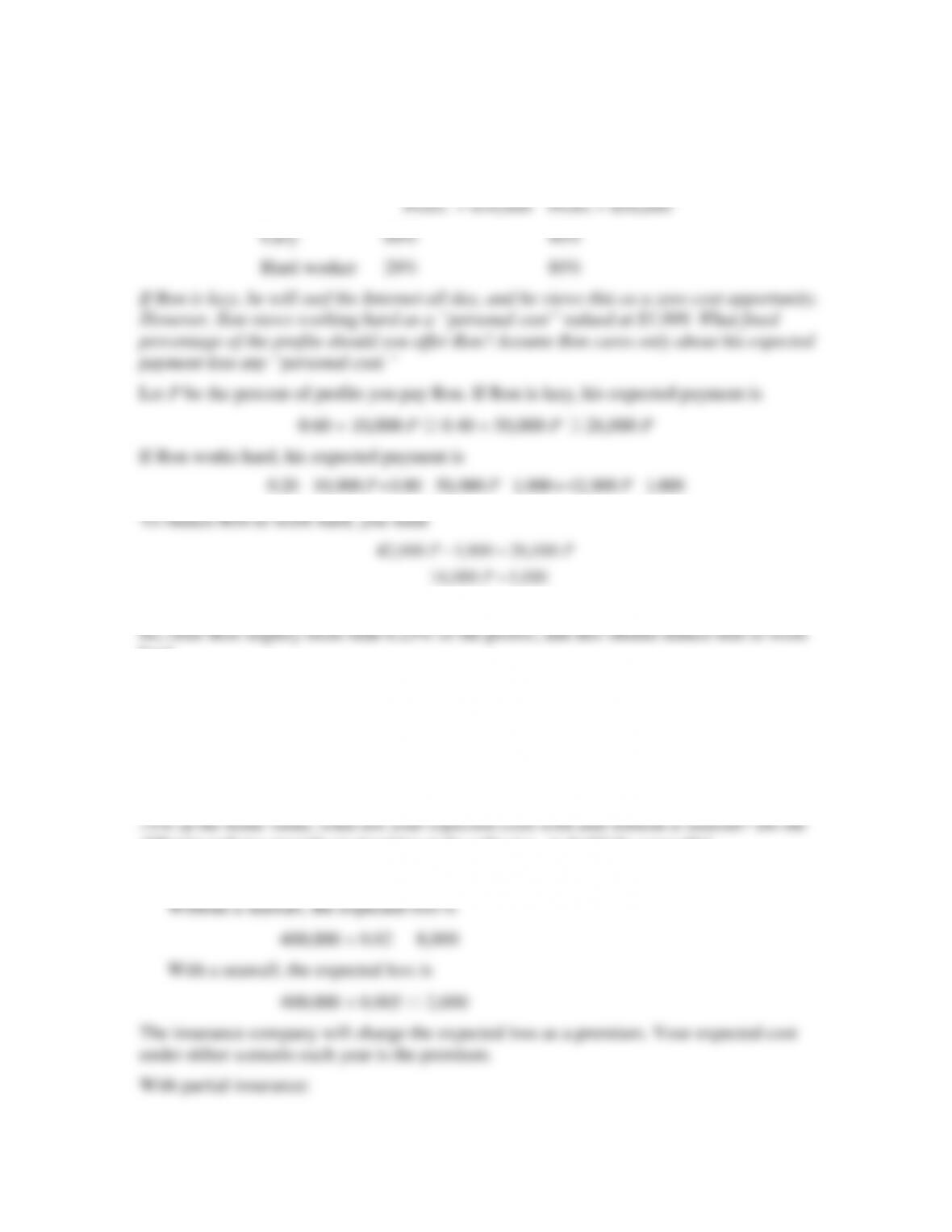
24. You wish to hire Ron to manage your Dallas operations. The profits from the operations
depend partially on how hard Ron works, as follows.
Profit Probabilities
Profit = $10,000
Profit = $50,000
Lazy
60%
40%
Hard worker
20%
80%
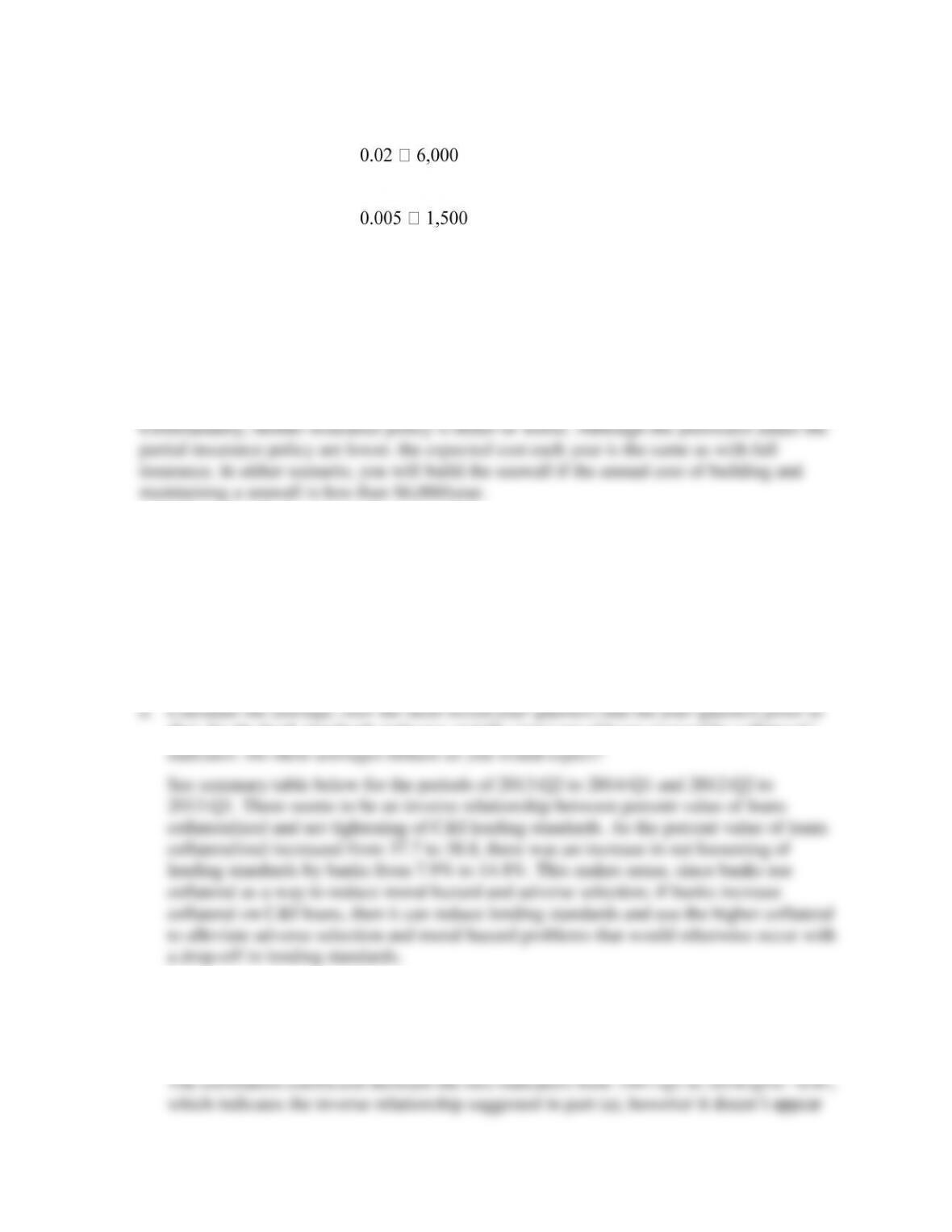

Net Tightening of
Mortgage Lending
Standards, Average
Net Worth Average
Growth Rate
2013:Q2 to 2014:Q1
-5.7
12.0
2012:Q2 to 2013:Q1
-1.1
8.2