Archives: Quiz
978-0078036866 Chapter 16 Part 1
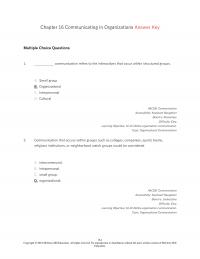
Chapter 16 Communicating in Organizations Answer Key Multiple Choice Questions 1. ____________ communication refers to the interactions that occur within structured groups. A. Small group B. Organizational C. Interpersonal D. Cultural AACSB: Communication Accessibility: Keyboard Navigation Bloom’s: Remember Difficulty: Easy […]
978-0078036866 Chapter 15 Part 2
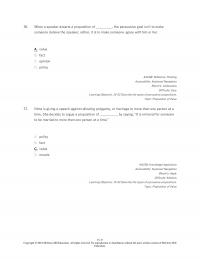
36. When a speaker asserts a proposition of __________, the persuasive goal isn’t to make someone believe the speaker; rather, it is to make someone agree with him or her. A. value B. fact C. opinion D. policy AACSB: Reflective […]
978-0078036866 Chapter 15 Part 1
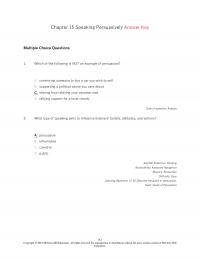
Chapter 15 Speaking Persuasively Answer Key Multiple Choice Questions 1. Which of the following is NOT an example of persuasion? A. convincing someone to buy a car you wish to sell B. supporting a political cause you care about C. […]
978-0078036866 Chapter 14 Part 2
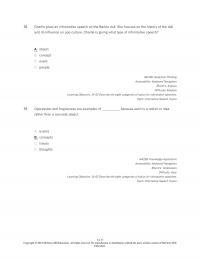
38. Charlie gives an informative speech on the Barbie doll. She focuses on the history of the doll and its influence on pop culture. Charlie is giving what type of informative speech? A. object B. concept C. event D. people […]
978-0078036866 Chapter 14 Part 1
Chapter 14 Speaking Informatively Answer Key Multiple Choice Questions 1. We rely on accurate ____________ from websites, newspapers, interpersonal encounters, and many other sources to make decisions in our personal and professional lives. A. speech B. feedback C. input D. […]
978-0078036866 Chapter 13 Part 2
36. A particularly good time to incorporate ________ into your delivery is during a transition in your speech because your change in position will correspond to a change in your remarks. A. gestures B. movement C. posture D. eye contact […]
978-0078036866 Chapter 13 Part 1
Chapter 13 Presenting a Speech Confidently and Competently Answer Key Multiple Choice Questions 1. Which of the following is NOT a basic style of delivery? A. extemporaneous B. memorized C. read D. impromptu Type of question: Analyze 2. Iris is […]
978-0078036866 Chapter 12 Part 2
35. The statement “Next, I’d like to discuss why the government should not negotiate with terrorists” is an example of what type of transition? A. summary B. signpost C. nonverbal D. preview AACSB: Knowledge Application Accessibility: Keyboard Navigation Bloom’s: Apply […]
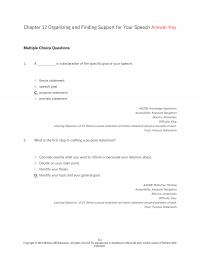
978-0078036866 Chapter 12 Part 1
Chapter 12 Organizing and Finding Support for Your Speech Answer Key Multiple Choice Questions 1. A ___________ is a declaration of the specific goal of your speech. A. thesis statement B. speech goal C. purpose statement D. preview statement AACSB: […]
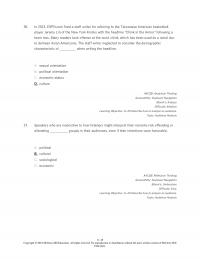
978-0078036866 Chapter 11 Part 2
36. In 2012, ESPN.com fired a staff writer for referring to the Taiwanese American basketball player Jeremy Lin of the New York Knicks with the headline “Chink in the Armor” following a team loss. Many readers took offense at the […]
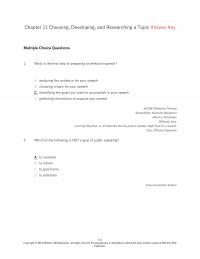
978-0078036866 Chapter 11 Part 1
Chapter 11 Choosing, Developing, and Researching a Topic Answer Key Multiple Choice Questions 1. What is the first step to preparing an effective speech? A. analyzing the audience for your speech B. choosing a topic for your speech C. identifying […]
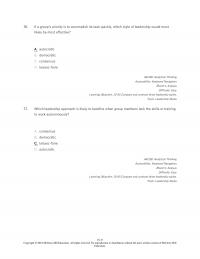
978-0078036866 Chapter 10 Part 2
36. If a group’s priority is to accomplish its task quickly, which style of leadership would most likely be most effective? A. autocratic B. democratic C. consensus D. laissez-faire AACSB: Analytical Thinking Accessibility: Keyboard Navigation Bloom’s: Analyze Difficulty: Easy Learning […]
978-0078036866 Chapter 10 Part 1
Chapter 10 Decision Making and Leadership in Groups Answer Key Multiple Choice Questions 1. Which of the following is NOT an example of a group decision? A. a faculty committee choosing what textbook to use B. a jury deciding if […]
978-0078036866 Appendix N
Appendix Workplace Communication and Interviewing Answer Key Multiple Choice Questions App-1 Copyright © 2018 McGraw-Hill Education. All rights reserved. No reproduction or distribution without the prior written consent of McGraw-Hill Education. 1. The interactions people have as part of their […]
978-0078036866 Chapter 9 Part 2
35. Caleb is feeling insecure in his new school. He doesn’t know anyone and feels like an outsider. Because he has always enjoyed writing, he joins the yearbook staff. Within a few days of joining the group, Caleb feels more […]
978-0078036866 Chapter 9 Part 1
Chapter 09 Communicating in Small Groups Answer Key Multiple Choice Questions 1. A _____________can be defined as a collection 3 to 20 people working interdependently to accomplish a task. A. small group B. task group C. working group D. cohesive […]
978-0078036866 Chapter 8 Part 2
37. Which word best describes romantic partners who talk about their disagreements openly and cooperatively? A. volatile B. hostile C. validating D. conflict-avoiding AACSB: Analytical Thinking Accessibility: Keyboard Navigation Bloom’s: Understand Difficulty: Medium Learning Objective: 08-06 Describe how romantic relationships […]
978-0078036866 Chapter 8 Part 1
Chapter 08 Communicating in Intimate Relationships Answer Key Multiple Choice Questions 1. ___________ relationships are characterized by significant emotional closeness and may or may not be romantic. A. Social B. Intimate C. Friendly D. Familial AACSB: Reflective Thinking Accessibility: Keyboard […]
978-0078036866 Chapter 7 Part 2
36. What theory maintains that a good relationship is one in which your ratio of costs and rewards is equal to your partner’s? A. social exchange theory B. attraction theory C. equity theory D. uncertainty reduction theory AACSB: Knowledge Application […]
978-0078036866 Chapter 7 Part 1
Chapter 07 Communicating in Social and Professional Relationships Answer Key Multiple Choice Questions 1. Having strong ______________ ties with friends, neighbors, coworkers, and others improves the quality of our life in multiple ways. A. personal B. social C. relational D. […]
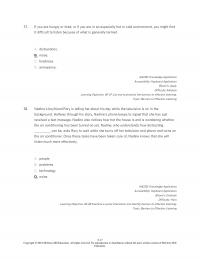
978-0078036866 Chapter 6 Part 2
37. If you are hungry or tired, or if you are in an especially hot or cold environment, you might find it difficult to listen because of what is generally termed A. distractions. B. noise. C. tiredness. D. annoyance. AACSB: […]
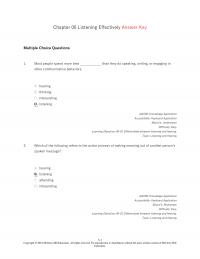
978-0078036866 Chapter 6 Part 1
Chapter 06 Listening Effectively Answer Key Multiple Choice Questions 1. Most people spend more time _____________ than they do speaking, writing, or engaging in other communicative behaviors. A. hearing B. thinking C. interpreting D. listening AACSB: Knowledge Application Accessibility: Keyboard […]
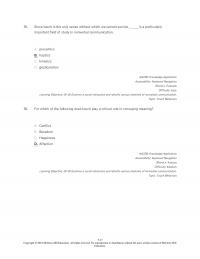
978-0078036866 Chapter 5 Part 2
35. Since touch is the only sense without which we cannot survive, _____ is a particularly important field of study in nonverbal communication. A. proxemics B. haptics C. kinesics D. gesticulation AACSB: Knowledge Application Accessibility: Keyboard Navigation Bloom’s: Evaluate Difficulty: […]
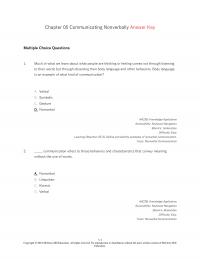
978-0078036866 Chapter 5 Part 1
Chapter 05 Communicating Nonverbally Answer Key Multiple Choice Questions 1. Much of what we learn about what people are thinking or feeling comes not through listening to their words but through observing their body language and other behaviors. Body language […]
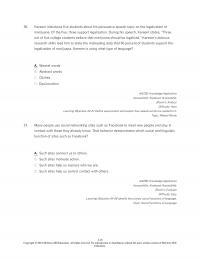
978-0078036866 Chapter 4 Part 2
36. Kareem interviews five students about his persuasive speech topic on the legalization of marijuana. Of the five, three support legalization. During his speech, Kareem states, “Three out of five college students believe that marijuana should be legalized.” Kareem’s dubious […]
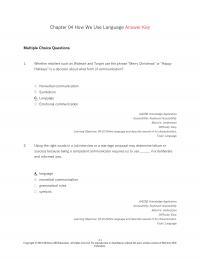
978-0078036866 Chapter 4 Part 1
Chapter 04 How We Use Language Answer Key Multiple Choice Questions 1. Whether retailers such as Walmart and Target use the phrase “Merry Christmas” or “Happy Holidays” is a decision about what form of communication? A. Nonverbal communication B. Symbolism […]
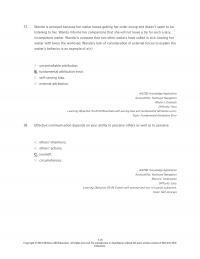
978-0078036866 Chapter 3 Part 2
37. Wanda is annoyed because her waiter keeps getting her order wrong and doesn’t seem to be listening to her. Wanda informs her companions that she will not leave a tip for such a lazy, incompetent waiter. Wanda is unaware […]
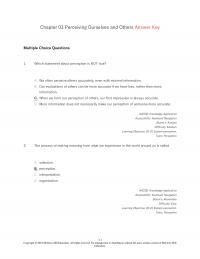
978-0078036866 Chapter 3 Part 1
Chapter 03 Perceiving Ourselves and Others Answer Key Multiple Choice Questions 1. Which statement about perception is NOT true? A. We often perceive others accurately, even with minimal information. B. Our evaluations of others can be more accurate if we […]
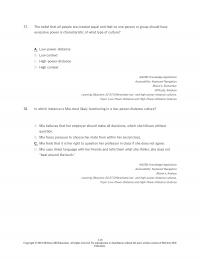
978-0078036866 Chapter 2 Part 2
37. The belief that all people are created equal and that no one person or group should have excessive power is characteristic of what type of culture? A. Low-power-distance B. Low context C. High-power-distance D. High context AACSB: Knowledge Application […]
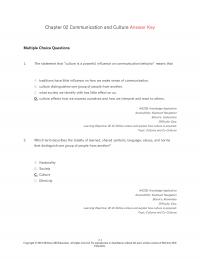
978-0078036866 Chapter 2 Part 1
Chapter 02 Communication and Culture Answer Key Multiple Choice Questions 1. The statement that “culture is a powerful influence on communication behavior” means that A. traditions have little influence on how we make sense of communication. B. culture distinguishes one […]
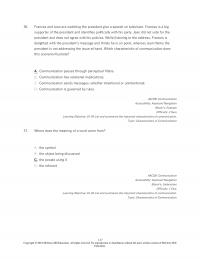
978-0078036866 Chapter 1 Part 2
36. Frances and Jean are watching the president give a speech on television. Frances is a big supporter of the president and identifies politically with his party. Jean did not vote for the president and does not agree with his […]
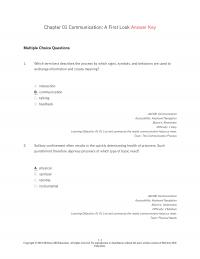
978-0078036866 Chapter 1 Part 1
Chapter 01 Communication: A First Look Answer Key Multiple Choice Questions 1. Which term best describes the process by which signs, symbols, and behaviors are used to exchange information and create meaning? A. interaction B. communication C. talking D. feedback […]
978-1457638916 Chapter 15
KEY Chapter 15: Persuasive Speaking Multiple-Choice Questions 1. “The act of using manipulation, threats, intimidation, or violence to gain compliance” is the definition of which of the following terms? a. persuasion b. interrogation c. coercion d. compliance gaining H = […]
978-1457638916 Chapter 14
KEY Chapter 14: Informative Speaking Multiple-Choice Questions 1. Which of the following adjectives describes an informational speaker? a. subjective b. objective c. opinionated d. biased H = The Goals of Informative Speaking (p. 310); C = comprehension; D = 2 […]
978-1457638916 Chapter 13
KEY Chapter 13: Delivering Presentations Multiple-Choice Questions 1. __________ refers to the nervousness we experience when we know we have to communicate publicly to an audience. a. Communication apprehension b. Stage fright c. Public speaking anxiety d. Speech panic response […]
978-1457638916 Chapter 12
KEY Chapter 12: Organizing, Writing, and Outlining Presentations Multiple-Choice Questions 1. __________ are the central claims that support a speaker’s specific purpose and thesis statement. a. Key words b. Main points c. Subpoints d. Facts H = Identifying Your Main […]
978-1457638916 Chapter 11
KEY Chapter 11: Preparing and Researching Presentations Multiple-Choice Questions 1. Speeches that are intended to influence the attitudes, beliefs, and behaviors of an audience are called a. informative. b. persuasive. c. special-occasion. d. impromptu. H = Persuasive Speeches (p. 237); […]
978-1457638916 Chapter 10
KEY Chapter 10: Leadership and Decision Making in Groups Multiple-Choice Questions 1. __________ is the ability to influence others’ behaviors and thoughts toward a productive end. a. Control b. Power c. Leadership d. Authority H = Understanding Group Leadership (p. […]
978-1457638916 Appendix b
Appendix B: Understanding Mass and Mediated Communication Multiple-Choice Questions 1. Which of the following would be considered mediated communication? 2. The merging of traditional mass communication with digital computing and telecommunication technologies is called a. media expansion. b. media pervasion. […]
978-1457638916 Appendix a
Appendix A: Competent Interviewing Multiple-Choice Questions 1. Which of the following is not an accurate statement about interviews? 2. When a television journalist sits down to interview a leading political figure, what type of interview is being conducted? a. appraisal […]
978-1457638916 Chapter 9
KEY Chapter 9: Communicating in Groups Multiple-Choice Questions 1. “A collection of more than two people who share some kind of relationship with one another, who communicate in an interdependent fashion, and who collaborate toward some shared purpose” defines which […]
978-1457638916 Chapter 8
KEY Chapter 8: Managing Conflict in Relationships Multiple-Choice Questions 1. __________ is a negative interaction between two or more interdependent people, which is rooted in some actual or perceived disagreement. a. Unproductive conflict b. Productive conflict c. Conflict d. Conflict […]
978-1457638916 Chapter 7
KEY Chapter 7: Developing and Maintaining Relationships Multiple-Choice Questions 1. The interconnection and interdependence between two individuals is referred to as a. a relational network. b. family. c. an interpersonal relationship. d. interpersonal communication. H = Developing and Maintaining Relationships […]
978-1457638916 Chapter 6
KEY Chapter 6: Listening Multiple-Choice Questions 1. The physiological process of perceiving sound is best associated with what term? a. listening b. hearing c. attending d. selecting H = How We Listen (p. 120); C = knowledge; D = 1 […]
978-1457638916 Chapter 5
KEY Chapter 5: Nonverbal Communication Multiple-Choice Questions 1. “The process of intentionally or unintentionally signaling meaning through behavior other than words” defines which of the following terms? a. verbal communication b. nonverbal communication c. body language d. encoding H = […]
978-1457638916 Chapter 4
KEY Chapter 4: Verbal Communication Multiple-Choice Questions 1. __________ is a system of symbols, governed by grammatical rules that we use to think about and communicate experiences and feelings. a. Denotative code b. Connotative code c. Language d. Body language […]
978-1457638916 Chapter 3
KEY Chapter 3: Communication and Culture Multiple-Choice Questions 1. “A learned system of thought and behavior that belongs to and typifies a relatively large group of people, including shared beliefs, values, and practices” represents which of the following terms? a. […]
978-1457638916 Chapter 2
KEY Chapter 2: Perceiving the Self and Others Multiple-Choice Questions 1. “A cognitive process through which we interpret our experiences and form our own unique understandings” is best associated with which of the following terms? a. perception b. selecting information […]
978-1457638916 Chapter 1
KEY Chapter 1: Communication: Essential Human Behavior Multiple-Choice Questions 1. __________ is the process by which individuals use symbols and behaviors to exchange information. a. Encoding b. Decoding c. Communication d. Perception H = Communication: Essential Human Behavior (p. 4); […]
978-1337614689 Chapter 0 Part 2
4-17 24. To reduce the risk inherent in ______________________________ a company should strive for a high proportion of variable costs in its cost structure. ANS: cyclical sales PTS: 1 25. Firms that have either convertible securities or stock options or […]