Archives
BUS 25464
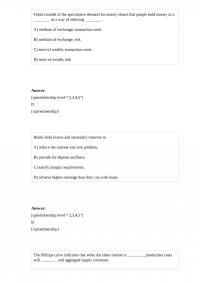
Tobin’s model of the speculative demand for money shows that people hold money as a ________ as a way of reducing ________. A) medium of exchange; transaction costs B) medium of exchange; risk C) store of wealth; transaction costs D) […]
BUS 28527
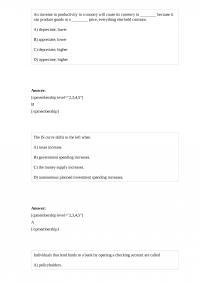
An increase in productivity in a country will cause its currency to ________ because it can produce goods at a ________ price, everything else held constant. A) depreciate; lower B) appreciate; lower C) depreciate; higher D) appreciate; higher Answer: The […]
BUS 32561
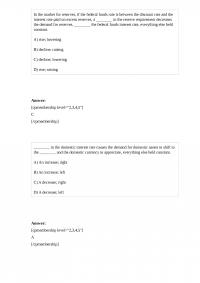
In the market for reserves, if the federal funds rate is between the discount rate and the interest rate paid on excess reserves, a ________ in the reserve requirement decreases the demand for reserves, ________ the federal funds interest rate, […]
BUS 43342
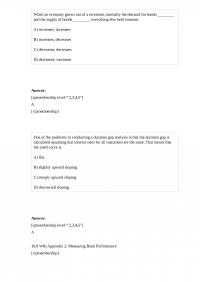
When an economy grows out of a recession, normally the demand for bonds ________ and the supply of bonds ________, everything else held constant. A) increases; increases B) increases; decreases C) decreases; decreases D) decreases; increases Answer: One of the […]
BUS 50426
If a $5,000 face-value discount bond maturing in one year is selling for $5,000, then its yield to maturity is A) 0 percent. B) 5 percent. C) 10 percent. D) 20 percent. Answer: The risk that interest payments will not […]
BUS 67062
The equation of exchange is A) M × P = V × Y. B) M + V = P + Y. C) M + Y = V + P. D) M × V = P × Y. Answer: In the […]

BUS 67341
Keynes’s liquidity preference theory indicates that the demand for money A) is purely a function of income, and interest rates have no effect on the demand for money. B) is purely a function of interest rates, and income has no […]
BUS 74636
________ is the field of study that applies concepts from social sciences such as psychology and sociology to help understand the behavior of securities prices. A) Behavioral finance B) Strategical finance C) Methodical finance D) Procedural finance Answer: FIRREA increased […]
BUS 76155
The most liquid securities traded in the capital market are A) corporate bonds. B) municipal bonds. C) U.S. Treasury bonds. D) mortgage-backed securities. Answer: Everything else held constant, a decrease in wealth A) increases the demand for stocks. B) increases […]
BUS 76430
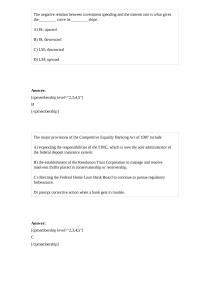
The negative relation between investment spending and the interest rate is what gives the ________ curve its ________ slope. A) IS; upward B) IS; downward C) LM; downward D) LM; upward Answer: The major provisions of the Competitive Equality Banking […]
BUS 78288
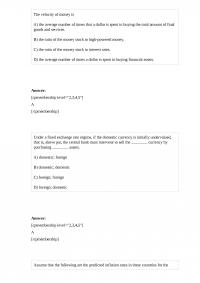
The velocity of money is A) the average number of times that a dollar is spent in buying the total amount of final goods and services. B) the ratio of the money stock to high-powered money. C) the ratio of […]
BUS 79297
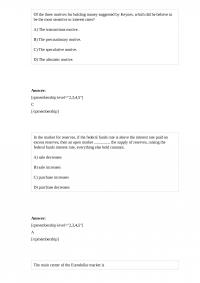
Of the three motives for holding money suggested by Keynes, which did he believe to be the most sensitive to interest rates? A) The transactions motive. B) The precautionary motive. C) The speculative motive. D) The altruistic motive. Answer: In […]
BUS 93552
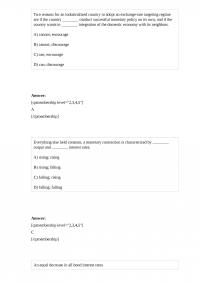
Two reasons for an industrialized country to adopt an exchange-rate targeting regime are if the country ________ conduct successful monetary policy on its own, and if the country wants to ________ integration of the domestic economy with its neighbors. A) […]
BUS 98011
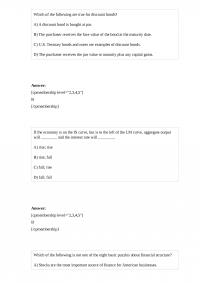
Which of the following are true for discount bonds? A) A discount bond is bought at par. B) The purchaser receives the face value of the bond at the maturity date. C) U.S. Treasury bonds and notes are examples of […]
ECB 15222
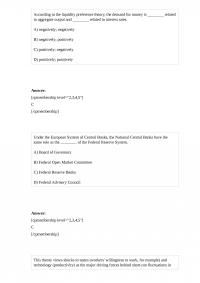
According to the liquidity preference theory, the demand for money is ________ related to aggregate output and ________ related to interest rates. A) negatively; negatively B) negatively; positively C) positively; negatively D) positively; positively Answer: Under the European System of […]
ECB 19256
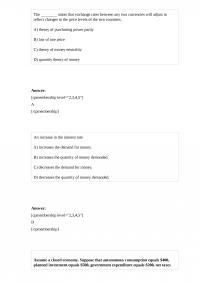
The ________ states that exchange rates between any two currencies will adjust to reflect changes in the price levels of the two countries. A) theory of purchasing power parity B) law of one price C) theory of money neutrality D) […]
ECB 22121
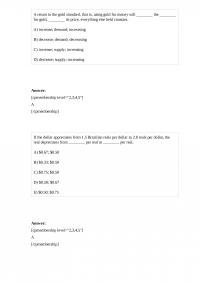
A return to the gold standard, that is, using gold for money will ________ the ________ for gold, ________ its price, everything else held constant. A) increase; demand; increasing B) decrease; demand; decreasing C) increase; supply; increasing D) decrease; supply; […]
ECB 35568
An analysis of the political economy of the savings and loan crisis helps one to understand A) why politicians aided the efforts of thrift regulators, raising regulatory appropriations and encouraging closing of insolvent thrifts. B) why thrift regulators were so […]
ECB 38542
Because policies in the United States were too expansionary from 1965 through 1973, the U.S. suffered A) demand-pull inflation. B) cost-push inflation, as workers sought higher wages in order to keep up with inflation. C) both demand-pull and cost-push inflation. […]

ECB 43256
Keynes’s liquidity preference theory indicates that the demand for money is ________ related to ________. A) negatively; interest rates B) positively; interest rates C) negatively; income D) negatively; wealth Answer: An increase in interest rates might ________ saving because more […]
ECB 60085
In a one-period valuation model, a decrease in the required return on investments in equity causes a(n) ________ in the ________ price of a stock. A) increase; current B) increase; expected sales C) decrease; current D) decrease; expected sales Answer: […]
ECB 61103
Both the CAPM and APT suggest that an asset should be priced so that it has a higher expected return A) when it has a greater systematic risk. B) when it has a greater risk in isolation. C) when it […]
ECB 76974
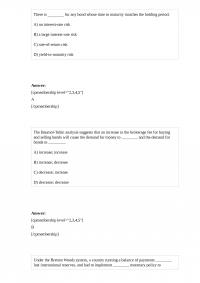
There is ________ for any bond whose time to maturity matches the holding period. A) no interest-rate risk B) a large interest-rate risk C) rate-of-return risk D) yield-to-maturity risk Answer: The Baumol-Tobin analysis suggests that an increase in the brokerage […]
ECB 81320
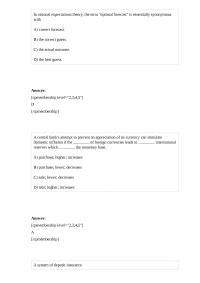
In rational expectations theory, the term “optimal forecast” is essentially synonymous with A) correct forecast. B) the correct guess. C) the actual outcome. D) the best guess. Answer: A central bank’s attempt to prevent an appreciation of its currency can […]
ECB 86979
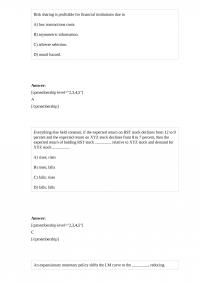
Risk sharing is profitable for financial institutions due to A) low transactions costs. B) asymmetric information. C) adverse selection. D) moral hazard. Answer: Everything else held constant, if the expected return on RST stock declines from 12 to 9 percent […]
ECB 92682
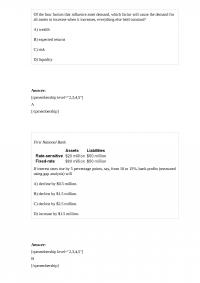
Of the four factors that influence asset demand, which factor will cause the demand for all assets to increase when it increases, everything else held constant? A) wealth B) expected returns C) risk D) liquidity Answer: First National Bank If […]
ECON 10063
When the growth rate of the money supply is increased, interest rates will fall immediately if the liquidity effect is ________ than the other money supply effects and there is ________ adjustment of expected inflation. A) larger; fast B) larger; […]
ECON 12525
In the Keynesian cross diagram, an increase in investment spending because companies become more optimistic about investment profitability causes the aggregate demand function to shift ________, the equilibrium level of aggregate output to rise, and the IS curve to shift […]
ECON 18846
An increase in the quantity of money supplied shifts the money supply curve to the ________ and the LM curve to the ________, everything else held constant. A) right; left B) right; right C) left; left D) left; right Answer: […]
ECON 30745
Because the United States was the reserve-currency country under the Bretton Woods system, it could run large balance of payments ________ without ________ significant amounts of international reserves. A) deficits; losing B) deficits; gaining C) surpluses; losing D) surpluses; gaining […]
ECON 60789
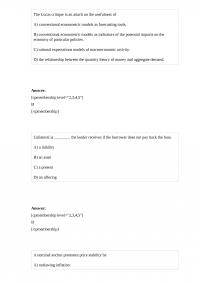
The Lucas critique is an attack on the usefulness of A) conventional econometric models as forecasting tools. B) conventional econometric models as indicators of the potential impacts on the economy of particular policies. C) rational expectations models of macroeconomic activity. […]
ECON 64426
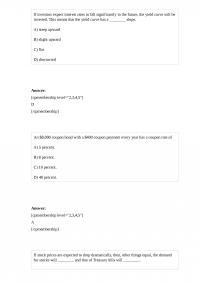
If investors expect interest rates to fall significantly in the future, the yield curve will be inverted. This means that the yield curve has a ________ slope. A) steep upward B) slight upward C) flat D) downward Answer: An $8,000 […]
ECON 72795
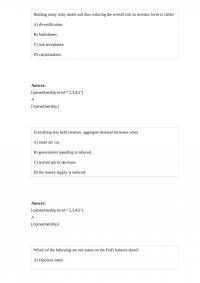
Holding many risky assets and thus reducing the overall risk an investor faces is called A) diversification. B) foolishness. C) risk acceptance. D) capitalization. Answer: Everything else held constant, aggregate demand increases when A) taxes are cut. B) government spending […]
ECON 79821
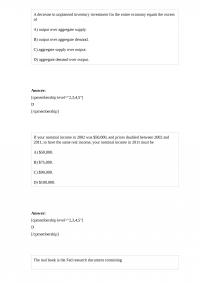
A decrease in unplanned inventory investment for the entire economy equals the excess of A) output over aggregate supply. B) output over aggregate demand. C) aggregate supply over output. D) aggregate demand over output. Answer: If your nominal income in […]
ECON 84307
In the ten year period 1981-1990, 1202 commercial banks were closed, with a peak of 206 failures in 1989. This rate of failures was approximately ________ times greater than that in the period from 1934 to 1980. A) two B) […]
ECON 91350
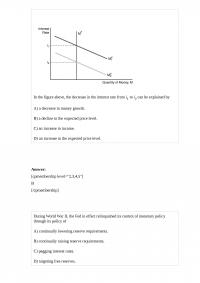
In the figure above, the decrease in the interest rate from i1 to i2 can be explained by A) a decrease in money growth. B) a decline in the expected price level. C) an increase in income. D) an increase […]
ECON 92079
The monetary base consists of A) currency in circulation and Federal Reserve notes. B) currency in circulation and the U.S. Treasury’s monetary liabilities. C) currency in circulation and reserves. D) reserves and Federal Reserve Notes. Answer: A ________ pays out […]
ECON A 10063
If brokerage commissions on stocks fall, everything else held constant, the demand for bonds ________, the price of bonds ________, and the interest rate ________. A) decreases; decreases; increases B) decreases; decreases; decreases C) increases; decreases; increases D) increases; increases; […]
ECON A 12762
Of the four effects on interest rates from an increase in the money supply, the one that works in the opposite direction of the other three is the A) liquidity effect. B) income effect. C) price level effect. D) expected […]
ECON A 29831
In the generalized dividend model, the current stock price is the sum of A) the actual value of the future dividend stream. B) the present value of the future dividend stream. C) the present value of the future dividend stream […]
ECON A 31498
When the interest rate on a bond is ________ the equilibrium interest rate, in the bond market there is excess ________ and the interest rate will ________. A) above; demand; rise B) above; demand; fall C) below; supply; fall D) […]
ECON A 32071
Suppose that from a new checkable deposit, First National Bank holds two million dollars in vault cash, eight million dollars on deposit with the Federal Reserve, and nine million dollars in excess reserves. Given this information, we can say First […]
ECON A 46136
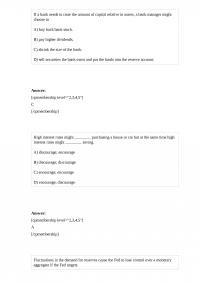
If a bank needs to raise the amount of capital relative to assets, a bank manager might choose to A) buy back bank stock. B) pay higher dividends. C) shrink the size of the bank. D) sell securities the bank […]
ECON A 62676
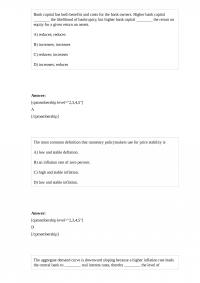
Bank capital has both benefits and costs for the bank owners. Higher bank capital ________ the likelihood of bankruptcy, but higher bank capital ________ the return on equity for a given return on assets. A) reduces; reduces B) increases; increases […]
ECON A 69689
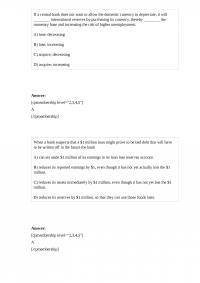
If a central bank does not want to allow the domestic currency to depreciate, it will ________ international reserves by purchasing its currency, thereby ________ the monetary base and increasing the risk of higher unemployment. A) lose; decreasing B) lose; […]
ECON A 70834
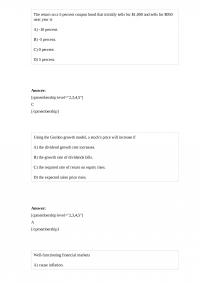
The return on a 5 percent coupon bond that initially sells for $1,000 and sells for $950 next year is A) -10 percent. B) -5 percent. C) 0 percent. D) 5 percent. Answer: Using the Gordon growth model, a stock’s […]
ECON A 83085
The ________ is defined as the payments to the owner plus the change in a security’s value expressed as a fraction of the security’s purchase price. A) yield to maturity B) current yield C) rate of return D) yield rate […]
ECON A 86370
In Keynes’s liquidity preference framework, if there is excess demand for money, there is A) an excess demand for bonds. B) equilibrium in the bond market. C) an excess supply of bonds. D) too much money. Answer: Everything else held […]
ECON A 92037
The most comprehensive measure of aggregate output is A) gross domestic product. B) net national product. C) the stock value of the industrial 500. D) national income. Answer: One factor contributing to the rapid growth of the commercial paper market […]
ECON A 95847
Which of the following would a bank not hold as insurance against the highest cost of deposit outflow-bank failure? A) Excess reserves B) Secondary reserves C) Bank capital D) Mortgages Answer: The National Bank Act of 1863, and subsequent amendments […]
ECON A 98823
If the expected path of 1-year interest rates over the next five years is 2 percent, 4 percent, 1 percent, 4 percent, and 3 percent, the expectations theory predicts that the bond with the lowest interest rate today is the […]
ECON E 34989
A budget ________ occurs when government expenditures exceed tax revenues for a particular time period. A) deficit B) surplus C) surge D) surfeit Answer: Keynes argued that when interest rates were low relative to some normal value, people would expect […]
ECON E 41931
The purpose of the commitment by the Fed to keep the federal funds rate at zero for a long period of time is to A) lower the long term interest rates. B) lower the short term interest rates. C) increase […]
ECON E 42036
The total amount of required reserves in the banking system is equal to the ________ the required reserve ratio and checkable deposits. A) sum of B) difference between C) product of D) ratio between Answer: If reserves in the banking […]
ECON E 54118
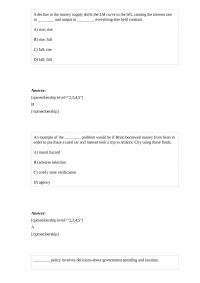
A decline in the money supply shifts the LM curve to the left, causing the interest rate to ________ and output to ________, everything else held constant. A) rise; rise B) rise; fall C) fall; rise D) fall; fall Answer: […]
ECON E 56698
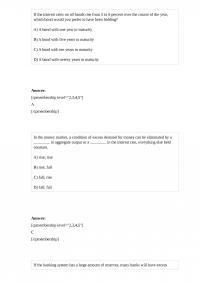
If the interest rates on all bonds rise from 5 to 6 percent over the course of the year, which bond would you prefer to have been holding? A) A bond with one year to maturity B) A bond with […]
ECON E 65268
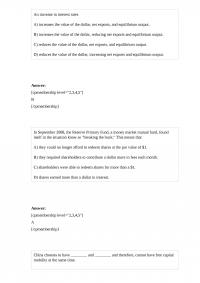
An increase in interest rates A) increases the value of the dollar, net exports, and equilibrium output. B) increases the value of the dollar, reducing net exports and equilibrium output. C) reduces the value of the dollar, net exports, and […]
ECON E 79899
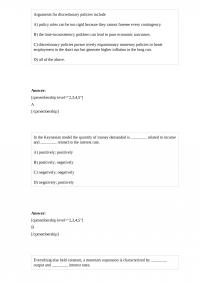
Arguments for discretionary policies include A) policy rules can be too rigid because they cannot foresee every contingency. B) the time-inconsistency problem can lead to poor economic outcomes. C) discretionary policies pursue overly expansionary monetary policies to boost employment in […]
ECON E 81056
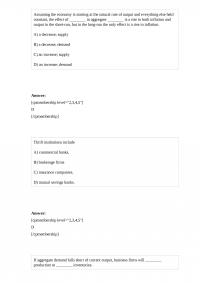
Assuming the economy is starting at the natural rate of output and everything else held constant, the effect of ________ in aggregate ________ is a rise in both inflation and output in the short-run, but in the long-run the only […]
ECON E 94312
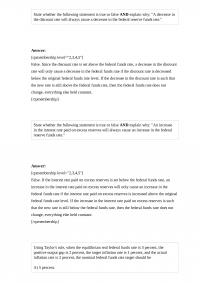
State whether the following statement is true or false AND explain why: “A decrease in the discount rate will always cause a decrease in the federal reserve funds rate.” Answer: State whether the following statement is true or false AND […]
Economics 25948
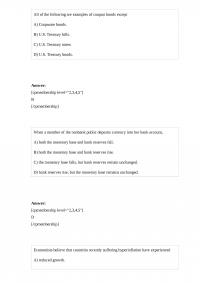
All of the following are examples of coupon bonds except A) Corporate bonds. B) U.S. Treasury bills. C) U.S. Treasury notes. D) U.S. Treasury bonds. Answer: When a member of the nonbank public deposits currency into her bank account, A) […]
Economics 31620
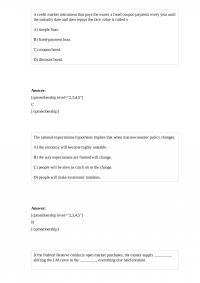
A credit market instrument that pays the owner a fixed coupon payment every year until the maturity date and then repays the face value is called a A) simple loan. B) fixed-payment loan. C) coupon bond. D) discount bond. Answer: […]
Economics 45634
If you have a very low tolerance for risk, which of the following bonds would you be least likely to hold in your portfolio? A) a U.S. Treasury bond B) a municipal bond C) a corporate bond with a rating […]
Economics 47561
Money market mutual funds A) function as interest-earning checking accounts. B) are legally deposits. C) are subject to reserve requirements. D) have an interest-rate ceiling. Answer: The high growth rate in China in the last twenty years has similarities to […]
Economics 49413
Recognizing the distinction between borrowed reserves and the nonborrowed monetary base, the money supply model is specified as A) M = m × (MBn – BR). B) M = m × (MBn + BR). C) M = m + (MBn […]
Economics 70023
When Americans or foreigners expect the return on ________ assets to be high relative to the return on ________ assets, there is a ________ demand for dollar assets, everything else held constant. A) dollar; foreign; constant B) dollar; foreign; higher […]
Economics 84110
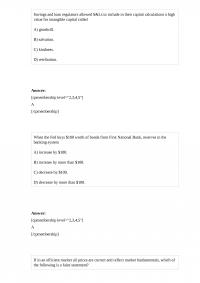
Savings and loan regulators allowed S&Ls to include in their capital calculations a high value for intangible capital called A) goodwill. B) salvation. C) kindness. D) retribution. Answer: When the Fed buys $100 worth of bonds from First National Bank, […]

MicroEconomic 15988
The elimination of unexploited profit opportunities requires that ________ market participants be well informed. A) all B) a few C) zero D) many Answer: As information technology improves, the lending role of financial institutions such as banks should A) increase […]
MicroEconomic 29687
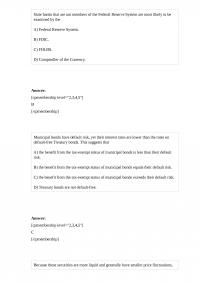
State banks that are not members of the Federal Reserve System are most likely to be examined by the A) Federal Reserve System. B) FDIC. C) FHLBS. D) Comptroller of the Currency. Answer: Municipal bonds have default risk, yet their […]
MicroEconomic 30150
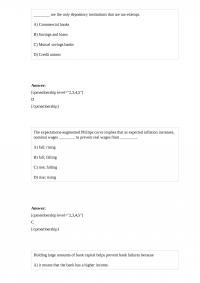
________ are the only depository institutions that are tax-exempt. A) Commercial banks B) Savings and loans C) Mutual savings banks D) Credit unions Answer: The expectations-augmented Phillips curve implies that as expected inflation increases, nominal wages ________ to prevent real […]
MicroEconomic 31986
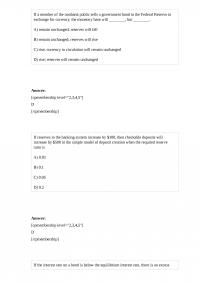
If a member of the nonbank public sells a government bond to the Federal Reserve in exchange for currency, the monetary base will ________, but ________. A) remain unchanged; reserves will fall B) remain unchanged; reserves will rise C) rise; […]
MicroEconomic 32388
A problem with barter exchange when there are many goods is that in a barter system A) transactions costs are minimized. B) there exists a multiple number of prices for each good. C) there is only one store of value. […]
MicroEconomic 41152
The development of money market mutual funds contributed to the growth of ________ since the money market mutual funds need to hold liquid, high-quality, short-terms assets. A) the commercial paper market B) the municipal bond market C) the corporate bond […]
MicroEconomic 50790
If a bank has excess reserves of $4,000 and demand deposit liabilities of $100,000, and if the reserve requirement is 15 percent, then the bank has actual reserves of A) $17,000. B) $19,000. C) $24,000. D) $29,000. Answer: Everything else […]
MicroEconomic 61973
Money market mutual fund shares function like A) checking accounts that pay interest. B) bonds. C) stocks. D) currency. Answer: The Governing Council usually meets ________ times a year. A) four B) six C) eight D) twelve Answer: D Everything […]
MicroEconomic 84343
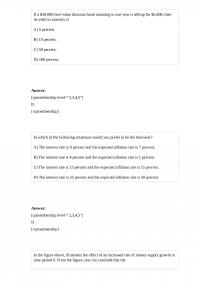
If a $10,000 face-value discount bond maturing in one year is selling for $5,000, then its yield to maturity is A) 5 percent. B) 10 percent. C) 50 percent. D) 100 percent. Answer: In which of the following situations would […]
MicroEconomic 85587
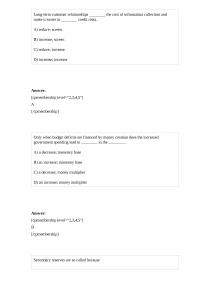
Long-term customer relationships ________ the cost of information collection and make it easier to ________ credit risks. A) reduce; screen B) increase; screen C) reduce; increase D) increase; increase Answer: Only when budget deficits are financed by money creation does […]
MicroEconomic 89412
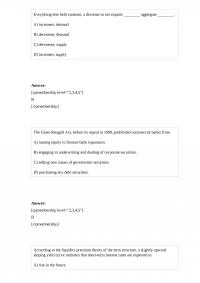
Everything else held constant, a decrease in net exports ________ aggregate ________. A) increases; demand B) decreases; demand C) decreases; supply D) increases; supply Answer: The Glass-Steagall Act, before its repeal in 1999, prohibited commercial banks from A) issuing equity […]
MicroEconomic 90446
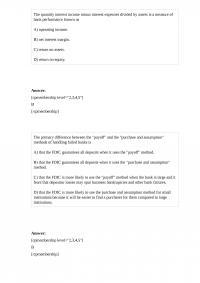
The quantity interest income minus interest expenses divided by assets is a measure of bank performance known as A) operating income. B) net interest margin. C) return on assets. D) return on equity. Answer: The primary difference between the “payoff” […]