
If a $10,000 face-value discount bond maturing in one year is selling for $5,000, then
its yield to maturity is
A) 5 percent.
B) 10 percent.
C) 50 percent.
D) 100 percent.
Answer:
In which of the following situations would you prefer to be the borrower?
A) The interest rate is 9 percent and the expected inflation rate is 7 percent.
B) The interest rate is 4 percent and the expected inflation rate is 1 percent.
C) The interest rate is 13 percent and the expected inflation rate is 15 percent.
D) The interest rate is 25 percent and the expected inflation rate is 50 percent.
Answer:
In the figure above, illustrates the effect of an increased rate of money supply growth at
time period 0. From the figure, one can conclude that the

A) Fisher effect is dominated by the liquidity effect and interest rates adjust slowly to
changes in expected inflation.
B) liquidity effect is dominated by the Fisher effect and interest rates adjust slowly to
changes in expected inflation.
C) liquidity effect is dominated by the Fisher effect and interest rates adjust quickly to
changes in expected inflation.
D) Fisher effect is smaller than the expected inflation effect and interest rates adjust
quickly to changes in expected inflation.
Answer:
Equity holders are a corporation’s ________. That means the corporation must pay all
of its debt holders before it pays its equity holders.
A) debtors
B) brokers
C) residual claimants
D) underwriters
Answer:
When the expected inflation rate increases, the demand for bonds ________, the supply
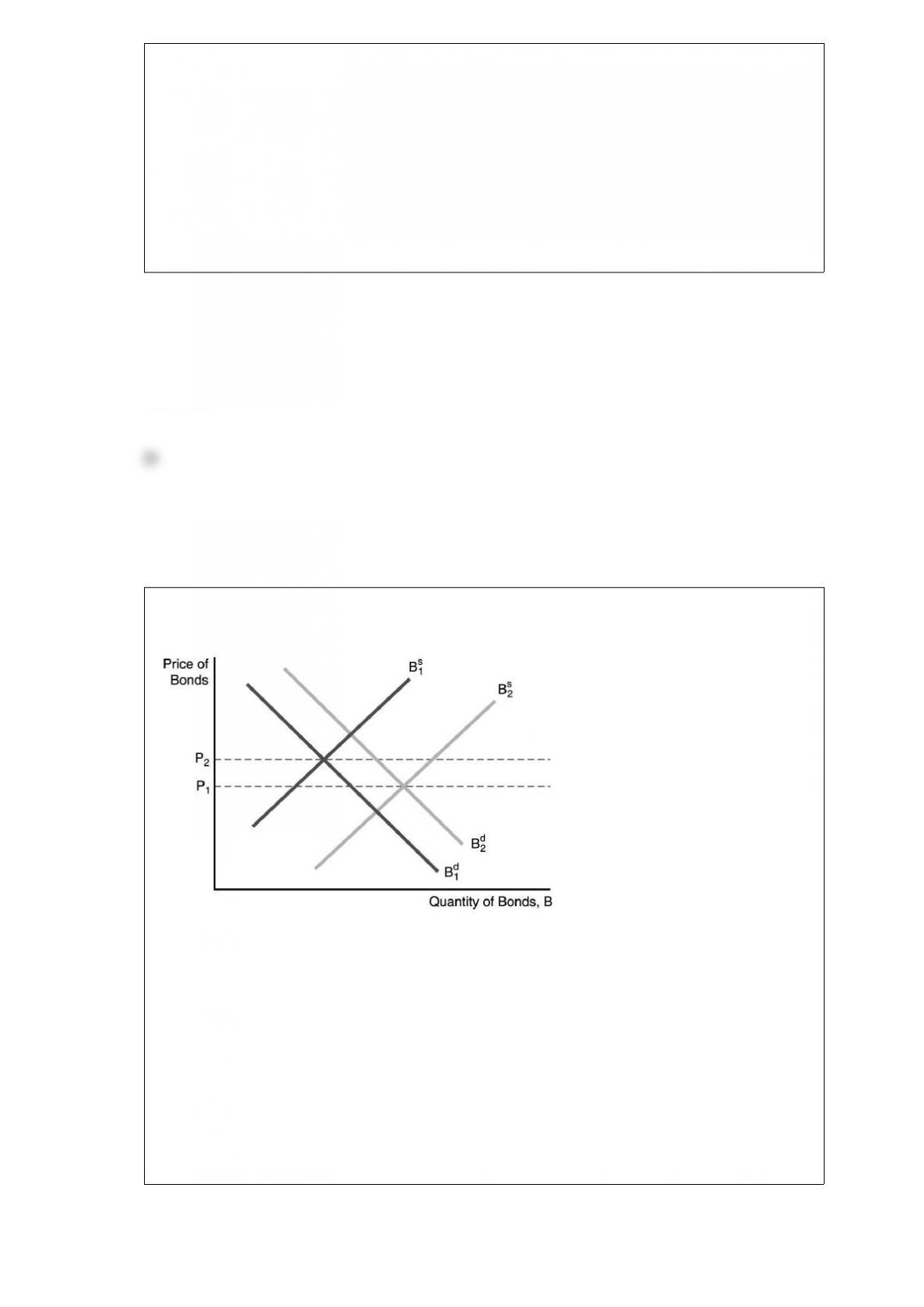
of bonds ________, and the interest rate ________, everything else held constant.
A) increases; increases; rises
B) decreases; decreases; falls
C) increases; decreases; falls
D) decreases; increases; rises
Answer:
In the figure above, a factor that could cause the demand for bonds to shift to the right
is:
A) an increase in the riskiness of bonds relative to other assets.
B) an increase in the expected rate of inflation.
C) expectations of lower interest rates in the future.
D) a decrease in wealth.

Answer:
When the exchange rate for the Mexican peso changes from 10 pesos to the U.S dollar
to 9 pesos to the U.S. dollar, then the Mexican peso has ________ and the U.S. dollar
has ________.
A) appreciated; appreciated
B) depreciated; appreciated
C) appreciated; depreciated
D) depreciated; depreciated
Answer:
The three players in the money supply process include
A) banks, depositors, and the U.S. Treasury.
B) banks, depositors, and borrowers.
C) banks, depositors, and the central bank.
D) banks, borrowers, and the central bank.
Answer:

The chaebols encouraged the Korean government to open up Korean financial markets
to foreign capital. The Korean government responded by
A) allowing unlimited short-term foreign borrowing but maintained quantity restrictions
on long-term foreign borrowing by financial institutions.
B) allowing unlimited short-term and long-term foreign borrowing by financial
institutions.
C) maintaining quantity restrictions on short-term foreign borrowing but allowing
unlimited long-term foreign borrowing by financial institutions.
D) not allowing any foreign borrowing by financial institutions.
Answer:
Planned investment spending, a component of aggregate demand, is equal to
A) fixed investment plus actual inventory investment.
B) fixed investment plus unplanned inventory investment.
C) fixed investment.
D) fixed investment plus planned inventory investment.
Answer:

The Federal Open Market Committee consists of the
A) five senior members of the seven-member Board of Governors.
B) seven members of the Board of Governors and seven presidents of the regional Fed
banks.
C) seven members of the Board of Governors and five presidents of the regional Fed
banks.
D) twelve regional Fed bank presidents and the chairman of the Board of Governors.
Answer:
Which of the following is not a nontransaction deposit?
A) Savings accounts
B) Small-denomination time deposits
C) Negotiable order of withdrawal accounts
D) Certificate of deposit
Answer:

In the liquidity preference framework, a one-time increase in the money supply results
in a price level effect. The maximum impact of the price level effect on interest rates
occurs
A) at the moment the price level hits its peak (stops rising) because both the price level
and expected inflation effects are at work.
B) immediately after the price level begins to rise, because both the price level and
expected inflation effects are at work.
C) at the moment the expected inflation rate hits its peak.
D) at the moment the inflation rate hits it peak.
Answer:
When a member of the nonbank public withdraws currency from her bank account,
A) both the monetary base and bank reserves fall.
B) both the monetary base and bank reserves rise.
C) the monetary base falls, but bank reserves remain unchanged.
D) bank reserves fall, but the monetary base remains unchanged.
Answer:

In the Baumol-Tobin analysis of the demand for money, either an increase in ________
or an increase in ________ increases money demand.
A) income; interest rates
B) brokerage fees; interest rates
C) interest rates; the price level
D) brokerage fees; income
Answer:
Because inflation was not a serious problem during the Great Depression, Keynes’s
analysis assumed
A) that unemployment also was not a problem.
B) that the money supply was fixed.
C) that the price level was fixed.
D) that monetary policy is not effective.
Answer:
During the 1960s, 1970s, and early 1980s, traditional bank profitability declined
because of

A) financial innovation that increased competition from new financial institutions.
B) a decrease in interest rates to fight the inflation problem.
C) a decrease in deposit insurance.
D) increased regulation that prohibited banks from making risky real estate loans.
Answer:
The existence of deposit insurance can increase the likelihood that depositors will need
deposit protection, as banks with deposit insurance
A) are likely to take on greater risks than they otherwise would.
B) are likely to be too conservative, reducing the probability of turning a profit.
C) are likely to regard deposits as an unattractive source of funds due to depositors’
demands for safety.
D) are placed at a competitive disadvantage in acquiring funds.
Answer:
If an economy experiences high interest rates and high unemployment, the ISLM
framework predicts that ________ policy has been too ________.

A) fiscal; expansionary
B) fiscal; contractionary
C) monetary; expansionary
D) monetary; contractionary
Answer:
Everything else held constant, a decrease in the currency ratio causes the M1 money
multiplier to ________ and the money supply to ________.
A) decrease; increase
B) increase; increase
C) decrease; decrease
D) increase; decrease
Answer:
As default risk decreases, the expected return on corporate bonds ________, and the
return becomes ________ uncertain, everything else held constant.
A) increases; less

B) increases; more
C) decreases; less
D) decreases; more
Answer:
Which of the following types of information most likely allows the exploitation of a
profit opportunity?
A) Financial analysts’ published recommendations
B) Technical analysis
C) Hot tips from a stockbroker
D) Insider information
Answer:
A deposit outflow results in equal reductions in
A) loans and reserves.
B) assets and liabilities.
C) reserves and capital.

D) assets and capital.
Answer:
Decisions by depositors to increase their holdings of ________, or of banks to hold
excess reserves will result in a ________ expansion of deposits than the simple model
predicts.
A) deposits; smaller
B) deposits; larger
C) currency; smaller
D) currency; larger
Answer:
The research document given to the Federal Open Market Committee that contains
information on the state of the economy in each Federal Reserve district is called the
A) beige book.
B) green book.
C) blue book.

D) black book.
Answer:
High interest rates might cause a corporation to ________ building a new plant that
would provide more jobs.
A) complete
B) consider
C) postpone
D) contemplate
Answer:
If a corporation begins to suffer large losses, then the default risk on the corporate bond
will
A) increase and the bond’s return will become more uncertain, meaning the expected
return on the corporate bond will fall.
B) increase and the bond’s return will become less uncertain, meaning the expected
return on the corporate bond will fall.
C) decrease and the bond’s return will become less uncertain, meaning the expected
return on the corporate bond will fall.

D) decrease and the bond’s return will become less uncertain, meaning the expected
return on the corporate bond will rise.
Answer:
The government institution that has responsibility for the amount of money and credit
supplied in the economy as a whole is the
A) central bank.
B) commercial bank.
C) bank of settlement.
D) monetary fund.
Answer:
In the simple deposit expansion model, if the Fed purchases $100 worth of bonds from
a bank that previously had no excess reserves, the bank can now increase its loans by
A) $10.
B) $100.
C) $100 times the reciprocal of the required reserve ratio.

D) $100 times the required reserve ratio.
Answer:
During the 1950s, Fed monetary policy targeted
A) the monetary base.
B) the exchange rate.
C) discount loans.
D) interest rates.
Answer:
Which of the following financial intermediaries is not a depository institution?
A) A savings and loan association
B) A commercial bank
C) A credit union
D) A finance company

Answer:
Poorly performing financial markets can be the cause of
A) wealth.
B) poverty.
C) financial stability.
D) financial expansion.
Answer:
Everything else held constant, when financial frictions increase, the real cost of
borrowing ________ so that planned investment spending ________ at any given
inflation rate.
A) increases; falls
B) decreases; falls
C) decreases; rises
D) increases; rises
Answer:

If, after a deposit outflow, a bank needs an additional $3 million to meet its reserve
requirements, the bank can
A) reduce deposits by $3 million.
B) increase loans by $3 million.
C) sell $3 million of securities.
D) repay its discount loans from the Fed.
Answer:
Explain what inflation targeting is. What are the advantages and disadvantages of this
type of monetary policy strategy?
Answer:
Explain how cigarettes could be called “money” in prisoner-of-war camps of World War
II.
Answer:
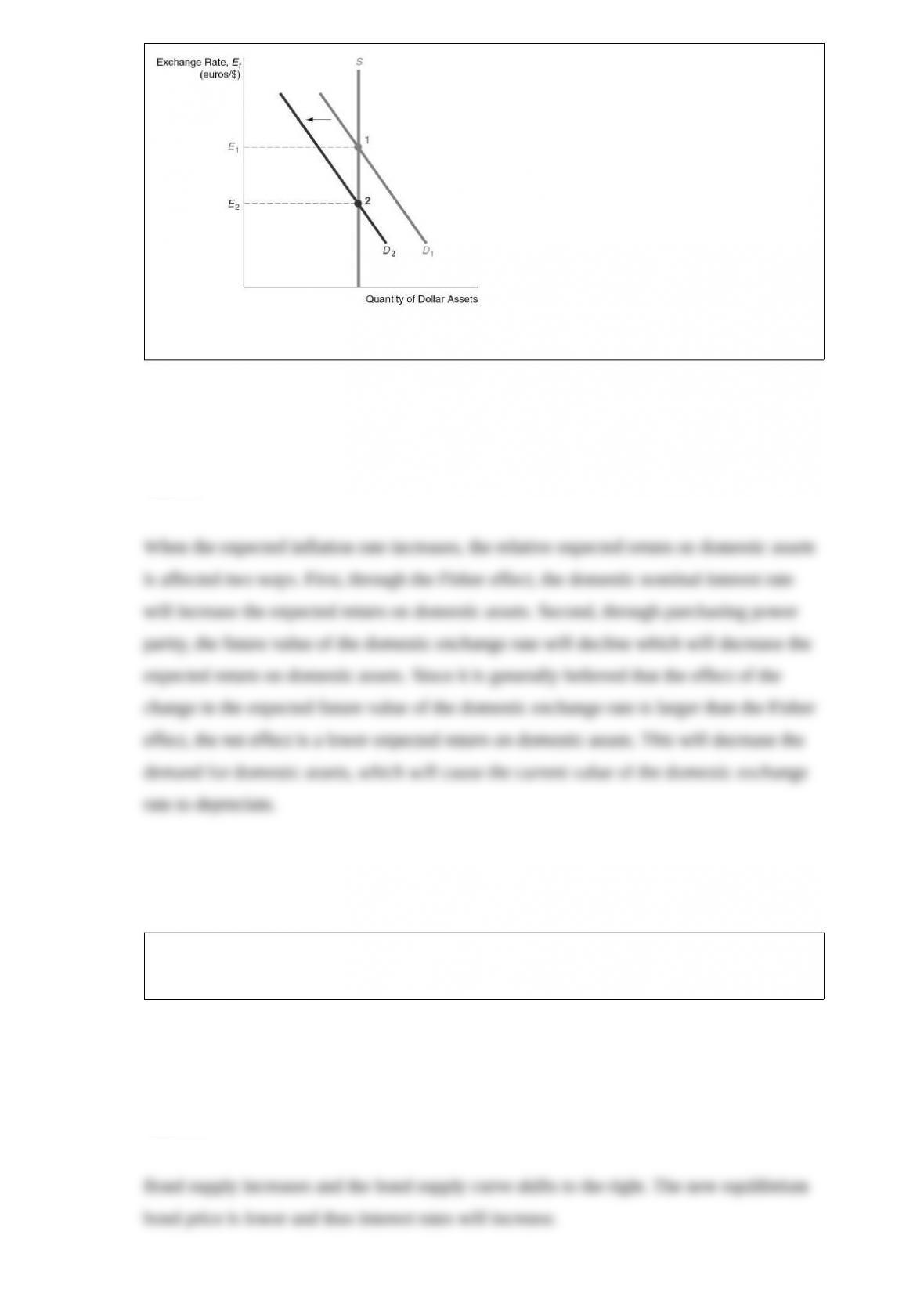
Explain and show graphically the effect of an increase in the expected inflation rate on
the equilibrium exchange rate, everything else held constant.
See figure below.
Answer:
What is the impact on interest rates when the Federal Reserve decreases the money
supply by selling bonds to the public?
Answer:
Your favorite uncle advises you to purchase long-term bonds because their interest rate
is 10%. Should you follow his advice?
Answer:
What is a stock? How do stocks affect the economy?
Answer:
Explain the principal-agent problem as it pertains to equity contracts.
Answer:
How did the increase in the interest rates in the early 80s contribute to the S&L crisis?
Answer:
The government safety net creates both an adverse selection problem and a moral
hazard problem. Explain.
Answer:
Banking crises have occurred throughout the world. What similarities do we find when
we look at the different countries?
Answer:
Who are the voting members of the Federal Open Market Committee and why is this
committee important? Where does the power lie within this committee?
Answer:
Using the ISLM model, show graphically and explain the effects of a monetary
contraction. What is the effect on the equilibrium interest rate and level of output?

See figure below.
Answer:
If the interest rate is 5%, what is the present value of a security that pays you $1, 050
next year and $1,102.50 two years from now? If this security sold for $2200, is the
yield to maturity greater or less than 5%? Why?
Answer:
What factors determine the demand for money in the Baumol-Tobin analysis of
transactions demand for money? How does a change in each factor affect the quantity
of money demanded?
Answer:
Corporations receive funds when their stock is sold in the primary market. Why do
corporations pay attention to what is happening to their stock in the secondary market?
Answer:
What factors have slowed down the movement to a system where all payments are
made electronically?
Answer: