
Which of the following are true for discount bonds?
A) A discount bond is bought at par.
B) The purchaser receives the face value of the bond at the maturity date.
C) U.S. Treasury bonds and notes are examples of discount bonds.
D) The purchaser receives the par value at maturity plus any capital gains.
Answer:
If the economy is on the IS curve, but is to the left of the LM curve, aggregate output
will ________ and the interest rate will ________.
A) rise; rise
B) rise; fall
C) fall; rise
D) fall; fall
Answer:
Which of the following is not one of the eight basic puzzles about financial structure?
A) Stocks are the most important source of finance for American businesses.

B) Issuing marketable securities is not the primary way businesses finance their
operations.
C) Indirect finance, which involves the activities of financial intermediaries, is many
times more important than direct finance, in which businesses raise funds directly from
lenders in financial markets.
D) Banks are the most important source of external funds to finance businesses.
Answer:
If the Fed expects currency holdings to rise, it conducts open market ________ to offset
the expected ________ in reserves.
A) purchases; increase
B) purchases; decrease
C) sales; increase
D) sales; decrease
Answer:
Everything else held constant, an increase in the required reserve ratio will mean
________ in the M2 money multiplier and ________ in the M2 money supply.

A) an increase; an increase
B) an increase; a decrease
C) a decrease; an increase
D) a decrease; a decrease
Answer:
In the market for reserves, if the federal funds rate is between the discount rate and the
interest rate paid on excess reserves, a decline in the reserve requirement ________ the
________ curve of reserves and causes the federal funds interest rate to fall, everything
else held constant.
A) decreases; demand
B) increases; demand
C) increases; supply
D) decreases; supply
Answer:
The agency that was created to protect depositors after the banking failures of
1930-1933 is the

A) Federal Reserve System.
B) Federal Deposit Insurance Corporation.
C) Treasury Department.
D) Office of the Comptroller of the Currency.
Answer:
Debt contracts
A) are agreements by the borrowers to pay the lenders fixed dollar amounts at periodic
intervals.
B) have a higher cost of state verification than equity contracts.
C) are used less frequently to raise capital than are equity contracts.
D) never result in a loss for the lender.
Answer:

The mound-shaped yield curve in the figure above indicates that short-term interest
rates are expected to
A) rise in the near-term and fall later on.
B) fall moderately in the near-term and rise later on.
C) fall sharply in the near-term and rise later on.
D) remain unchanged in the near-term and fall later on.
Answer:
Bank capital is equal to ________ minus ________.
A) total assets; total liabilities
B) total liabilities; total assets
C) total assets; total reserves
D) total liabilities; total borrowings

Answer:
It is true that inflation is a
A) continuous increase in the money supply.
B) continuous fall in prices.
C) decline in interest rates.
D) continually rising price level.
Answer:
Bonds with relatively high risk of default are called
A) Brady bonds.
B) junk bonds.
C) zero coupon bonds.
D) investment grade bonds.
Answer:

The evidence from banking crises in other countries indicates that
A) deposit insurance is to blame in each country.
B) a government safety net for depositors need not increase moral hazard.
C) regulatory forbearance never leads to problems.
D) deregulation combined with poor regulatory supervision raises moral hazard
incentives.
Answer:
Banks hold capital because
A) they are required to by regulatory authorities.
B) higher capital increases the returns to the owners.
C) it increases the likelihood of bankruptcy.
D) higher capital increases the return on equity.
Answer:

When you deposit $50 in your account at First National Bank and a $100 check you
have written on this account is cashed at Chemical Bank, then
A) the assets of First National rise by $50.
B) the assets of Chemical Bank rise by $50.
C) the reserves at First National fall by $50.
D) the liabilities at Chemical Bank rise by $50.
Answer:
In general, banks would prefer to acquire funds quickly by ________ rather than
________.
A) reducing loans; selling securities
B) reducing loans; borrowing from the Fed
C) borrowing from the Fed; reducing loans
D) “calling in” loans; selling securities
Answer:
Equity contracts

A) are claims to a share in the profits and assets of a business.
B) have the advantage over debt contracts of a lower costly state verification.
C) are used much more frequently to raise capital than are debt contracts.
D) are not subject to the moral hazard problem.
Answer:
You would be less willing to purchase U.S. Treasury bonds, other things equal, if
A) you inherit $1 million from your Uncle Harry.
B) you expect interest rates to fall.
C) gold becomes more liquid.
D) stock prices are expected to fall.
Answer:
The formula for the simple deposit multiplier can be expressed as
A) R = △ × T△

B) D = △ × R△
C) rr = △ × T△
D) R = △ × D △
Answer:
Everything else held constant, when stock prices become ________ volatile, the
demand curve for bonds shifts to the ________ and the interest rate ________.
A) more; right; rises
B) more; right; falls
C) less; left; falls
D) less; left; does not change
Answer:
Assuming initially that rr = 15%, c = 40%, and e = 5%, an increase in e to 10% causes
the M1 money multiplier to ________, everything else held constant.
A) increase from 2.15 to 2.33

B) decrease from 2.33 to 2.15
C) increase from 1.54 to 1.67
D) decrease from 1.67 to 1.54
Answer:
Credit cards date back to
A) prior to the second World War.
B) just after the second World War.
C) the early 1950s.
D) the late 1950s.
Answer:
Deflation causes the demand for bonds to ________, the supply of bonds to ________,
and bond prices to ________, everything else held constant.
A) increase; increase; increase
B) increase; decrease; increase

C) decrease; increase; increase
D) decrease; decrease; increase
Answer:
Macroeconomic equilibrium requires
A) equilibrium in the goods market.
B) equilibrium in the money market.
C) equilibrium in both the goods and money markets.
D) equilibrium in neither the goods nor the money market.
Answer:
If the money supply is $20 trillion and velocity is 2, then nominal GDP is
A) $2 trillion.
B) $10 trillion.
C) $20 trillion.
D) $40 trillion.

Answer:
If the dollar depreciates relative to the Swiss franc
A) Swiss chocolate will become cheaper in the United States.
B) American computers will become more expensive in Switzerland.
C) Swiss chocolate will become more expensive in the United States.
D) Swiss computers will become cheaper in the United States.
Answer:
The Federal Open Market Committee usually meets ________ times a year.
A) four
B) six
C) eight
D) twelve
Answer:

The Fed was committed to keeping interest rates low to assist Treasury financing of
budget deficits
A) only during World War I.
B) during the Great Depression.
C) during World War I and World War II.
D) throughout the entire existence of the Fed.
Answer:
Which of the following is a depository institution?
A) A life insurance company
B) A mutual savings bank
C) A pension fund
D) A finance company
Answer:

In the period 1965 through the 1970s, policymakers pursued ________ policies in order
to achieve ________.
A) expansionary; high employment
B) expansionary; low inflation
C) contractionary; high employment
D) contractionary; low inflation
Answer:
With ________ finance, borrowers obtain funds from lenders by selling them securities
in the financial markets.
A) active
B) determined
C) indirect
D) direct
Answer:

One of the criticisms of Basel 2 is that it is procyclical. That means that
A) banks may be required to hold more capital during times when capital is short.
B) banks may become professional at a cyclical response to economic conditions.
C) banks may be required to hold less capital during times when capital is short.
D) banks will not be required to hold capital during an expansion.
Answer:
Everything else held constant, would an increase in volatility of stock prices have any
impact on the demand for rare coins? Why or why not?
Answer:
Because there is an imbalance of information in a lending situation, we must deal with
the problems of adverse selection and moral hazard. Define these terms and explain
how financial intermediaries can reduce these problems.
Answer:
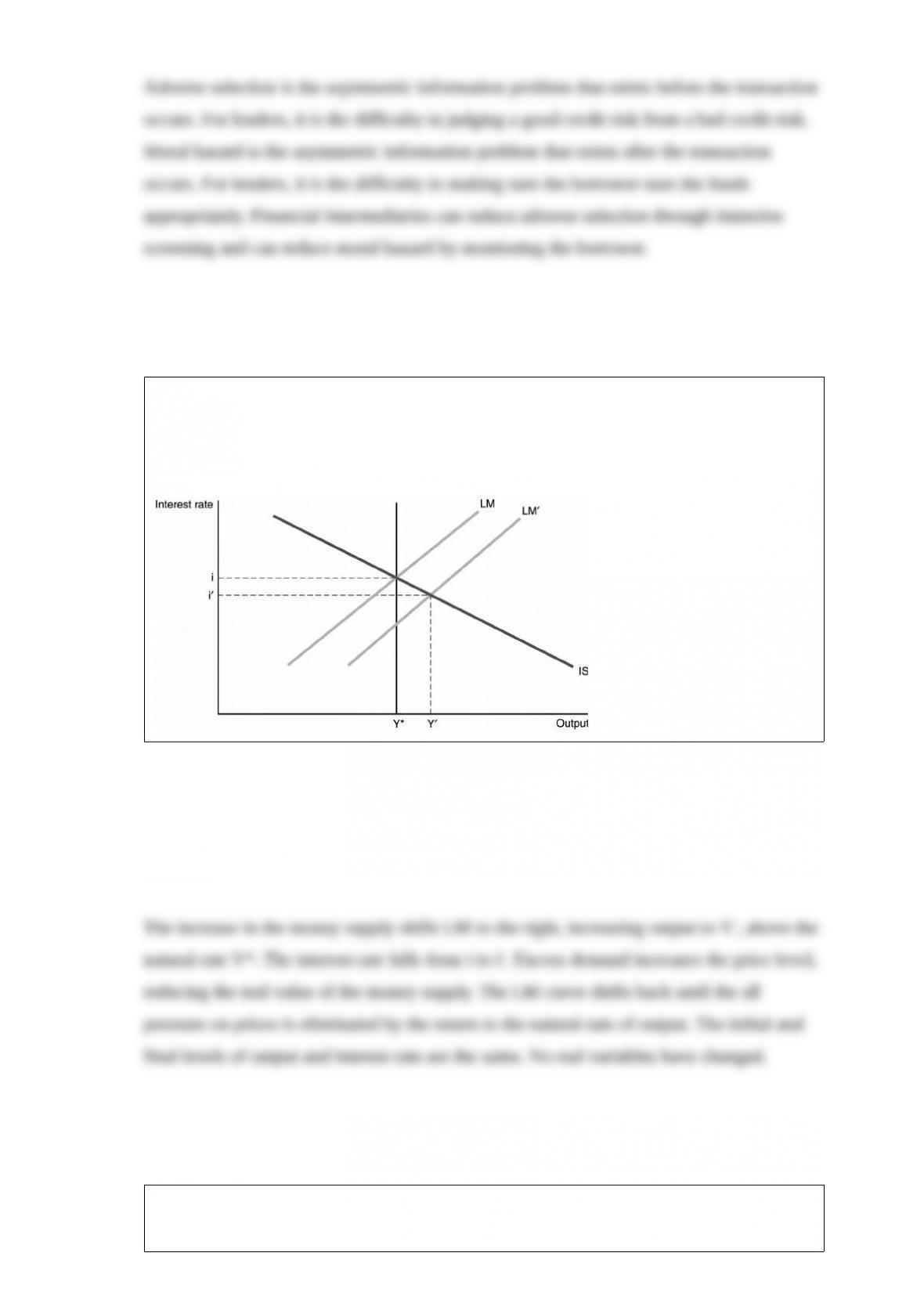
Using the long-run ISLM model, explain and demonstrate graphically the neutrality of
money, for the case of an increase in the money supply.
See figure below.
Answer:
As of 2009, China’s economy had recovered from the global recession that began in
2008. Use aggregate demand and aggregate supply analysis to explain why, and to
explain the likely consequences for China of an increase in the growth rate of the global
economy.
Answer: