
If a bank needs to raise the amount of capital relative to assets, a bank manager might
choose to
A) buy back bank stock.
B) pay higher dividends.
C) shrink the size of the bank.
D) sell securities the bank owns and put the funds into the reserve account.
Answer:
High interest rates might ________ purchasing a house or car but at the same time high
interest rates might ________ saving.
A) discourage; encourage
B) discourage; discourage
C) encourage; encourage
D) encourage; discourage
Answer:
Fluctuations in the demand for reserves cause the Fed to lose control over a monetary
aggregate if the Fed targets

A) a monetary aggregate.
B) the monetary base.
C) an interest rate.
D) nominal GDP.
Answer:
Since the Federal Reserve sets the required reserve ratio to less than one, one dollar of
reserves can support ________ of checkable deposits.
A) exactly one dollar
B) less than one dollar
C) more than one dollar
D) exactly twice the amount
Answer:
According to the segmented markets theory of the term structure
A) bonds of one maturity are close substitutes for bonds of other maturities, therefore,
interest rates on bonds of different maturities move together over time.

B) the interest rate for each maturity bond is determined by supply and demand for that
maturity bond.
C) investors’ strong preferences for short-term relative to long-term bonds explains why
yield curves typically slope downward.
D) because of the positive term premium, the yield curve will not be observed to be
downward-sloping.
Answer:
The ________ of the term structure states the following: the interest rate on a long-term
bond will equal an average of short-term interest rates expected to occur over the life of
the long-term bond plus a term premium that responds to supply and demand conditions
for that bond.
A) segmented markets theory
B) expectations theory
C) liquidity premium theory
D) separable markets theory
Answer:
The First Bank of the United States

A) was disbanded in 1811 when its charter was not renewed.
B) had its charter renewal vetoed in 1832.
C) was fundamental in helping the Federal Government finance the War of
D) None of the above.
Answer:
For banks,
A) return on assets exceeds return on equity.
B) return on assets equals return on equity.
C) return on equity exceeds return on assets.
D) return on equity is another name for net interest margin.
Answer:
Which of the following does not shift the IS curve?
A) An increase in autonomous consumption.
B) An increase in government spending.

C) A decline in government spending.
D) A fall in the interest rate.
Answer:
Experts predict that the future structure of the U.S. banking industry will have
A) an increased number of banks.
B) as few as ten banks.
C) several thousand banks.
D) a few hundred banks.
Answer:
Each governor on the Board of Governors can serve
A) only one nonrenewable fourteen-year term.
B) one full nonrenewable fourteen-year term plus part of another term.
C) only one nonrenewable eight-year term.
D) one full nonrenewable eight-year term plus part of another term.

Answer:
The excess reserves ratio is ________ related to expected deposit outflows, and is
________ related to the market interest rate.
A) negatively; negatively
B) negatively; positively
C) positively; negatively
D) positively; positively
Answer:
Holding all other factors constant, the quantity demanded of an asset is
A) positively related to wealth.
B) negatively related to its expected return relative to alternative assets.
C) positively related to the risk of its returns relative to alternative assets.
D) negatively related to its liquidity relative to alternative assets.
Answer:

A liquid asset is
A) an asset that can easily and quickly be sold to raise cash.
B) a share of an ocean resort.
C) difficult to resell.
D) always sold in an over-the-counter market.
Answer:
All else equal, the ________ the coupon rate on a bond, the ________ the bond’s
duration.
A) higher; longer
B) higher; shorter
C) lower; shorter
D) greater; longer
Answer:

The collapse of the Bank of Credit and Commerce International, BCCI, showed the
difficulty of international banking regulation. BCCI operated in more than ________
countries and was supervised by the small country of ________.
A) 70, Luxembourg
B) 100, Monaco
C) 70, Monaco
D) 100, Luxembourg
Answer:
With a 10 percent interest rate on dollar deposits, and an expected appreciation of 7
percent over the coming year, the expected return on dollar deposits in terms of the
foreign currency is
A) 3 percent.
B) 10 percent.
C) 5 percent.
D) 17 percent.
Answer:

The ________ interest rate is adjusted for expected changes in the price level.
A) ex ante real
B) ex post real
C) ex post nominal
D) ex ante nominal
Answer:
Assuming the same coupon rate and maturity length, the difference between the yield
on a Treasury Inflation Protected Security and the yield on a nonindexed Treasury
security provides insight into
A) the nominal interest rate.
B) the real interest rate.
C) the nominal exchange rate.
D) the expected inflation rate.
Answer:
If the required reserve ratio is 10 percent, currency in circulation is $400 billion,
checkable deposits are $1000 billion, and excess reserves total $1 billion, then the

currency ratio is
A) 0.25
B) 0.50
C) 0.40
D) 0.05
Answer:
During hyperinflations,
A) the value of money rises rapidly.
B) money no longer functions as a good store of value and people may resort to barter
transactions on a much larger scale.
C) middle-class savers benefit as prices rise.
D) money’s value remains fixed to the price level; that is, if prices double so does the
value of money.
Answer:
The velocity of money is defined as
A) real GDP divided by the money supply.
B) nominal GDP divided by the money supply.
C) real GDP times the money supply.
D) nominal GDP times the money supply.
Answer:
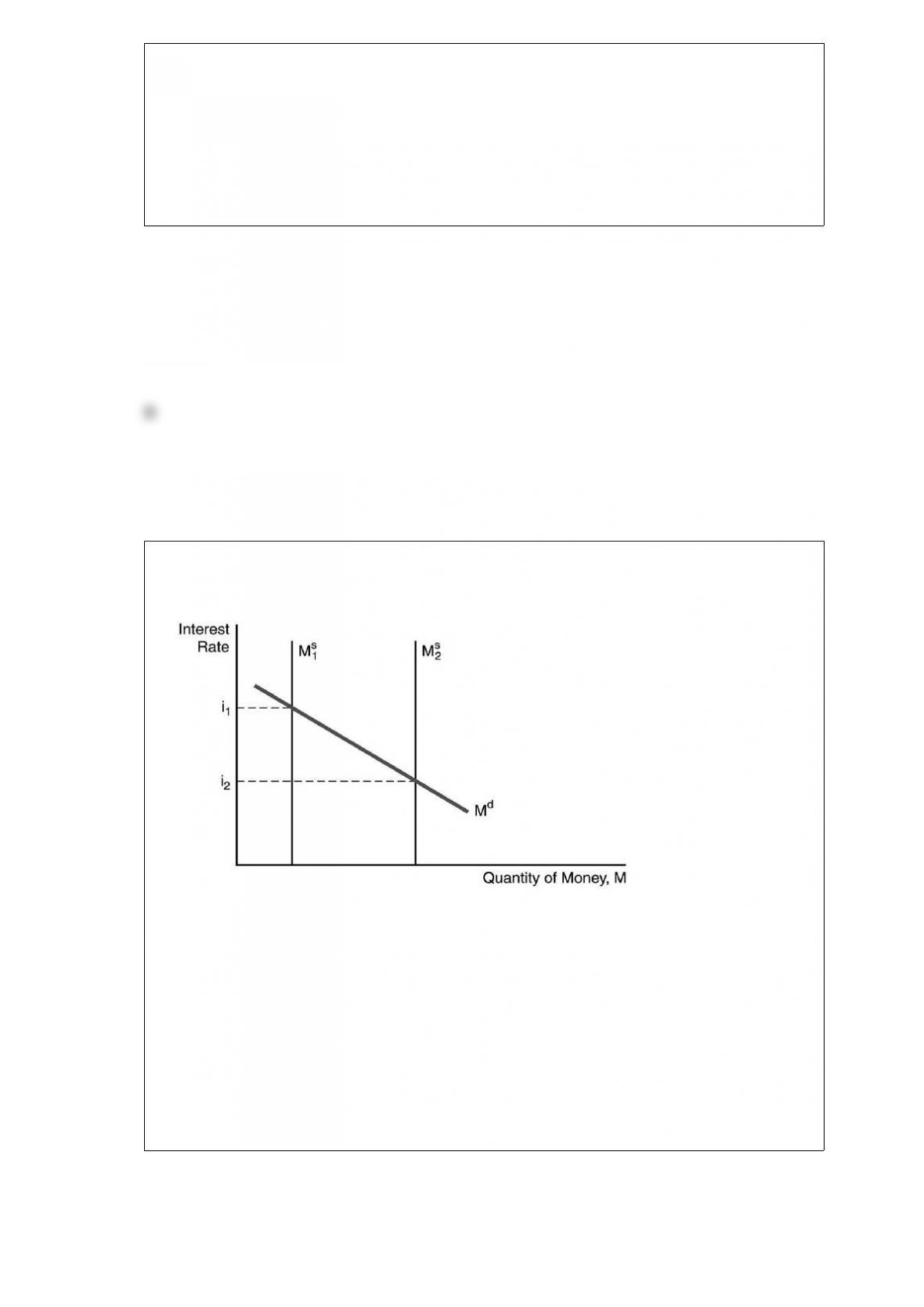
In the figure above, the factor responsible for the decline in the interest rate is
A) a decline the price level.
B) a decline in income.
C) an increase in the money supply.
D) a decline in the expected inflation rate.

Answer:
A rising stock market index due to higher share prices
A) increases people’s wealth, but is unlikely to increase their willingness to spend.
B) increases people’s wealth and as a result may increase their willingness to spend.
C) decreases the amount of funds that business firms can raise by selling newly-issued
stock.
D) decreases people’s wealth, but is unlikely to increase their willingness to spend.
Answer:
A corporation acquires new funds only when its securities are sold in the
A) primary market by an investment bank.
B) primary market by a stock exchange broker.
C) secondary market by a securities dealer.
D) secondary market by a commercial bank.
Answer:

Everything else held constant, if a central bank makes an unsterilized purchase of
foreign assets, then the domestic money supply will ________ and the domestic
currency will ________.
A) increase; appreciate
B) increase; depreciate
C) decrease; appreciate
D) decrease; depreciate
Answer:
The Federal Reserve Banks are ________ institutions since they are owned by the
________.
A) quasi-public; private commercial banks in the district where the Reserve Bank is
located
B) public; private commercial banks in the district where the Reserve Bank is located
C) quasi-public; Board of Governors
D) public; Board of Governors
Answer:

If a bank has excess reserves of $15,000 and demand deposit liabilities of $80,000, and
if the reserve requirement is 20 percent, then the bank has total reserves of
A) $11,000.
B) $21,000.
C) $31,000.
D) $41,000.
Answer:
The condition that states that the domestic interest rate equals the foreign interest rate
minus the expected appreciation of the domestic currency is called
A) the purchasing power parity condition.
B) the interest parity condition.
C) money neutrality.
D) the theory of foreign capital mobility.
Answer:

Although the Fed professed employment of a monetary aggregate targeting strategy
during the 1970s, its behavior suggests that it emphasized
A) free-reserve targeting.
B) interest-rate targeting.
C) a real-bills doctrine.
D) price-index targeting.
Answer:
If the quantity of money demanded is not affected by changes in the interest rate, the
LM curve is ________ and fiscal policy will be ________.
A) horizontal; very effective
B) horizontal; ineffective
C) vertical; ineffective
D) vertical; very effective
Answer:
A higher ________ means that an asset’s return is more sensitive to changes in the value
of the market portfolio.

A) alpha
B) beta
C) CAPM
D) APT
Answer:
When the level of unplanned inventory investment is equal to zero, the economy is
A) in disequilibrium.
B) in a recession.
C) in equilibrium.
D) overheating
Answer:
Bank customers perceive Internet banks as being
A) more secure than physical bank branches.
B) a better method for the purchase of long-term savings products.
C) better at keeping customer information private.
D) prone to many more technical problems.
Answer:
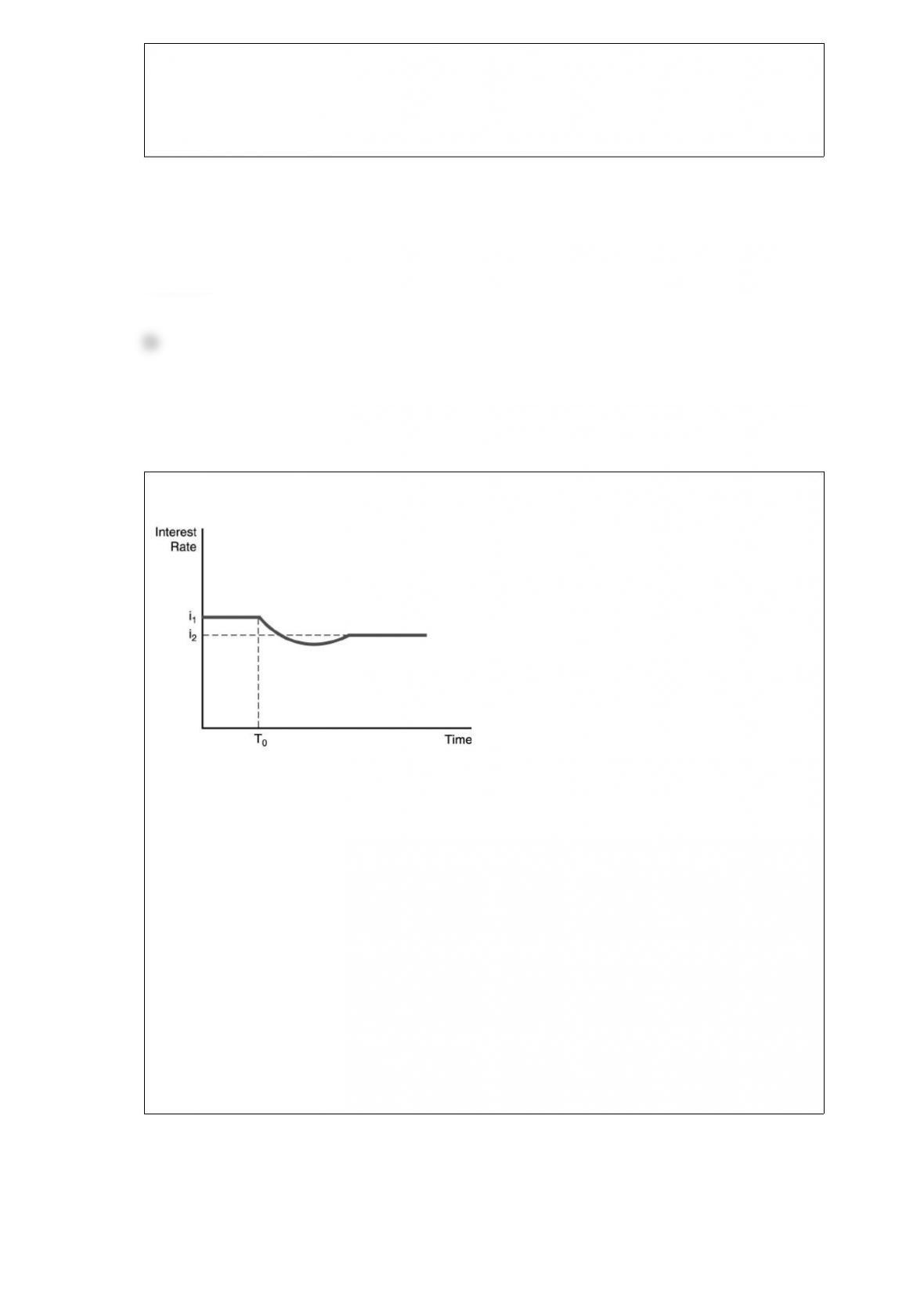
The figure above illustrates the effect of an increased rate of money supply growth at
time period T0. From the figure, one can conclude that the
A) liquidity effect is smaller than the expected inflation effect and interest rates adjust
quickly to changes in expected inflation.
B) liquidity effect is larger than the expected inflation effect and interest rates adjust
quickly to changes in expected inflation.
C) liquidity effect is larger than the expected inflation effect and interest rates adjust
slowly to changes in expected inflation.
D) liquidity effect is smaller than the expected inflation effect and interest rates adjust
slowly to changes in expected inflation.
Answer: