
An increase in productivity in a country will cause its currency to ________ because it
can produce goods at a ________ price, everything else held constant.
A) depreciate; lower
B) appreciate; lower
C) depreciate; higher
D) appreciate; higher
Answer:
The IS curve shifts to the left when
A) taxes increase.
B) government spending increases.
C) the money supply increases.
D) autonomous planned investment spending increases.
Answer:
Individuals that lend funds to a bank by opening a checking account are called
A) policyholders.

B) partners.
C) depositors.
D) debt holders.
Answer:
The decision by inflation targeters to choose inflation targets ________ zero reflects the
concern of monetary policymakers that particularly ________ inflation can have
substantial negative effects on real economic activity.
A) below; high
B) below; low
C) above; high
D) above; low
Answer:
Bruce the Bank Manager can reduce interest rate risk by ________ the duration of the
bank’s assets to increase their rate sensitivity or, alternatively, ________ the duration of
the bank’s liabilities.
A) shortening; lengthening

B) shortening; shortening
C) lengthening; lengthening
D) lengthening; shortening
Answer:
Macroprudential supervision policies try to prevent a leverage cycle by changing capital
requirements so that they ________ during an expansion and ________ during a
downturn.
A) increase; decrease
B) increase; increase
C) decrease; increase
D) decrease; decrease
Answer:
A problem with the too-big-to-fail policy is that it ________ the incentives for
________ by big banks.
A) increases; moral hazard
B) decreases; moral hazard
C) decreases; adverse selection
D) increases; adverse selection
Answer:
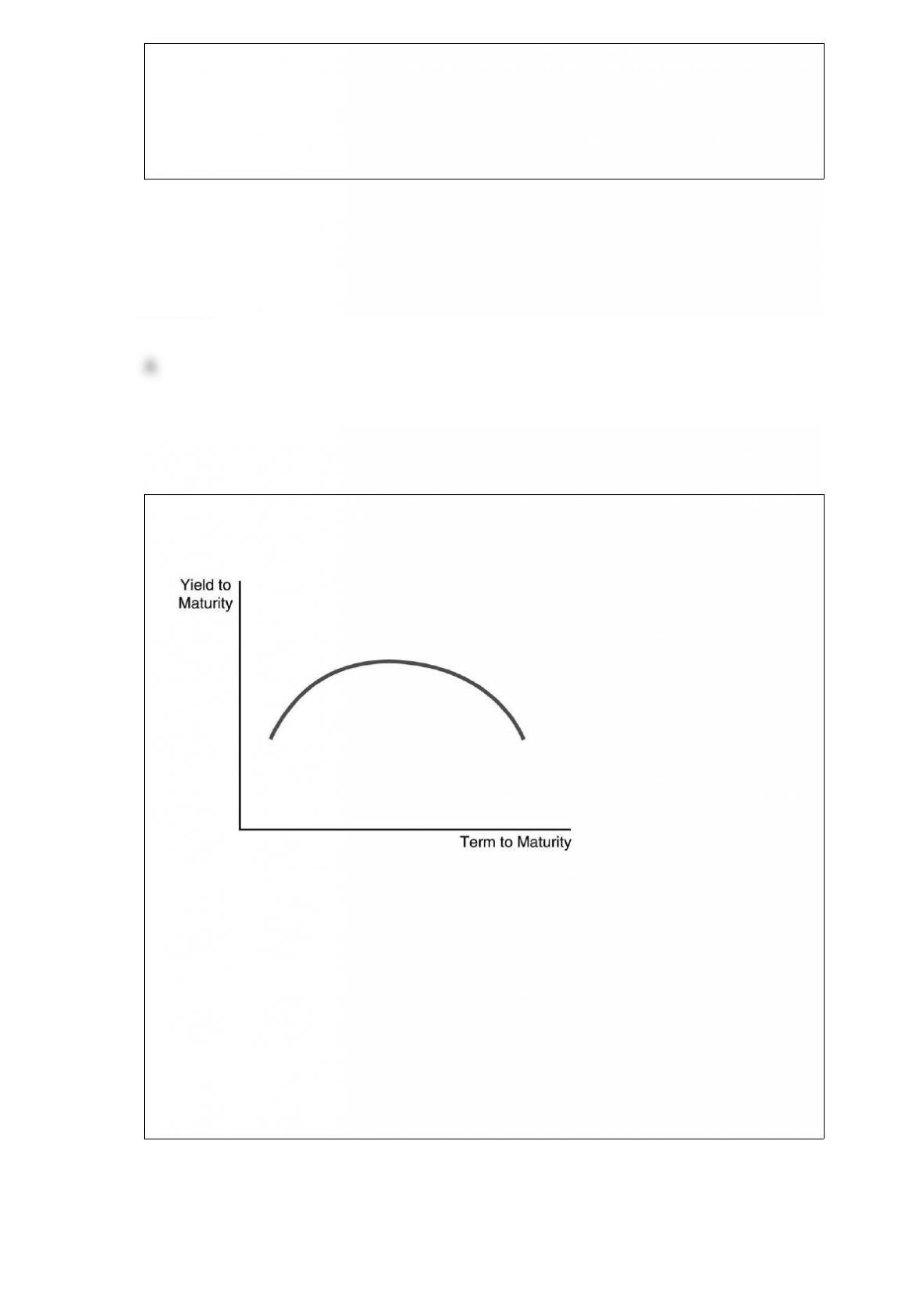
The mound-shaped yield curve in the figure above indicates that the inflation rate is
expected to
A) remain constant in the near-term and fall later on.
B) fall moderately in the near-term and rise later on.
C) rise moderately in the near-term and fall later on.
D) remain unchanged in the near-term and rise later on.

Answer:
The Policy Trilemma states that a country or a monetary union can’t pursue the
following three policies at the same time:
A) capital control, a fixed exchange rate, and an independent monetary policy.
B) free capital mobility, a fixed exchange rate, and an independent monetary policy.
C) free capital mobility, a flexible exchange rate, and an independent monetary policy.
D) capital control, a flexible exchange rate, and an independent monetary policy.
Answer:
If the required reserve ratio is one-third, currency in circulation is $300 billion, and
checkable deposits are $900 billion, then the currency ratio is
A) 0.25
B) 0.33
C) 0.67
D) 0.375
Answer:

The spectacular growth in international banking can be explained by
A) the rapid growth in international trade.
B) the 1988 Basel Agreement.
C) the desire for U.S. banks to escape burdensome domestic regulations.
D) the creation of the World Trade Organization.
Answer:
The price of a consol equals the coupon payment
A) times the interest rate.
B) plus the interest rate.
C) minus the interest rate.
D) divided by the interest rate.
Answer:

Lack of competition in the United States banking industry can be attributed to
A) the fact that competition does not benefit consumers.
B) the fact that branching has eliminated competition.
C) recent legislation restricting competition.
D) nineteenth-century populist sentiment.
Answer:
Aggregate demand in an economy with no government or foreign trade is
A) consumer expenditure plus actual investment.
B) consumer expenditure plus planned investment.
C) consumer expenditure plus inventory investment.
D) consumer expenditure plus fixed investment.
Answer:
The ratio that relates the change in the money supply to a given change in the monetary
base is called the
A) money multiplier.

B) required reserve ratio.
C) deposit ratio.
D) discount rate.
Answer:
Which of the following is not an example of a backup line of credit?
A) loan commitments
B) overdraft privileges
C) standby letters of credit
D) mortgages
Answer:
American companies can borrow funds
A) only in U.S. financial markets.
B) only in foreign financial markets.
C) in both U.S. and foreign financial markets.

D) only from the U.S. government.
Answer:
A clause in a debt contract requiring that the borrower purchase insurance against loss
of the asset financed with the loan is called a
A) collateral-insurance clause.
B) prescription covenant.
C) restrictive covenant.
D) proscription covenant.
Answer:
A decrease in the availability of raw materials that increases the price level is called a
________ shock
A) negative demand
B) positive demand
C) negative supply
D) positive supply

Answer:
When the domestic currency is initially overvalued in a fixed exchange rate regime, the
central bank must intervene in the foreign exchange market to ________ the domestic
currency, thereby allowing the money supply to ________.
A) purchase; decline
B) sell; decline
C) purchase; increase
D) sell; increase
Answer:
A shift in tastes toward American goods ________ net exports in the U.S. and causes
the quantity of aggregate output demanded to ________ in the U.S., everything else
held constant.
A) decreases; rise
B) decreases; fall
C) increases; rise
D) increases; fall

Answer:
The money supply is ________ related to expected deposit outflows, and is ________
related to the market interest rate.
A) negatively; negatively
B) negatively; positively
C) positively; negatively
D) positively; positively
Answer:
If merchants in the country Zed choose to close their doors, preferring to be stuck with
rotting merchandise rather than worthless currency, then one can conclude that Zed is
experiencing a
A) superdeflation.
B) hyperdeflation.
C) disinflation.
D) hyperinflation.
Answer:

Because of asymmetric information, the failure of one bank can lead to runs on other
banks. This is the
A) too-big-to-fail effect.
B) moral hazard problem.
C) adverse selection problem.
D) contagion effect.
Answer:
The risk structure of interest rates is
A) the structure of how interest rates move over time.
B) the relationship among interest rates of different bonds with the same maturity.
C) the relationship among the term to maturity of different bonds.
D) the relationship among interest rates on bonds with different maturities.
Answer:

Which of the following instruments are traded in a money market?
A) Bank commercial loans
B) Commercial paper
C) State and local government bonds
D) Residential mortgages
Answer:
Suppose a person cashes his payroll check and holds all the funds in the form of
currency. Everything else held constant, total reserves in the banking system ________
and the monetary base ________.
A) remain unchanged; increases
B) decrease; increases
C) decrease; remains unchanged
D) decrease; decreases
Answer:

The evidence from banking crises in other countries indicates that
A) deposit insurance is to blame in each country.
B) a government safety net for depositors need not increase moral hazard.
C) regulatory forbearance never leads to problems.
D) deregulation combined with poor regulatory supervision raises moral hazard
incentives.
Answer:
Total reserves are the sum of ________ and ________.
A) excess reserves; borrowed reserves
B) required reserves; currency in circulation
C) vault cash; excess reserves
D) excess reserves; required reserves
Answer:
The McFadden Act of 1927
A) effectively prohibited banks from branching across state lines.

B) required that banks maintain bank capital equal to at least 6 percent of their assets.
C) effectively required that banks maintain a correspondent relationship with large
money center banks.
D) separated the commercial banks and investment banks.
Answer: