
In the Keynesian cross diagram, an increase in investment spending because companies
become more optimistic about investment profitability causes the aggregate demand
function to shift ________, the equilibrium level of aggregate output to rise, and the IS
curve to shift to the ________, everything else held constant.
A) up; left
B) up; right
C) down; left
D) down; right
Answer:
Which of the following is a depository institution?
A) A life insurance company
B) A credit union
C) A pension fund
D) A mutual fund
Answer:
Everything else held constant, in the market for reserves, when the federal funds rate

equals the interest rate paid on excess reserves, raising the interest rate paid on excess
reserves
A) increases the federal funds rate.
B) lowers the federal funds rate.
C) has no effect on the federal funds rate.
D) has an indeterminate effect of the federal funds rate.
Answer:
The marginal propensity to consume (mpc) can be defined as the fraction of
A) a change in income that is spent.
B) a change in income that is saved.
C) income that is spent.
D) income that is saved.
Answer:
During business cycle expansions when income and wealth are rising, the demand for
bonds ________ and the demand curve shifts to the ________, everything else held
constant.

A) falls; right
B) falls; left
C) rises; right
D) rises; left
Answer:
A problem for equity contracts is a particular type of ________ called the ________
problem.
A) adverse selection; principal-agent
B) moral hazard; principal-agent
C) adverse selection; free-rider
D) moral hazard; free-rider
Answer:
Assume a closed economy with no government. Suppose that autonomous
consumption equals $400, planned investment equals $500, and the mpc equals 0.9.

Assume equilibrium at full employment for an economy characterized by the simple
Keynesian model. If the government raises taxes to eliminate a budget deficit, then
A) the rate of unemployment will increase.
B) the level of aggregate output will increase.
C) the price level will increase.
D) the rate of interest will fall.
Answer:
If bad credit risks are the ones who most actively seek loans then financial
intermediaries face the problem of
A) moral hazard.
B) adverse selection.
C) free-riding.
D) costly state verification.
Answer:
A major difference between the United States and Japanese banking systems is that

A) American banks are allowed to hold substantial equity stakes in commercial firms,
whereas Japanese banks cannot.
B) Japanese banks are allowed to hold substantial equity stakes in commercial firms,
whereas American banks cannot.
C) bank holding companies are illegal in the United States.
D) Japanese banks are usually organized as bank holding companies.
Answer:
During the Great Depression, Tobin’s q
A) rose dramatically, as did real interest rates.
B) fell to unprecedentedly low levels.
C) stayed fairly constant, in contrast to most other economic measures.
D) rose only slightly, in spite of Hoover’s attempts to prop it up.
Answer:
In the Keynesian cross diagram, a decrease in investment spending because companies
become more pessimistic about investment profitability causes the aggregate demand
function to shift down, the equilibrium level of aggregate output to ________, and the
IS curve to shift to the ________, everything else held constant.

A) rise; left
B) rise; right
C) fall; left
D) fall; right
Answer:
A bond with default risk will always have a ________ risk premium and an increase in
its default risk will ________ the risk premium.
A) positive; raise
B) positive; lower
C) negative; raise
D) negative; lower
Answer:
Mortgage brokers often did not make a strong effort to evaluate whether the borrower
could pay off the loan. This created a
A) severe adverse selection problem.

B) decline in mortgage applications.
C) call to deregulate the industry.
D) decrease in the demand for houses.
Answer:
When the economy suffers a permanent negative supply shock and the central bank
does not respond by changing the autonomous component of monetary policy, then
A) inflation will be lower.
B) output will be at its potential.
C) output will be lower.
D) inflation will not change.
E) both B and C.
Answer:
The long-run aggregate supply curve is
A) a vertical line through the non-inflationary rate of output.

B) a vertical line through the current level of output.
C) a vertical line through the natural rate level of output.
D) a horizontal line through the current level of output.
Answer:
The account that shows international transactions involving financial transactions
(stocks, bonds, bank loans, etc.) is called the
A) trade balance.
B) current account.
C) balance of payments.
D) capital account.
Answer:
As bonds become a riskier asset, the demand for money ________ and, all else
constant, the equilibrium interest rate ________.
A) rises; rises
B) rises; falls

C) falls; rises
D) falls; falls
Answer:
An increase in the expected inflation rate causes the supply of bonds to ________ and
the supply curve to shift to the ________, everything else held constant.
A) increase; left
B) increase; right
C) decrease; left
D) decrease; right
Answer:
When the central bank ________ the money supply, the LM curve shifts to the right,
interest rates ________, and equilibrium aggregate output ________, everything else
held constant.
A) increases; fall; increases
B) increases; rise; decreases
C) decreases; rise; decreases

D) decreases; fall; increases
Answer:
An autonomous depreciation of the U.S. dollar makes American goods ________
relative to foreign goods and results in a ________ in U.S. net exports, everything else
held constant.
A) cheaper; decline
B) cheaper; rise
C) more expensive; decline
D) more expensive; rise
Answer:
Banks can lower the cost of information production by applying one information
resource to many different services. This process is called
A) economies of scale.
B) asset transformation.
C) economies of scope.

D) asymmetric information.
Answer:
A key factor in producing high economic growth is
A) eliminating foreign trade.
B) well-functioning financial markets.
C) high interest rates.
D) stock market volatility.
Answer:
Collateral requirements lessen the consequences of ________ because the collateral
reduces the lender’s losses in the case of a loan default and it reduces ________ because
the borrower has more to lose from a default.
A) adverse selection; moral hazard
B) moral hazard; adverse selection
C) adverse selection; diversification
D) diversification; moral hazard

Answer:
If the maturity of a debt instrument is less than one year, the debt is called
A) short-term.
B) intermediate-term.
C) long-term.
D) prima-term.
Answer:
If the First National Bank has a gap equal to a negative $30 million, then a 5 percentage
point increase in interest rates will cause profits to
A) increase by $15 million.
B) increase by $1.5 million.
C) decline by $15 million.
D) decline by $1.5 million.
Answer:

The problem created by asymmetric information before the transaction occurs is called
________, while the problem created after the transaction occurs is called ________.
A) adverse selection; moral hazard
B) moral hazard; adverse selection
C) costly state verification; free-riding
D) free-riding; costly state verification
Answer:
Of the sources of external funds for nonfinancial businesses in the United States, loans
from banks and other financial intermediaries account for approximately ________ of
the total.
A) 6%
B) 40%
C) 56%
D) 60%
Answer:

The chartering process is especially designed to deal with the ________ problem, and
regular bank examinations help to reduce the ________ problem.
A) adverse selection; adverse selection
B) adverse selection; moral hazard
C) moral hazard; adverse selection
D) moral hazard; moral hazard
Answer:
A substantial decrease in the aggregate price level that reduces firms’ net worth may
stall a recovery from a recession. This process is called
A) debt deflation.
B) moral hazard.
C) insolvency.
D) illiquidity.
Answer:

The monetary base declines when
A) the Fed extends discount loans.
B) Treasury deposits at the Fed decrease.
C) float increases.
D) the Fed sells securities.
Answer:
In the late 1990s, the stock market bubble ________ the value of Tobin’s q, and caused
________ in business equipment.
A) increased; underinvestment
B) increased; overinvestment
C) decreased; underinvestment
D) decreased; overinvestment
Answer:
One of the concerns of increased bank consolidation is the reduction in community
banks which could result in

A) less lending to small businesses.
B) loss of cultural identity.
C) higher interest rates.
D) more bank regulation.
Answer:
When you deposit a $50 bill in the Security Pacific National Bank,
A) its liabilities decrease by $50.
B) its assets increase by $50.
C) its reserves decrease by $50.
D) its cash items in the process of collection increase by $50.
Answer:
Your bank has the following balance sheet:
Assets Liabilities
Reserves $ 50 million Checkable deposits $200
million

Securities 50 million
Loans 150 million Bank capital 50
million
If the required reserve ratio is 10%, what actions should the bank manager take if there
is an unexpected deposit outflow of $50 million?
Answer:
Explain through the component parts of aggregate demand why the aggregate demand
curve slopes down with respect to the inflation rate. Be sure to discuss two channels
through which changes in inflation rates affect demand.
Answer:
How do regulators help to ensure the soundness of financial intermediaries?

Answer:
Distinguish between direct finance and indirect finance. Which of these is the most
important source of funds for corporations in the United States?
Answer:
How can specializing in lending help to reduce the adverse selection problem in
lending?
Answer:

Explain the similarities and differences between the European System of Central Banks
and the Federal Reserve System.
Answer:
Why does the Federal Reserve Bank of New York play a special role within the Federal
Reserve System?
Answer:
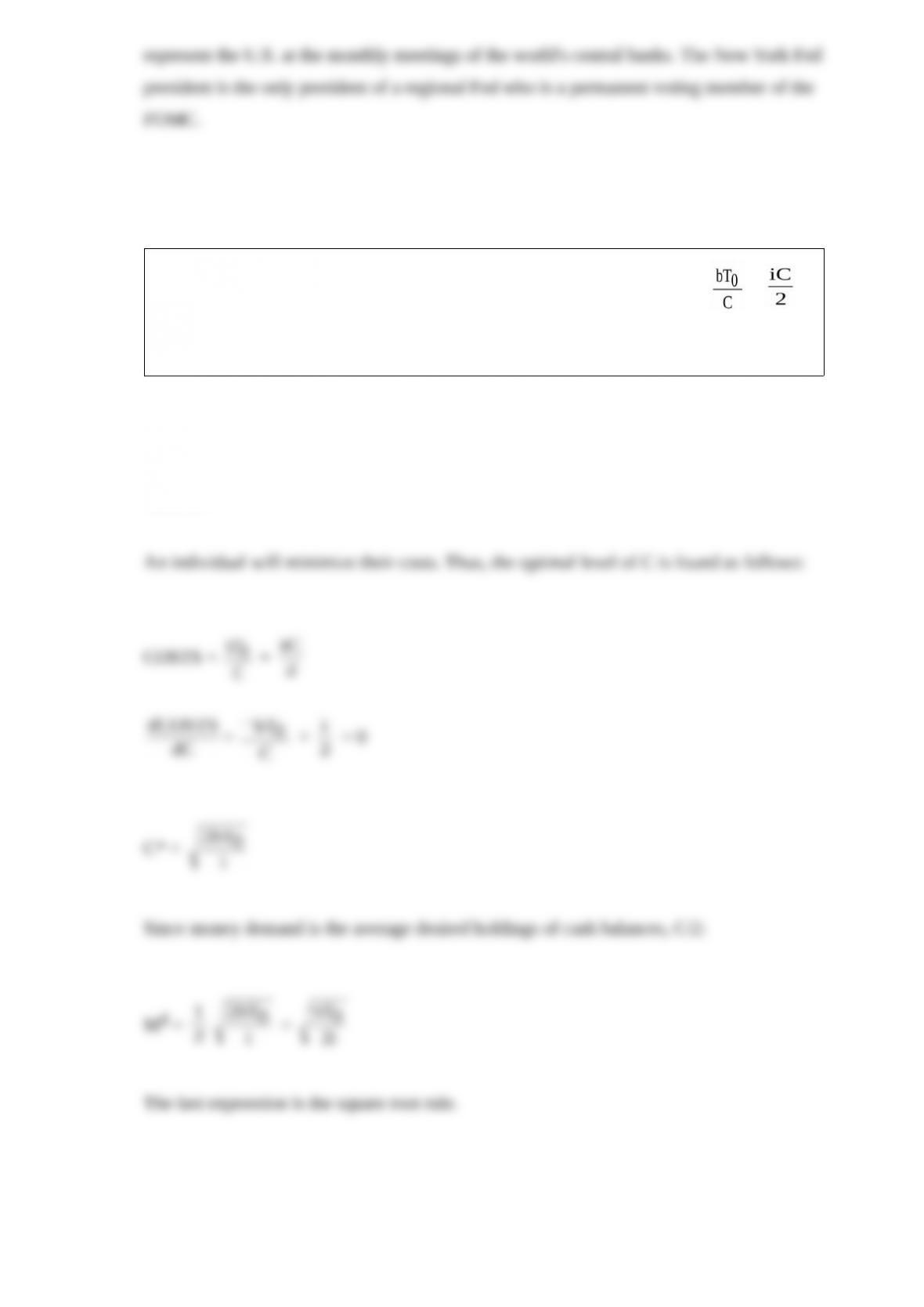
In the Baumol-Tobin model, given that total costs for an individual equals + ,
where T0 = monthly income, b = brokerage costs, and C = amount raised from each
bond transaction, derive the so-called square root rule.
Answer:
What financial innovations helped banks to get around the bank branching restrictions
of the McFadden Act?
Answer:
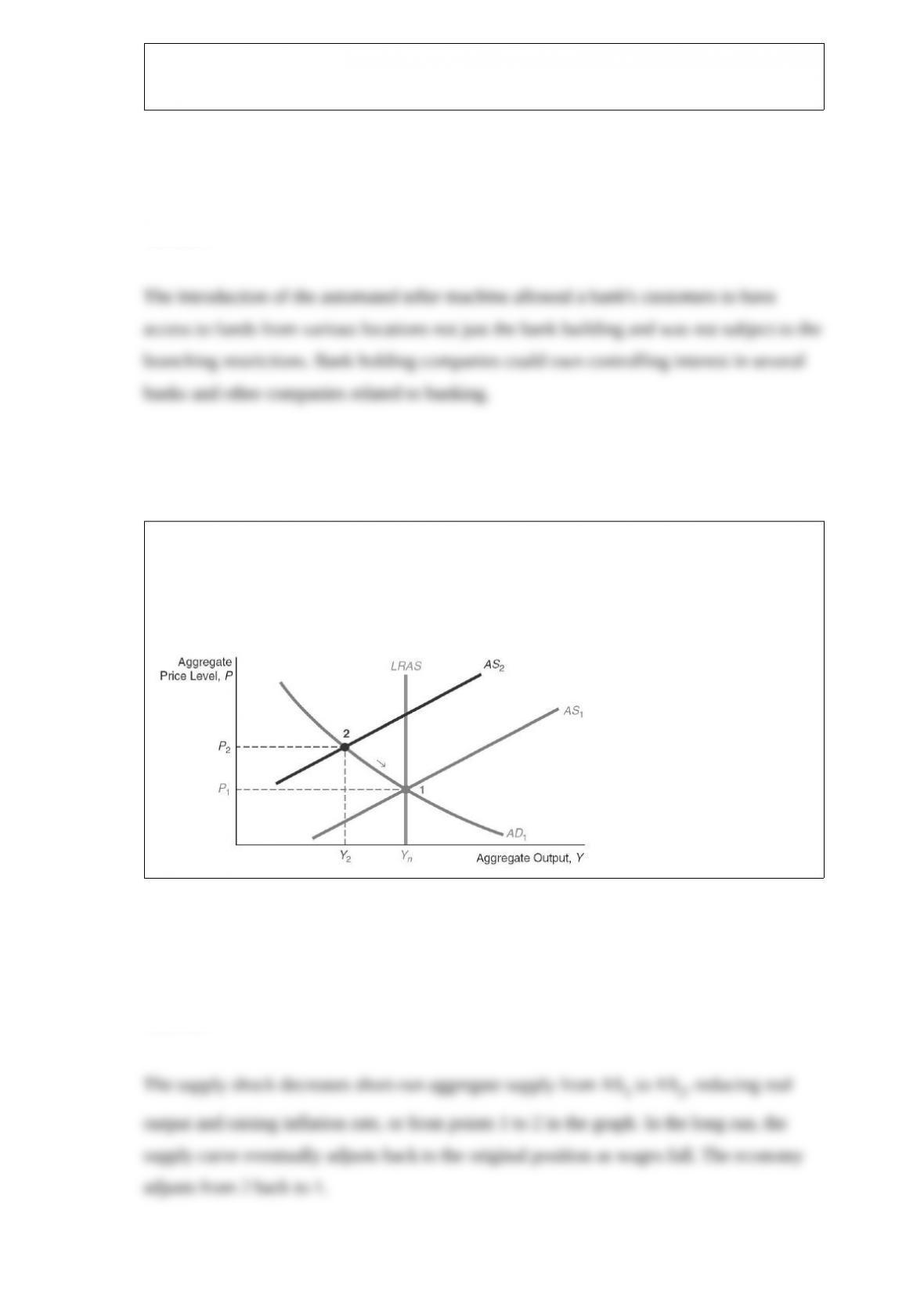
Explain and demonstrate graphically the effects of a negative supply shock in both the
short-run and long-run.
See figure below.
Answer:

Typically, the economy recovers fairly quickly from a recession. Why did this not
happen in the United States during the Great Depression?
Answer:
What two key factors trigger speculative attacks leading to currency cries in emerging
market countries?
Answer:
Your bank has the following balance sheet
Assets Liabilities
Rate-sensitive $100 million Rate-sensitive $75 million
Fixed-rate 100 million Fixed-rate 125 million
What would happen to bank profits if the interest rates in the economy go down? Is
there anything that you could do to keep your bank from being so vulnerable to interest
rate movements?
Answer:
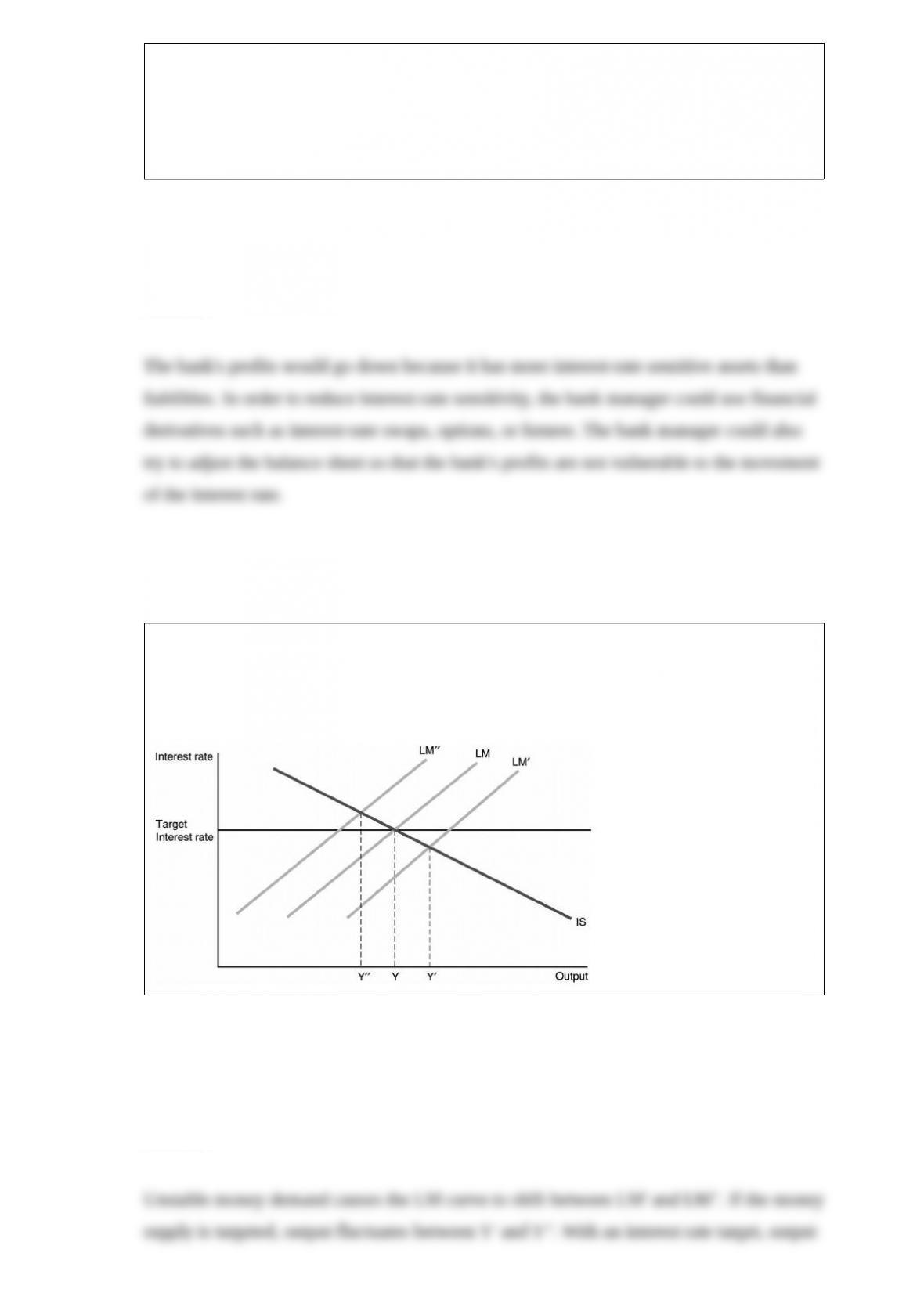
Show graphically and explain why targeting an interest rate is preferable when money
demand is unstable and the IS curve is stable.
See figure below.
Answer:

Explain two reasons why the Fed does not have complete control over the level of bank
deposits and loans. Explain how a change in either factor affects the deposit expansion
process.
Answer:
Explain the traditional interest-rate channel for expansionary monetary policy. Explain
how a tight monetary policy affects the economy through this channel.
Answer:
Make the case for and against an independent Federal Reserve.
Answer: