
Arguments for discretionary policies include
A) policy rules can be too rigid because they cannot foresee every contingency.
B) the time-inconsistency problem can lead to poor economic outcomes.
C) discretionary policies pursue overly expansionary monetary policies to boost
employment in the short run but generate higher inflation in the long run.
D) all of the above.
Answer:
In the Keynesian model the quantity of money demanded is ________ related to income
and ________ related to the interest rate.
A) positively; positively
B) positively; negatively
C) negatively; negatively
D) negatively; positively
Answer:
Everything else held constant, a monetary expansion is characterized by ________
output and ________ interest rates.

A) rising; rising
B) rising; falling
C) falling; rising
D) falling; falling
Answer:
________ of a foreign bank operates in the U.S. but cannot accept deposits from
domestic residents.
A) An agency office
B) A universal corporation
C) A McFadden corporation
D) A Basel branch
Answer:
If the aggregate price level at time t is denoted by Pt, the inflation rate from time t – 1 to
t is defined as
A) πt = (Pt – Pt – 1)/ Pt – 1.

B) πt = (Pt + 1 – Pt – 1) /Pt – 1.
C) πt = (Pt + 1 – Pt) /Pt.
D) πt = (Pt – Pt – 1) /Pt.
Answer:
An increase in the expected future domestic exchange rate causes the demand for
domestic assets to ________ and the domestic currency to ________, everything else
held constant.
A) increase; appreciate
B) increase; depreciate
C) decrease; appreciate
D) decrease; depreciate
Answer:
Under the Exchange Rate Mechanism of the European Monetary System, when the
German mark depreciated below its lower limit against the British pound, the German
central bank was required to buy ________ and sell ________, thereby ________
international reserves.

A) pounds; marks; losing
B) pounds; marks; gaining
C) marks; pounds; gaining
D) marks; pounds; losing
Answer:
The president from which Federal Reserve Bank always has a vote in the Federal Open
Market Committee?
A) Philadelphia
B) Boston
C) San Francisco
D) New York
Answer:
The money supply is ________ related to the nonborrowed monetary base, and
________ related to the level of borrowed reserves.
A) positively; negatively

B) negatively; not
C) positively; positively
D) negatively; negatively
Answer:
The Depository Institutions Deregulation and Monetary Control Act of 1980
A) established higher reserve requirements for nonmember than for member banks.
B) established higher reserve requirements for member than for nonmember banks.
C) abolished reserve requirements.
D) established uniform reserve requirements for all banks.
Answer:
If American college students decide that drinking Mexican-brewed beer helps one get
noticed, net exports will tend to fall, causing aggregate demand to ________ and the
________ curve to shift to the left, everything else held constant.
A) fall; LM
B) fall; IS

C) rise; LM
D) rise; IS
Answer:
Thrift institutions include
A) banks, mutual funds, and insurance companies.
B) savings and loan associations, mutual savings banks, and credit unions.
C) finance companies, mutual funds, and money market funds.
D) pension funds, mutual funds, and banks.
Answer:
Depositors lack of information about the quality of bank assets can lead to
A) bank panics.
B) bank booms.
C) sequencing.
D) asset transformation.

Answer:
Which of the following has not resulted from more active liability management on the
part of banks?
A) Increased bank holdings of cash items
B) Aggressive targeting of goals for asset growth by banks
C) Increased use of negotiable CDs to raise funds
D) An increased proportion of bank assets held in loans
Answer:
After 2003, The Federal Reserve usually keeps the discount rate
A) above the target federal funds rate.
B) equal to the target federal funds rate.
C) below the target federal funds rate.
D) equal to zero.
Answer:

An investment bank helps ________ issue securities.
A) a corporation
B) the United States government
C) the SEC
D) foreign governments
Answer:
New information that might lead to a decrease in a stock’s price might be
A) an expected decrease in the level of future dividends.
B) a decrease in the required rate of return.
C) an expected increase in the dividend growth rate.
D) an expected increase in the future sales price.
Answer:
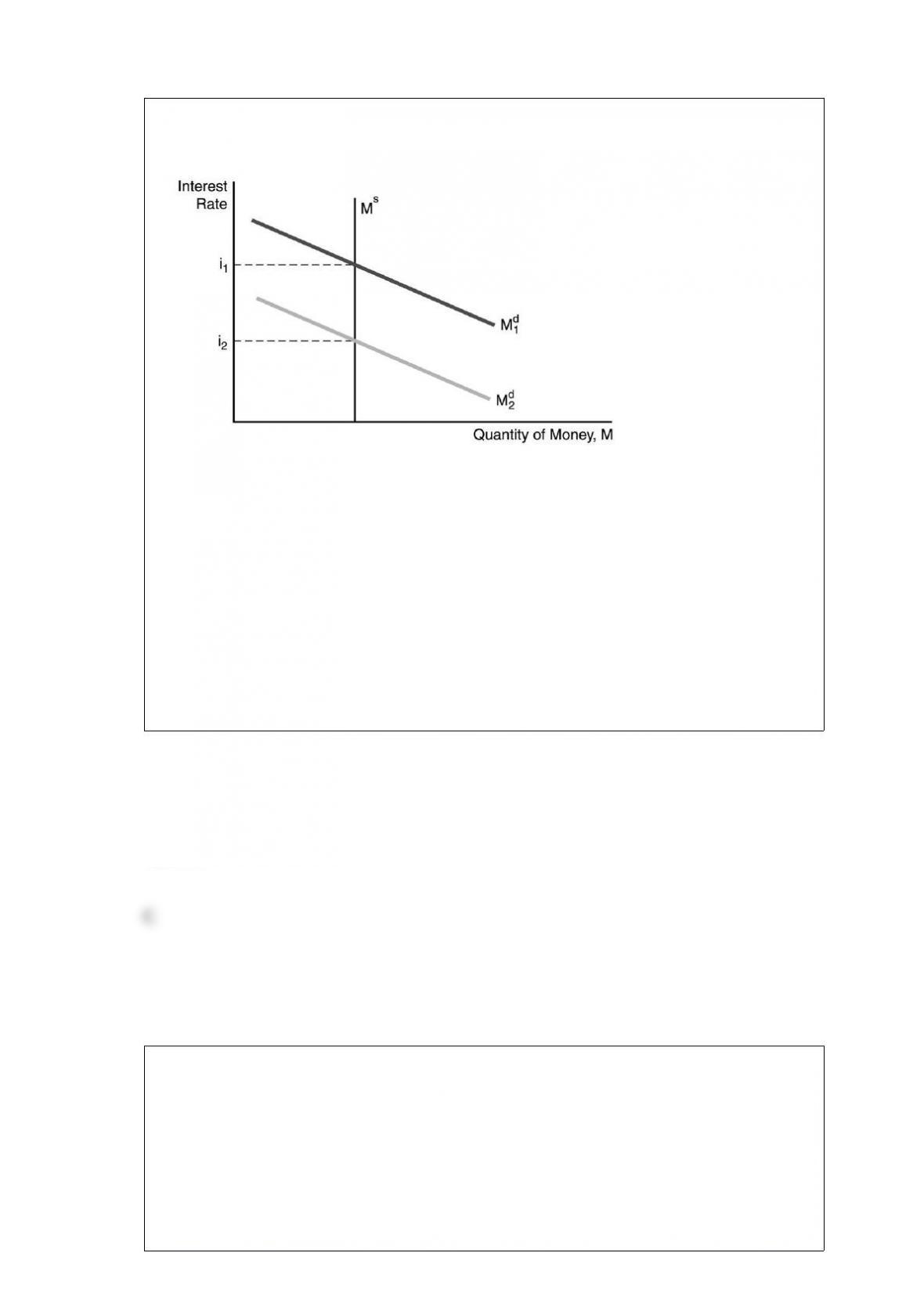
In the figure above, one factor not responsible for the decline in the demand for money
is
A) a decline the price level.
B) a decline in income.
C) an increase in income.
D) a decline in the expected inflation rate.
Answer:
Open market sales ________ reserves and the monetary base thereby ________ the
money supply.
A) raise; lowering
B) raise; raising
C) lower; lowering

D) lower; raising
Answer:
________ imposes a conceptual structure and inherent discipline on policy makers, but
without eliminating all flexibility.
A) Constrained discretion
B) A policy rule
C) A discretionary policy
D) The Taylor rule
Answer:
Money is
A) anything that is generally accepted in payment for goods and services or in the
repayment of debt.
B) a flow of earnings per unit of time.
C) the total collection of pieces of property that are a store of value.
D) always based on a precious metal like gold or silver.

Answer:
An increase in which of the following leads to a decline in the monetary base?
A) Float
B) Discount loans
C) Foreign deposits at the Fed
D) SDRs
Answer:
An autonomous increase in money demand, other things equal, shifts the ________
curve to the ________.
A) IS; right
B) IS; left
C) LM; left
D) LM; right
Answer:

Everything else held constant, if aggregate output is to the ________ of the IS curve,
then there is an excess ________ of goods which will cause aggregate output to fall.
A) right; supply
B) right; demand
C) left; supply
D) left; demand
Answer:
As default risk increases, the expected return on corporate bonds ________, and the
return becomes ________ uncertain, everything else held constant.
A) increases; less
B) increases; more
C) decreases; less
D) decreases; more
Answer:

If the Federal Reserve conducts open market ________, the money supply ________,
shifting the LM curve to the right, everything else held constant.
A) purchases; decreases
B) sales; decreases
C) purchases; increases
D) sales; increases
Answer:
Which of the following appears in the capital account part of the balance of payments?
A) A gift to an American from his English aunt.
B) A purchase by the Honda corporation of a U.S. Treasury bill.
C) A purchase by the Bank of England of a U.S. Treasury bill.
D) Income earned by the Honda corporation on its automobile plant in Ohio.
Answer:

Everything else held constant, which of the following does not cause aggregate demand
to increase?
A) An increase in net exports
B) An increase in government spending
C) An increase in taxes
D) An increase in consumer optimism
Answer:
With ________, firms value assets on their balance sheet at what they would sell for in
the market.
A) mark-to-market accounting
B) book-value accounting
C) historical-cost accounting
D) off-balance sheet accounting
Answer:
Measuring the sensitivity of bank profits to changes in interest rates by multiplying the
gap times the change in the interest rate is called

A) basic duration analysis.
B) basic gap analysis.
C) interest-exposure analysis.
D) gap-exposure analysis.
Answer:
When the financial crisis started in August 2007, inflation was rising and the Fed began
an aggressive easing lowering of the federal funds rate, which indicated that
A) the Fed pursued an autonomous monetary policy tightening.
B) the Fed pursued an autonomous monetary policy easing.
C) the Fed had an automatic negative response to inflation based on the Taylor rule.
D) the Fed had an automatic positive response to inflation based on the Taylor rule.
Answer:
A financial innovation that developed as a result of banks avoidance of bank branching
restrictions was
A) money market mutual funds.

B) commercial paper.
C) junk bonds.
D) bank holding companies.
Answer:
The Federal Deposit Insurance Corporation Improvement Act of 1991
A) increased the FDIC’s ability to borrow from the Treasury to deal with failed banks.
B) increased the FDIC’s ability to use the too-big-to-fail doctrine.
C) eliminated governmentally-administered deposit insurance.
D) eliminated restrictions on nationwide banking.
Answer:
For restrictive covenants to help reduce the moral hazard problem they must be
________ by the lender.
A) monitored and enforced
B) written in all capitals

C) easily changed
D) impossible to remove
Answer:
As aggregate output rises, the demand for money ________ and the interest rate
________, so that money demanded equals money supplied and the money market is in
equilibrium.
A) increases; rises
B) increases; falls
C) decreases; rises
D) decreases; falls
Answer: