
The elimination of unexploited profit opportunities requires that ________ market
participants be well informed.
A) all
B) a few
C) zero
D) many
Answer:
As information technology improves, the lending role of financial institutions such as
banks should
A) increase somewhat.
B) decrease.
C) stay the same.
D) increase significantly.
Answer:
If a person selling bonds to the Fed cashes the Fed’s check, then reserves ________ and
currency in circulation ________, everything else held constant.

A) remain unchanged; declines
B) remain unchanged; increases
C) decline; remains unchanged
D) increase; remains unchanged
Answer:
Lessons that economists and policy makers have learned from the recent global
financial crisis include
A) Developments in the financial sector have a far greater impact on economic activity
than was earlier realized.
B) The zero lower bound on interest rates can be a serious problem.
C) The cost of cleaning up after a financial crisis is very high.
D) Price and output stability do not ensure financial stability.
E) All of the above.
Answer:
As the banking system in the United States evolves, it is expected that

A) the number and importance of small banks will increase.
B) the number and importance of large banks will decrease.
C) small banks will grow at the expense of large banks.
D) the number and importance of large banks will increase.
Answer:
An international lender of last resort creates a serious ________ problem because
depositors and other creditors of banking institutions expect that they will be protected
if a crisis occurs.
A) moral hazard
B) adverse selection
C) public choice
D) strategic choice
Answer:
If the Fed wants to temporarily inject reserves into the banking system, it will engage in
A) a repurchase agreement.

B) a matched sale-purchase transaction.
C) a reverse repurchase agreement.
D) an open market sale.
Answer:
If a bank has excess reserves of $10,000 and demand deposit liabilities of $80,000, and
if the reserve requirement is 20 percent, then the bank has actual reserves of
A) $16,000.
B) $20,000.
C) $26,000.
D) $36,000.
Answer:
If market participants notice that a variable behaves differently now than in the past,
then, according to rational expectations theory, we can expect market participants to
A) change the way they form expectations about future values of the variable.
B) begin to make systematic mistakes.

C) no longer pay close attention to movements in this variable.
D) give up trying to forecast this variable.
Answer:
A decrease in default risk on corporate bonds ________ the demand for these bonds,
and ________ the demand for default-free bonds, everything else held constant.
A) increases; lowers
B) lowers; increases
C) does not change; greatly increases
D) moderately lowers; does not change
Answer:
When Americans or foreigners expect the return on dollar assets to be high relative to
the return on foreign assets, there is a ________ demand for dollar assets and a
correspondingly ________ demand for foreign assets.
A) higher; higher
B) higher; lower

C) lower; higher
D) lower; lower
Answer:
In the simple deposit expansion model, if the Fed extends a $100 discount loan to a
bank that previously had no excess reserves, the bank can now increase its loans by
A) $10.
B) $100.
C) $100 times the reciprocal of the required reserve ratio.
D) $100 times the required reserve ratio.
Answer:
When good weather speeds the check-clearing process, float tends to ________ causing
the Fed to initiate defensive open market ________.
A) decrease; sales
B) decrease; purchases
C) increase; sales

D) increase; purchases
Answer:
The monetary policy strategy that does not allow the policy to focus on domestic
considerations is
A) exchange-rate targeting.
B) monetary targeting.
C) inflation targeting.
D) the implicit nominal anchor.
Answer:
If reserves in the banking system increase by $100, then checkable deposits will
increase by $1000 in the simple model of deposit creation when the required reserve
ratio is
A) 0.01
B) 0.1
C) 0.05
D) 0.2

Answer:
If the Federal Reserve conducts open market sales, the money supply ________,
shifting the LM curve to the ________, everything else held constant.
A) decreases; right
B) decreases; left
C) increases; right
D) increases; left
Answer:
An electronic payments system has not completely replaced the paper payments system
because of all of the following reasons except
A) expensive equipment is necessary to set up the system.
B) security concerns.
C) privacy concerns.
D) transportation costs.

Answer:
Everything else held constant, if the expected return on U.S. Treasury bonds falls from
8 to 7 percent and the expected return on corporate bonds falls from 10 to 8 percent,
then the expected return of corporate bonds ________ relative to U.S. Treasury bonds
and the demand for corporate bonds ________.
A) rises; rises
B) rises; falls
C) falls; rises
D) falls; falls
Answer:
Competition between banks
A) encourages greater risk taking.
B) encourages conservative bank management.
C) increases bank profitability.
D) eliminates the need for government regulation.
Answer:

A decrease in ________ leads to an equal ________ in the monetary base in the short
run.
A) float; increase
B) float; decrease
C) Treasury deposits at the Fed; decrease
D) discount loans; increase
Answer:
Banks earn profits from off-balance sheet loan sales
A) by foreclosing on delinquent accounts.
B) by selling the loans at discounted prices.
C) by selling existing loans for more than the original loan amount.
D) by calling-in loans before the maturity date.
Answer:

When the Treasury acquires gold or SDRs, it issues certificates to the ________, which
are a claim on the gold or SDRs, and in turn is credited with deposit balances at the
________.
A) Federal Reserve System; Fed
B) Federal Reserve System; IMF
C) International Monetary Fund; Fed
D) International Monetary Fund; IMF
Answer:
Large-denomination CDs are ________, so that like a bond they can be resold in a
________ market before they mature.
A) nonnegotiable; secondary
B) nonnegotiable; primary
C) negotiable; secondary
D) negotiable; primary
Answer:
A key finding of the economic analysis of financial structure is that

A) the existence of the free-rider problem for traded securities helps to explain why
banks play a predominant role in financing the activities of businesses.
B) while free-rider problems limit the extent to which securities markets finance some
business activities, nevertheless the majority of funds going to businesses are channeled
through securities markets.
C) given the great extent to which securities markets are regulated, free-rider problems
are not of significant economic consequence in these markets.
D) economists do not have a very good explanation for why securities markets are so
heavily regulated.
Answer:
A contractionary monetary policy shifts the LM curve to the ________, reducing
________, everything else held constant.
A) left; output and increasing interest rates
B) left; both real output and interest rates
C) right; both interest rates and real output
D) right; interest rates and increasing real output
Answer:

In the long run, following a combination of a negative demand shock and a temporary
negative supply shock,
A) both inflation and output return to the original long-run equilibrium values.
B) inflation is permanently increased, while output returns to potential output.
C) output returns to potential output, while inflation may be higher or lower than its
initial value.
D) inflation is permanently reduced, while output returns to potential output.
E) None of the above.
Answer:
When the central bank allows the purchase or sale of domestic currency to have an
effect on the monetary base, it is called
A) an unsterilized foreign exchange intervention.
B) a sterilized foreign exchange intervention.
C) an exchange rate feedback rule.
D) a money neutral foreign exchange intervention.
Answer:

According to the expectations theory of the term structure
A) when the yield curve is steeply upward sloping, short-term interest rates are
expected to remain relatively stable in the future.
B) when the yield curve is downward sloping, short-term interest rates are expected to
remain relatively stable in the future.
C) investors have strong preferences for short-term relative to long-term bonds,
explaining why yield curves typically slope upward.
D) yield curves should be equally likely to slope downward as slope upward.
Answer:
Bonds that are sold in a foreign country and are denominated in the country’s currency
in which they are sold are known as
A) foreign bonds.
B) Eurobonds.
C) equity bonds.
D) country bonds.
Answer:

Assuming initially that rr = 15%, c = 40%, and e = 5%, a decrease in e to 0% causes the
M1 money multiplier to ________, everything else held constant.
A) increase from 2.33 to 2.55
B) decrease from 2.55 to 2.33
C) increase from 1.67 to 1.82
D) decrease from 1.82 to 1.67
Answer:
Commercial and farm mortgages, in which property is pledged as collateral, account for
A) one-quarter of borrowing by nonfinancial businesses.
B) one-half of borrowing by nonfinancial businesses.
C) one-twentieth of borrowing by nonfinancial businesses.
D) two-thirds of borrowing by nonfinancial businesses.
Answer:
Which of the following are primary concerns of the bank manager?
A) Maintaining sufficient reserves to minimize the cost to the bank of deposit outflows

B) Extending loans to borrowers who will pay low interest rates, but who are poor
credit risks
C) Acquiring funds at a relatively high cost, so that profitable lending opportunities can
be realized
D) Maintaining high levels of capital and thus maximizing the returns to the owners.
Answer:
________ are short-term loans in which Treasury bills serve as collateral.
A) Repurchase agreements
B) Negotiable certificates of deposit
C) Federal funds
D) U.S. government agency securities
Answer:
Assume a closed economy. Suppose that autonomous consumption equals $400,
planned investment equals $500, government expenditure equals $200, net taxes
equals $50, and the mpc equals 0.9.

Aggregate output is ________ related to autonomous consumer expenditure, and is
________ related to planned investment spending.
A) negatively; negatively
B) negatively; positively
C) positively; negatively
D) positively; positively
Answer:
Explain the time-inconsistency problem. What is the likely outcome of discretionary
policy? What are the solutions to the time-inconsistency problem?
Answer:
Explain the 1992 crisis that led to the breakdown of the European Union’s Exchange
Rate Mechanism. What disadvantages of exchange-rate targeting were exhibited during
this crisis?
Answer:
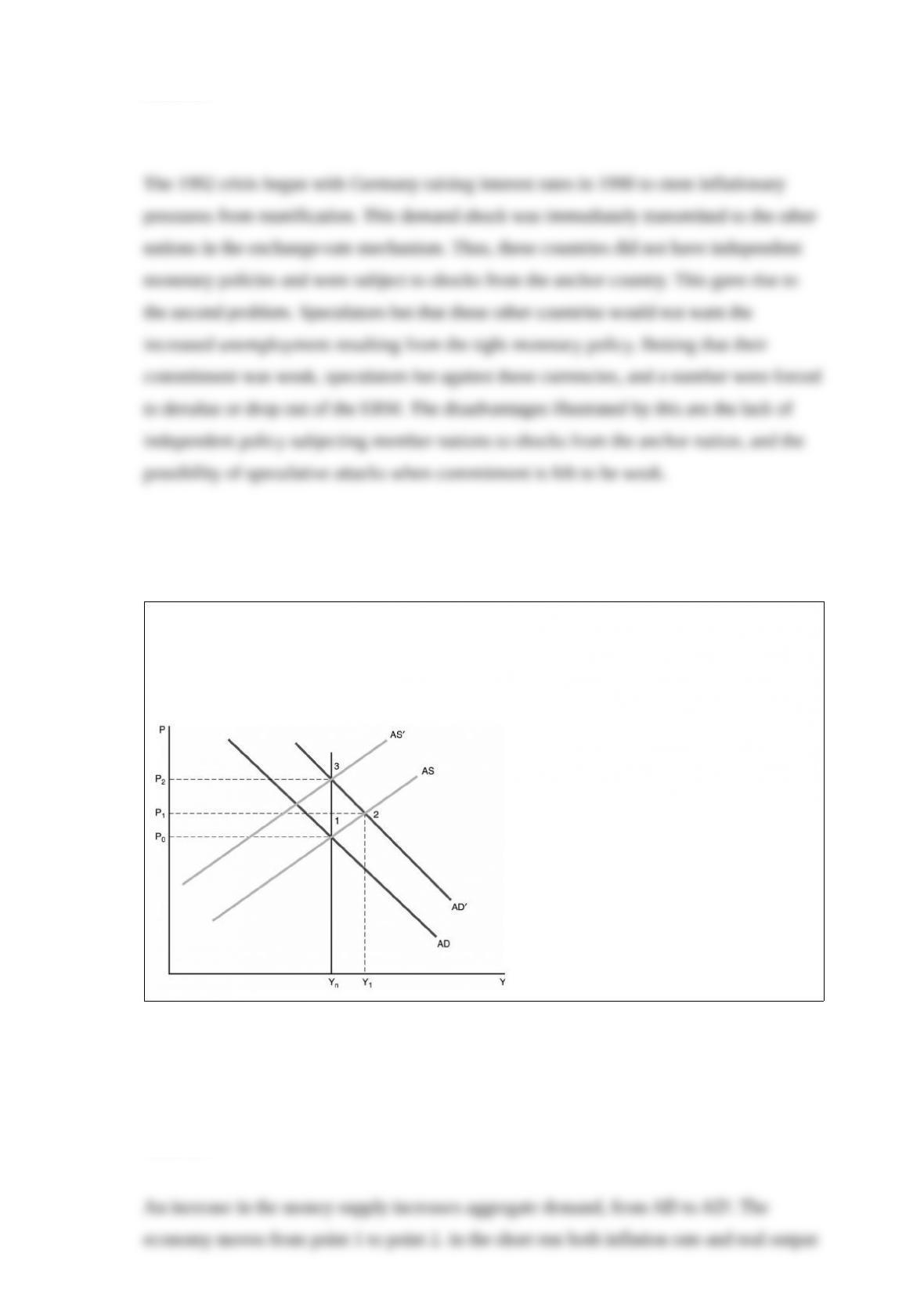
Using the aggregate demand-aggregate supply model, explain and demonstrate
graphically the short-run and long-run effects of an increase in the money supply.
See figure below.
Answer:

Explain the Keynesian theory of money demand. What motives did Keynes think
determined money demand? What are the two reasons why Keynes thought velocity
could not be treated as a constant?
Answer:
Explain dynamic and defensive open market operations. What is the purpose of each
type? Describe two situations when defensive open market operations are used. How
are defensive open market operations typically conducted?
Answer:

Explain two concepts of central bank independence. Is the Fed politically independent?
Why do economists think central bank independence is important?
Answer:
Explain the Fed’s three tools of monetary policy and how each is used to change the
money supply. Does each tool affect the monetary base or the money multiplier?
Answer:

What is the theory of bureaucratic behavior and how can it be used to explain the
behavior of the Federal Reserve?
Answer:
You believe that a corporation’s dividends will grow 5% on average into the foreseeable
future. If the company’s last dividend payment was $5 what should be the current price
of the stock assuming a 12% required return?
Answer:
Use demand and supply analysis to explain why an expectation of Fed rate hikes would
cause Treasury prices to fall.
Answer:
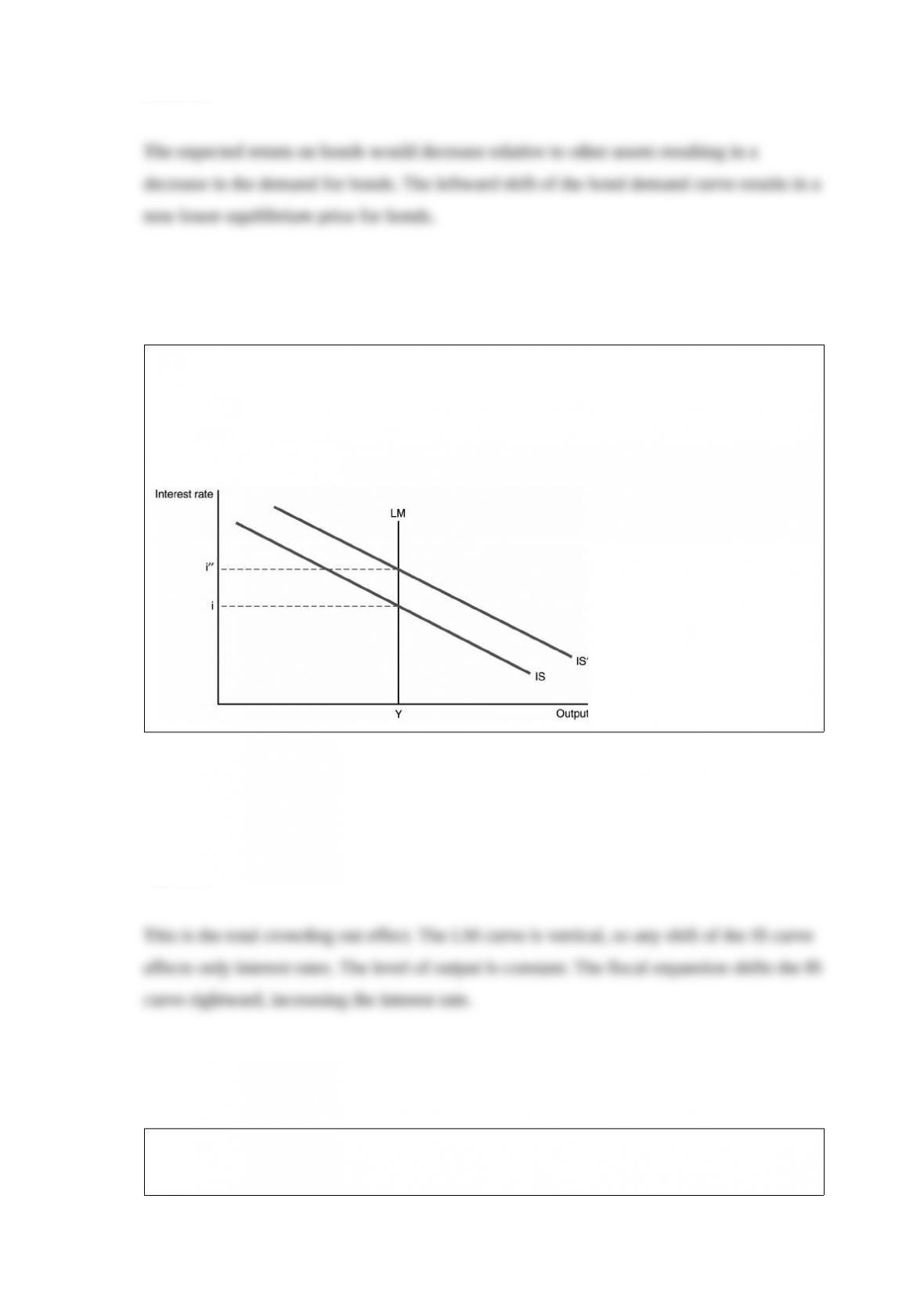
Using the ISLM model, explain and show graphically the effect of a fiscal expansion
when the demand for money is completely insensitive to changes in the interest rate.
What is this effect called?
See figure below.
Answer:
Describe what the liquidity trap is. Explain how it can be problematic for monetary
policymakers.
Answer:
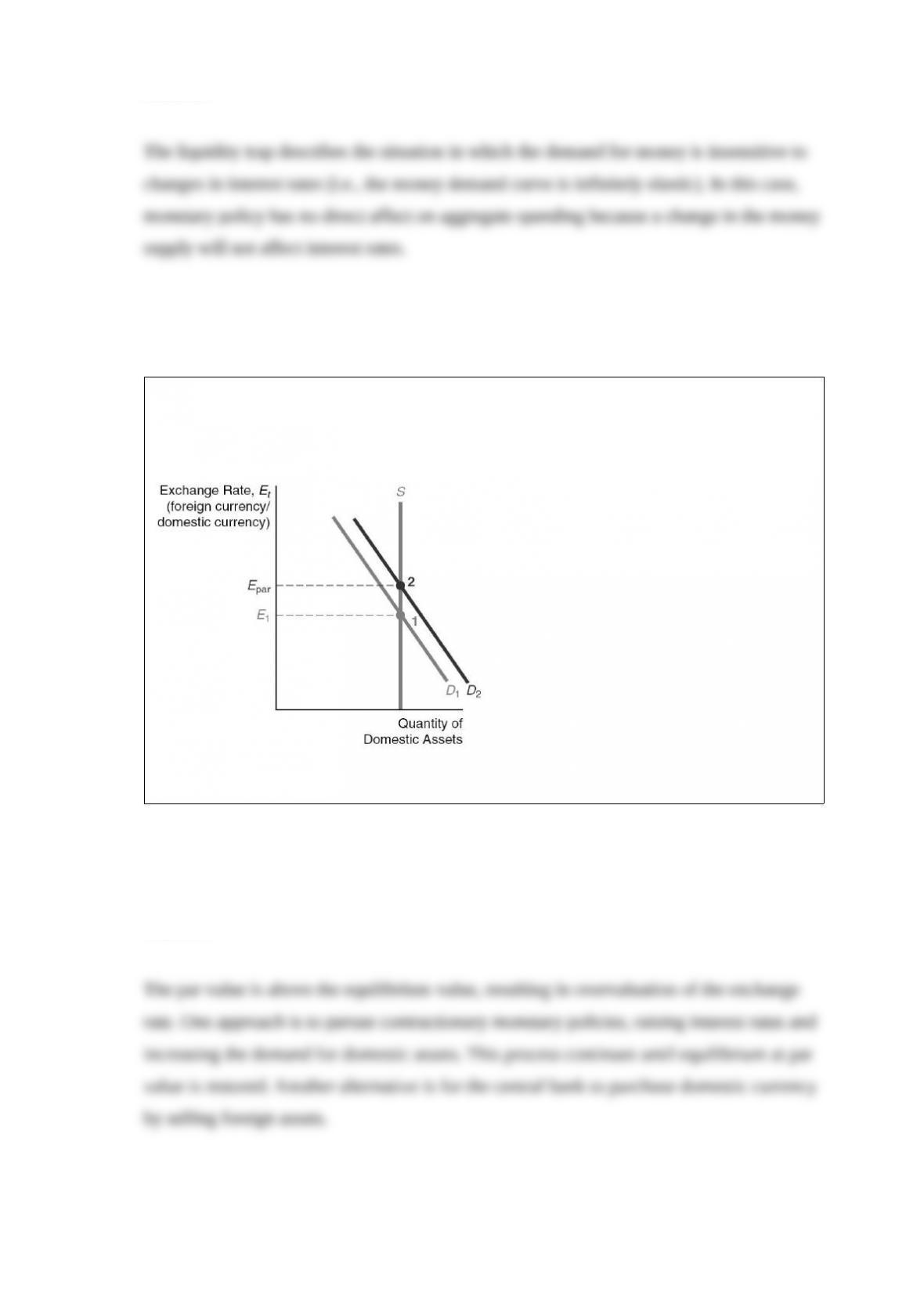
Explain and demonstrate graphically the situation of an overvalued exchange rate in a
fixed exchange rate system. What alternative policies are available to eliminate the
overvaluation of the exchange rate?
Answer:
Assume that a fixed exchange rate is overvalued. Describe the situation of a speculative
crisis against this currency. What can the central bank do to defend the currency? Why
might the alternative of devaluation be preferable?
Answer:
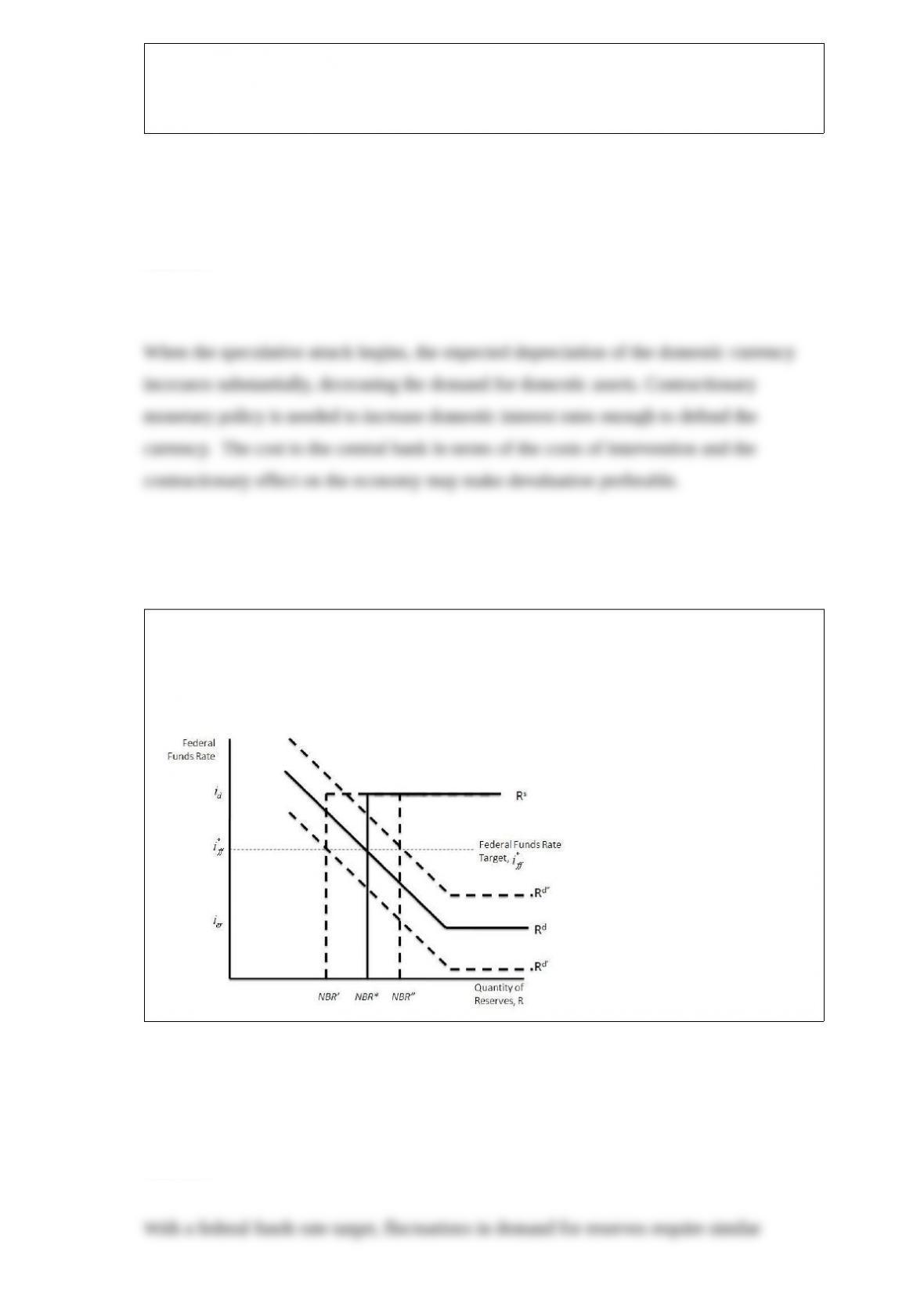
Explain and demonstrate graphically how targeting the federal funds rate can result in
fluctuations in nonborrowed reserves.
See figure below.
Answer:

Why are most of the U.S. dollars held outside of the United States?
Answer: