
If the interest rates on all bonds rise from 5 to 6 percent over the course of the year,
which bond would you prefer to have been holding?
A) A bond with one year to maturity
B) A bond with five years to maturity
C) A bond with ten years to maturity
D) A bond with twenty years to maturity
Answer:
In the money market, a condition of excess demand for money can be eliminated by a
________ in aggregate output or a ________ in the interest rate, everything else held
constant.
A) rise; rise
B) rise; fall
C) fall; rise
D) fall; fall
Answer:
If the banking system has a large amount of reserves, many banks will have excess

reserves to lend and the federal funds rate will probably ________; if the level of
reserves is low, few banks will have excess reserves to lend and the federal funds rate
will probably ________.
A) fall; fall
B) fall; rise
C) rise; fall
D) rise; rise
Answer:
The two key factors that trigger speculative attacks on emerging market currencies are
A) deterioration in bank balance sheets and severe fiscal imbalances.
B) deterioration in bank balance sheets and low interest rates abroad.
C) low interest rates abroad and severe fiscal imbalances.
D) low interest rates abroad and rising asset prices.
Answer:
In the liquidity trap, monetary policy

A) has a large impact on interest rates.
B) has a small impact on interest rates.
C) has no impact on interest rates.
D) has a proportionate impact on interest rates.
Answer:
Which of the following statements is true?
A) State and local governments cannot default on their bonds.
B) Bonds issued by state and local governments are called municipal bonds.
C) All government issued bonds local, state, and federal are federal income tax exempt.
D) The coupon payment on municipal bonds is usually higher than the coupon payment
on Treasury bonds.
Answer:
Suppose the economy is producing at the natural rate of output. An open market sale of
bonds by the Fed will cause ________ in real GDP in the short run and ________ in
inflation in the short run, everything else held constant.
A) an increase; an increase

B) a decrease; a decrease
C) no change; an increase
D) no change; a decrease
Answer:
Keynes was especially concerned with explaining the ________ level of output and
employment during the ________.
A) low; 1920s
B) low; 1930s
C) high; 1920s
D) high; 1930s
Answer:
A(n) ________ in the liquidity of corporate bonds will ________ the price of corporate
bonds and ________ the yield on corporate bonds, all else equal.
A) increase; increase; decrease
B) increase; decrease; decrease

C) decrease; increase; increase
D) decrease; decrease; decrease
Answer:
An emerging market country that successfully used exchange-rate targeting to lower its
inflation from above 100 percent in 1988 to below 10 percent in 1994 (before
devaluation) was
A) Thailand.
B) Mexico.
C) The Philippines.
D) Indonesia.
Answer:
If expectations are formed rationally, then individuals
A) will have a forecast that is 100% accurate all of the time.
B) change their forecast when faced with new information.
C) use only the information from past data on a single variable to form their forecast.

D) have forecast errors that are persistently low.
Answer:
Banks that suffered significant losses in the 1980s made the mistake of
A) holding too many liquid assets.
B) minimizing default risk.
C) failing to diversify their loan portfolio.
D) holding only safe securities.
Answer:
Banks, savings and loan associations, mutual savings banks, and credit unions
A) are no longer important players in financial intermediation.
B) since deregulation now provide services only to small depositors.
C) have been adept at innovating in response to changes in the regulatory environment.
D) produce nothing of value and are therefore a drain on society’s resources.

Answer:
Assume a closed economy with no government. Suppose that autonomous
consumption equals $400, planned investment equals $500, and the mpc equals 0.9.
Using the information contained in Situation 20-1, if autonomous consumption
increases by $100, then equilibrium aggregate output will change by
A) -$1,000.
B) -$100.
C) $100.
D) $1,000.
Answer:
The Japanese banking system went through a cycle of ________ in the 1990s similar to
the one that occurred in the U.S. in the 1980s.
A) regulatory forbearance
B) policy antagonism
C) regulatory ignorance
D) policy renewal

Answer:
Deposits in European banks denominated in dollars for the purpose of international
transactions are known as
A) Eurodollars.
B) European Currency Units.
C) European Monetary Units.
D) International Monetary Units.
Answer:
The time it takes to pass legislation to implement a particular policy is called
A) the data lag.
B) the recognition lag.
C) the legislative lag.
D) the implementation lag.
E) the effectiveness lag.
Answer:

Everything else constant, a stronger dollar will mean that
A) vacationing in England becomes more expensive.
B) vacationing in England becomes less expensive.
C) French cheese becomes more expensive.
D) Japanese cars become more expensive.
Answer:
A reduction in government spending causes the equilibrium level of aggregate output to
________ at any given interest rate and shifts the ________ curve to the ________,
everything else held constant.
A) rise; LM; right
B) fall; IS; left
C) fall; LM; left
D) rise; IS; right
Answer:

In the Keynesian model of income determination, consumer expenditure includes
spending by
A) consumers on personal computers.
B) businesses on personal computers.
C) governments on personal computers.
D) foreigners on domestic personal computers.
Answer:
The primary goal of the European Central Bank is
A) price stability.
B) exchange rate stability.
C) interest rate stability.
D) high employment.
Answer:

Under a fixed exchange rate regime, if a central bank must intervene to purchase the
domestic currency by selling foreign assets, then, like an open market sale, this action
________ the monetary base and the money supply, causing the interest rate on
domestic assets to ________.
A) increases; rise
B) increases; fall
C) reduces; rise
D) reduces; fall
Answer:
Moral hazard in equity contracts is known as the ________ problem because the
manager of the firm has fewer incentives to maximize profits than the stockholders
might ideally prefer.
A) principal-agent
B) adverse selection
C) free-rider
D) debt deflation
Answer:

An autonomous appreciation of the U.S. dollar makes American goods ________
expensive relative to foreign goods which ________ net exports in the U.S.
A) less; decreases
B) less; increases
C) more; decreases
D) more; increases
Answer:
If a central bank does not want to see its currency ________ in value, it may pursue
contractionary monetary policy to raise the domestic interest rate, thereby ________ its
currency.
A) fall; strengthening
B) fall; weakening
C) rise; strengthening
D) rise; weakening
Answer:
An autonomous decrease in money demand, other things equal, shifts the ________

curve to the ________.
A) IS; right
B) IS; left
C) LM; left
D) LM; right
Answer:
If the expected path of one-year interest rates over the next five years is 4 percent, 5
percent, 7 percent, 8 percent, and 6 percent, then the expectations theory predicts that
today’s interest rate on the five-year bond is
A) 4 percent.
B) 5 percent.
C) 6 percent.
D) 7 percent.
Answer:
The discount rate is kept ________ the federal funds rate because the Fed prefers that

A) below ; banks can monitor each other for credit risk.
B) below; the Fed can monitor banks for credit risk.
C) above ; banks can monitor each other for credit risk.
D) above; the Fed can monitor banks for credit risk.
Answer:
If the yield curve is flat for short maturities and then slopes downward for longer
maturities, the liquidity premium theory (assuming a mild preference for shorter-term
bonds) indicates that the market is predicting.
A) a rise in short-term interest rates in the near future and a decline further out in the
future.
B) constant short-term interest rates in the near future and a decline further out in the
future.
C) a decline in short-term interest rates in the near future and a rise further out in the
future.
D) a decline in short-term interest rates in the near future and an even steeper decline
further out in the future.
Answer:

Assume a closed economy with no government. Suppose that autonomous
consumption equals $400, planned investment equals $500, and the mpc equals 0.9.
The Keynesian framework indicates that government can play an important role in
determining aggregate output by
A) changing the level of government spending or taxes.
B) raising consumer confidence.
C) raising investor confidence.
D) changing the money supply and interest rates.
Answer:
The German central bank gained international reserves in the early 1970s because it
sold ________ to prevent mark ________.
A) marks; appreciation
B) dollars; appreciation
C) marks; depreciation
D) dollars; depreciation
Answer:

The higher a security’s price in the secondary market the ________ funds a firm can
raise by selling securities in the ________ market.
A) more; primary
B) more; secondary
C) less; primary
D) less; secondary
Answer:
When the exchange rate for the Mexican peso changes from 9 pesos to the U.S. dollar
to 10 pesos to the U.S. dollar, then the Mexican peso has ________ and the U.S. dollar
has ________.
A) appreciated; appreciated
B) depreciated; appreciated
C) appreciated; depreciated
D) depreciated; depreciated
Answer:
Assume a closed economy. Suppose that autonomous consumption equals $400,
planned investment equals $500, government expenditure equals $200, net taxes
equals $50, and the mpc equals 0.9.
Keynes believed that unstable investment caused the Great Depression. Using the
simple Keynesian model, explain how a fall in investment affects equilibrium output.
Answer:
Explain two ways by which the Federal Reserve System can increase the monetary
base. Why is the effect of Federal Reserve actions on bank reserves less exact than the
effect on the monetary base?
Answer:
If a higher inflation is expected, what would you expect to happen to the shape of the
yield curve? Why?

Answer:
Would it make sense to buy a house when mortgage rates are 14% and expected
inflation is 15%? Explain your answer.
Answer:
Explain the law of one price and the theory of purchasing power parity. Why doesn’t
purchasing power parity explain all exchange rate movements? What factors determine
long-run exchange rates?
Answer:

Discuss three channels by which monetary policy affects stock prices and aggregate
spending.
Answer:
Explain an additional disadvantage for a country undergoing dollarization compared to
a currency board or other exchange-rate targeting regimes.
Answer:

The Federal Reserve increases interest rates when it wants to reduce aggregate demand
to fight inflation. How do increases in the interest rate reduce aggregate demand?
Answer:
Explain the Federal Reserve’s “just do it” approach to monetary policy. What are the
advantages and disadvantages to this type of strategy?
Answer:
The monetary base increased by 20% during the contraction of 1929-1933, but the
money supply fell by 25%. Explain why this occurred. How can the money supply fall
when the base increases?
Answer:
If the federal government where to raise the income tax rates, would this have any
impact on a state’s cost of borrowing funds? Explain.
Answer:
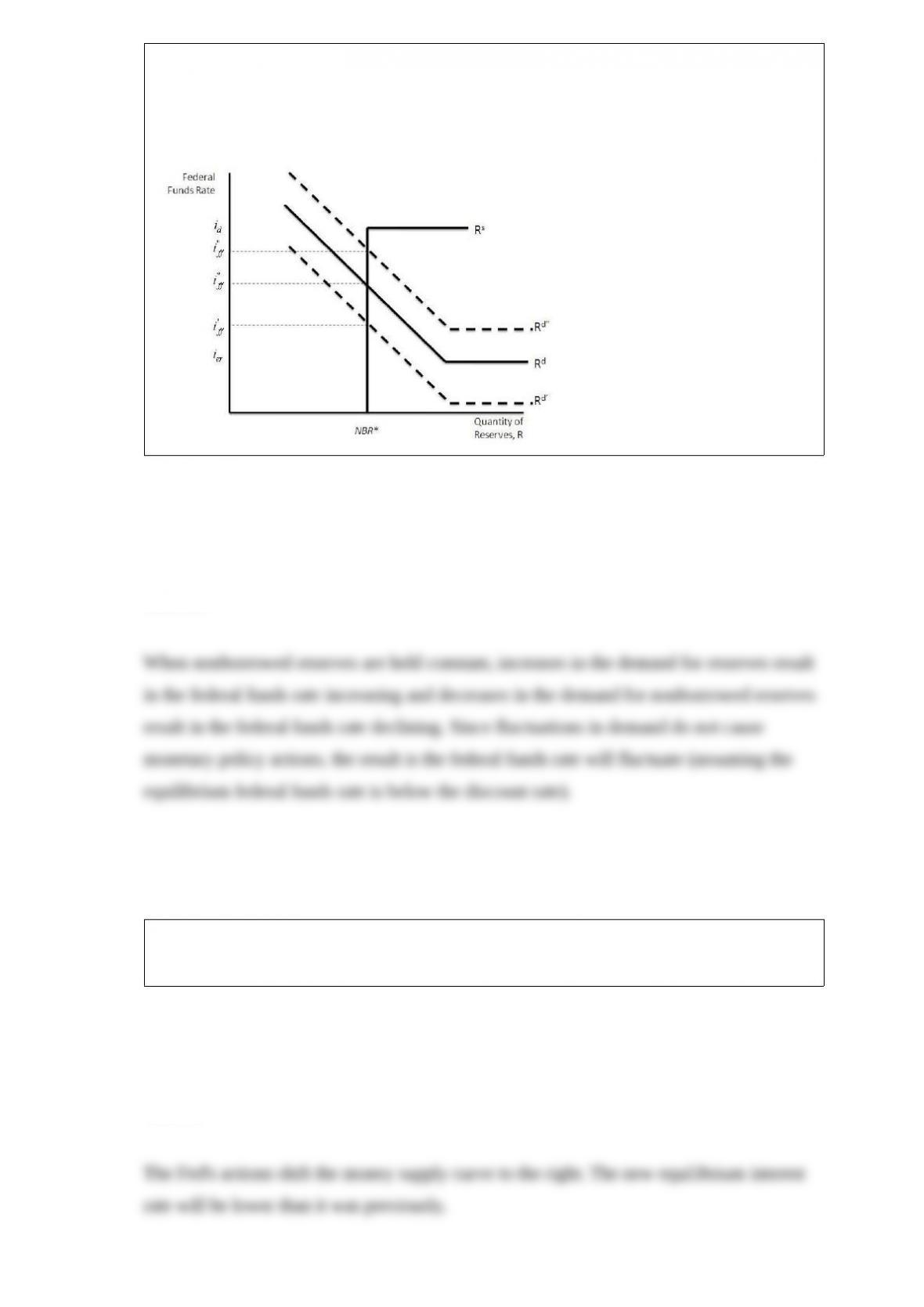
Explain and demonstrate graphically how targeting nonborrowed reserves can result in
federal funds rate instability.
See figure below.
Answer:
Using the liquidity preference framework, what will happen to interest rates if the Fed
increases the money supply?
Answer:
What happens to economic growth and unemployment during a business cycle
recession? What is the relationship between the money growth rate and a business cycle
recession?
Answer:
Assume that no banks hold excess reserves, and the public holds no currency. If a bank
sells a $100 security to the Fed, explain what happens to this bank and two additional
steps in the deposit expansion process, assuming a 10% reserve requirement. How
much do deposits and loans increase for the banking system when the process is
completed?
Answer:

How does collateral help to reduce the adverse selection problem in credit market?
Answer:
Explain why the simple deposit multiplier overstates the true deposit multiplier.
Answer:
Distinguish between a foreign bond and a Eurobond.
Answer: