
Of the four effects on interest rates from an increase in the money supply, the one that
works in the opposite direction of the other three is the
A) liquidity effect.
B) income effect.
C) price level effect.
D) expected inflation effect.
Answer:
Everything else held constant, when the government has higher budget deficits
A) the demand curve for bonds shifts to the left and the interest rate rises.
B) the demand curve for bonds shifts to the left and the interest rate falls.
C) the supply curve for bonds shifts to the right and the interest rate falls.
D) the supply curve for bonds shifts to the right and the interest rate rises.
Answer:
First National Bank
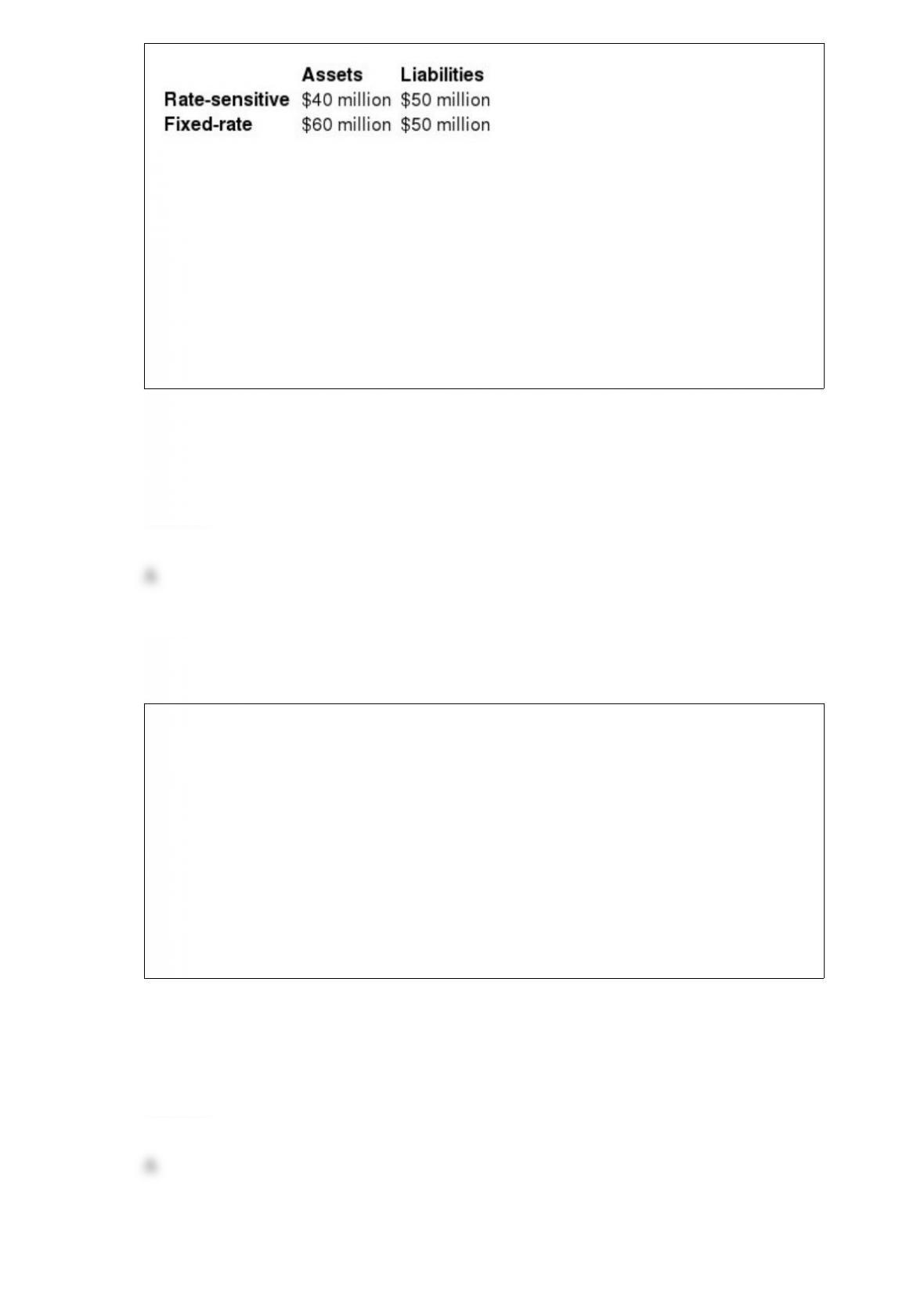
If interest rates rise by 5 percentage points, say from 10 to 15%, bank profits (measured
using gap analysis) will
A) decline by $0.5 million.
B) decline by $1.5 million.
C) decline by $2.5 million.
D) increase by $2.0 million.
Answer:
The time-inconsistency problem with monetary policy tells us that, if policymakers use
discretionary policy, there is a higher probability that the ________ will be higher,
compared to policy makers following a behavior rule.
A) inflation rate
B) unemployment rate
C) interest rate
D) foreign exchange rate
Answer:

If initially the money supply is $2 trillion, velocity is 5, the price level is 2, and real
GDP is $5 trillion, a fall in the money supply to $1 trillion
A) reduces real GDP to $2.5 trillion.
B) causes velocity to rise to 10.
C) decreases the price level to 1.
D) decreases the price level to 1 and decreases velocity to 2.5.
Answer:
Subtracting borrowed reserves from the monetary base obtains
A) reserves.
B) high-powered money.
C) the nonborrowed monetary base.
D) the borrowed monetary base.
Answer:
When the domestic currency is initially undervalued in a fixed exchange rate regime,
the central bank must intervene in the foreign exchange market to ________ the
domestic currency, thereby allowing the money supply to ________.

A) purchase; decline
B) sell; decline
C) purchase; increase
D) sell; increase
Answer:
If housing prices are expected to increase, then, other things equal, the demand for
houses will ________ and that of Treasury bills will ________.
A) increase; increase
B) increase; decrease
C) decrease; decrease
D) decrease; increase
Answer:
In deriving the aggregate demand curve a ________ inflation rate leads the central bank
to ________ real interest rates, thereby ________ the level of equilibrium aggregate
output.

A) higher; raise; lowering
B) lower; raise; lowering
C) higher; lower; lowering
D) higher; lower; raising
Answer:
When the price level falls, the ________ curve for nominal money ________, and
interest rates ________, everything else held constant.
A) demand; decreases; fall
B) demand; increases; rise
C) supply; increases; rise
D) supply; decreases; fall
Answer:
Suppose your payroll check is directly deposited to your checking account. Everything
else held constant, total reserves in the banking system ________ and the monetary
base ________.
A) remain unchanged; remains unchanged

B) remain unchanged; increases
C) decrease; increases
D) decrease; decreases
Answer:
Which of the following instruments is not traded in a money market?
A) Residential mortgages
B) U.S. Treasury Bills
C) Negotiable bank certificates of deposit
D) Commercial paper
Answer:
Provisions in loan contracts that prohibit borrowers from engaging in specified risky
activities are called
A) proscription bonds.
B) restrictive covenants.

C) due-on-sale clauses.
D) liens.
Answer:
Under the Bretton Woods system, when a country adopted an expansionary monetary
policy, thereby causing a balance of payments ________, the country would eventually
be forced to implement ________ monetary policy.
A) deficit; expansionary
B) deficit; contractionary
C) surplus; expansionary
D) surplus; contractionary
Answer:
The largest percentage of banks’ holdings of securities consist of
A) Treasury and government agency securities.
B) tax-exempt municipal securities.
C) state and local government securities.

D) corporate securities.
Answer:
“Bureaucratic gambling” refers to
A) the strategy of thrift managers that they would not be audited by thrift regulators in
the 1980s due to the relatively weak bureaucratic power of thrift regulators.
B) the risk that thrift regulators took in publicizing the plight of the S&L industry in the
early 1980s.
C) the strategy adopted by thrift regulators of lowering capital requirements and
pursuing regulatory forbearance in the 1980s in the hope that conditions in the S&L
industry would improve.
D) the risk that regulators took in going to Congress to ask for additional funds.
Answer:
A common element in all of the banking crisis episodes in different countries is
A) the existence of a government safety net.
B) deposit insurance.
C) increased regulation.

D) lack of competition.
Answer:
Reasons regulators chose to follow regulatory forbearance rather than to close the
insolvent S&Ls include all of the following except
A) they had insufficient funds to close all of the insolvent S&Ls.
B) they were friends with the S&L owners.
C) they hoped the problem would go away.
D) they did not have the authority to close the insolvent S&Ls.
Answer:
Everything else held constant, an increase in the required reserve ratio on checkable
deposits causes the M1 money multiplier to ________ and the money supply to
________.
A) decrease; increase
B) increase; increase
C) decrease; decrease
D) increase; decrease

Answer:
The Lucas critique indicates that
A) advocates of discretionary policies’ criticisms of rational expectations models are
well-founded.
B) advocates of discretionary policies’ criticisms of rational expectations models are not
well-founded.
C) expectations are important in determining the outcome of a discretionary policy.
D) expectations are not important in determining the outcome of a discretionary policy.
Answer:
Everything else held constant, abolishing all taxes will
A) increase the interest rate on corporate bonds.
B) reduce the interest rate on municipal bonds.
C) increase the interest rate on municipal bonds.
D) increase the interest rate on Treasury bonds.

Answer:
When tax revenues are greater than government expenditures, the government has a
budget.
A) crisis.
B) deficit.
C) surplus.
D) revision.
Answer:
When $1 million is deposited at a bank, the required reserve ratio is 20 percent, and the
bank chooses not to hold any excess reserves but makes loans instead, then, in the
bank’s final balance sheet,
A) the assets at the bank increase by $800,000.
B) the liabilities of the bank increase by $1,000,000.
C) the liabilities of the bank increase by $800,000.
D) reserves increase by $160,000.
Answer:

Federal deposit insurance covers deposits up to $250,000, but as part of a doctrine
called “too-big-to-fail” the FDIC sometimes ends up covering all deposits to avoid
disrupting the financial system. When the FDIC does this, it uses the
A) “payoff” method.
B) “purchase and assumption” method.
C) “inequity” method.
D) “Basel” method.
Answer:
Since the abandonment of the Bretton Woods system, balance of payments
considerations have become ________ important, and exchange rate considerations
________ important in the conduct of monetary policy.
A) more; less
B) more; more
C) less; less
D) less; more
Answer:
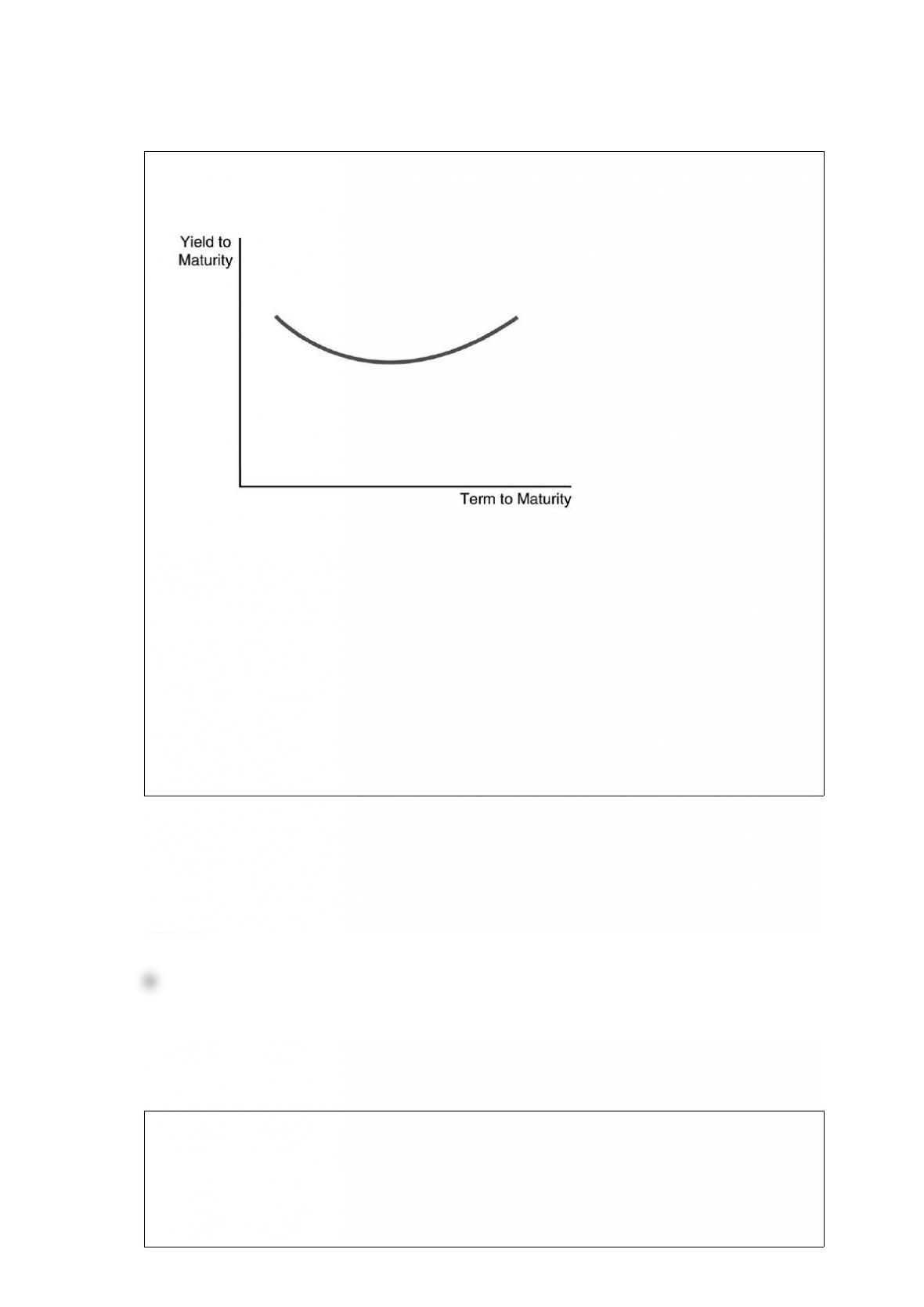
The U-shaped yield curve in the figure above indicates that short-term interest rates are
expected to
A) rise in the near-term and fall later on.
B) fall sharply in the near-term and rise later on.
C) fall moderately in the near-term and rise later on.
D) remain unchanged in the near-term and rise later on.
Answer:
________ work in the secondary markets matching buyers with sellers of securities.
A) Dealers
B) Underwriters

C) Brokers
D) Claimants
Answer:
The decline in stock prices from 2000 through 2002
A) increased individuals’ willingness to spend.
B) had no effect on individual spending.
C) reduced individuals’ willingness to spend.
D) increased individual wealth.
Answer:
Which of the following is an entity of the Federal Reserve System?
A) The U.S. Treasury Secretary
B) The FOMC
C) The Comptroller of the Currency
D) The FDIC

Answer:
For the classical economists, the quantity theory of money provided an explanation of
movements in the price level. Changes in the price level result
A) from proportional changes in the quantity of money.
B) primarily from changes in the quantity of money.
C) only partially from changes in the quantity of money.
D) from changes in factors other than the quantity of money.
Answer: