State whether the following statement is true or false AND explain why: “A decrease in
the discount rate will always cause a decrease in the federal reserve funds rate.”
Answer:
State whether the following statement is true or false AND explain why: “An increase
in the interest rate paid on excess reserves will always cause an increase in the federal
reserve funds rate.”
Answer:
Using Taylor’s rule, when the equilibrium real federal funds rate is 3 percent, the
positive output gap is 2 percent, the target inflation rate is 1 percent, and the actual
inflation rate is 2 percent, the nominal federal funds rate target should be
A) 5 percent.

B) 5 percent.
C) 6 percent.
D) 5 percent.
Answer:
Evidence from the United States during the period 1973-2002 indicates that the value of
the dollar and the measure of the ________ interest rate rose and fell together.
A) real
B) nominal
C) expected
D) actual
Answer:
Suppose that from a new checkable deposit, First National Bank holds eight million
dollars on deposit with the Federal Reserve, one million dollars in required reserves,
and faces a required reserve ratio of ten percent. Given this information, we can say
First National Bank has ________ million dollars in vault cash.
A) two

B) eight
C) nine
D) ten
Answer:
The interest rate on secondary credit is set ________ basis points ________ the primary
credit rate.
A) 100; above
B) 100; below
C) 50; above
D) 50; below
Answer:
Open market sales shrink ________ thereby lowering ________.
A) the money multiplier; the money supply
B) the money multiplier; reserves and the monetary base

C) reserves and the monetary base; the money supply
D) the money base; the money multiplier
Answer:
A reason why rogue traders have bankrupt their banks is due to
A) the separation of trading activities from the bookkeepers.
B) stringent supervision of trading activities by bank management.
C) accounting errors.
D) a failure to maintain proper internal controls.
Answer:
The Fed’s lender-of-last-resort function
A) has proven to be ineffective.
B) cannot prevent runs by large depositors.
C) is no longer necessary due to FDIC insurance.
D) creates a moral hazard problem.

Answer:
Which of the following items are not counted in U.S. GDP?
A) your purchase of a new Ford Mustang
B) your purchase of new tires for your old car
C) GM’s purchase of tires for new cars
D) a foreign consumer’s purchase of a new Ford Mustang
Answer:
The nonactivists who opposed the recent fiscal stimulus package argue that
A) fiscal stimulus would take too long to work because of long implementation lags.
B) fiscal stimulus might kick in after the economy had already recovered.
C) fiscal stimulus could lead to increased volatility in inflation and economic activity.
D) all of the above.
E) none of the above.
Answer:
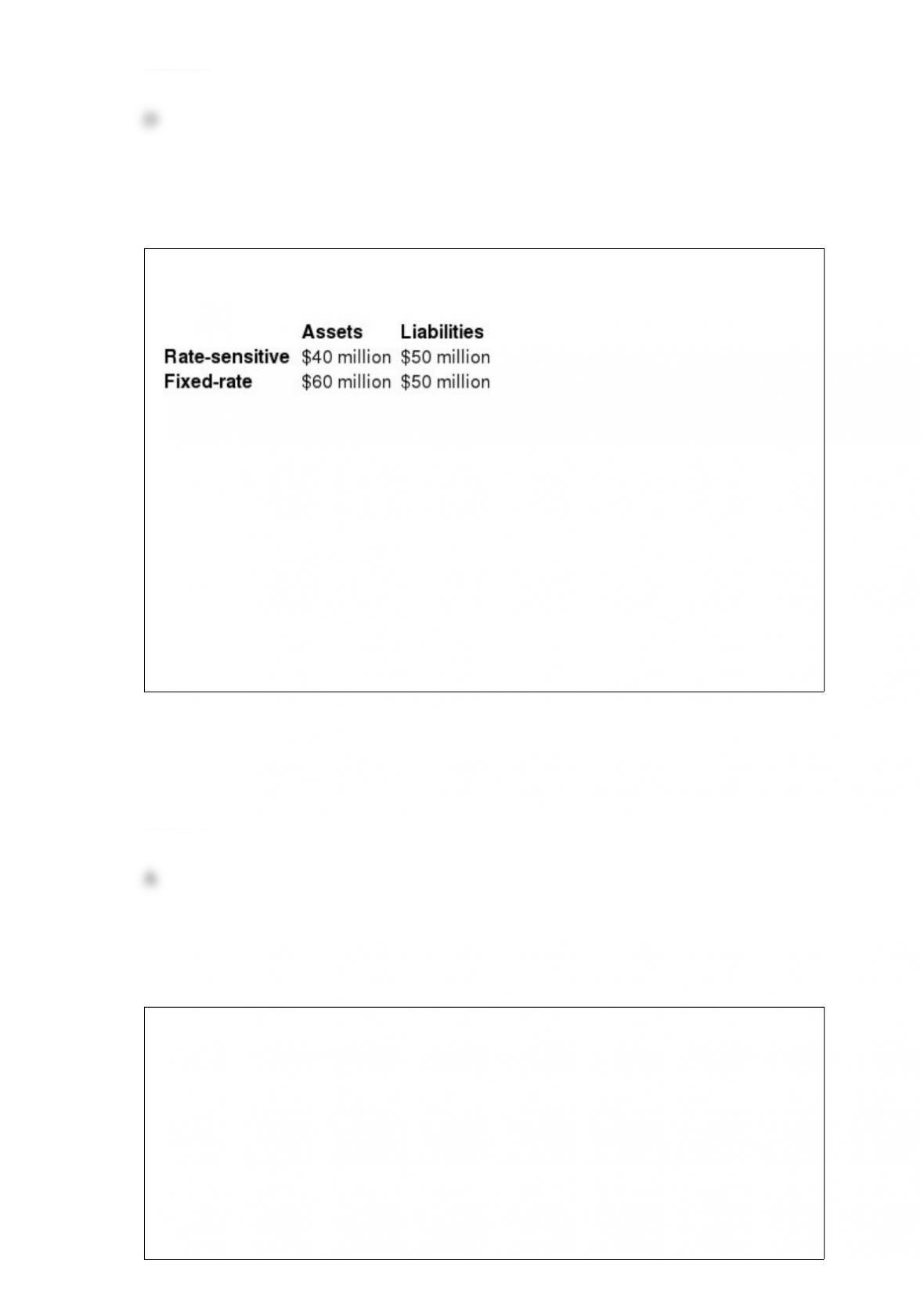
First National Bank
Assuming that the average duration of its assets is four years, while the average
duration of its liabilities is three years, then a 5 percentage point increase in interest
rates will cause the net worth of First National to ________ by ________ of the total
original asset value.
A) decline; 5 percent
B) decline; 10 percent
C) decline; 15 percent
D) increase; 20 percent
Answer:
An example of the problem of ________ is when a corporation uses the funds raised
from selling bonds to fund corporate expansion to pay for Caribbean cruises for all of
its employees and their families.
A) adverse selection
B) moral hazard
C) risk sharing

D) credit risk
Answer:
If expectations are formed adaptively, then people
A) use more information than just past data on a single variable to form their
expectations of that variable.
B) often change their expectations quickly when faced with new information.
C) use only the information from past data on a single variable to form their
expectations of that variable.
D) never change their expectations once they have been made.
Answer:
What is the return on a 5 percent coupon bond that initially sells for $1,000 and sells for
$1,200 next year?
A) 5 percent
B) 10 percent
C) -5 percent
D) 25 percent

Answer:
If a bank has excess reserves of $4,000 and demand deposit liabilities of $100,000, and
if the reserve requirement is 10 percent, then the bank has actual reserves of
A) $14,000.
B) $19,000.
C) $24,000.
D) $29,000.
Answer:
The formula that links checkable deposits to the money supply is
A) M = .
B) M = × D.
C) D = × M.
D) D = (1 + c) × M.

Answer:
In the simple deposit expansion model, an expansion in checkable deposits of $1,000
when the required reserve ratio is equal to 20 percent implies that the Fed
A) sold $200 in government bonds.
B) sold $500 in government bonds.
C) purchased $200 in government bonds.
D) purchased $500 in government bonds.
Answer:
An advantage to American banks from operating foreign branches is that Eurodollar
deposits in offshore branches are
A) not subject to reserve requirements.
B) insured by the FDIC.
C) subject to extensive regulatory supervision.
D) all demand deposits that pay no interest.
Answer:

Prices and returns for ________ bonds are more volatile than those for ________
bonds, everything else held constant.
A) long-term; long-term
B) long-term; short-term
C) short-term; long-term
D) short-term; short-term
Answer:
Recent research indicates that inflation performance (low inflation) has been found to
be best in countries with
A) the most independent central banks.
B) political control of monetary policy.
C) money financing of budget deficits.
D) a policy of always keeping interest rates low.
Answer:

If unplanned investment is positive, firms will ________ production and output will
________.
A) cut; rise
B) cut; fall
C) increase; rise
D) increase; fall
Answer:
Everything else held constant, an autonomous tightening of monetary policy will cause
A) the quantity of aggregate demand to increase.
B) the quantity of aggregate demand to decrease.
C) aggregate demand to increase.
D) aggregate demand to decrease.
Answer:

The regulatory system that has evolved in the United States whereby banks are
regulated at the state level, the national level, or both, is known as a
A) bilateral regulatory system.
B) tiered regulatory system.
C) two-tiered regulatory system.
D) dual banking system.
Answer:
Everything else held constant, increased demand for a country’s exports causes its
currency to ________ in the long run, while increased demand for imports causes its
currency to ________.
A) appreciate; appreciate
B) appreciate; depreciate
C) depreciate; appreciate
D) depreciate; depreciate
Answer:
The effectiveness lag is

A) the time it takes for policy makers to obtain data indicating what is happening in the
economy.
B) the time it takes for policy makers to be sure of what the data are signaling about the
future course of the economy.
C) the time it takes to pass legislation to implement a particular policy.
D) the time it takes for policy makers to change policy instruments once they have
decided on the new policy.
E) the time it takes for the policy actually to have an impact on the economy.
Answer:
The riskiness of an asset that is unique to the particular asset is
A) systematic risk.
B) portfolio risk.
C) investment risk.
D) nonsystematic risk.
Answer:

According to Keynes’s theory of liquidity preference, velocity increases when
A) income increases.
B) wealth increases.
C) brokerage commissions increase.
D) interest rates increase.
Answer:
Everything else held constant, a decrease in net taxes will cause the IS curve to shift to
the ________ and aggregate demand will ________.
A) right; increase
B) right; decrease
C) left; increase
D) left; decrease
Answer:
Evidence from the United States and other foreign countries indicates that
A) there is a strong positive association between inflation and growth rate of money

over long periods of time.
B) there is little support for the assertion that “inflation is always and everywhere a
monetary phenomenon.”
C) countries with low monetary growth rates tend to experience higher rates of
inflation, all else being constant.
D) money growth is clearly unrelated to inflation.
Answer:
The exchange rate is
A) the price of one currency relative to gold.
B) the value of a currency relative to inflation.
C) the change in the value of money over time.
D) the price of one currency relative to another.
Answer:
Everything else held constant, in the market for reserves, when the demand for federal
funds intersects the reserve supply curve along the horizontal section, increasing the
discount rate

A) increases the federal funds rate.
B) lowers the federal funds rate.
C) has no effect on the federal funds rate.
D) has an indeterminate effect on the federal funds rate.
Answer:
The classical economists believed that if the quantity of money doubled,
A) output would double.
B) prices would fall.
C) prices would double.
D) prices would remain constant.
Answer:
The spread between the interest rates on Baa corporate bonds and U.S. government
bonds is very large during the Great Depression years 1930-1933. Explain this
difference using the bond supply and demand analysis.
Answer:
Explain the complete formula for the M1 money supply, and explain how changes in
required reserves, excess reserves, the currency ratio, the nonborrowed base, and
borrowed reserves affect the money supply.
Answer:
What crucial role do financial intermediaries perform in an economy?
Answer:
Using the liquidity preference framework, show what happens to interest rates during a
business cycle recession.
Answer:
Describe the two methods of organizing a secondary market.
Answer:
Using T-accounts show what happens to reserves at Security National Bank if one
individual deposits $1000 in cash into her checking account and another individual
withdraws $750 in cash from her checking account.
Answer:
From 1980-1985, the dollar strengthened in value against other currencies. Who was
helped and who was hurt by this strong dollar?
Answer:
Using the ISLM model, explain the effects of a monetary expansion combined with a
fiscal contraction. How do the equilibrium level of output and interest rate change?
Answer:

How does a mutual fund lower transactions costs through economies of scale?
Answer:
Why did the interest rate volatility of the 1970s spur financial innovation?
Answer:
Why does the free-rider problem occur in the debt market?
Answer:
Discuss three ways in which U.S. banks can become involved in international banking.
Answer:
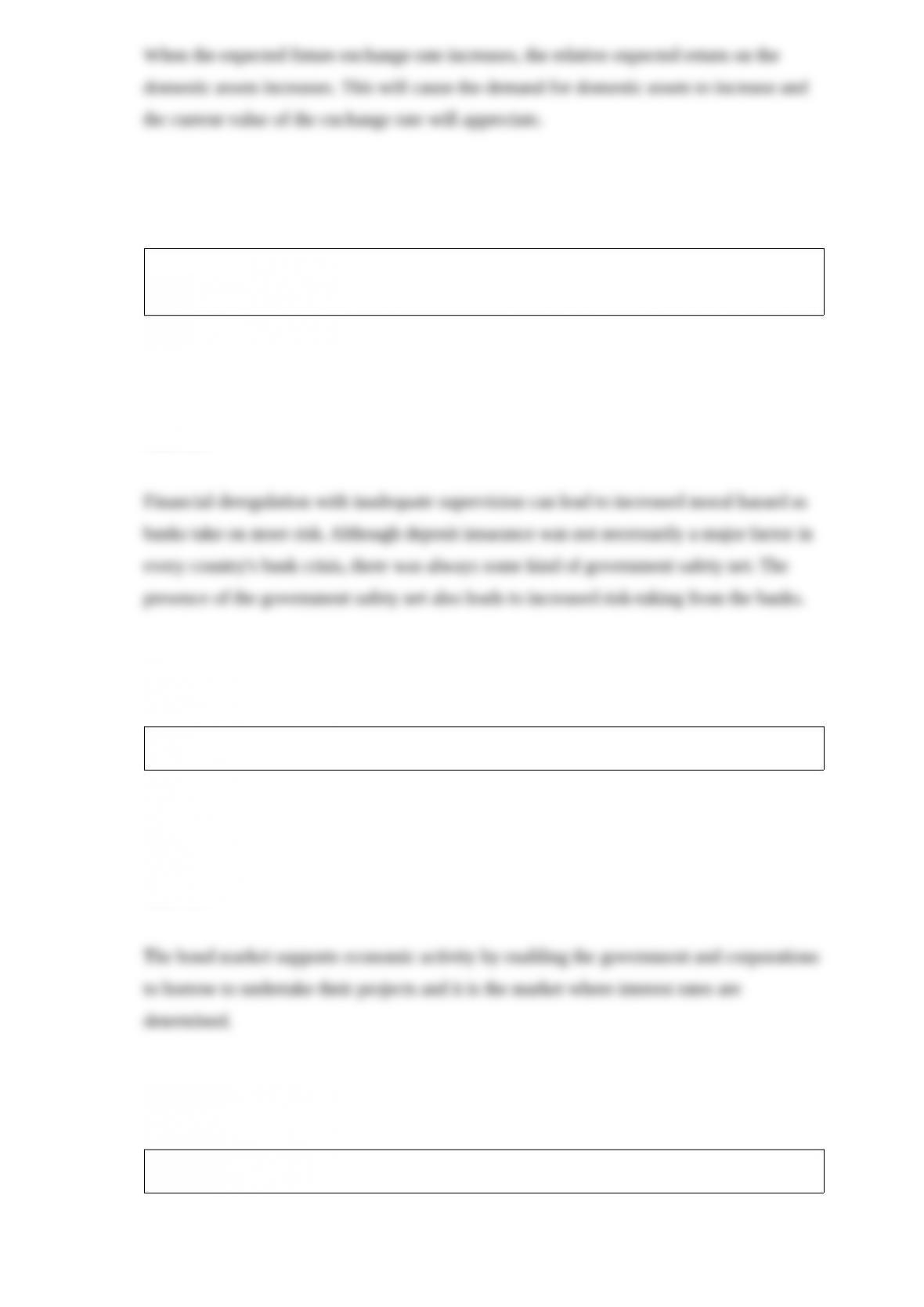
Explain and show graphically the effect of an increase in the expected future exchange
rate on the equilibrium exchange rate, everything else held constant.
See figure below.
Answer:
Banking crises have occurred throughout the world. What similarities do we find when
we look at the different countries?
Answer:
Why is it important to understand the bond market?
Answer:
What rights does ownership interest give stockholders?
Answer:
If a corporation announces that it expects quarterly earnings to increase by 25% and it
actually sees an increase of 22%, what should happen to the price of the corporation’s
stock if the efficient markets hypothesis holds, everything else held constant?
Answer:
Explain how expansionary and contractionary monetary policies affect aggregate
demand through the exchange rate channel.
Answer:

Your best friend calls and gives you the latest stock market “hot tip” that he heard at the
health club. Should you act on this information? Why or why not?
Answer: