
An analysis of the political economy of the savings and loan crisis helps one to
understand
A) why politicians aided the efforts of thrift regulators, raising regulatory
appropriations and encouraging closing of insolvent thrifts.
B) why thrift regulators were so quick to inform Congress of the problems that existed
in the thrift industry.
C) why thrift regulators willingly acceded to pressures placed upon them by members
of Congress.
D) why politicians listened so closely to the taxpayers they represented.
Answer:
Everything else held constant, if a central bank makes an unsterilized ________ of
foreign assets, then the domestic money supply will increase and the domestic currency
will ________.
A) purchase; appreciate
B) purchase; depreciate
C) sale; appreciate
D) sale; depreciate
Answer:

Bank holding companies that rival money center banks in size, but are not located in
money center cities are
A) superregional banks.
B) bank clearing houses.
C) international banks.
D) local banks.
Answer:
Despite an expansionary monetary policy, an economy experiences a recession.
Everything else held constant, the recession could occur in spite of the rightward shift
of the LM curve if
A) consumer confidence decreases sharply.
B) there is an investment boom.
C) the money supply increases.
D) taxes are cut.
Answer:
The problem faced by the lender that the borrower may take on additional risk after

receiving the loan is called
A) adverse selection.
B) moral hazard.
C) transactions costs.
D) diversification.
Answer:
A(n) ________ in the riskiness of corporate bonds will ________ the price of corporate
bonds and ________ the yield on corporate bonds, all else equal.
A) increase; increase; increase
B) increase; decrease; increase
C) decrease; increase; increase
D) decrease; decrease;decrease
Answer:
Everything else held constant, if the expected return on ABC stock rises from 5 to 10
percent and the expected return on CBS stock is unchanged, then the expected return of
holding CBS stock ________ relative to ABC stock and the demand for CBS stock

________.
A) rises; rises
B) rises; falls
C) falls; rises
D) falls; falls
Answer:
Crowding out will be more pronounced the closer to vertical is the
A) IS curve.
B) LM curve.
C) consumption function.
D) aggregate demand function.
Answer:
Everything else held constant, an autonomous monetary policy easing ________
aggregate ________.
A) increases; demand

B) decreases; demand
C) decreases; supply
D) increases; supply
Answer:
If reserves in the banking system increase by $100, then checkable deposits will
increase by $2,000 in the simple model of deposit creation when the required reserve
ratio is
A) 0.01
B) 0.05
C) 0.1
D) 0.2
Answer:
The long-run aggregate supply curve shifts to the right when there is
A) a decrease in the total amount of capital in the economy.
B) a decrease in the total amount of labor supplied in the economy.

C) a decrease in the available technology.
D) a decline in the natural rate of unemployment.
Answer:
The problem created by asymmetric information before the transaction occurs is called
________, while the problem created after the transaction occurs is called ________.
A) adverse selection; moral hazard
B) moral hazard; adverse selection
C) costly state verification; free-riding
D) free-riding; costly state verification
Answer:
Probably the most significant factor explaining the drastic drop in the number of bank
failures since the Great Depression has been
A) the creation of the FDIC.
B) rapid economic growth since 1941.
C) the employment of new procedures by the Federal Reserve.

D) better bank management.
Answer:
If the government finances its spending by issuing debt to the public, the monetary base
will ________ and the money supply will ________.
A) increase; increase
B) increase; decrease
C) decrease; increase
D) not change; not change
Answer:
The driving force behind the securitization of mortgages and automobile loans has been
A) the rising regulatory constraints on substitute financial instruments.
B) the desire of mortgage and auto lenders to exit this field of lending.
C) the improvement in computer technology.
D) the relaxation of regulatory restrictions on credit card operations.
Answer:
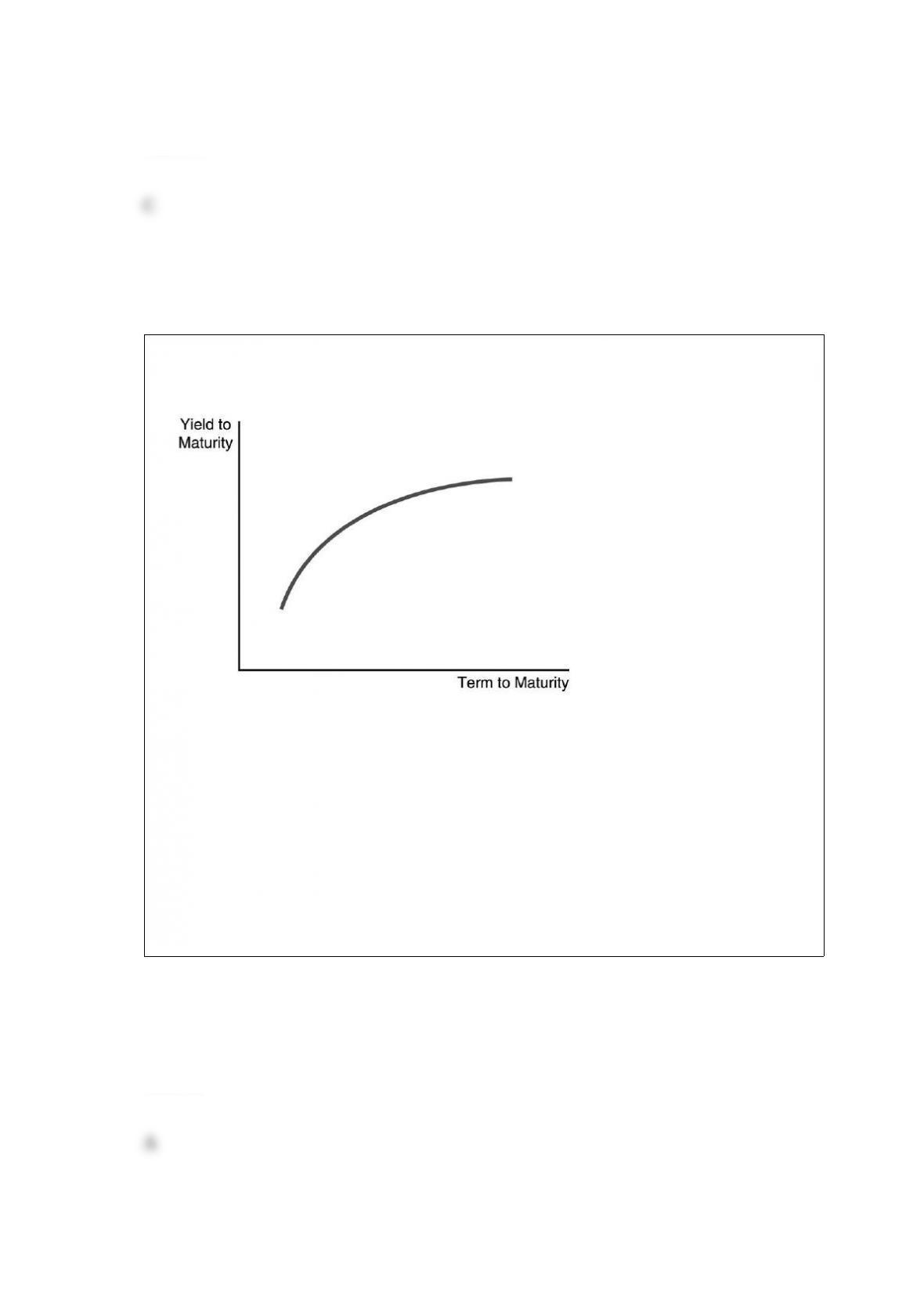
The steeply upward sloping yield curve in the figure above indicates that
A) short-term interest rates are expected to rise in the future.
B) short-term interest rates are expected to fall moderately in the future.
C) short-term interest rates are expected to fall sharply in the future.
D) short-term interest rates are expected to remain unchanged in the future.
Answer:

If the United States has a current account deficit with England of $1 million, and the
Bank of England sells $1 million worth of pounds in the foreign exchange market, then
England ________ $1 million of international reserves and its monetary base ________
by $1 million.
A) gains; rises
B) gains; falls
C) loses; rises
D) loses; falls
Answer:
When the price of a bond decreases, all else equal, the bond demand curve
A) shifts right.
B) shifts left.
C) does not shift.
D) inverts.
Answer:
According to aggregate demand and supply analysis, the negative demand shock of

2000-2004 had the effect of
A) increasing aggregate output, lowering unemployment, and raising inflation.
B) decreasing aggregate output, raising unemployment, and raising inflation.
C) increasing aggregate output, lowering unemployment, and lowering inflation.
D) decreasing aggregate output, raising unemployment, and lowering inflation.
Answer:
________ are the time and resources spent trying to exchange goods and services.
A) Bargaining costs.
B) Transaction costs.
C) Contracting costs.
D) Barter costs.
Answer:
The evolution of the payments system from barter to precious metals, then to fiat
money, then to checks can best be understood as a consequence of
A) government regulations designed to improve the efficiency of the payments system.

B) government regulations designed to promote the safety of the payments system.
C) innovations that reduced the costs of exchanging goods and services.
D) competition among firms to make it easier for customers to purchase their products.
Answer:
If the FDIC decides that a bank is too big to fail, it will use the ________ method,
effectively ensuring that ________ depositors will suffer losses.
A) payoff; large
B) payoff; no
C) purchase and assumption; large
D) purchase and assumption; no
Answer:
If nominal GDP in 2001 is $9 trillion, and 2001 real GDP in 1996 prices is $6 trillion,
the GDP deflator price index is
A) 7
B) 100

C) 150
D) 200
Answer:
The percentage of deposits that banks must hold in reserve is the
A) excess reserve ratio.
B) required reserve ratio.
C) total reserve ratio.
D) currency ratio.
Answer:
Because inflation in Germany after World War I sometimes exceeded 1,000 % per
month, one can conclude that the German economy suffered from
A) deflation.
B) disinflation.
C) hyperinflation.

D) superdeflation.
Answer:
Holding the expected return on bonds constant, an increase in the expected return on
common stocks would ________ the demand for bonds, shifting the demand curve to
the ________.
A) decrease; left
B) decrease; right
C) increase; left
D) increase; right
Answer:
During a “flight to quality”
A) the spread between Treasury bonds and Baa bonds increases.
B) the spread between Treasury bonds and Baa bonds decreases.
C) the spread between Treasury bonds and Baa bonds is not affected.
D) the change in the spread between Treasury bonds and Baa bonds cannot be
predicted.

Answer:
A credit boom can lead to a(n) ________ such as we saw in the tech stock market in the
late 1990s.
A) asset-price bubble
B) liability war
C) decline in lending
D) decrease in moral hazard
Answer:
Financial instruments whose payoffs are linked to previously issued securities are called
A) grandfathered bonds.
B) financial derivatives.
C) hedge securities.
D) reversible bonds.
Answer:

If expectations of the future inflation rate are formed solely on the basis of a weighted
average of past inflation rates, then economics would say that expectation formation is
A) irrational.
B) rational.
C) adaptive.
D) reasonable.
Answer:
The monetary liabilities of the Federal Reserve include
A) securities and loans to financial institutions.
B) currency in circulation and reserves.
C) securities and reserves.
D) currency in circulation and loans to financial institutions.
Answer:

If a bank’s liabilities are more sensitive to interest rate movements than are its assets,
then
A) an increase in interest rates will reduce bank profits.
B) a decrease in interest rates will reduce bank profits.
C) interest rates changes will not impact bank profits.
D) an increase in interest rates will increase bank profits.
Answer:
If the inflation rate in the United States is higher than that in Mexico and productivity is
growing at a slower rate in the United States than in Mexico, then, in the long run,
________, everything else held constant.
A) the Mexican peso will appreciate relative to the U.S. dollar
B) the Mexican peso will depreciate relative to the U.S. dollar
C) the Mexican peso will either appreciate, depreciate, or remain constant relative to the
U.S. dollar
D) there will be no effect on the Mexican peso relative to the U.S. dollar
Answer:

The seignorage for a government is greater for ________ than for ________.
A) dollarization; a currency board
B) dollarization; exchange-rate targeting
C) dollarization; monetary targeting
D) dollarization; inflation targeting
E) exchange-rate targeting; dollarization
Answer: