
When the growth rate of the money supply is increased, interest rates will fall
immediately if the liquidity effect is ________ than the other money supply effects and
there is ________ adjustment of expected inflation.
A) larger; fast
B) larger; slow
C) smaller; slow
D) smaller; fast
Answer:
One of the problems experienced by the savings and loan industry during the 1980s was
A) managers lack of expertise to manage risk in new lines of business.
B) heavy regulations in the new areas open to S&Ls.
C) slow growth in lending.
D) close monitoring by the FSLIC.
Answer:
According to Tobin’s q theory, if q is ________, new plant and equipment capital is
________ relative to the market value of business firms, so companies can buy a lot of

new investment goods with only a ________ issue of stock.
A) high; dear; large
B) high; cheap; large
C) high; cheap; small
D) low; cheap; large
E) low; cheap; small
Answer:
The legislation that separated investment banking from commercial banking until its
repeal in 1999 is known as the
A) National Bank Act of 1863.
B) Federal Reserve Act of 1913.
C) Glass-Steagall Act.
D) McFadden Act.
Answer:
A clause in a mortgage loan contract requiring the borrower to purchase homeowner’s

insurance is an example of a
A) proscriptive covenant.
B) prescriptive covenant.
C) restrictive covenant.
D) constraint-imposed covenant.
Answer:
The Federal Reserve ________ pay interest on reserves held on deposit. The European
System of Central Banks ________ pay interest on reserves held on deposit.
A) does; does
B) does; does not
C) does not; does
D) does not; does not
Answer:
Assume a closed economy with no government. Suppose that autonomous
consumption equals $400, planned investment equals $500, and the mpc equals 0.9.

A tax cut initially
A) increases consumption expenditure by an amount greater than the tax cut.
B) increases consumption expenditure by an amount equal to the tax cut.
C) increases consumption expenditure by an amount that is less than the value of the tax
cut.
D) has no effect on consumption expenditure.
E) reduces consumption expenditure by an amount that is less than the value of the tax
cut.
Answer:
If the price of gold becomes less volatile, then, other things equal, the demand for
stocks will ________ and the demand for antiques will ________.
A) increase; increase
B) increase; decrease
C) decrease; decrease
D) decrease; increase
Answer:

Using Taylor’s rule, when the equilibrium real federal funds rate is 2 percent, there is no
output gap, the actual inflation rate is zero, and the target inflation rate is 2 percent, the
nominal federal funds rate should be
A) 0 percent.
B) 1 percent.
C) 2 percent.
D) 3 percent.
Answer:
Firms that are designated as systemically important financial institutions (SIFIs) are
subject to all of the following additional Federal Reserve regulations except
A) higher capital standards.
B) stricter liquidity requirements.
C) providing a plan for orderly liquidation if necessary.
D) interest rate ceilings on time deposits.
Answer:
Everything else held constant, when the current value of the domestic exchange rate

increases, the ________ of domestic assets ________.
A) quantity supplied; does not change
B) supply; decreases
C) quantity supplied; increases
D) supply; increases
Answer:
If reserves in the banking system increase by $100, then checkable deposits will
increase by $100 in the simple model of deposit creation when the required reserve
ratio is
A) 0.01
B) 0.1
C) 0.2
D) 1
Answer:
Which of the following statements are true?

A) A bank’s assets are its sources of funds.
B) A bank’s liabilities are its uses of funds.
C) A bank’s balance sheet shows that total assets equal total liabilities plus equity
capital.
D) A bank’s balance sheet indicates whether or not the bank is profitable.
Answer:
Exchange rates are determined in
A) the money market.
B) the foreign exchange market.
C) the stock market.
D) the capital market.
Answer:
Of the following, the one that appears in the current account of the balance of payments
is
A) an Italian investor’s purchase of IBM stock.

B) income earned by U.S. subsidiaries of Barclay’s Bank of London.
C) a loan by a Swiss bank to an American corporation.
D) a purchase of a British Treasury bond by the Fed.
Answer:
Evidence against market efficiency includes
A) failure of technical analysis to outperform the market.
B) the random walk behavior of stock prices.
C) the inability of mutual fund managers to consistently beat the market.
D) the January effect.
Answer:
The yield to maturity for a perpetuity is a useful approximation for the yield to maturity
on long-term coupon bonds. It is called the ________ when approximating the yield for
a coupon bond.
A) current yield
B) discount yield

C) future yield
D) star yield
Answer:
A country that dollarizes
A) maximizes its seignorage.
B) earns the same amount of seignorage as it would with a currency board.
C) earns the same amount of seignorage as it would with exchange-rate targeting.
D) eliminates its seignorage.
E) must pay seignorage to other governments to use their currency.
Answer:
The riskiness of an asset is measured by
A) the magnitude of its return.
B) the absolute value of any change in the asset’s price.
C) the standard deviation of its return.

D) risk is impossible to measure.
Answer:
Everything else held constant, if disposable income increases by 200 and consumption
expenditure increases by 150, the mpc is
A) 0
B) 0.15
C) 0.5
D) 0.75
Answer:
If reserves in the banking system increase by $100, then checkable deposits will
increase by $400 in the simple model of deposit creation when the required reserve
ratio is
A) 0.01
B) 0.10
C) 0.2
D) 0.25

Answer:
The declining cost of computer technology has made ________ a reality.
A) brick and mortar banking
B) commercial banking
C) virtual banking
D) investment banking
Answer:
Which of the following is NOT an argument for the Federal Reserve paying interest on
excess reserve holdings?
A) Paying interest reduces the effective tax on deposits.
B) Paying interest will help in the implementation of monetary policy.
C) Paying interest will help the Federal Reserve have more control of the amount of
discount loans.
D) Paying interest increases the capacity of the Fed’s balance sheet which will make it
easier to address financial crises.

Answer:
If a bank has excess reserves of $5,000 and demand deposit liabilities of $80,000, and if
the reserve requirement is 20 percent, then the bank has actual reserves of
A) $11,000.
B) $20,000.
C) $21,000.
D) $26,000.
Answer:
The predominant form of household debt is
A) consumer installment debt.
B) collateralized debt.
C) unsecured debt.
D) unrestricted debt.
Answer:

A positive supply shock causes ________ to ________.
A) aggregate demand; increase
B) aggregate demand; decrease
C) short-run aggregate supply; decrease
D) short-run aggregate supply; increase
Answer:
The Federal Reserve Act required all ________ banks to become members of the
Federal Reserve System, while ________ banks could choose to become members of
the system.
A) state; national
B) state; municipal
C) national; state
D) national; municipal
Answer:

If a bank has $50 million in rate-sensitive assets and $20 million in rate-sensitive
liabilities then
A) an increase in interest rates will reduce bank profits.
B) a decrease in interest rates will reduce bank profits.
C) interest rate changes will not impact bank profits.
D) a decrease in interest rates will increase bank profits.
Answer:
The average number of times that a dollar is spent in buying the total amount of final
goods and services produced during a given time period is known as
A) gross national product.
B) the spending multiplier.
C) the money multiplier.
D) velocity.
Answer:
When I purchase a corporate ________, I am lending the corporation funds for a
specific time. When I purchase a corporation’s ________, I become an owner in the
corporation.
A) bond; stock
B) stock; bond
C) stock; debt security
D) bond; debt security
Answer:
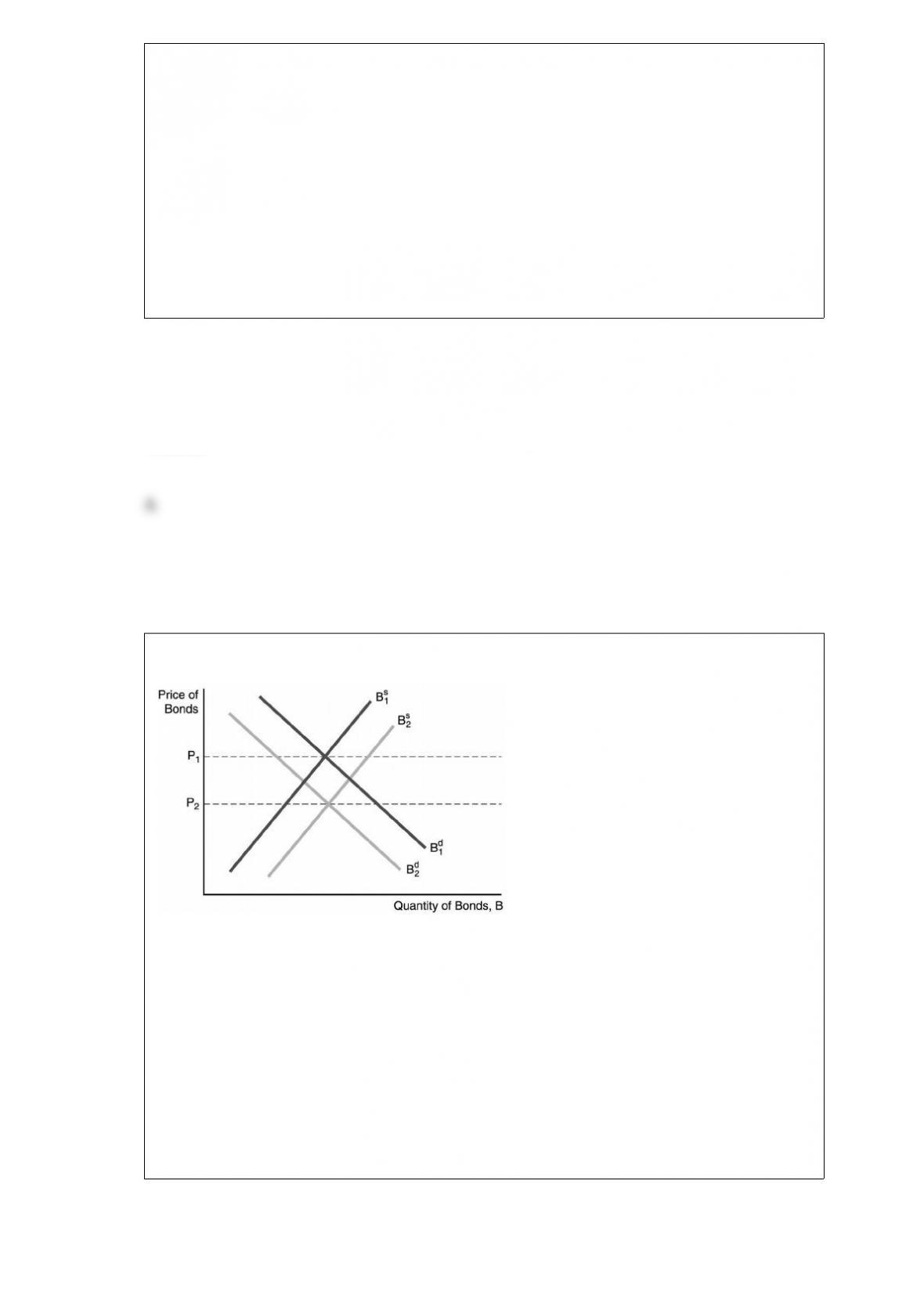
In the figure above, a factor that could cause the demand for bonds to decrease (shift to
the left) is:
A) an increase in the expected return on bonds relative to other assets.
B) a decrease in the expected return on bonds relative to other assets.
C) an increase in wealth.
D) a reduction in the riskiness of bonds relative to other assets.

Answer:
The effect of an open market purchase on reserves differs depending on how the seller
of the bonds keeps the proceeds. If the proceeds are kept in ________, the open market
purchase has no effect on reserves; if the proceeds are kept as ________, reserves
increase by the amount of the open market purchase.
A) deposits; deposits
B) deposits; currency
C) currency; deposits
D) currency; currency
Answer:
When the Fed decreases the money stock, the money supply curve shifts to the
________ and the interest rate ________, everything else held constant.
A) right; rises
B) right; falls
C) left; falls
D) left; rises

Answer:
If you expect the inflation rate to be 4 percent next year and a one year bond has a yield
to maturity of 7 percent, then the real interest rate on this bond is
A) -3 percent.
B) -2 percent.
C) 3 percent.
D) 7 percent.
Answer:
In the simple Keynesian model, equilibrium aggregate output is determined by
A) aggregate demand.
B) aggregate supply.
C) the national demand for labor.
D) the price level.
Answer: