
A budget ________ occurs when government expenditures exceed tax revenues for a
particular time period.
A) deficit
B) surplus
C) surge
D) surfeit
Answer:
Keynes argued that when interest rates were low relative to some normal value, people
would expect bond prices to ________ so the quantity of money demanded would
________.
A) increase; increase
B) increase; decrease
C) decrease; increase
D) decrease; decrease
Answer:
A debt instrument sold by a bank to its depositors that pays annual interest of a given
amount and at maturity pays back the original purchase price is called
A) commercial paper.
B) a negotiable certificate of deposit.
C) a municipal bond.
D) federal funds.
Answer:
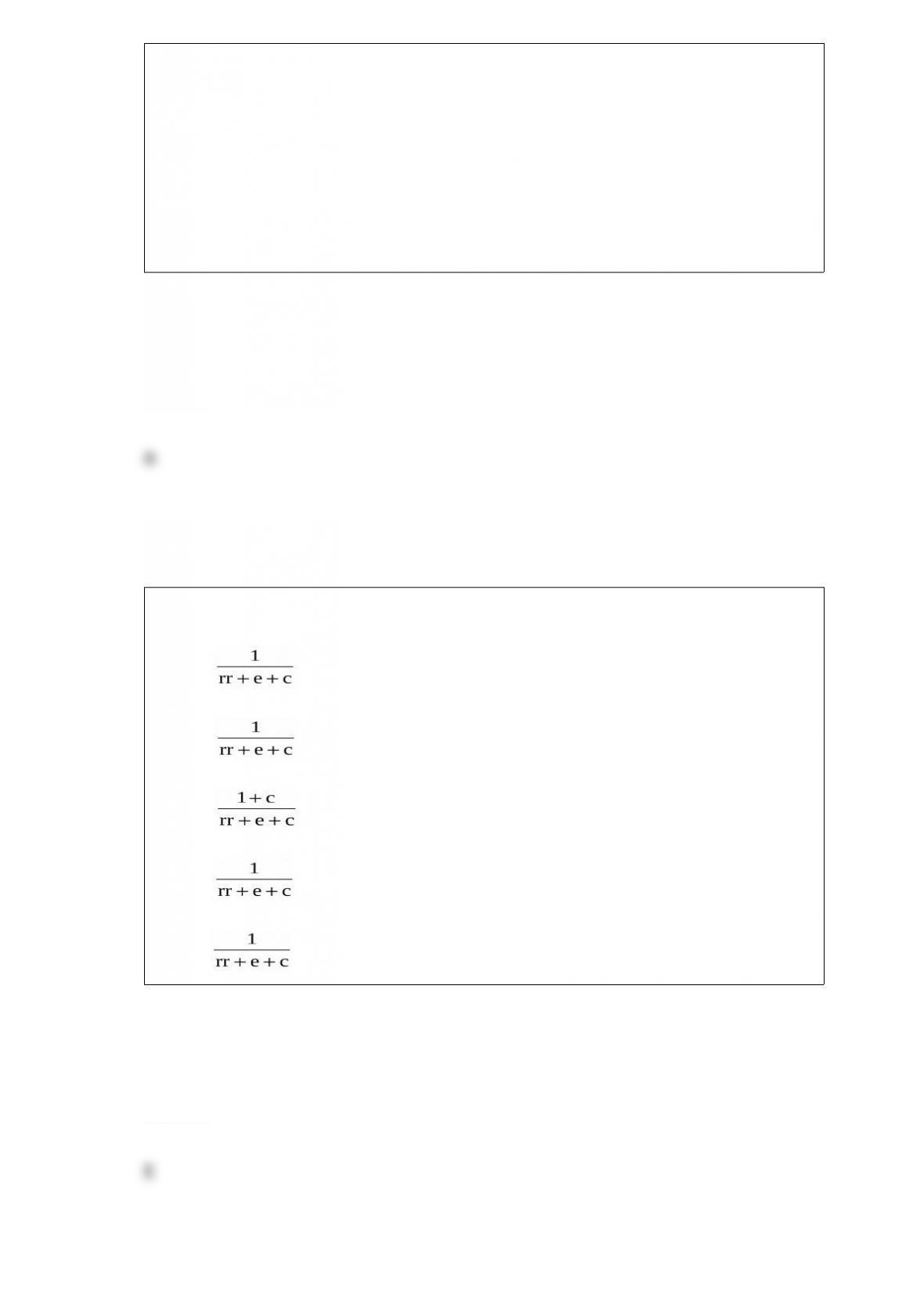
The formula that links checkable deposits to the monetary base is
A) m = .
B) M = .
C) M = .
D) D = .
E) D = × MB.
Answer:

The expectations theory and the segmented markets theory do not explain the facts very
well, but they provide the groundwork for the most widely accepted theory of the term
structure of interest rates,
A) the Keynesian theory.
B) separable markets theory.
C) liquidity premium theory.
D) the asset market approach.
Answer:
A bank has excess reserves of $1,000 and demand deposit liabilities of $80,000 when
the reserve requirement is 20 percent. If the reserve requirement is lowered to 10
percent, the bank’s excess reserves will be
A) $1,000.
B) $8,000.
C) $9,000.
D) $17,000.
Answer:

Which of the following is most likely to lead to inflationary monetary policy?
A) Declining oil prices
B) Resolution of conflict in the Middle East
C) The enactment of a free-trade agreement with Mexico
D) Rising unemployment
Answer:
The demand curve for bonds has the usual downward slope, indicating that at ________
prices of the bond, everything else equal, the ________ is higher.
A) higher; demand
B) higher; quantity demanded
C) lower; demand
D) lower; quantity demanded
Answer:
When the Fed ________ the money stock, the money supply curve shifts to the
________ and the interest rate ________, everything else held constant.

A) decreases; right; rises
B) increases; right; falls
C) decreases; left; falls
D) increases; left; rises
Answer:
When the effects of the global financial crisis started to spread more quickly throughout
the rest of the world, the U.S. dollar ________ because demand for U.S. assets
________.
A) appreciated; increased
B) depreciated; increased
C) appreciated; decreased
D) depreciated; decreased
Answer:
Other things equal, a decrease in autonomous consumption shifts the ________ curve to
the ________.
A) IS; right

B) IS; left
C) LM; left
D) LM; right
Answer:
Because prices are slow to move in the short-run, when the Federal Reserve lowers the
federal funds rate,
A) nominal interest rates rise.
B) real interest rates fall.
C) inflation falls.
D) real interest rates rise.
Answer:
Everything else held constant, if consumption expenditure falls by 160 when disposable
income falls by 200, the mpc is
A) 0
B) 0.2

C) 0.4
D) 0.8
Answer:
Due to the lack of timely data for the price level and economic growth, the Fed’s
strategy
A) targets the exchange rate, since the Fed can control this variable.
B) targets the price of gold, since it is closely related to economic activity.
C) uses an intermediate target, such as an interest rate.
D) stabilizes the consumer price index, since the Fed can control the CPI.
Answer:
The first country to adopt inflation targeting was
A) the United Kingdom.
B) Canada.
C) New Zealand.

D) Australia.
Answer:
Which of the following are not assets on the Fed’s balance sheet?
A) Securities
B) Discount loans
C) Cash items in the process of collection
D) Deferred availability cash items
Answer:
The belief that bank failures were regularly caused by fraud or the lack of sufficient
bank capital explains, in part, the passage of
A) the National Bank Charter Amendments of 1918.
B) the Garn-St. Germain Act of 1982.
C) the National Bank Act of 1863.
D) Federal Reserve Act of 1913.

Answer:
If the expected path of 1-year interest rates over the next five years is 1 percent, 2
percent, 3 percent, 4 percent, and 5 percent, the expectations theory predicts that the
bond with the highest interest rate today is the one with a maturity of
A) two years.
B) three years.
C) four years.
D) five years.
Answer:
The present value of a fixed-payment loan is calculated as the ________ of the present
value of all cash flow payments.
A) sum
B) difference
C) multiple
D) log
Answer:

In the 1990s Japan had the lowest interest rates in the world due to a combination of
A) inflation and recession.
B) deflation and expansion.
C) inflation and expansion.
D) deflation and recession.
Answer:
Which of the following are reported as liabilities on a bank’s balance sheet?
A) Discount loans
B) Reserves
C) U.S. Treasury securities
D) Loans
Answer:

By looking at aggregate demand via its component parts, we can conclude that the
aggregate demand curve is downward sloping because
A) a lower inflation rate causes the real interest rate to fall, and stimulates planned
investment spending.
B) a lower inflation rate causes the real interest rate to rise, and stimulates planned
investment spending.
C) a higher inflation rate causes the real interest rate to fall, and stimulates planned
investment spending.
D) a higher inflation rate causes the real interest rate to rise, and stimulates planned
investment spending.
Answer:
When the price of a bond is ________ the equilibrium price, there is an excess demand
for bonds and price will ________.
A) above; rise
B) above; fall
C) below; fall
D) below; rise
Answer:

A decrease in the riskiness of corporate bonds will ________ the price of corporate
bonds and ________ the price of Treasury bonds, everything else held constant.
A) increase; increase
B) reduce; reduce
C) reduce; increase
D) increase; reduce
Answer:
The ________ states that the nominal interest rate equals the real interest rate plus the
expected rate of inflation.
A) Fisher equation
B) Keynesian equation
C) Monetarist equation
D) Marshall equation
Answer:

A business cycle expansion increases income, causing money demand to ________ and
interest rates to ________, everything else held constant.
A) increase; increase
B) increase; decrease
C) decrease; decrease
D) decrease; increase
Answer:
Markets in which funds are transferred from those who have excess funds available to
those who have a shortage of available funds are called
A) commodity markets.
B) fund-available markets.
C) derivative exchange markets.
D) financial markets.
Answer:
A fully amortized loan is another name for

A) a simple loan.
B) a fixed-payment loan.
C) a commercial loan.
D) an unsecured loan.
Answer:
When financial intermediaries deleverage, firms cannot fund investment opportunities
resulting in
A) a contraction of economic activity.
B) an economic boom.
C) an increased opportunity for growth.
D) a call for government regulation.
Answer:
The legislation that effectively prohibited banks from branching across state lines and
forced all national banks to conform to the branching regulations in the state in which
they reside is the
A) McFadden Act.

B) National Bank Act.
C) Glass-Steagall Act.
D) Garn-St.Germain Act.
Answer:
ATMs were developed because of breakthroughs in technology and as a
A) means of avoiding restrictive branching regulations.
B) means of avoiding paying interest to corporate customers.
C) way of concealing transactions from the SEC.
D) increasing the competition from foreign banks.
Answer:
The revenue a government gains from issuing money is
A) interest.
B) rent.
C) seignorage.

D) the national dividend.
E) the inflation tax.
Answer:
Between 1950 and 1980 in the U.S., interest rates trended upward. During this same
time period,
A) the rate of money growth declined.
B) the rate of money growth increased.
C) the government budget deficit (expressed as a percentage of GNP) trended
downward.
D) the aggregate price level declined quite dramatically.
Answer:
An increase in government spending causes the equilibrium level of aggregate output to
________ at any given interest rate and shifts the ________ curve to the ________,
everything else held constant.
A) rise; LM; right
B) rise; IS; right

C) fall; IS; left
D) fall; LM; left
Answer:
Even if the Fed could completely control the money supply, monetary policy would
have critics because
A) the Fed is asked to achieve many goals, some of which are incompatible with others.
B) the Fed’s goals do not include high employment, making labor unions a critic of the
Fed.
C) the Fed’s primary goal is exchange rate stability, causing it to ignore domestic
economic conditions.
D) it is required to keep Treasury security prices high.
Answer: