
A decrease in unplanned inventory investment for the entire economy equals the excess
of
A) output over aggregate supply.
B) output over aggregate demand.
C) aggregate supply over output.
D) aggregate demand over output.
Answer:
If your nominal income in 2002 was $50,000, and prices doubled between 2002 and
2011, to have the same real income, your nominal income in 2011 must be
A) $50,000.
B) $75,000.
C) $90,000.
D) $100,000.
Answer:
The teal book is the Fed research document containing

A) the forecast of national economic variables for the next three years.
B) forecasts of the money aggregates conditional on different monetary policy stances.
C) information on the state of the economy in each Federal Reserve district.
D) both A and B.
E) A, B and C.
Answer:
If the current account balance shows a surplus, and the capital account also shows a
surplus, then the official reserve transactions balance
A) must be positive.
B) must be negative.
C) must be zero.
D) can either be positive, negative, or zero.
Answer:
Supply-side economic policies seek to
A) raise interest rates through contractionary monetary policy.

B) increase federal government expenditures.
C) increase consumption expenditures by increasing taxes.
D) increase saving and investment using tax incentives.
Answer:
Everything else held constant, if a central bank makes an unsterilized ________ of
foreign assets, then the domestic money supply will ________ and the domestic
currency will depreciate.
A) purchase; increase
B) purchase; decrease
C) sale; increase
D) sale; decrease
Answer:
The most important developments that have reduced banks cost advantages in the past
thirty years include:
A) the growth of the junk bond market.

B) the competition from money market mutual funds.
C) the growth of securitization.
D) the growth in the commercial paper market.
Answer:
The monetary base minus reserves equals
A) currency in circulation.
B) the borrowed base.
C) the nonborrowed base.
D) discount loans.
Answer:
Other things being equal, an increase in the default risk of corporate bonds shifts the
demand curve for corporate bonds to the ________ and the demand curve for Treasury
bonds to the ________.
A) right; right
B) right; left

C) left; right
D) left; left
Answer:
A plot of the interest rates on default-free government bonds with different terms to
maturity is called
A) a risk-structure curve.
B) a default-free curve.
C) a yield curve.
D) an interest-rate curve.
Answer:
China is trying to move its banking system from being strictly ________ owned by
having them issue shares overseas.
A) state
B) domestic investor
C) depositor
D) domestic corporate
Answer:
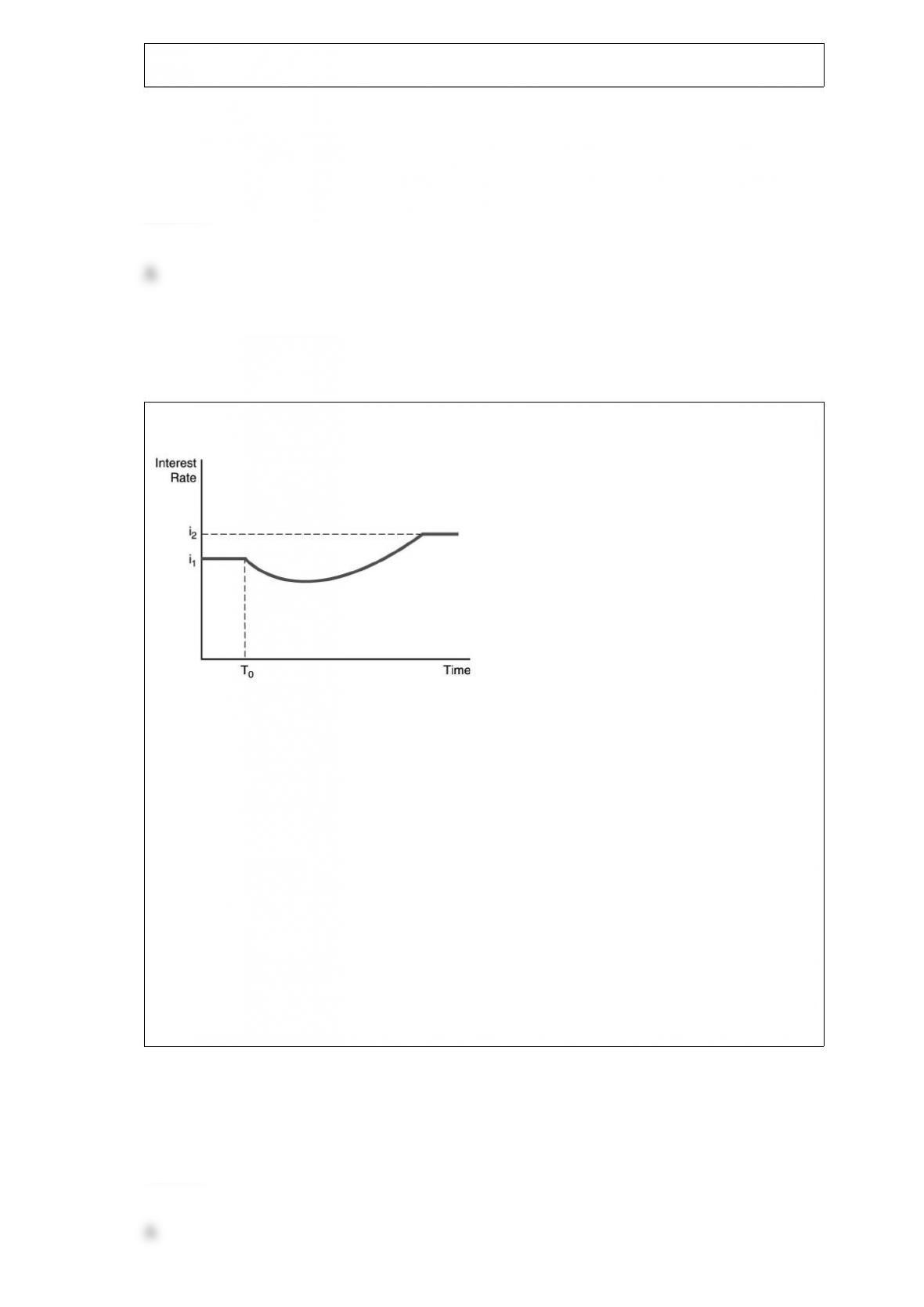
The figure above illustrates the effect of an increased rate of money supply growth at
time period T0. From the figure, one can conclude that the
A) Fisher effect is dominated by the liquidity effect and interest rates adjust slowly to
changes in expected inflation.
B) liquidity effect is dominated by the Fisher effect and interest rates adjust slowly to
changes in expected inflation.
C) liquidity effect is dominated by the Fisher effect and interest rates adjust quickly to
changes in expected inflation.
D) Fisher effect is smaller than the expected inflation effect and interest rates adjust
quickly to changes in expected inflation.
Answer:

If the money supply is $500 and nominal income is $3,000, the velocity of money is
A) 1/60.
B) 1/6.
C) 6.
D) 60.
Answer:
Which of the following statements is false?
A) Checkable deposits are usually the lowest cost source of bank funds.
B) Checkable deposits are the primary source of bank funds.
C) Checkable deposits are payable on demand.
D) Checkable deposits include NOW accounts.
Answer:
Because sterilized interventions mean offsetting open market operations, there is no

impact on the monetary base and the money supply, and therefore a sterilized
intervention
A) causes the exchange rate to overshoot in the short run.
B) causes the exchange rate to undershoot in the short run.
C) causes the exchange rate to depreciate in the short run, but has no effect on the
exchange rate in the long run.
D) has no effect on the exchange rate.
Answer:
The ________ of a coupon bond and the yield to maturity are inversely related.
A) price
B) par value
C) maturity date
D) term
Answer:
Factors that led to worsening financial market conditions in East Asia in 1997-1998
include
A) weak supervision by bank regulators.
B) a rise in interest rates abroad.
C) unanticipated increases in the price level.
D) increased uncertainty from political shocks.
Answer:
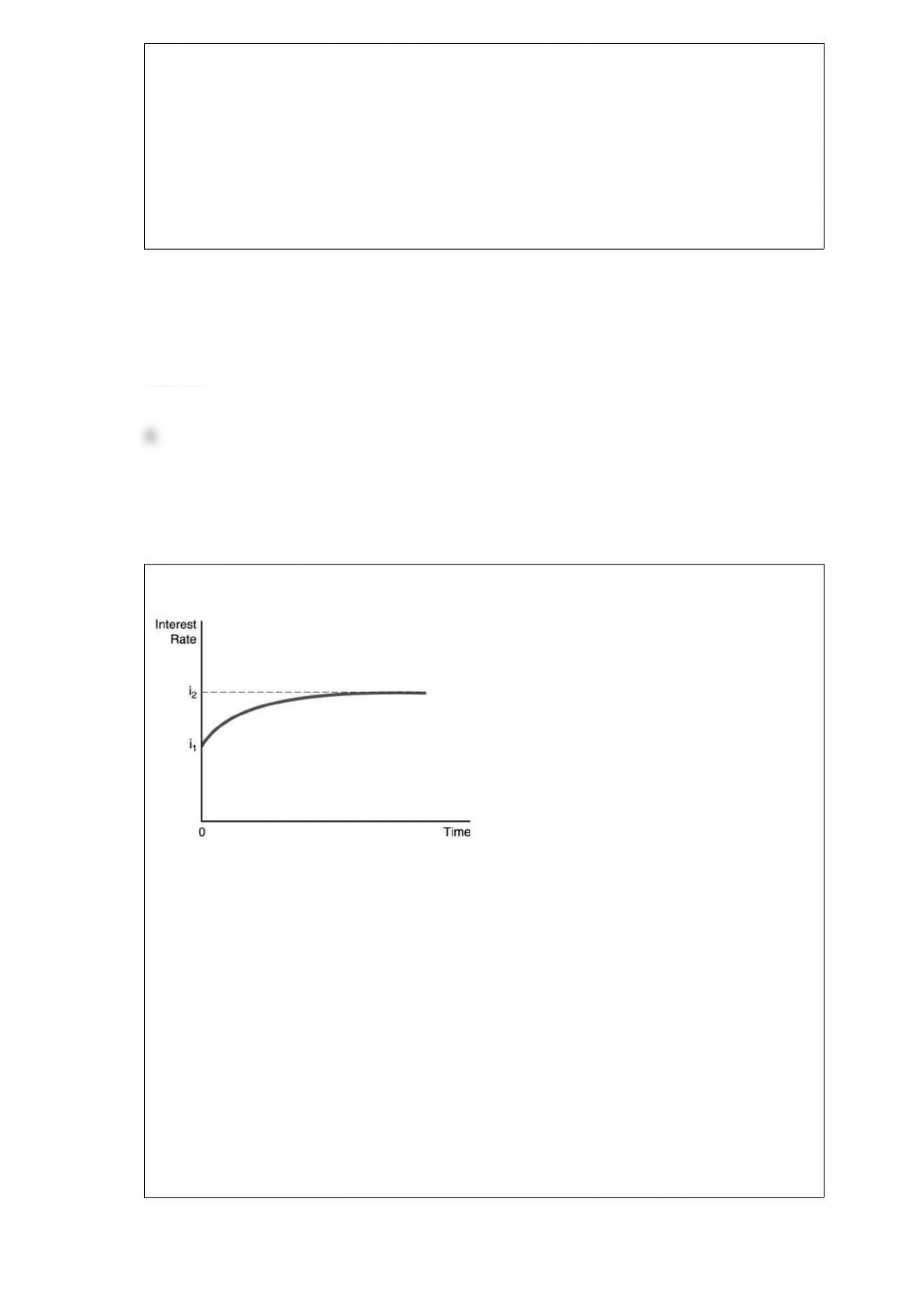
In the figure above, illustrates the effect of an increased rate of money supply growth at
time period 0. From the figure, one can conclude that the
A) liquidity effect is smaller than the expected inflation effect and interest rates adjust
quickly to changes in expected inflation.
B) liquidity effect is larger than the expected inflation effect and interest rates adjust
quickly to changes in expected inflation.
C) liquidity effect is larger than the expected inflation effect and interest rates adjust
slowly to changes in expected inflation.
D) liquidity effect is smaller than the expected inflation effect and interest rates adjust
slowly to changes in expected inflation.

Answer:
The price of gold should be ________ to the expected inflation rate.
A) positively related
B) negatively related
C) inversely related
D) unrelated
Answer:
The too-big-to-fail policy
A) reduces moral hazard problems.
B) puts large banks at a competitive disadvantage in attracting large deposits.
C) treats large depositors of small banks inequitably when compared to depositors of
large banks.
D) allows small banks to take on more risk than large banks.
Answer:

Suppose the economy is producing below the natural rate of output and the government
is suffering from large budget deficits. To deal with the deficit problem, suppose the
government takes a policy action to reduce the size of the deficits. This policy action
will cause ________ in the unemployment rate in the short run and ________ in
inflation in the short run, everything else held constant.
A) an increase; an increase
B) a decrease; a decrease
C) a decrease; an increase
D) an increase; a decrease
Answer:
If people expect nominal interest rates to be higher in the future, the expected return to
bonds ________, and the demand for money ________.
A) rises; increases
B) rises; decreases
C) falls; increases
D) falls; decreases
Answer:

In one sense ________ appears surprising since it means that the bank is not ________
its portfolio of loans and thus is exposing itself to more risk.
A) specialization in lending; diversifying
B) specialization in lending; rationing
C) credit rationing; diversifying
D) screening; rationing
Answer:
Everything else held constant, changes in the interest rate affect planned investment
spending and hence the equilibrium level of output, but this change in investment
spending
A) merely causes a movement along the IS curve and not a shift.
B) is crowded out by higher taxes.
C) is crowded out by higher government spending.
D) is crowded out by lower consumer expenditures.
Answer:

Equity of U.S. companies can be purchased by
A) U.S. citizens only.
B) foreign citizens only.
C) U.S. citizens and foreign citizens.
D) U.S. mutual funds only.
Answer:
The ________ that required separation of commercial and investment banking was
repealed in 1999.
A) the Federal Reserve Act.
B) the Glass-Steagall Act.
C) the Bank Holding Company Act.
D) the Monetary Control Act.
Answer:
A decline in the expected inflation rate causes the demand for money to ________ and

the demand curve to shift to the ________, everything else held constant.
A) decrease; right
B) decrease; left
C) increase; right
D) increase; left
Answer:
The Volcker Rule addresses the off-balance-sheet problem involving
A) trading risks.
B) selling loans.
C) loan guarantees.
D) interest rate risks.
Answer:
If a central bank does not want to see its currency rise in value, it may pursue ________
monetary policy to ________ the domestic interest rate, thereby weakening its currency.
A) expansionary; raise

B) contractionary; raise
C) expansionary; lower
D) contractionary; lower
Answer:
A firm issuing credit cards earns income from
A) loans it makes to credit card holders.
B) subsidies from the local governments.
C) payments made to it by manufacturers of the products sold in stores on credit card
purchases.
D) sales of the card in foreign countries.
Answer:
Because shifts in aggregate demand are not viewed as being particularly important to
aggregate output fluctuations, they do not see much need for activist policy to eliminate
high unemployment. “They” refers to proponents of
A) the natural rate hypothesis.

B) monetarism.
C) the Phillips curve model.
D) real business cycle theory.
Answer:
Methods of financing government spending are described by an expression called the
government budget constraint, which states the following:
A) DEFICIT = (G – T) = ΔMB + ΔBONDS.
B) DEFICIT = (G – T) = ΔMB – ΔBONDS.
C) DEFICIT = (G – T) = ΔBONDS – ΔMB.
D) DEFICIT = (G – T) = ΔMB/ΔBONDS.
Answer:
Adjustable rate mortgages
A) reduce the interest-rate risk for financial institutions.
B) benefit homeowners when interest rates rise.
C) generally have higher initial interest rates than conventional fixed-rate mortgages.

D) allow borrowers to avoid paying interest on portions of their mortgage loans.
Answer:
If a bank has ________ rate-sensitive assets than liabilities, then ________ in interest
rates will increase bank profits.
A) more; a decline
B) more; an increase
C) fewer; an increase
D) fewer; a surge
Answer: