
When an economy grows out of a recession, normally the demand for bonds ________
and the supply of bonds ________, everything else held constant.
A) increases; increases
B) increases; decreases
C) decreases; decreases
D) decreases; increases
Answer:
One of the problems in conducting a duration gap analysis is that the duration gap is
calculated assuming that interest rates for all maturities are the same. That means that
the yield curve is
A) flat.
B) slightly upward sloping.
C) steeply upward sloping.
D) downward sloping.
Answer:

In the market for reserves, a lower discount rate
A) decreases the supply of reserves.
B) increases the supply of reserves.
C) lengthens the vertical section of the supply curve of reserves.
D) shortens the vertical section of the supply curve of reserves.
Answer:
In the model of the money supply process, the bank’s role in influencing the money
supply process is represented by
A) the excess reserve.
B) both the excess reserve and the market interest rate.
C) the currency ratio.
D) only borrowed reserves.
Answer:
As in the United States, an important factor in the banking crises in Norway, Sweden,
and Finland was the

A) financial liberalization that occurred in the 1980s.
B) decline in real interest rates that occurred in the 1980s.
C) high inflation that occurred in the 1980s.
D) sluggish economic growth that occurred in the 1980s.
Answer:
When a corporation announces a major decline in earnings, the stock price may initially
decline significantly and then rise back to normal levels over the next few weeks. This
impact is called
A) the January effect.
B) mean reversion.
C) market overreaction.
D) the small-firm effect.
Answer:
Everything else held constant, if a factor decreases the demand for ________ goods
relative to ________ goods, the domestic currency will depreciate.
A) foreign; domestic

B) foreign; foreign
C) domestic; domestic
D) domestic; foreign
Answer:
The supply curve for bonds has the usual upward slope, indicating that as the price
________, ceteris paribus, the ________ increases.
A) falls; supply
B) falls; quantity supplied
C) rises; supply
D) rises; quantity supplied
Answer:
If the required reserve ratio is 10 percent, currency in circulation is $400 billion,
checkable deposits are $800 billion, and excess reserves total $0.8 billion, then the
money supply is ________ billion.
A) $8000

B) $1200
C) $1200.8
D) $8400
Answer:
Everything else held constant, if aggregate output is to the right of the IS curve, then
there is an excess ________ of goods which will cause aggregate output to ________.
A) supply; fall
B) supply; rise
C) demand; fall
D) demand; rise
Answer:
If stock prices are expected to climb next year, everything else held constant, the
________ curve for bonds shifts ________ and the interest rate ________.
A) demand; left; rises
B) demand; right; rises
C) demand; left; falls
D) supply; left; rises
Answer:
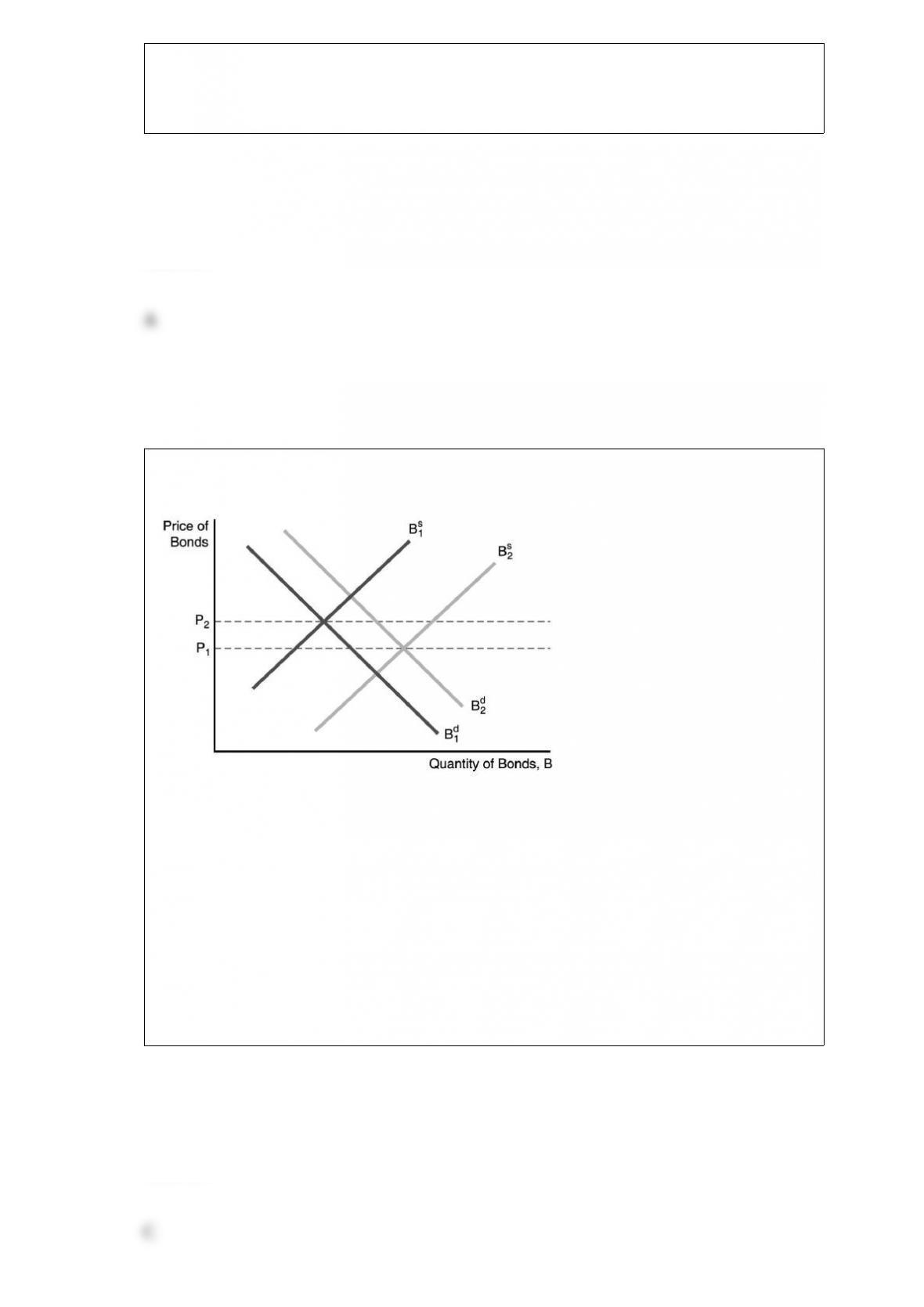
In the figure above, a factor that could cause the supply of bonds to increase (shift to
the right) is:
A) a decrease in government budget deficits.
B) a decrease in expected inflation.
C) expectations of more profitable investment opportunities.
D) a business cycle recession.
Answer:

Mutual savings banks are owned by
A) shareholders.
B) partners.
C) depositors.
D) foreign investors.
Answer:
If aggregated demand is less than actual output, unplanned inventory ________ will
cause output to ________.
A) accumulation; rise
B) depletion; fall
C) depletion; rise
D) accumulation; fall
Answer:

Using the Gordon growth model, if D1 is $.50, ke is 7%, and g is 5%, then the present
value of the stock is
A) $2.50.
B) $25.
C) $50.
D) $46.73.
Answer:
An advantage of an international lender of last resort is its ability to prevent ________,
in which a successful speculative attack on one currency leads to attacks on others; its
disadvantage is the problem of ________ if creditors expect to be protected if a crisis
occurs.
A) contagion; moral hazard
B) contagion; adverse selection
C) currency virus; moral hazard
D) currency virus; adverse selection
Answer:

His analysis started with the recognition that the total quantity demanded of an
economy’s output was the sum of four types of spending: consumer expenditure,
planned investment spending, government spending, and net exports.
A) John Maynard Keynes
B) Sir John Hicks
C) Milton Friedman
D) Paul A. Samuelson
Answer:
________ in the foreign interest rate causes the demand for domestic assets to increase
and the domestic currency to ________, everything else held constant.
A) An increase; appreciate
B) An increase; depreciate
C) A decrease; appreciate
D) A decrease; depreciate
Answer:
Banks earn profits by selling ________ with attractive combinations of liquidity, risk,

and return, and using the proceeds to buy ________ with a different set of
characteristics.
A) loans; deposits
B) securities; deposits
C) liabilities; assets
D) assets; liabilities
Answer:
Direct finance involves the sale to ________ of marketable securities such as stocks and
bonds.
A) households
B) insurance companies
C) pension funds
D) financial intermediaries
Answer:
By analyzing aggregate demand through its component parts, we can conclude that,
everything else held constant, a decline in the inflation rate causes

A) an increase in real interest rates, a decline in investment spending, and a decline in
aggregate output demand.
B) a decline in real interest rates, a decrease in investment spending, and an increase in
aggregate output demand.
C) a decline in real interest rates, an increase in investment spending, and an increase in
aggregate output demand.
D) an increase in real interest rates, a decline in investment spending, and a decline in
aggregate output demand.
Answer:
A sharp depreciation of the domestic currency after a currency crisis leads to
A) higher inflation.
B) lower import prices.
C) lower interest rates.
D) decrease in the value of foreign currency-denominated liabilities.
Answer:
In the Keynesian framework, as long as output is ________ the equilibrium level,

unplanned inventory investment will remain ________ and firms will continue to lower
production.
A) below; negative
B) above; negative
C) below; positive
D) above; positive
Answer:
With regard to external sources of financing for nonfinancial businesses in the United
States, which of the following are accurate statements?
A) Marketable securities account for a larger share of external business financing in the
United States than in Germany and Japan.
B) Since 1970, most of the newly issued corporate bonds and commercial paper have
been sold directly to American households.
C) Direct finance accounts for more than 50 percent of the external financing of
American businesses.
D) Smaller businesses almost always raise funds by issuing marketable securities.
Answer:

Asymmetric information is a universal problem. This would suggest that financial
regulations
A) in industrial countries are an unqualified failure.
B) differ significantly around the world.
C) in industrialized nations are similar.
D) are unnecessary.
Answer:
The reduction of brokerage commissions for trading common stocks that occurred in
1975 caused the demand for bonds to ________ and the demand curve to shift to the
________.
A) fall; right
B) fall, left
C) rise; right
D) rise; left
Answer:
Which of the following increases aggregate supply in the short-run, everything else held

constant?
A) An increase in the price of crude oil.
B) A successful wage push by workers.
C) Expectations of a higher inflation.
D) A technological improvement that increases worker productivity.
Answer:
In Irving Fisher’s quantity theory of money, velocity was determined by
A) interest rates.
B) real GDP.
C) the institutions in an economy that affect individuals’ transactions.
D) the price level.
Answer:
If a banker expects interest rates to fall in the future, her best strategy for the present is
A) to increase the duration of the bank’s liabilities.

B) to buy short-term bonds.
C) to sell long-term certificates of deposit.
D) to increase the duration of the bank’s assets.
Answer:
Everything else held constant, an autonomous easing of monetary policy will cause
A) the quantity of aggregate demand to increase.
B) the quantity of aggregate demand to decrease.
C) aggregate demand to decrease.
D) aggregate demand to increase.
Answer:
The countries that have made the least use of securities markets are ________ and
________; in these two countries finance from financial intermediaries has been almost
ten times greater than that from securities markets.
A) Germany; Japan
B) Germany; Great Britain

C) Great Britain; Canada
D) Canada; Japan
Answer:
Bank consolidation will likely result in
A) less competition.
B) the elimination of community banks.
C) increased competition.
D) a shift in assets from larger banks to smaller banks.
Answer:
People hold money even during inflationary episodes when other assets prove to be
better stores of value. This can be explained by the fact that money is
A) extremely liquid.
B) a unique good for which there are no substitutes.
C) the only thing accepted in economic exchange.
D) backed by gold.
Answer: