
If a central bank does not want to allow the domestic currency to depreciate, it will
________ international reserves by purchasing its currency, thereby ________ the
monetary base and increasing the risk of higher unemployment.
A) lose; decreasing
B) lose; increasing
C) acquire; decreasing
D) acquire; increasing
Answer:
When a bank suspects that a $1 million loan might prove to be bad debt that will have
to be written off in the future the bank
A) can set aside $1 million of its earnings in its loan loss reserves account.
B) reduces its reported earnings by $1, even though it has not yet actually lost the $1
million.
C) reduces its assets immediately by $1 million, even though it has not yet lost the $1
million.
D) reduces its reserves by $1 million, so that they can use those funds later.
Answer:

As a result of its power to dictate loan terms to borrowing countries (under the Bretton
Woods system), the IMF could encourage ________ countries to pursue ________
monetary policies that would strengthen their currency or eliminate their balance of
payments deficits.
A) surplus; contractionary
B) surplus; expansionary
C) deficit; contractionary
D) deficit; expansionary
Answer:
Under a fixed exchange rate regime, a country that depletes its international reserves in
an attempt to keep its currency from ________ will be forced to ________ its currency.
A) depreciating; revalue
B) depreciating; devalue
C) appreciating; revalue
D) appreciating; devalue
Answer:

The opportunity cost of holding money is
A) the level of income.
B) the price level.
C) the interest rate.
D) the discount rate.
Answer:
Which of the following sequences accurately describes the evolution of the payments
system?
A) Barter, coins made of precious metals, paper currency, checks, electronic funds
transfers
B) Barter, coins made of precious metals, checks, paper currency, electronic funds
transfers
C) Barter, checks, paper currency, coins made of precious metals, electronic funds
transfers
D) Barter, checks, paper currency, electronic funds transfers
Answer:

An increase in the foreign interest rate causes the demand for domestic assets to
________ and the domestic currency to ________, everything else held constant.
A) increase; appreciate
B) increase; depreciate
C) decrease; appreciate
D) decrease; depreciate
Answer:
So-called fallen angels differ from junk bonds in that
A) junk bonds refer to newly issued bonds with low credit ratings, whereas fallen
angels refer to previously issued bonds that have had their credit ratings fall below Baa.
B) junk bonds refer to previously issued bonds that have had their credit ratings fall
below Baa, whereas fallen angels refer to newly issued bonds with low credit ratings.
C) junk bonds have ratings below Baa, whereas fallen angels have ratings below C.
D) fallen angels have ratings below Baa, whereas junk bonds have ratings below C.
Answer:
The demand for money as a cushion against unexpected contingencies is called the

A) transactions motive.
B) precautionary motive.
C) insurance motive.
D) speculative motive.
Answer:
In the Gordon growth model, a decrease in the required rate of return on equity
A) increases the current stock price.
B) increases the future stock price.
C) reduces the future stock price.
D) reduces the current stock price.
Answer:
A contractionary monetary policy raises the real interest rate, causing the domestic
currency to ________, thereby ________ net exports.
A) appreciate; raising

B) appreciate; lowering
C) depreciate; raising
D) depreciate; lowering
Answer:
If the required reserve ratio is 10 percent, currency in circulation is $400 billion,
checkable deposits are $800 billion, and excess reserves total $0.8 billion, then the M1
money multiplier is
A) 2.5
B) 1.67
C) 2
D) 0.601
Answer:
In the simple deposit expansion model, if the banking system has excess reserves of
$75, and the required reserve ratio is 20%, the potential expansion of checkable
deposits is
A) $75.

B) $750.
C) $37.50.
D) $375.
Answer:
A shift in tastes toward American goods ________ net exports in the U.S. and causes
the IS curve to shift to the ________ in the U.S., everything else held constant.
A) decreases; right
B) decreases; left
C) increases; right
D) increases; left
Answer:
Suppose that the Bank of Japan buys yen-denominated assets with U.S. dollar assets.
Everything else held constant, this transaction will cause ________ in the foreign assets
held by the Federal Reserve and ________ in the U.S. monetary base.
A) an increase; an increase
B) an increase; a decrease

C) a decrease; an increase
D) a decrease; a decrease
Answer:
Which of the following are true concerning the distinction between interest rates and
returns?
A) The rate of return on a bond will not necessarily equal the interest rate on that bond.
B) The return can be expressed as the difference between the current yield and the rate
of capital gains.
C) The rate of return will be greater than the interest rate when the price of the bond
falls between time t and time t + 1.
D) The return can be expressed as the sum of the discount yield and the rate of capital
gains.
Answer:
In a liquidity trap, monetary policy has ________ effect on aggregate spending because
a change in the money supply has ________ effect on interest rates.
A) no; no

B) no; a large
C) no; a small
D) a large; a large
Answer:
An increase in the liquidity of corporate bonds will ________ the price of corporate
bonds and ________ the yield of Treasury bonds, everything else held constant.
A) increase; increase
B) reduce; reduce
C) increase; reduce
D) reduce; increase
Answer:
The market where one currency is converted into another currency is called the
________ market.
A) stock
B) bond

C) derivatives
D) foreign exchange
Answer:
The concept of adverse selection helps to explain all of the following except
A) why firms are more likely to obtain funds from banks and other financial
intermediaries, rather than from the securities markets.
B) why indirect finance is more important than direct finance as a source of business
finance.
C) why direct finance is more important than indirect finance as a source of business
finance.
D) why the financial system is so heavily regulated.
Answer:
Everything else held constant, an increase in the time deposit ratio will mean ________
in the M2 money multiplier and ________ in the M2 money supply.
A) an increase; an increase
B) an increase; a decrease

C) a decrease; an increase
D) a decrease; a decrease
Answer:
According to the liquidity premium theory of the term structure
A) bonds of different maturities are not substitutes.
B) if yield curves are downward sloping, then short-term interest rates are expected to
fall by so much that, even when the positive term premium is added, long-term rates fall
below short-term rates.
C) yield curves should never slope downward.
D) interest rates on bonds of different maturities do not move together over time.
Answer:
A decrease in ________ increases the money supply since it causes the ________ to
rise.
A) reserve requirements; monetary base
B) reserve requirements; money multiplier
C) margin requirements; monetary base

D) margin requirements; money multiplier
Answer:
Financial crises generally develop along two basic paths:
A) mismanagement of financial liberalization/globalization and severe fiscal
imbalances.
B) stock market declines and severe fiscal imbalances.
C) mismanagement of financial liberalization/globalization and stock market declines.
D) stock market declines and unanticipated declines in the value of the domestic
currency.
Answer:
Equity and debt instruments with maturities greater than one year are called ________
market instruments.
A) capital
B) money
C) federal
D) benchmark
Answer:
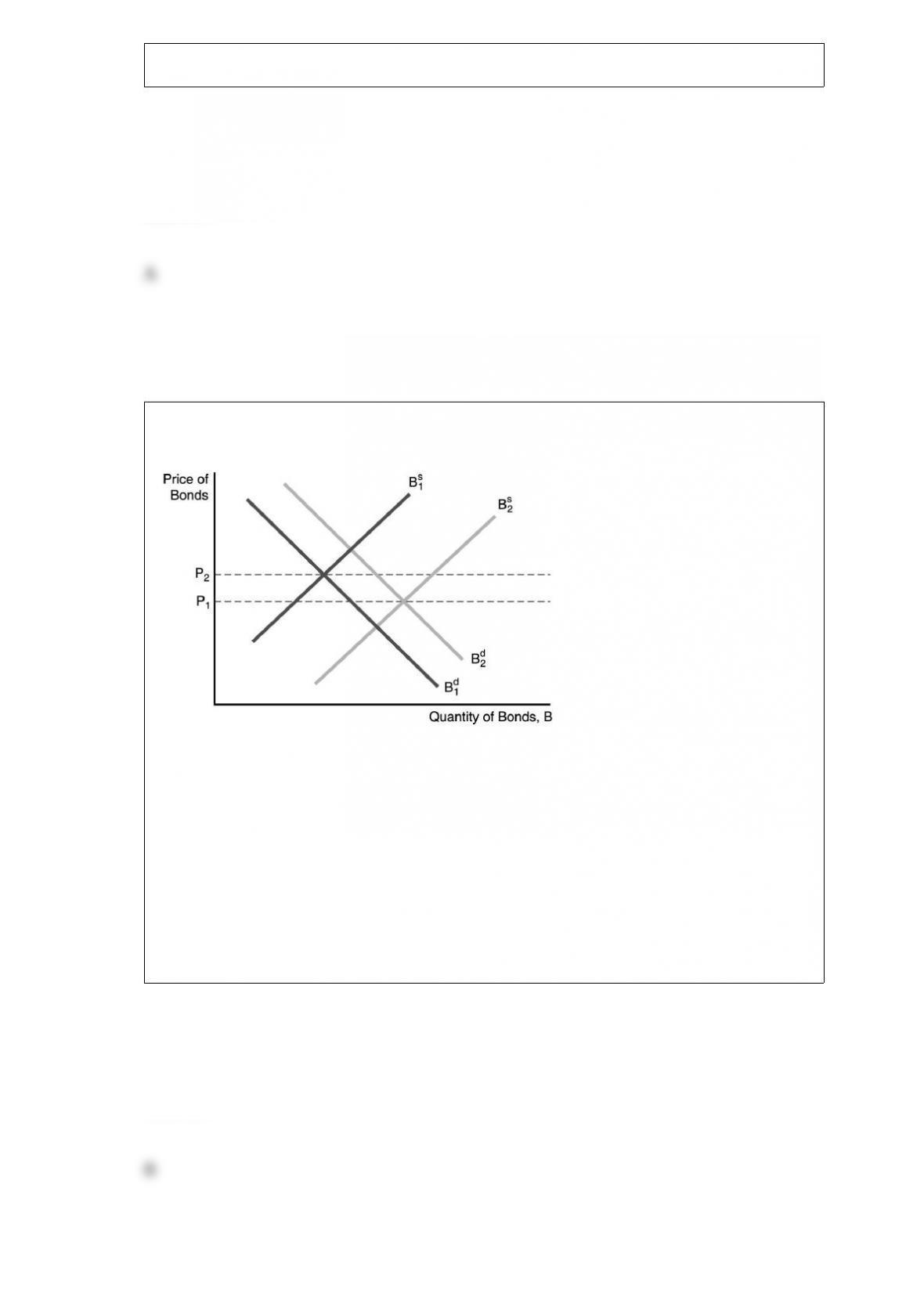
In the figure above, the price of bonds would fall from P2 to P1 if
A) there is a business cycle recession.
B) there is a business cycle expansion.
C) inflation is expected to increase in the future.
D) inflation is expected to decrease in the future.
Answer:

Everything else held constant, when actual output exceeds the natural rate of output
________ aggregate supply ________.
A) short-run; decreases
B) short-run; increases
C) long-run; increases
D) long-run; decreases
Answer:
Increasing transactions costs of selling an asset make the asset
A) more valuable.
B) more liquid.
C) less liquid.
D) more moneylike.
Answer:
The delivery of financial services electronically is called

A) e-business.
B) e-commerce.
C) e-finance.
D) e-possible.
Answer:
________ is the narrowest monetary aggregate that the Fed reports.
A) M0
B) M1
C) M2
D) M3
Answer:
A central bank has ________ chance to identify a credit-driven bubble compared to an
irrational exuberance bubble.
A) a greater

B) less of a
C) about the same level of a
D) a greater, less or about the same level of a
Answer:
The ability of a central bank to set monetary policy goals is
A) political independence.
B) goal independence.
C) policy independence.
D) instrument independence.
Answer:
High-powered money minus currency in circulation equals
A) reserves.
B) the borrowed base.
C) the nonborrowed base.

D) discount loans.
Answer:
A consol paying $20 annually when the interest rate is 5 percent has a price of
A) $100.
B) $200.
C) $400.
D) $800.
Answer: