
State banks that are not members of the Federal Reserve System are most likely to be
examined by the
A) Federal Reserve System.
B) FDIC.
C) FHLBS.
D) Comptroller of the Currency.
Answer:
Municipal bonds have default risk, yet their interest rates are lower than the rates on
default-free Treasury bonds. This suggests that
A) the benefit from the tax-exempt status of municipal bonds is less than their default
risk.
B) the benefit from the tax-exempt status of municipal bonds equals their default risk.
C) the benefit from the tax-exempt status of municipal bonds exceeds their default risk.
D) Treasury bonds are not default-free.
Answer:
Because these securities are more liquid and generally have smaller price fluctuations,

corporations and banks use the ________ securities to earn interest on temporary
surplus funds.
A) money market
B) capital market
C) bond market
D) stock market
Answer:
Excess reserves are equal to
A) total reserves minus discount loans.
B) vault cash plus deposits with Federal Reserve banks minus required reserves.
C) vault cash minus required reserves.
D) deposits with the Fed minus vault cash plus required reserves.
Answer:
Tests used to rate the performance of rules developed in technical analysis conclude that
technical analysis

A) outperforms the overall market.
B) far outperforms the overall market, suggesting that stockbrokers provide valuable
services.
C) does not outperform the overall market.
D) does not outperform the overall market, suggesting that stockbrokers do not provide
services of any value.
Answer:
Suppose that from a new checkable deposit, First National Bank holds eight million
dollars on deposit with the Federal Reserve, nine million dollars in excess reserves, and
faces a required reserve ratio of ten percent. Given this information, we can say First
National Bank has ________ million dollars in required reserves.
A) one
B) two
C) nine
D) ten
Answer:
If the economy suffers a permanent negative supply shock because there is an increase

in regulations that permanently reduce the level of potential output, then
A) potential output falls.
B) the long-run aggregate supply curve shifts leftward.
C) the short-run aggregate supply curve shifts upward.
D) all of the above.
Answer:
Assuming the same coupon rate and maturity length, when the interest rate on a
Treasury Inflation Protected Security is 3 percent, and the yield on a nonindexed
Treasury bond is 8 percent, the expected rate of inflation is
A) 3 percent.
B) 5 percent.
C) 8 percent.
D) 11 percent.
Answer:
As their relative riskiness ________, the expected return on corporate bonds ________
relative to the expected return on default-free bonds, everything else held constant.

A) increases; increases
B) increases; decreases
C) decreases; decreases
D) decreases; does not change
Answer:
________ is used to make purchases while ________ is the total collection of pieces of
property that serve to store value.
A) Money; income
B) Wealth; income
C) Income; money
D) Money; wealth
Answer:
A bank has excess reserves of $1,000 and demand deposit liabilities of $80,000 when
the reserve requirement is 25 percent. If the reserve requirement is lowered to 20
percent, the bank’s excess reserves will be

A) $1,000.
B) $5,000.
C) $8,000.
D) $9,000.
Answer:
When comparing the banking crisis in the United States to the crises in Latin America,
cost to the taxpayers of the government bailouts was
A) higher in Latin American than in the United States.
B) higher in the United States than in Latin America.
C) about the same in both Latin America and the United States.
D) positive in Latin America but negative in the United States.
Answer:
If the required reserve ratio is 10 percent, the simple deposit multiplier is
A) 5
B) 2.5

C) 100
D) 10
Answer:
A possible sequence for the three stages of a financial crisis in an advanced economy
might be ________ leads to ________ leads to ________.
A) asset price declines; banking crises; unanticipated decline in price level
B) unanticipated decline in price level; banking crises; increase in interest rates
C) banking crises; increase in interest rates; unanticipated decline in price level
D) banking crises; increase in uncertainty; increase in interest rates
Answer:
A weakness of the Bretton Woods system was that the ________ had no way to force
surplus countries to either revalue their exchange rates upwards or pursue more
expansionary policies.
A) IMF
B) World Bank

C) European Exchange Rate Mechanism (ERM)
D) Bank of International Settlements
Answer:
Assume a closed economy with no government. Suppose that autonomous
consumption equals $400, planned investment equals $500, and the mpc equals 0.9.
Keynes believed that changes in autonomous spending were dominated by changes in
A) consumer expenditure.
B) autonomous consumer expenditure.
C) investment spending.
D) taxes.
E) none of the above.
Answer:
Consumer protection legislation includes legislation to
A) reduce discrimination in credit markets.

B) require banks to make loans to everyone who applies.
C) reduce the amount of interest that bank’s can charge on loans.
D) require banks to make periodic reports to the Better Business Bureau.
Answer:
If borrowers with the most risky investment projects seek bank loans in higher
proportion to those borrowers with the safest investment projects, banks are said to face
the problem of
A) adverse credit risk.
B) adverse selection.
C) moral hazard.
D) lemon lenders.
Answer:
________ occurs when market participants observe returns on a security that are larger
than what is justified by the characteristics of that security and take action to quickly
eliminate the unexploited profit opportunity.
A) Arbitrage
B) Mediation
C) Asset capitalization
D) Market intercession
Answer:
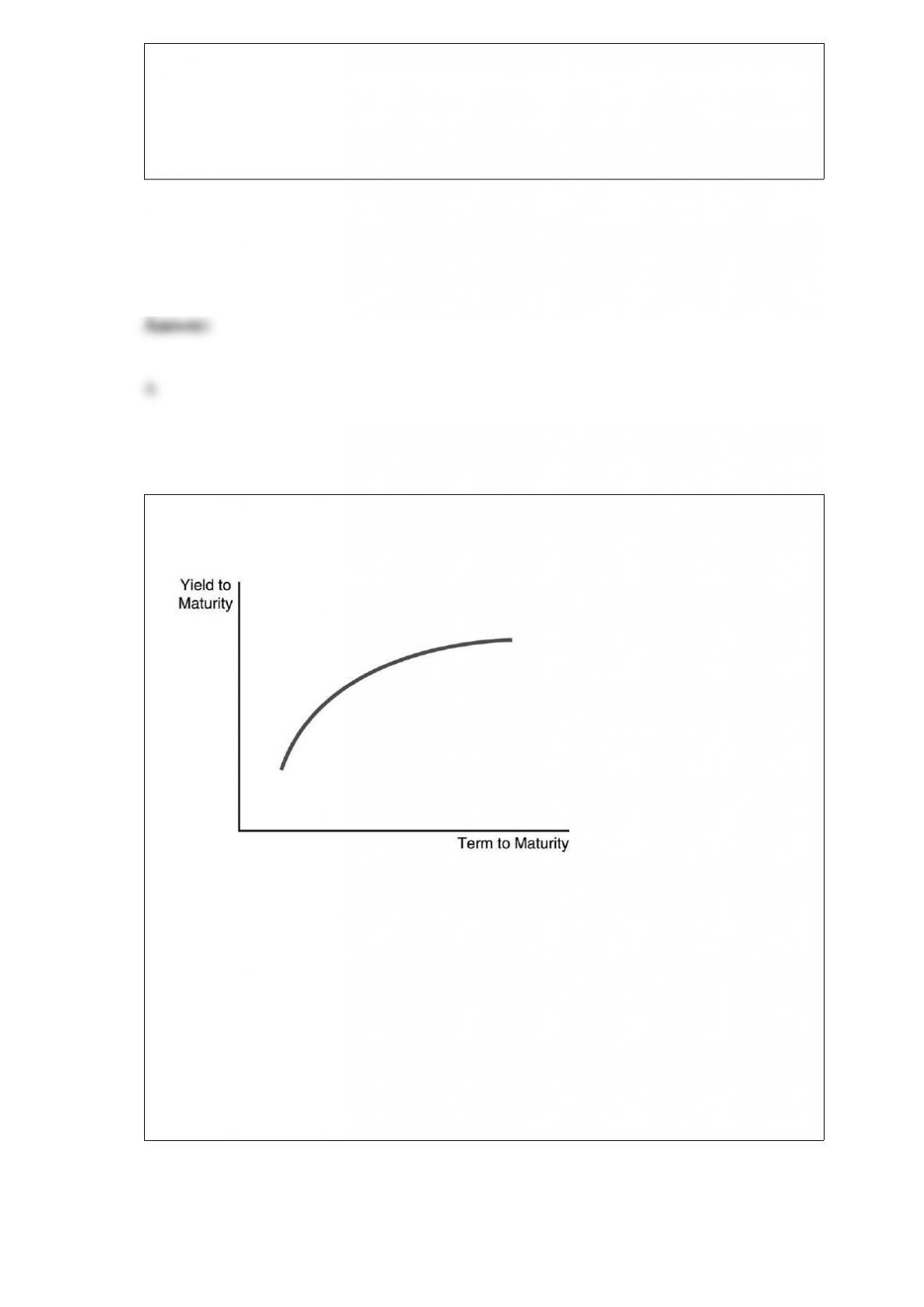
The steeply upward sloping yield curve in the figure above indicates that ________
interest rates are expected to ________ in the future.
A) short-term; rise
B) short-term; fall moderately
C) short-term; remain unchanged
D) long-term; fall moderately

Answer:
In the market for reserves, if the federal funds rate is between the discount rate and the
interest rate paid on excess reserves, an increase in the reserve requirement ________
the demand for reserves, ________ the federal funds rate, everything else held constant.
A) decreases; lowering
B) increases; lowering
C) increases; raising
D) decreases; raising
Answer:
Differences in ________ explain why interest rates on Treasury securities are not all the
same.
A) risk
B) liquidity
C) time to maturity
D) tax characteristics
Answer:

Like the dual banking system for commercial banks, thrifts can have either ________ or
________ charters.
A) state; federal
B) state; local
C) local; federal
D) municipal; federal
Answer:
When the price level falls, the ________ curve for nominal money ________, and
interest rates ________, everything else held constant.
A) demand; decreases; fall
B) demand; increases; rise
C) supply; increases; rise
D) supply; decreases; fall
Answer:

One reason financial systems in developing and transition countries are underdeveloped
is
A) they have weak links to their governments.
B) they make loans only to nonprofit entities.
C) the legal system may be poor making it difficult to enforce restrictive covenants.
D) the accounting standards are too stringent for the banks to meet.
Answer:
Foreign banks may engage in banking activities in the United States by opening all of
the following except
A) an agency office of the foreign bank.
B) a subsidiary U.S. bank.
C) a branch of the foreign bank.
D) a McFadden Corporation.
Answer:

The theory of purchasing power parity cannot fully explain exchange rate movements
because
A) all goods are identical even if produced in different countries.
B) monetary policy differs across countries.
C) some goods are not traded between countries.
D) fiscal policy differs across countries.
Answer:
That most used cars are sold by intermediaries (i.e., used car dealers) provides evidence
that these intermediaries
A) have been afforded special government treatment, since used car dealers do not
provide information that is valued by consumers of used cars.
B) are able to prevent potential competitors from free-riding off the information that
they provide.
C) have failed to solve adverse selection problems in this market because “lemons”
continue to be traded.
D) have solved the moral hazard problem by providing valuable information to their
customers.
Answer:

________ is the process of researching and developing profitable new products and
services by financial institutions.
A) Financial engineering
B) Financial manipulation
C) Customer manipulation
D) Customer engineering
Answer:
In the ISLM framework a contractionary fiscal policy causes aggregate output to
________ and the interest rate to ________, everything else held constant.
A) increase; increase
B) increase; decrease
C) decrease; decrease
D) decrease; increase
Answer:
Secondary reserves include

A) deposits at Federal Reserve Banks.
B) deposits at other large banks.
C) short-term Treasury securities.
D) state and local government securities.
Answer:
To be considered well capitalized, a bank’s leverage ratio must exceed
A) 10%.
B) 8%.
C) 5%.
D) 3%.
Answer:
In the market for reserves, when the federal funds interest rate is below the discount
rate, the supply curve of reserves is
A) vertical.
B) horizontal.

C) positively sloped.
D) negatively sloped.
Answer: