
In the generalized dividend model, the current stock price is the sum of
A) the actual value of the future dividend stream.
B) the present value of the future dividend stream.
C) the present value of the future dividend stream plus the actual future sales price.
D) the present value of the future sales price.
Answer:
Everything else held constant, if aggregate output is to the ________ of the IS curve,
then there is an excess demand of goods which will cause aggregate output to
________.
A) right; fall
B) right; rise
C) left; fall
D) left; rise
Answer:
In the early stages of the 1980s banking crisis, financial institutions were especially
harmed by

A) declining interest rates from late 1979 until 1981.
B) the severe recession in 1981-82.
C) the disinflation from mid 1980 to early 1983.
D) the increase in energy prices in the early 80s.
Answer:
During the boom years of the 1920s, bank failures were quite
A) uncommon, averaging less than 30 per year.
B) uncommon, averaging less than 100 per year.
C) common, averaging about 600 per year.
D) common, averaging about 1000 per year.
Answer:
A decrease in the foreign interest rate causes the demand for domestic assets to shift to
the ________ and the domestic currency to ________, everything else held constant.
A) right; appreciate

B) right; depreciate
C) left; appreciate
D) left; depreciate
Answer:
What makes the Federal Reserve so unique compared to other central banks around the
world is its
A) centralized structure.
B) decentralized structure.
C) regulatory functions.
D) monetary policy functions.
Answer:
Since 1980
A) bank profitability has declined.
B) banks have offset the decline in profits from traditional activities with increased
income from off-balance-sheet activities.

C) banks have offset the decline in profits from off-balance-sheet activities with
increased income from traditional activities.
D) bank profits have grown rapidly due to deregulation.
Answer:
A central bank’s attempt to prevent an appreciation of its currency can stimulate
domestic inflation if the ________ of its currency leads to ________ international
reserves which ________ the monetary base.
A) purchase; higher; increases
B) purchase; lower; decreases
C) sale; lower; decreases
D) sale; higher; increases
Answer:
Suppose, while cleaning out its closets, a worker at the Federal Reserve bank branch in
Memphis discovers a painting of Elvis (medium: acrylic on velvet) that used to grace
the walls of the conference room. Suppose further that, at a public auction, the bank
sells the painting for $19.95. This sale will cause ________ in the monetary base,
everything else held constant.
A) an increase of $19.95

B) an increase of more than $19.95
C) a decrease of $19.95
D) a decrease of more than $19.95
Answer:
All of the following are necessary criteria for a commodity to function as money except
A) it must deteriorate quickly.
B) it must be divisible.
C) it must be easy to carry.
D) it must be widely accepted.
Answer:
Which of the following can be described as involving indirect finance?
A) You make a loan to your neighbor.
B) You buy shares in a mutual fund.
C) You buy a U.S. Treasury bill from the U.S. Treasury.

D) A corporation buys a short-term security issued by another corporation in the
primary market.
Answer:
The Fed is considering eliminating
A) primary credit lending.
B) secondary credit lending.
C) seasonal credit lending.
D) its lender of last resort function.
Answer:
In the United States during the late 1970s, the nominal interest rates were quite high,
but the real interest rates were negative. From the Fisher equation, we can conclude that
expected inflation in the United States during this period was
A) irrelevant.
B) low.
C) negative.

D) high.
Answer:
If the Fed injects reserves into the banking system and they are held as excess reserves,
then the monetary base ________ and the money supply ________.
A) remains unchanged; remains unchanged
B) remains unchanged; increases
C) increases; increases
D) increases; remains unchanged
Answer:
If the required reserve ratio is 10 percent, currency in circulation is $400 billion,
checkable deposits are $1000 billion, and excess reserves total $1 billion, then the
excess reserves-checkable deposit ratio is
A) 0.01
B) 0.10
C) 0.001
D) 0.05

Answer:
If a financial institution has 50% of its portfolio in a bond with a five-year duration and
50% of its portfolio in a bond with a seven-year duration, what is the duration of the
portfolio?
A) 12 years
B) 7 years
C) 6 years
D) 5 years
Answer:
The implementation lag is
A) the time it takes for policy makers to obtain data indicating what is happening in the
economy.
B) the time it takes for policy makers to be sure of what the data are signaling about the
future course of the economy.
C) the time it takes to pass legislation to implement a particular policy.
D) the time it takes for policy makers to change policy instruments once they have
decided on the new policy.

E) the time it takes for the policy actually to have an impact on the economy.
Answer:
Because checking accounts are ________ liquid for the depositor than passbook
savings, they earn ________ interest rates.
A) less; higher
B) less; lower
C) more; higher
D) more; lower
Answer:
Suppose the U.S. economy is producing at the natural rate of output. An appreciation of
the U.S. dollar will cause ________ in real GDP in the short run and ________ in
inflation in the long run, everything else held constant. (Assume the appreciation causes
no effects in the supply side of the economy.)
A) an increase; an increase
B) a decrease; a decrease
C) no change; an increase

D) no change; a decrease
Answer:
The type of monetary policy that is used in Canada, New Zealand, and the United
Kingdom is
A) monetary targeting.
B) inflation targeting.
C) targeting with an implicit nominal anchor.
D) interest-rate targeting.
Answer:
The principal lender-savers are
A) governments.
B) businesses.
C) households.
D) foreigners.

Answer:
Everything else held constant, an increase in government spending will cause
A) aggregate demand to increase.
B) aggregate demand to decrease.
C) the quantity of aggregate demand to increase.
D) the quantity of aggregate demand to decrease.
Answer:
Which of the following is an example of an intermediate-term debt?
A) A thirty-year mortgage.
B) A sixty-month car loan.
C) A six month loan from a finance company.
D) A Treasury bond.
Answer:
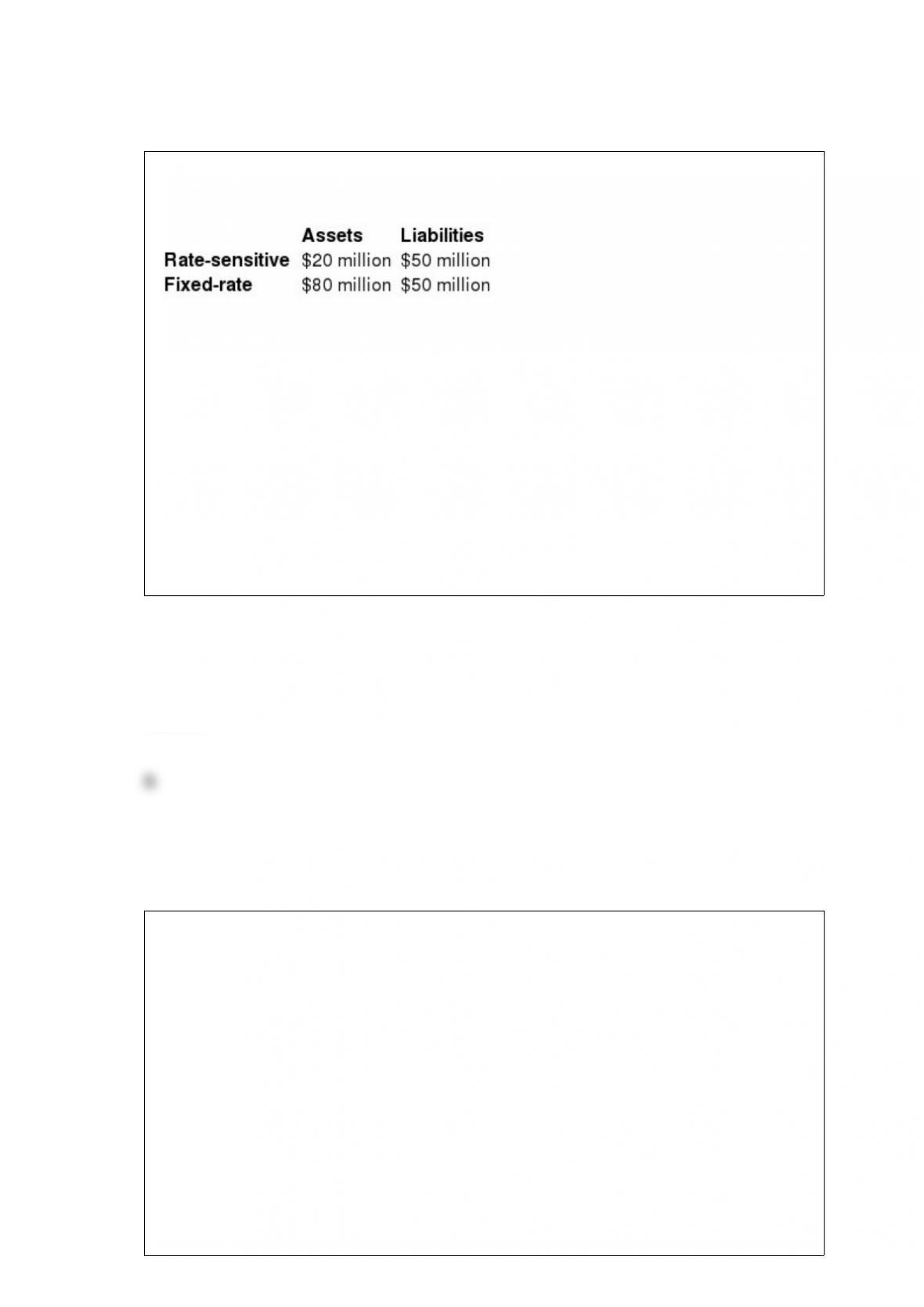
First National Bank
Assuming that the average duration of its assets is five years, while the average duration
of its liabilities is three years, then a 5 percentage point increase in interest rates will
cause the net worth of First National to decline by ________ of the total original asset
value.
A) 5 percent
B) 10 percent
C) 15 percent
D) 25 percent
Answer:
Assume a closed economy. Suppose that autonomous consumption equals $400,
planned investment equals $500, government expenditure equals $200, net taxes
equals $50, and the mpc equals 0.9.
If net exports increase by 250 and the mpc is 0.75, equilibrium aggregate output
increases by
A) 250
B) 500
C) 750

D) 1000
Answer:
U.S. Treasury bills pay no interest but are sold at a ________. That is, you will pay a
lower purchase price than the amount you receive at maturity.
A) premium
B) collateral
C) default
D) discount
Answer:
If the British pound appreciates from $0.50 per pound to $0.75 per pound, the U.S.
dollar depreciates from ________ per dollar to ________ per dollar.
A) £2; £2.5
B) £2; £1.33
C) £2; £1.5
D) £2; £1.25

Answer:
Stockholders are residual claimants, meaning that they
A) have the first priority claim on all of a company’s assets.
B) are liable for all of a company’s debts.
C) will never share in a company’s profits.
D) receive the remaining cash flow after all other claims are paid.
Answer:
The dollar amount of the yearly coupon payment expressed as a percentage of the face
value of the bond is called the bond’s
A) coupon rate.
B) maturity rate.
C) face value rate.
D) payment rate.
Answer:

If an individual moves money from a small-denomination time deposit to a demand
deposit account,
A) M1 increases and M2 stays the same.
B) M1 stays the same and M2 increases.
C) M1 stays the same and M2 stays the same.
D) M1 increases and M2 decreases.
Answer:
Everything else held constant, in the market for reserves, when the supply for federal
funds intersects the reserve demand curve on the downward sloping section, decreasing
the interest rate paid on excess reserves
A) increases the federal funds rate.
B) lowers the federal funds rate.
C) has no effect on the federal funds rate.
D) has an indeterminate effect on the federal funds rate.
Answer:

The ________ traces out the points for which total quantity of goods produced equals
total quantity of goods demanded.
A) LM curve
B) IS curve
C) consumption function
D) investment schedule
Answer:
Everything else held constant, a balanced budget increase in government spending (that
is, an increase in government spending that is matched by an identical increase in net
taxes) will
A) increase aggregate demand, but not by as much as if just government spending
increases.
B) increase aggregate demand by more than if just government spending increases.
C) not affect aggregate demand.
D) decrease aggregate demand.
Answer:

Under the Exchange Rate Mechanism of the European Monetary System, when the
German mark depreciated below its lower limit against the British pound, the Bank of
England was required to buy ________ and sell ________, thereby ________
international reserves.
A) pounds; marks; losing
B) pounds; marks; gaining
C) marks; pounds; gaining
D) marks; pounds; losing
Answer: