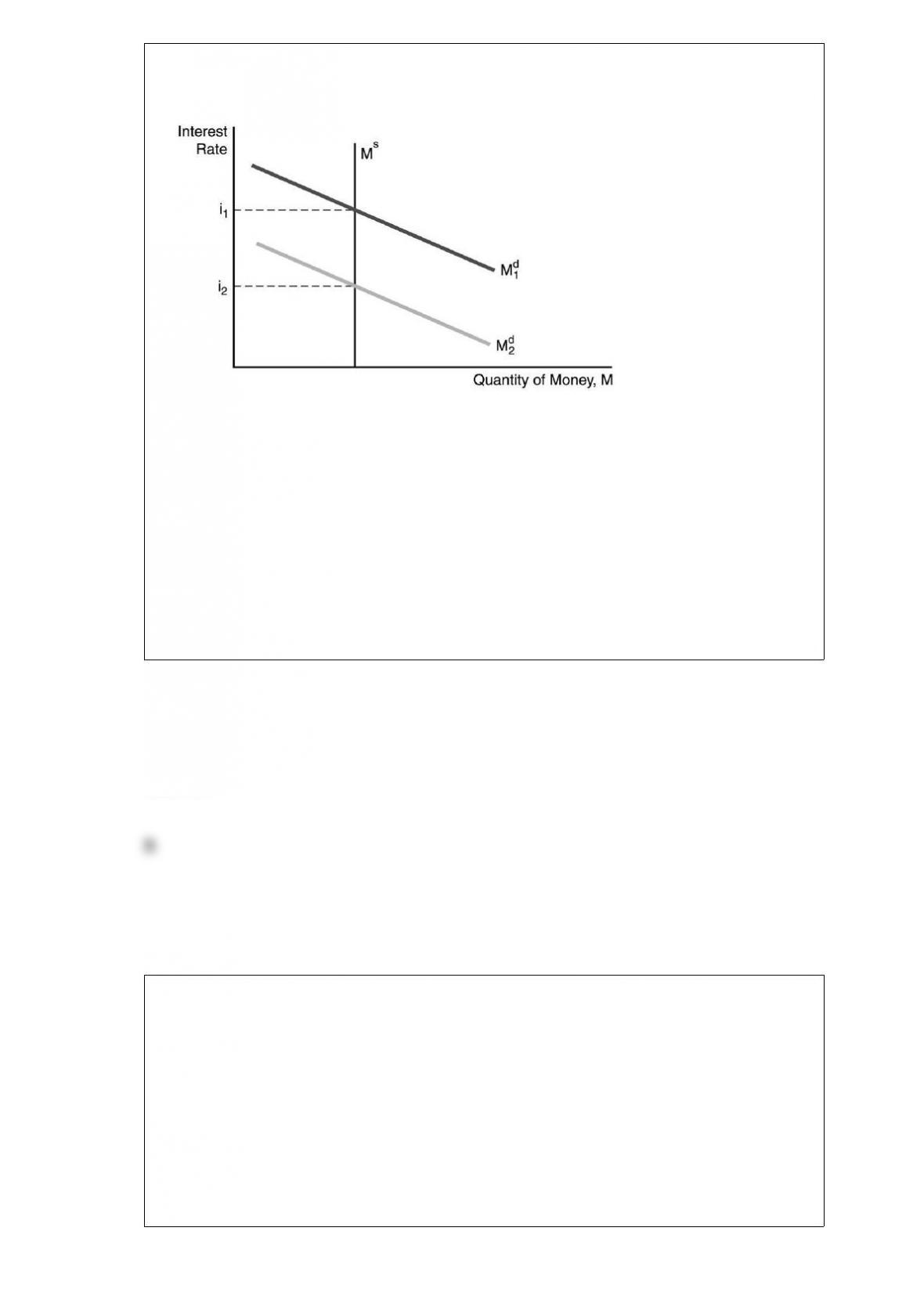
In the figure above, the decrease in the interest rate from i1 to i2 can be explained by
A) a decrease in money growth.
B) a decline in the expected price level.
C) an increase in income.
D) an increase in the expected price level.
Answer:
During World War II, the Fed in effect relinquished its control of monetary policy
through its policy of
A) continually lowering reserve requirements.
B) continually raising reserve requirements.
C) pegging interest rates.
D) targeting free reserves.

Answer:
________ in the foreign interest rate causes the demand for domestic assets to shift to
the right and the domestic currency to ________, everything else held constant.
A) An increase; appreciate
B) An increase; depreciate
C) A decrease; appreciate
D) A decrease; depreciate
Answer:
The ability to use the too-big-to-fail policy was curtailed by the passage of the FDICIA.
To use this action today, the FDIC must get approval of a two-thirds majority of both
the Board of Governors of the Federal Reserve and the directors of the FDIC and also
the approval of the
A) Secretary of the Treasury.
B) Senate Finance Committee Chairperson.
C) President of the United States.
D) Governor of the state in which the failed bank is located.

Answer:
Which of the following is not an operating instrument?
A) Nonborrowed reserves
B) Monetary base
C) Federal funds interest rate
D) Discount rate
Answer:
Currency circulated by banks that could be redeemed for gold was called
A) junk bonds.
B) banknotes.
C) gold bills.
D) state money.
Answer:

Which of the following is NOT an argument against using monetary policy to prick
asset-price bubbles?
A) The effect of increasing interest rates on asset prices is uncertain.
B) A bubble may only exist in some asset-prices and monetary policy will affect all
asset prices.
C) Using monetary policy to prick an asset-price bubble may have adverse effect on the
aggregate economy.
D) Even though credit-drive bubbles are easier to identify, they are still relatively hard
to identify.
Answer:
Everything else held constant, if aggregate output is to the left of the LM curve, then
there is an excess ________ of money which will cause the interest rate to ________.
A) supply; fall
B) supply; rise
C) demand; fall
D) demand; rise
Answer:

When the economy suffers a permanent negative supply shock and the central bank
responds by changing the autonomous component of monetary policy to keep inflation
at the target inflation rate, then
A) aggregate demand curve shifts leftward.
B) output will be unchanged.
C) output will be at its potential.
D) all of the above.
E) both A and C.
Answer:
If uncertainty about banks’ health causes depositors to begin to withdraw their funds
from banks, the country experiences a(n)
A) banking crisis.
B) financial recovery.
C) reduction of the adverse selection and moral hazard problems.
D) increase in information available to investors.
Answer:

Targeting interest rates can be procyclical because
A) an increase in income increases interest rates, causing the Fed to buy bonds,
increasing the monetary base and money supply, leading to further increases in income.
B) an increase in interest rates increases income, causing the Fed to buy bonds,
increasing the monetary base and money supply, leading to further increases in income.
C) an increase in the monetary base increases the money supply, causing the Fed to buy
bonds, increasing the monetary base and money supply, leading to further increases in
income.
D) an increase in income increases the monetary base and money supply, causing the
Fed to buy bonds to increase interest rates and income.
Answer:
Tobin’s q is defined as the market value of firms ________ the replacement cost of
capital.
A) times
B) minus
C) plus
D) divided by
Answer:

An important factor in producing the subprime mortgage crisis was
A) lax consumer protection regulation.
B) onerous rules placed on mortgage originators.
C) weak incentives for mortgage brokers to use complicated mortgage products.
D) strong incentives for the mortgage brokers to verify income information.
Answer:
If a borrower takes out a $200 million loan in a repo agreement and is asked to post
$220 million of mortgage-backed securities as collateral, the “haircut” is
A) 5%.
B) 10%.
C) 20%.
D) 50%.
Answer:

The time it takes for the policy actually to have an impact on the economy is called
A) the data lag.
B) the recognition lag.
C) the legislative lag.
D) the implementation lag.
E) the effectiveness lag.
Answer:
The U-shaped yield curve in the figure above indicates that the inflation rate is expected
to
A) remain constant in the near-term and fall later on.
B) fall sharply in the near-term and rise later on.
C) rise moderately in the near-term and fall later on.

D) remain constant in the near-term and rise later on.
Answer:
Under a fixed exchange rate regime, if a country has an undervalued exchange rate,
then its central bank’s attempt to keep its currency from ________ will result in a
________ of international reserves.
A) depreciating; gain
B) depreciating; loss
C) appreciating; gain
D) appreciating; loss
Answer:
When yield curves are downward sloping,
A) long-term interest rates are above short-term interest rates.
B) short-term interest rates are above long-term interest rates.
C) short-term interest rates are about the same as long-term interest rates.
D) medium-term interest rates are above both short-term and long-term interest rates.

Answer:
A key assumption in the segmented markets theory is that bonds of different maturities
A) are not substitutes at all.
B) are perfect substitutes.
C) are substitutes only if the investor is given a premium incentive.
D) are substitutes but not perfect substitutes.
Answer:
Financial markets promote greater economic efficiency by channeling funds from
________ to ________.
A) investors; savers
B) borrowers; savers
C) savers; borrowers
D) savers; lenders
Answer:

Everything else held constant, a change in workers’ expectations about inflation will
cause ________ to change.
A) aggregate demand
B) short-run aggregate supply
C) the production function
D) long-run aggregate supply
Answer:
In the long-run ISLM model and with everything else held constant, the long-run effect
of an autonomous increase in investment is to ________ real output and ________ the
interest rate.
A) increase; increase
B) increase; not change
C) not change; increase
D) not change; decrease
Answer:

Suppose the economy is producing at the natural rate of output. Assuming a fixed
natural rate of output and everything else held constant, the development of a new,
more productive technology will cause ________ in the unemployment rate and
________ in the inflation in the long run.
A) an increase; an increase
B) a decrease; a decrease
C) a decrease; an increase
D) no change; no change
Answer:
The primary assets of money market mutual funds are
A) stocks.
B) bonds.
C) money market instruments.
D) deposits.
Answer:

Duration is
A) an asset’s term to maturity.
B) the time until the next interest payment for a coupon bond.
C) the average lifetime of a debt security’s stream of payments.
D) the time between interest payments for a coupon bond.
Answer:
When the interest rate changes,
A) the demand curve for bonds shifts to the right.
B) the demand curve for bonds shifts to the left.
C) the supply curve for bonds shifts to the right.
D) it is because either the demand or the supply curve has shifted.
Answer:
Factors causing an increase in currency holdings include

A) an increase in the interest rates paid on checkable deposits.
B) an increase in the cost of acquiring currency.
C) a decrease in bank panics.
D) an increase in illegal activity.
Answer:
Policy makers cannot achieve both price stability and economic activity stability when
facing
A) temporary supply shocks.
B) permanent supply shocks.
C) demand shocks.
D) all of the above.
Answer:
During the 1950s, the Fed targeted
A) M1.
B) M2.

C) the monetary base.
D) money market conditions.
Answer:
Open market operations intended to offset movements in noncontrollable factors (such
as float) that affect reserves and the monetary base are called
A) defensive open market operations.
B) dynamic open market operations.
C) offensive open market operations.
D) reactionary open market operations.
Answer:
A decrease in the riskiness of corporate bonds will ________ the yield on corporate
bonds and ________ the yield on Treasury securities, everything else held constant.
A) increase; increase
B) decrease; decrease
C) increase; decrease

D) decrease; increase
Answer: