Of the four factors that influence asset demand, which factor will cause the demand for
all assets to increase when it increases, everything else held constant?
A) wealth
B) expected returns
C) risk
D) liquidity
Answer:
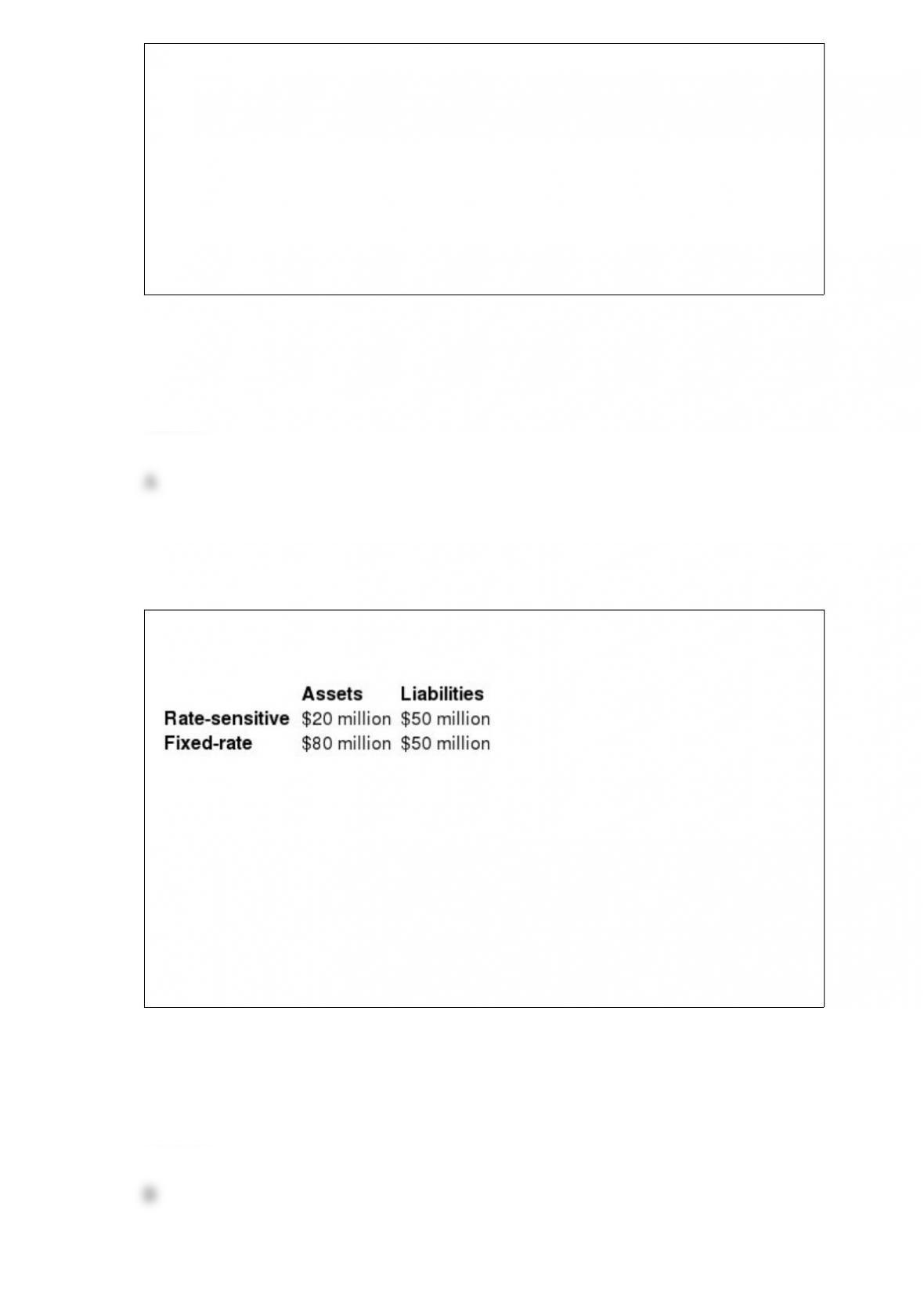
First National Bank
If interest rates rise by 5 percentage points, say, from 10 to 15%, bank profits (measured
using gap analysis) will
A) decline by $0.5 million.
B) decline by $1.5 million.
C) decline by $2.5 million.
D) increase by $1.5 million.
Answer:

In order to reduce risk and increase the safety of financial institutions, commercial
banks and other depository institutions are prohibited from
A) owning municipal bonds.
B) making real estate loans.
C) making personal loans.
D) owning common stock.
Answer:
The U.S. government can play an important role in establishing the credibility of
anti-inflation policy by
A) demonstrating fiscal responsibility.
B) monitoring the Fed.
C) conducting fiscal policy.
D) all of the above.
Answer:

A borrowed reserves target is ________ because increases in income ________ interest
rates and discount loans, causing the Fed to ________ the monetary base, everything
else held constant.
A) procyclical; increase; increase
B) countercyclical; increase; increase
C) procyclical; reduce; reduce
D) countercyclical; reduce; reduce
Answer:
Everything else held constant, an autonomous easing of monetary policy will cause
A) aggregate demand to increase.
B) aggregate demand to decrease.
C) the quantity of aggregate demand to increase.
D) the quantity of aggregate demand to decrease.
Answer:
Examples of off-balance-sheet activities include

A) loan sales.
B) extending loans to depositors.
C) borrowing from other banks.
D) selling negotiable CDs.
Answer:
There is a ________ association between inflation and the growth rate of money
________.
A) positive; demand
B) positive; supply
C) negative; demand
D) negative; supply
Answer:
According to aggregate demand and supply analysis, the rising oil prices coupled with
the global financial crisis in 2007-2008 caused the unemployment rate to ________ and
the level of real aggregate output to ________.
A) increase; increase

B) increase; decrease
C) decrease; increase
D) decrease; decrease
Answer:
According to Tobin’s q theory, when equity prices are high the market price of existing
capital is ________ relative to new capital, so expenditure on fixed investment is
________.
A) cheap; low
B) dear ; low
C) cheap; high
D) dear; high
Answer:
If the CPI in 2004 is 200, and in 2005 the CPI is 180, the rate of inflation from 2004 to
2005 is
A) 20%.

B) 10%.
C) 0%.
D) -10%.
Answer:
The most common type of discount lending, ________ credit loans, are intended to help
healthy banks with short-term liquidity problems that often result from temporary
deposit outflows.
A) secondary
B) primary
C) temporary
D) seasonal
Answer:
The monetary transmission mechanism that links monetary policy to GDP through real
interest rates and investment spending is called the
A) traditional interest-rate channel.
B) Tobins’ q theory.

C) wealth effects.
D) cash flow channel.
Answer:
________ and ________ may provide an explanation for stock market bubbles.
A) Overconfidence; social contagion
B) Underconfidence; social contagion
C) Overconfidence; social isolationism
D) Underconfidence; social isolationism
Answer:
Under the Bretton Woods system, a country running a balance of payments deficit
________ international reserves, and had to implement ________ monetary policy to
strengthen its currency.
A) lost; expansionary
B) lost; contractionary
C) gained; expansionary

D) gained; contractionary
Answer:
Off-balance sheet activities involving guarantees of securities and back-up credit lines
A) have no impact on the risk a bank faces.
B) greatly reduce the risk a bank faces.
C) increase the risk a bank faces.
D) slightly reduce the risk a bank faces.
Answer:
When the value of the dollar changes from £0.5 to £0.75, then the British pound has
________ and the U.S. dollar has ________.
A) appreciated; appreciated
B) depreciated; appreciated
C) appreciated; depreciated
D) depreciated; depreciated

Answer:
The starting point for understanding how exchange rates are determined is a simple idea
called ________, which states: if two countries produce an identical good, the price of
the good should be the same throughout the world no matter which country produces it.
A) Gresham’s law
B) the law of one price
C) purchasing power parity
D) arbitrage
Answer:
Assume a closed economy with no government. Suppose that autonomous
consumption equals $400, planned investment equals $500, and the mpc equals 0.9.
Using the information in Situation 20-1, the equilibrium level of aggregate output is
A) $900
B) $8,000
C) $9,000
D) $10,000

Answer:
If the price of a euro (the European currency) increases from $1.00 to $1.10, then,
everything else held constant,
A) a European vacation becomes less expensive.
B) a European vacation becomes more expensive.
C) the cost of a European vacation is not affected.
D) foreign travel becomes impossible.
Answer:
When a $10 check written on the First National Bank of Chicago is deposited in an
account at Citibank, then
A) the liabilities of the First National Bank increase by $10.
B) the reserves of the First National Bank increase by $ 10.
C) the liabilities of Citibank increase by $10.
D) the assets of Citibank fall by $10.
Answer:
The goal for high employment should be a level of unemployment at which the demand
for labor equals the supply of labor. Economists call this level of unemployment the
A) frictional level of unemployment.
B) structural level of unemployment.
C) natural rate level of unemployment.
D) Keynesian rate level of unemployment.
Answer:
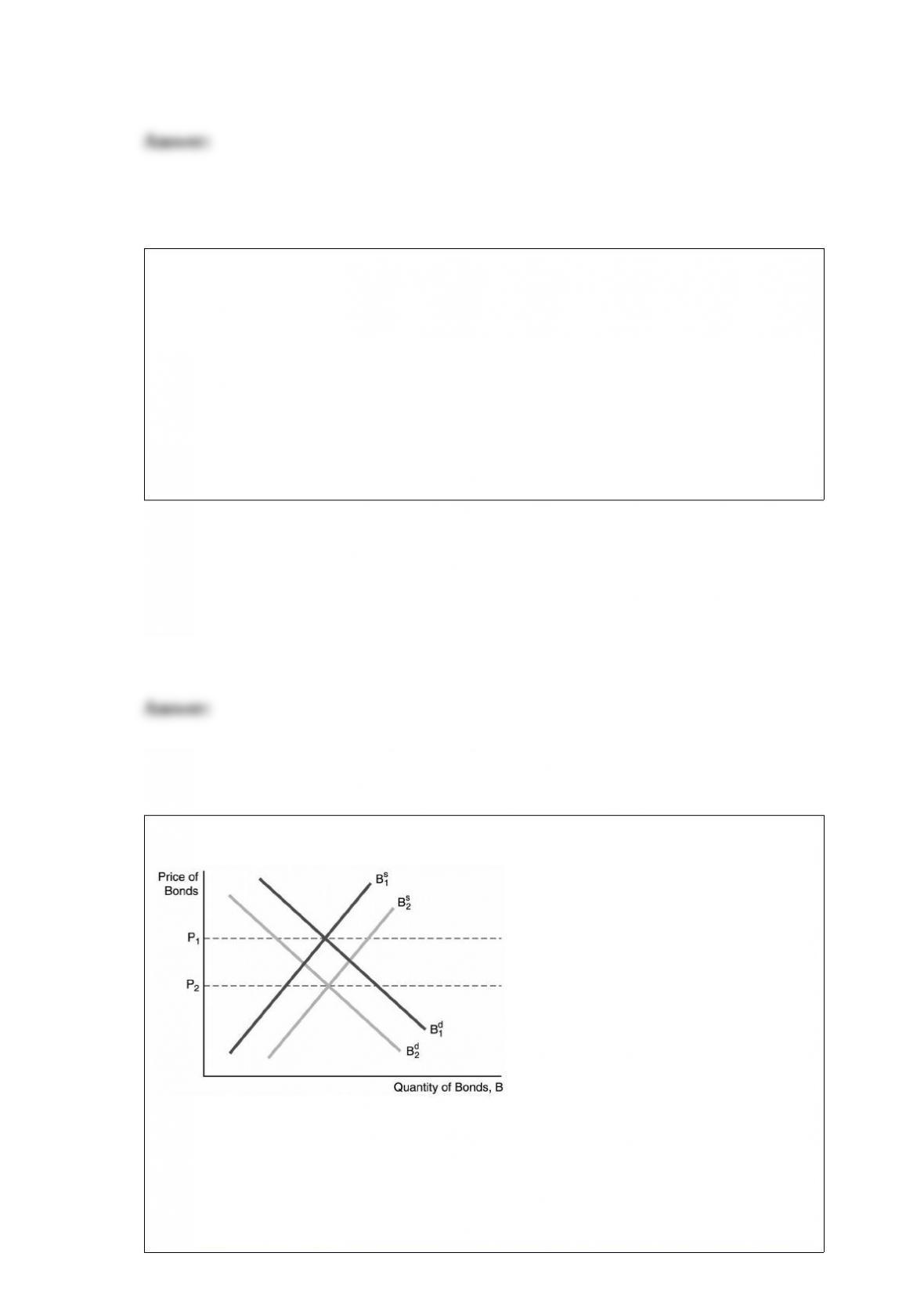
In the figure above, the price of bonds would fall from P1 to P2 when
A) inflation is expected to increase in the future.
B) interest rates are expected to fall in the future.

C) the expected return on bonds relative to other assets is expected to increase in the
future.
D) the riskiness of bonds falls relative to other assets.
Answer:
The discount rate refers to the interest rate on
A) primary credit.
B) secondary credit.
C) seasonal credit.
D) federal funds.
Answer:
External financing by ________ should be more important in developing countries than
in industrialized countries because information about private firms is more difficult to
collect in developing countries.
A) financial intermediaries
B) bonds

C) stock
D) direct lending
Answer:
Which of the following securities has the lowest interest rate?
A) Junk bonds
B) U.S. Treasury bonds
C) Investment-grade bonds
D) Corporate Baa bonds
Answer:
The volume of loans that the Fed makes to banks is affected by the Fed’s setting of the
interest rate on these loans, called the
A) federal funds rate.
B) prime rate.
C) discount rate.
D) interbank rate.

Answer:
Keynes’s model of the demand for money suggests that velocity is
A) constant.
B) positively related to interest rates.
C) negatively related to interest rates.
D) positively related to bond values.
Answer:
If you default on your auto loan, your car will be repossessed because it has been
pledged as ________ for the loan.
A) interest
B) collateral
C) dividend
D) commodity
Answer:

Higher tariffs and quotas cause a country’s currency to ________ in the ________ run,
everything else held constant.
A) depreciate; short
B) appreciate; short
C) depreciate; long
D) appreciate; long
Answer:
If the required reserve ratio is 10 percent, currency in circulation is $400 billion,
checkable deposits are $800 billion, and excess reserves total $0.8 billion, then the
excess reserves-checkable deposit ratio is
A) 0.001
B) 0.1
C) 0.01
D) 0.05
Answer:

All of the following are operating expenses for a bank except
A) service charges on deposit accounts.
B) salaries and employee benefits.
C) rent on buildings.
D) servicing costs of equipment such as computers.
Answer:
In the Keynesian framework, as long as output is ________ the equilibrium level,
unplanned inventory investment will remain positive and firms will continue to
________ production.
A) below; lower
B) above; lower
C) below; raise
D) above; raise
Answer:
Which of the following criteria need not be satisfied for choosing a policy instrument?
A) The variable must be measurable.
B) The variable must be controllable.
C) The variable must be predictable.
D) The variable must be transportable.
Answer:
Everything else held constant, an increase in net taxes ________ aggregate ________.
A) increases; demand
B) decreases; demand
C) decreases; supply
D) increases; supply
Answer: