
When the interest rate on a bond is ________ the equilibrium interest rate, in the bond
market there is excess ________ and the interest rate will ________.
A) above; demand; rise
B) above; demand; fall
C) below; supply; fall
D) above; supply; rise
Answer:
Regulations designed to provide information to the marketplace so that investors can
make informed decisions are called
A) disclosure requirements.
B) efficient market requirements.
C) asset restrictions.
D) capital requirements.
Answer:
When the inflation rate is expected to increase, the ________ for bonds falls, while the
________ curve shifts to the right, everything else held constant.

A) demand; demand
B) demand; supply
C) supply; demand
D) supply; supply
Answer:
A situation in which the quantity of bonds supplied exceeds the quantity of bonds
demanded is called a condition of excess supply; because people want to sell ________
bonds than others want to buy, the price of bonds will ________.
A) fewer; fall
B) fewer; rise
C) more; fall
D) more; rise
Answer:
The real bills doctrine was the guiding principle for the conduct of monetary policy
during the

A) 1910s.
B) 1940s.
C) 1950s.
D) 1960s.
Answer:
Banks subject to reserve requirements set by the Federal Reserve System include
A) only nationally chartered banks.
B) only banks with assets less than $100 million.
C) only banks with assets less than $500 million.
D) all banks whether or not they are members of the Federal Reserve System.
Answer:
Rules used to predict movements in stock prices based on past patterns are, according to
the efficient markets hypothesis,
A) a waste of time.
B) profitably employed by all financial analysts.

C) the most efficient rules to employ.
D) consistent with the random walk hypothesis.
Answer:
Of the following, which would be the first choice for a bank facing a reserve
deficiency?
A) Call in loans
B) Borrow from the Fed
C) Sell securities
D) Borrow from other banks
Answer:
If a perpetuity has a price of $500 and an annual interest payment of $25, the interest
rate is
A) 5 percent.
B) 5 percent.
C) 5 percent.

D) 10 percent.
Answer:
In response to the overvalued dollar in the early 1970s, the German Bundesbank bought
dollars and sold marks to keep the exchange rate fixed, gaining international reserves.
The huge purchase of international reserves meant that the German monetary base
began to ________, leading to ________ growth in the German money supply.
A) decline; sluggish
B) decline; rapid
C) grow; sluggish
D) grow; rapid
Answer:
The steepest increase in the currency ratio since 1892 occurred during
A) World War II.
B) the Great Depression.
C) the interwar years.

D) the past twenty years.
Answer:
If there are five goods in a barter economy, one needs to know ten prices in order to
exchange one good for another. If, however, there are ten goods in a barter economy,
then one needs to know ________ prices in order to exchange one good for another.
A) 20
B) 25
C) 30
D) 45
Answer:
The Fed’s mistakes of the early 1930s were compounded by its decision to
A) raise reserve requirements in 1936-1937.
B) lower reserve requirements in 1936-1937.
C) raise the monetary base in 1936-1937.
D) lower the monetary base in 1936-1937.

Answer:
Tobin’s model of the speculative demand for money improves on Keynes’s analysis by
showing that
A) the speculative demand for money is interest insensitive.
B) the transactions demand for money is interest insensitive.
C) people will hold a diversified portfolio.
D) people will hold money or bonds but not both.
Answer:
The view that expectations change relatively slowly over time in response to new
information is known in economics as
A) rational expectations.
B) irrational expectations.
C) slow-response expectations.
D) adaptive expectations.

Answer:
When gold prices become more volatile, the ________ curve for gold shifts to the
________; ________ the price of gold.
A) supply; right; increasing
B) supply; left; increasing
C) demand; right; decreasing
D) demand; left; decreasing
Answer:
Banks that actively manage liabilities will most likely meet a reserve shortfall by
A) calling in loans.
B) borrowing federal funds.
C) selling municipal bonds.
D) seeking new deposits.
Answer:
Banks face the problem of ________ in loan markets because bad credit risks are the
ones most likely to seek bank loans.
A) adverse selection
B) moral hazard
C) moral suasion
D) intentional fraud
Answer:
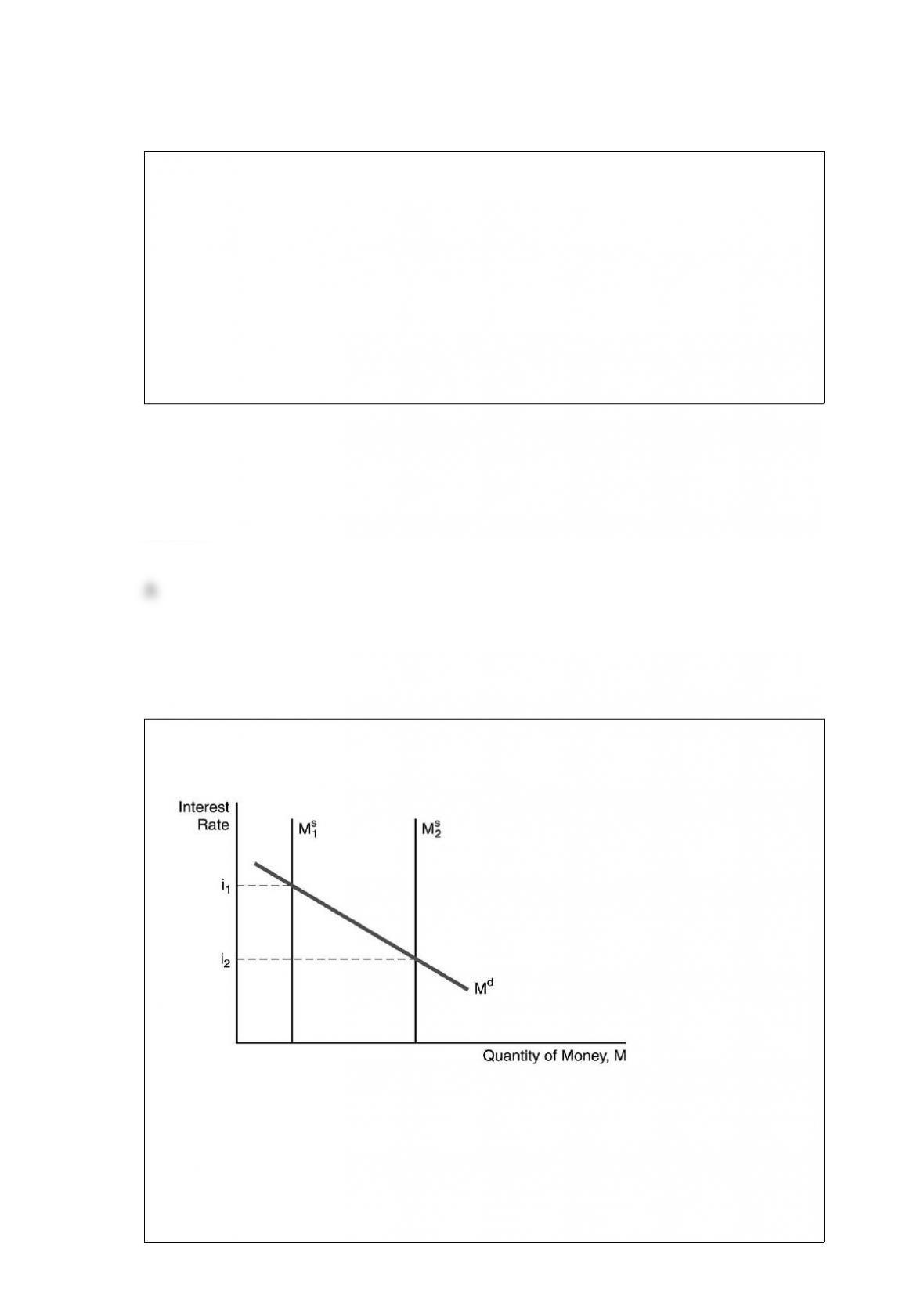
In the figure above, the decrease in the interest rate from i1 to i2 can be explained by
A) a decrease in money growth.
B) an increase in money growth.

C) a decline in the expected price level.
D) an increase in income.
Answer:
Everything else held constant, a decrease in marginal tax rates would likely have the
effect of ________ the demand for municipal bonds, and ________ the demand for
U.S. government bonds.
A) increasing; increasing
B) increasing; decreasing
C) decreasing; increasing
D) decreasing; decreasing
Answer:
A feature of debt markets in emerging-market countries is that debt contracts are
typically
A) very short term.
B) long term.

C) intermediate term.
D) perpetual.
Answer:
Financial institutions that accept deposits and make loans are called ________
institutions.
A) investment
B) contractual savings
C) depository
D) underwriting
Answer:
The mandate for the monetary policy goals that has been given to the Federal Reserve
System is an example of a ________ mandate.
A) primary
B) dual
C) secondary

D) hierarchical
Answer:
The upward slope of the MP curve indicates that
A) the central bank lowers real interest rates when inflation rises.
B) the central bank raises real interest rates when inflation falls.
C) the central bank raises nominal interest rates when inflation rises.
D) the central bank raises real interest rates when inflation rises.
Answer:
The advantage of a “buy-and-hold strategy” is that
A) net profits will tend to be higher because there will be fewer brokerage
commissions.
B) losses will eventually be eliminated.
C) the longer a stock is held, the higher will be its price.
D) profits are guaranteed.

Answer:
For simple loans, the simple interest rate is ________ the yield to maturity.
A) greater than
B) less than
C) equal to
D) not comparable to
Answer:
Deposit insurance is only one type of government safety net. All of the following are
types of government support for troubled financial institutions except
A) forgiving tax debt.
B) lending from the central bank.
C) lending directly from the government’s treasury department.
D) nationalizing and guaranteeing that all creditors will be repaid their loans in full.
Answer:

Which of the following is included in both M1 and M2?
A) Currency
B) Savings deposits
C) Small-denomination time deposits
D) Money market deposit accounts
Answer:
Nonfinancial businesses in Germany, Japan, and Canada raise most of their funds
A) by issuing stock.
B) by issuing bonds.
C) from nonbank loans.
D) from bank loans.
Answer:

The total quantity of an economy’s final goods and services demanded at different
inflation rates is
A) the aggregate supply curve.
B) the aggregate demand curve.
C) the Phillips curve.
D) the aggregate expenditure function.
Answer: