Archives
978-0078036811 Chapter 1 Lecture Note 1
Chapter 1 Communication: Begin Right Here! ABOUT CHAPTER 1 This chapter is designed to set the scene for your students’ study of communication. By introducing them to communication in general, we help them understand the nature of the communicative act […]
978-0078036811 Chapter 1 Lecture Note 2
1.9 SKILL BUILDER: Exploring the World of the Cybercommunicator Describe the role that online interaction presently plays in your life. Next, interview three people to discover the role it plays in their lives. Finally, identify the reasons you and the […]

978-0078036811 Chapter 10 Lecture Note
Chapter 10 Leading Others and Resolving Conflict ABOUT CHAPTER 10 In this chapter we define leadership, and we distinguish among leadership styles. We explore how trait theory, situational theory, functional theory and transformational leadership contribute to our understanding of leadership […]

978-0078036811 Chapter 11 Lecture Note
Chapter 11 The Speaker and the Audience; The Occasion and the Subject ABOUT CHAPTER 11 In this chapter, students learn that public communication occurs in a somewhat formal setting and requires the communicator to be extremely well prepared. They then […]
978-0078036811 Chapter 12 Lecture Note
Chapter 12 Researching, Supporting, and Outlining Your Speech ABOUT CHAPTER 12 In this chapter, students continue their work on public speaking, examining the topic- development stage of the process. They learn about gathering various research materials and integrating these materials […]
978-0078036811 Chapter 13 Lecture Note
Chapter 13 Preparing Presentation Aids and Delivering Your Speech ABOUT CHAPTER 13 In this chapter students explore visual and audio support in the form of models, photographs, drawings, videotapes, audiotapes, and other sources. Power Point techniques and guidelines are covered […]
978-0078036811 Chapter 14 Lecture Note
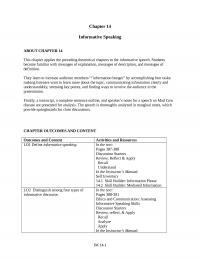
Chapter 14 Informative Speaking ABOUT CHAPTER 14 This chapter applies the preceding theoretical chapters to the informative speech. Students become familiar with messages of explanation, messages of description, and messages of definition. They learn to increase audience members’ “’information hunger” […]

978-0078036811 Chapter 15 Lecture Note
Chapter 15 Persuasive Speaking ABOUT CHAPTER 15 The purpose of this chapter is to increase students’ ability to prepare and present persuasive speeches. They consider the persuader’s purpose and techniques for becoming a more effective persuader. Students also explore listeners’ […]
978-0078036811 Chapter 16 Instructor Part 1
Instructor’s Resource Integrator Manual to accompany Communication Works ELEVENTH EDITION Teri Kwal Gamble College of New Rochelle Michael Gamble New York Institute of Technology CONTENTS SECTION ONE: TO THE INSTRUCTOR SECTION TWO: STRATEGIES FOR TEACHING Chapter-by-chapter resources for instructors Part […]
978-0078036811 Chapter 16 Instructor Part 2
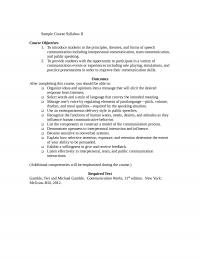
Sample Course Syllabus II Course Objectives 1. To introduce students to the principles, theories, and forms of speech communication including interpersonal communication, team communication, and public speaking. 2. To provide students with the opportunity to participate in a variety of […]

978-0078036811 Chapter 17 Lecture Note
APPENDIX Interviewing and Developing Professional Relationships ABOUT THE APPENDIX During the course of their lives, students will take part in a number of interviews as either interviewee or interviewer. This chapter gives them the opportunity to explore both sides of […]

978-0078036811 Chapter 18 Section Three Part 1
SECTION THREE SELF ASSESSMENT SCALES To the student: Filling out these scales will help you identify which concepts in each chapter you have mastered and which concepts need further attention. SELF-ASSESSMENT SCALES FOR CHAPTER 1 Communication: The Starting Line 1. […]
978-0078036811 Chapter 18 Section Three Part 2
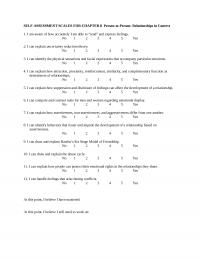
SELF-ASSESSMENT SCALES FOR CHAPTER 8 Person-to-Person: Relationships in Context 1. I am aware of how accurately I am able to “read” and express feelings. No 1 2 3 4 5 Yes 2. I can explain uncertainty reduction theory. No 1 […]

978-0078036811 Chapter 2 Lecture Note
Chapter 2 Communicating in a Multicultural Society and World ABOUT CHAPTER 2 In this chapter we introduce students to the fact that we live in an age of increased global contact and diversity. Thus, enhancing our understanding of sensitivity to […]

978-0078036811 Chapter 3 Lecture Note 1
Chapter 3 The “I” Behind the Eye: Perception and the Self ABOUT CHAPTER 3 In this chapter students explore how they see themselves and how they see the world around them. We explore questions like: Who are you? How do […]
978-0078036811 Chapter 3 Lecture Note 2
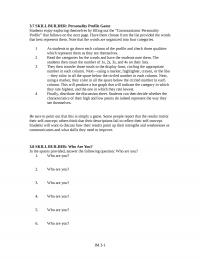
3.7 SKILL BUILDER: Personality Profile Game Students enjoy exploring themselves by filling out the “Communicator Personality Profile” that follows on the next page. Have them choose from the list provided the words that best represent them. Note that the words […]
978-0078036811 Chapter 4 Lecture Note 1
Chapter 4 Language and Meaning: Helping Minds Meet ABOUT CHAPTER 4 In this chapter you introduce your students to the concept of language as a system of symbols that permits us to share meanings. They have an opportunity to consider […]
978-0078036811 Chapter 4 Lecture Note 2
4.9 SKILL BUILDER: Political Speak Ask students to find texts of, or excerpts from, recent political speeches, and identify apparent examples of political “babble.” What information (if any) do the “babble” words actually convey? Next ask the students to give […]
978-0078036811 Chapter 5 Lecture Note 1
Chapter 5 Nonverbal Communication: Silent Language Speaks ABOUT CHAPTER 5 In this chapter your students explore nonverbal communication—all the kinds of human responses not expressed in words. They will learn why perceiving and analyzing nonverbal cues can help them understand […]
978-0078036811 Chapter 5 Lecture Note 2
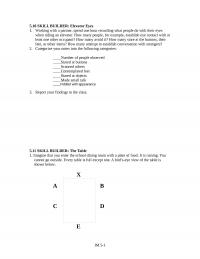
5.10 SKILL BUILDER: Elevator Eyes 1. Working with a partner, spend one hour recording what people do with their eyes when riding an elevator. How many people, for example, establish eye contact with at least one other occupant? How many […]
978-0078036811 Chapter 6 Lecture Note
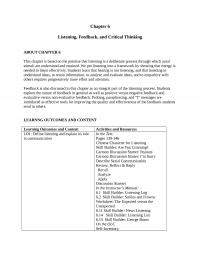
Chapter 6 Listening, Feedback, and Critical Thinking ABOUT CHAPTER 6 This chapter is based on the premise that listening is a deliberate process through which aural stimuli are understood and retained. We put listening into a framework by showing that […]

978-0078036811 Chapter 7 Lecture Note
Chapter 7 Understanding Relationships ABOUT CHAPTER 7 In this chapter students learn that communication is the one variable common to all our relationships. They are given an opportunity to explore human beings’ needs for inclusion, control, and affection—that is, the […]

978-0078036811 Chapter 8 Lecture Note
Chapter 8 Person-to-Person: Relationships in Context ABOUT CHAPTER 8 In this chapter students learn that emotions can have a significant impact on relationships. As communicators, people experience some emotion at all times. If we have a tendency to experience one […]
978-0078036811 Chapter 9 Lecture Note 1
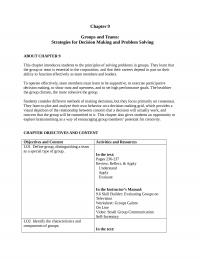
Chapter 9 Groups and Teams: Strategies for Decision Making and Problem Solving ABOUT CHAPTER 9 This chapter introduces students to the principles of solving problems in groups. They learn that the group or team is essential in the corporation, and […]

978-0078036811 Chapter 9 Lecture Note 2
9.4 SKILL BUILDER: Brain Power through Brainstorming Use these two cases to help students experience brainstorming. Case A: A Stitch in Time A woman was surprised to discover that her somewhat eccentric uncle had left her more than 1 million […]
CAS 54932
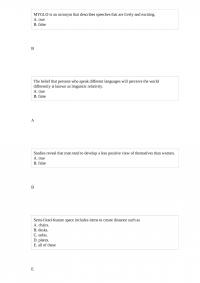
MYGLO is an acronym that describes speeches that are lively and exciting. A. true B. false The belief that persons who speak different languages will perceive the world differently is known as linguistic relativity. A. true B. false A Studies […]
CAS 56742
The United States is now the _____ demographically diverse country in the world. A. most B. least C. newest D. none of these Which of the following statements is true of the opening phase of an interview? A. It should […]
CAS 65522
In general, people learn more if they are permitted to remain passive during a presentation. A. true B. false B A way to create information hunger is to give the audience so much information that they will inevitably be interested […]
CAS 80255
The digital divide refers to the lack of access to online information by the elderly, poor, and others around the world. A. true B. false According to the text, Americans give more direct feedback to each other than Japanese people. […]
CAS 95358
We are born with our self-concept. A. true B. false Informal rules for interaction in a group are called group A. goals. B. structure. C. norms. D. climate. C According to the Sapir-Whorf hypothesis, A. meaning and culture are unrelated. […]
COM CM 36177
Which of the following statements about role reversal is true? A. You can understand the other person’s arguments in order to counter them more effectively. B. You can avoid judging the other person by seeing things from his or her […]
COM CM 85588
Chronemics refers to the study of the use of A. time. B. color. C. touch. D. distance. E. none of these To convince listeners to change their attitudes and beliefs, it is suggested that you first A. show them that […]
COMM 23784
According to Eric Berne, we A. constantly invent new scripts to meet new situations. B. demonstrate great flexibility in communication. C. sometimes enact similar scripts with different sets of players. E. take many vacations. An effective way to make sure […]
COMM 60234
According to uncertainty reduction theory, when we initially meet someone we are uncertain about the relationship. A. true B. false The interpretation of a message or the behavior of a leader often varies according to the gender of the leader. […]
COMM 82970
We spend more time sleeping than interacting with the media. A. true B. false A job interview is A. purposeful. B. planned. C. decision making. D. all of these D Mindfulness allows us to focus on another person and what […]
COMU 19974
The proverb, “Even the emperor cannot buy back one single day” implies that A. the emperor has no clothes if he cannot communicate effectively. B. the emperor is an ineffective communicator. C. communication is unrepeatable and irreversible. D. communication is […]
COMU 30048
Benjamin Whorf believed that our words determine the way we interpret the world. A. true B. false An interpersonal relationship is A. an online relationship. B. a sexual relationship. C. a meaningful relationship. D. a phatic relationship. C Emotions may […]
COMU 34782
Which of the following statements about groups is correct? A. A group is a collection of people. B. A group is a random assemblage of independent individuals. C. A group is composed of individuals who cooperate with one another to […]
COMU 77165
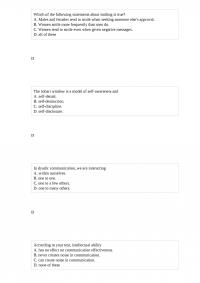
Which of the following statements about smiling is true? A. Males and females tend to smile when seeking someone else’s approval. B. Women smile more frequently than men do. C. Women tend to smile even when given negative messages. D. […]
COMU 81967
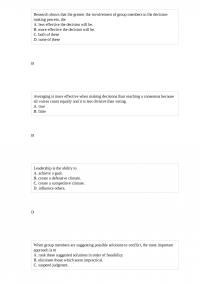
Research shows that the greater the involvement of group members in the decision- making process, the A. less effective the decision will be. B. more effective the decision will be. C. both of these D. none of these Averaging is […]
COMU 85442
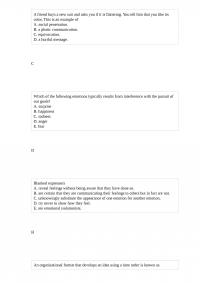
A friend buys a new suit and asks you if it is flattering. You tell him that you like its color. This is an example of A. social penetration. B. a phatic communication. C. equivocation. D. a hurtful message. Which […]
COMU 98688
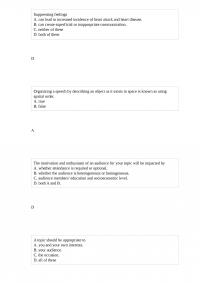
Suppressing feelings A. can lead to increased incidence of heart attack and heart disease. B. can create superficial or inappropriate communication. C. neither of these D. both of these Organizing a speech by describing an object as it exists in […]
STM 16605
Communication privacy management theory describes A. the costs and benefits of our relationships. B. the idea that progress over time in intensity and intimacy. C. the establishment of the boundaries that we decide others may or may not cross. D. […]
STM 92528
Kenneth Benne and Paul Sheats reasoned that if a group wants to achieve tasks and build relationships, it must eliminate self-serving roles. A. true B. false The more central a belief, the more willing we are to change it. A. […]