Archives
BUS 21298
Consider a proposed law to deregulate the hair-care industry. Barbers would be allowed to do work previously confined to stylists, and the latter would no longer be required to pass strict licensure exams. Which outcome would you expect to result […]
BUS 28727
Fringe benefits will tend to be a greater proportion of total compensation, the: a. more income elastic are fringe benefits b. more they increase worker turnover c. lower the employer’s share of the Social Security tax d. less there are […]

ECB 56319
Compared to a monopsonist that sells its output in a competitive product market, an otherwise identical monopsonist with monopoly power in the product market will pay: a. a lower wage b. a higher wage c. the same wage d. more […]
ECB 97667
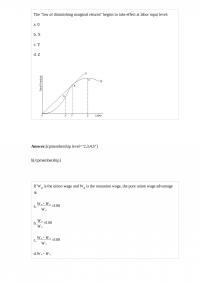
The “law of diminishing marginal returns” begins to take effect at labor input level: a. 0 b. X c. Y d. Z If Wu is the union wage and Wn is the nonunion wage, the pure union wage advantage is: […]
ECON 17245
The probability of accepting the next wage offer is: a.higher, the higher is the acceptance wage b.lower, the lower is the acceptance wage c.lower, the higher is the acceptance wage d.higher, the higher is unemployment compensation The aggregate labor force […]
ECON 50895
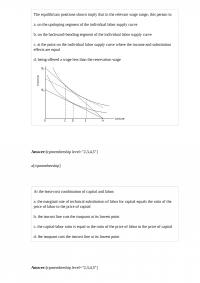
The equilibrium positions shown imply that in the relevant wage range, this person is: a. on the upsloping segment of the individual labor supply curve b. on the backward-bending segment of the individual labor supply curve c. at the point […]
ECON 56067
The employer’s share of the Social Security and Medicare components of the payroll tax has increased, from 6.13% in 1980 to its current rate of 7.65%. Because employers pay no payroll tax on many fringe benefits, this change in tax […]
ECON 62241
As a percentage of benefits, the largest share goes to: a. retirement and savings b. insurance c. paid leave d. legally required benefits Of the 3.8 million workers displaced from their jobs between 2003 and 2005, by 2006 most: a.were […]

ECON 69788
Consider the impact of a general increase in real wages. Empirical evidence suggests that men will tend to work _____ hours and women will tend to work _____ hours. a. more; fewer b. more; about the same c. fewer; fewer […]
ECON 74467
What is the value of the third worker’s marginal product? (the following table that shows the short-run production relationship and the product demand schedule for a firm.) a. $18 b. $57 c. $72 d. $342 Salaried workers can be considered […]
ECON 79161
With respect to workers’ compensation insurance, research by Moore and Viscusi indicates that job fatalities are: a.reduced because the positive incentive effect swamps the negative moral hazard effect of the law b.reduced because the negative moral hazard effect swamps the […]
ECON 82131
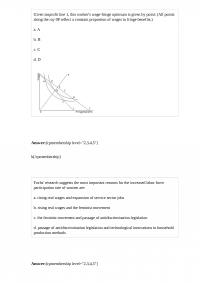
Given isoprofit line 1, this worker’s wage-fringe optimum is given by point: (All points along the ray 0P reflect a constant proportion of wages to fringe benefits.) a. A b. B c. C d. D Fuchs’ research suggests the most […]
ECON A 44506
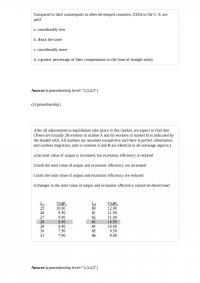
Compared to their counterparts in other developed countries, CEOs in the U. S. are paid: a. considerably less b. about the same c. considerably more d. a greater percentage of their compensation in the form of straight salary After all […]
ECON A 49371
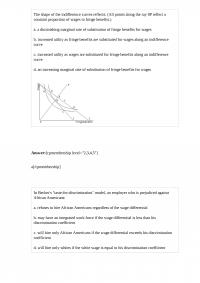
The shape of the indifference curves reflects: (All points along the ray 0P reflect a constant proportion of wages to fringe benefits.) a. a diminishing marginal rate of substitution of fringe benefits for wages b. increased utility as fringe benefits […]
ECON A 54814
The short-run labor demand curve of a competitive firm is: a. its average revenue product curve b. its marginal revenue product curve, provided marginal product is below average product c. its marginal product curve d. stage II of the total […]
ECON E 48187
Mary’s employer is considering her for a firm-specific training program that will cost $3 per hour. Her current marginal revenue product is $15 per hour and will rise to $20 upon completion of the program. Of the following, Mary’s training […]

ECON E 49890
Which of the following is not typically given as a reason the aggregate demand curve slopes downward and to the right? a.The real balances effect b.The foreign purchases effect c.The interest rate effect d.The substitution effect Compared to present-oriented people, […]
ECON E 57105
Compared to a conscripted military, an all-volunteer military: a.is likely to substitute labor for capital b.is likely to substitute capital for labor c.has a lower nominal cost and a lower real cost d.has a higher nominal cost and a higher […]
ECON E 63018
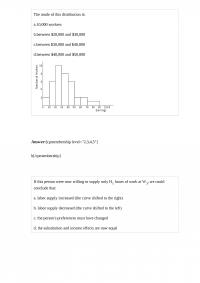
The mode of this distribution is: a.10,000 workers b.between $20,000 and $30,000 c.between $30,000 and $40,000 d.between $40,000 and $50,000 If this person were now willing to supply only H1 hours of work at W3, we could conclude that: a. […]
ECON E 67848
The inefficiencies of occupational segregation by gender arise because: a. women are paid less than their values of marginal product b. men are paid less than their values of marginal product c. both women and men are paid less than […]
ECON E 99598
If an economics professor moves from the University of California at Berkeley to the University of Texas at Austin, that is an example of: a.job change/no change in residence b.occupational change/no change in residence c.geographic change/no change in occupation d.geographic […]
Economics 44271
Evidence suggests that unions reduce firm profitability and discourage investment, so that: a.the dynamic efficiency loss from unionization is smaller than the static efficiency loss b.the dynamic efficiency loss from unionization is greater than the static efficiency loss c.turnover in […]
Economics 46137
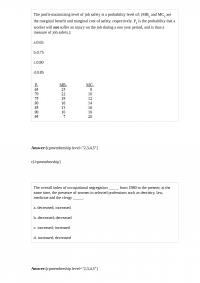
The profit-maximizing level of job safety is a probability level of: (MBs and MCs are the marginal benefit and marginal cost of safety, respectively. Ps is the probability that a worker will not suffer an injury on the job during […]
Economics 58849
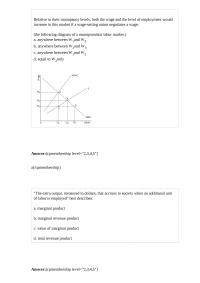
Relative to their monopsony levels, both the wage and the level of employment would increase in this market if a wage-setting union negotiates a wage: (the following diagram of a monopsonistic labor market.) a. anywhere between W1and W3 b. anywhere […]
Economics 90575
Which of the following required equal treatment for all persons in hiring, firing, promotion and compensation decisions without regard to race, color, religion, sex, or nationality? a. Equal Pay Act of 1963 b. Civil Rights Act of 1964 c. A […]
MicroEconomic 30714
Suppose an individual worker is on the backward-bending portion of her labor supply curve. Then, for a wage increase, the: a. income and substitution effects both increase desired work hours b. income and substitution effects are equal c. income effect […]