
As a percentage of benefits, the largest share goes to:
a. retirement and savings
b. insurance
c. paid leave
d. legally required benefits
Of the 3.8 million workers displaced from their jobs between 2003 and 2005, by 2006
most:
a.were still unemployed
b.were employed in new jobs, with nearly all workers earning less than before
c.had dropped out of the labor force
d.were employed in new jobs, with about half the workers earning more than before
A single union firm in a competitive industry otherwise comprised of nonunion firms:
a.will make economic losses if it pays a wage rate above its competitors
b.will pay a higher union wage advantage than unionized firms in less competitive
industries

c.will make economic profits if it pays a wage rate equal to its rival firms
d.will produce more output than its rival firms
Proponents of the view that a fundamental change in the economy occurred in the late
1990s cite as evidence all of the following except:
a.heavy investment in information capital
b.the fast pace of technological progress and efficiency
c.the procyclical nature of productivity growth
d.increased spending on capital other than information capital contributed little to the
acceleration in productivity
In some instances, profit sharing may not be a very effective tool for raising worker
productivity because of the:
a. free-rider problem
b. principal-agent problem
c. retirement problem
d. tax and accounting rules that cause economic profit to differ from accounting profit

Research by Borjas on relatively recent immigrants to the U.S. suggests that they:
a.tend to earn more than natives from the time they arrive at the destination
b.initially tend to earn less than natives, catch up after 10-15 years, and eventually
surpass natives
c.have little or no variance in their earnings
d.typically do not catch up to the earnings of native-born workers, even after several
years
Empirical evidence suggests that the:
a. added-worker effect dominates the discouraged-worker effect; the participation rate
varies inversely with the unemployment rate
b. discouraged-worker effect dominates the added-worker effect; the participation rate
varies inversely with the unemployment rate
c. added-worker effect dominates the discouraged-worker effect; the participation rate
varies directly with the unemployment rate
d. discouraged-worker effect dominates the added-worker effect; the participation rate
varies directly with the unemployment rate

Wage rates are most likely to be set in accordance with administrative rules and
procedures in the:
a.secondary labor market
b.internal labor market
c.external labor market
d.orthodox labor market
In 2010, average earnings at each educational level indicated that:
a. white men earned more than African American men and African American men
earned more than both African American and white women
b. white men and white women earned more than African American men
c. white men earned more than white women, but African American men earned less
than African American women
d. white men earned more than African American men and African American men
earned approximately the same as white women
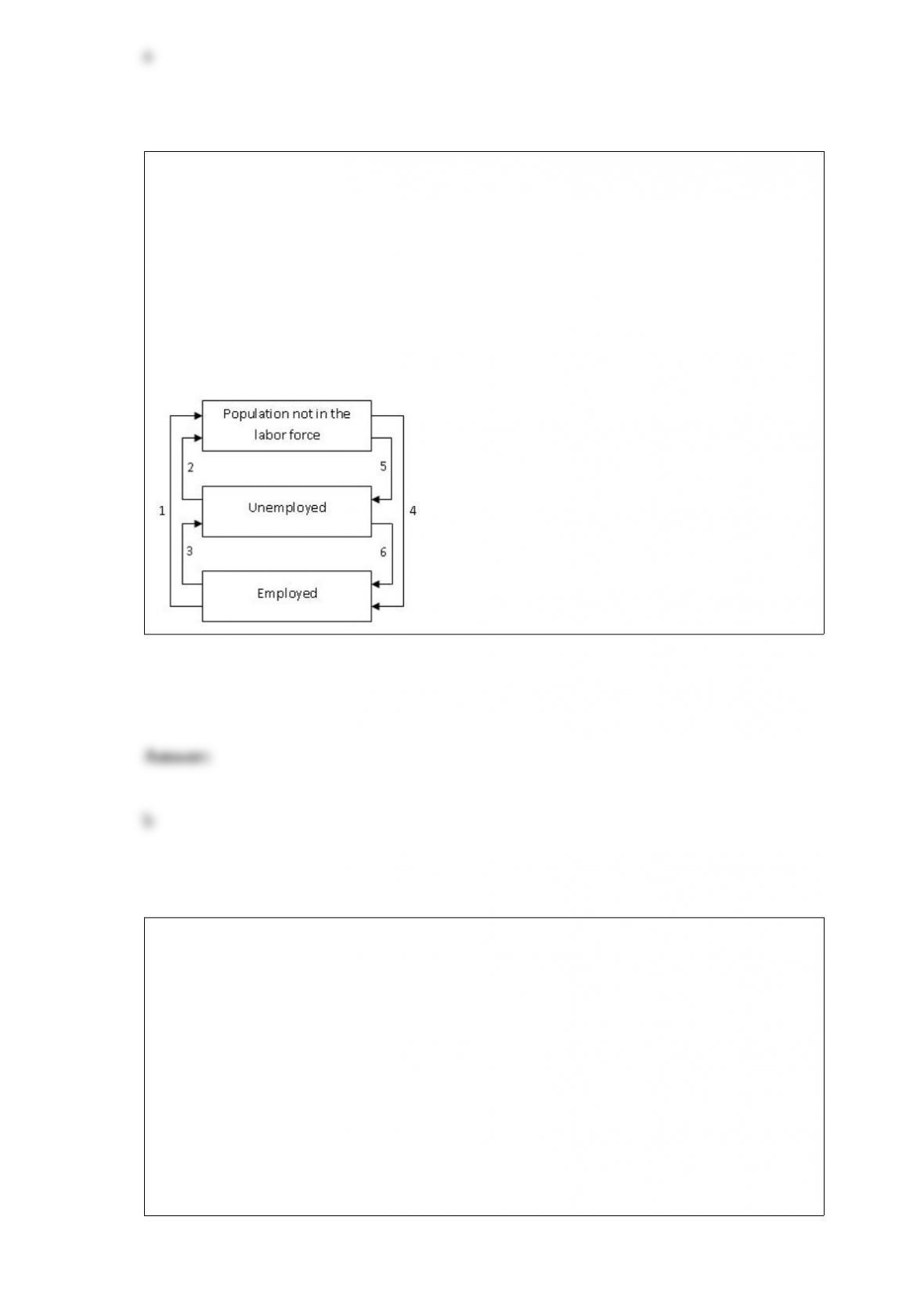
If flow 4 increases and flows 3 and 5 both decrease, then the unemployment rate will:
a.rise
b.fall
c.stay the same
d.change, but it cannot be determined how
Work-time lost as a result of a strike:
a.is generally less costly in service industries than in durable-goods industries
b.is estimated to be more costly than the efficiency losses resulting from union-caused
labor misallocation
c.may overstate the cost of a strike if struck employers are able to expand their
inventories in anticipation of the strike
d.may understate the cost of a strike if the work stoppage disrupts production in
associated industries

As a percentage of the U.S. labor force, union membership peaked in the 1940s at
approximately:
a.19%
b.34%
c.47%
d.63%
The shift from budget line AB1 to AB2 implies a(n):
a. decrease in the wage rate
b. decrease in non-wage income
c. increase in the wage rate
d. increase in non-wage income

An efficient labor contract entails (π1 and π2 are a firm’s isoprofit curves. The monopoly
union outcome is given by point ū.)
a.a point on the labor demand curve corresponding to a wage of Wx
b.a point on the labor demand curve corresponding to a wage of Wy
c.a wage of Wu and employment of Qx
d.wage and employment levels along the line xy

Which of the following best describes the “law of diminishing marginal returns”?
a. the marginal product of labor is negative
b. output per worker must eventually fall
c. as more labor is added to a fixed stock of capital, total output must eventually fall
d. as more labor is added to a fixed stock of capital, labor’s marginal product must
eventually fall

Specific training:
a. will be paid for by the employee in the form of a reduced wage
b. occurs once a student majors in a specific subject area
c. helps to make labor a quasi-fixed resource
d. reduces the worker’s value to the firm, because the worker’s wage rate would have to
rise
According to Census Bureau predictions:
a. immigration will not significantly affect the U. S. population between 2000 and 2050
b. the ratio of paid workers to Social Security recipients will fall more than had been
predicted earlier
c. the racial composition of the labor force will remain essentially unchanged for the
next 50 years
d. the projected slowdown in labor force growth will be only temporary
Assume that all workers are equally productive, but the white wage is $14 and the
African American wage is $10. An employer who employs only African American
workers has a discrimination coefficient of:

a. 0
b. at least $4
c. at most $4
d. at least 10/14
If capital and labor are gross complements, an increase in the cost of capital will:
a. increase the supply of labor and drive the wage down
b. decrease the demand for labor and drive the wage down
c. increase the demand for labor and drive the wage up
d. either increase or decrease the demand for labor depending on whether the
substitution effect or the output effect is stronger
The longer the expected length of tenure on the job:
a.the higher the acceptance wage and the longer the expected job search duration
b.the higher the acceptance wage and the shorter the expected job search duration
c.the lower the acceptance wage and the longer the expected job search duration
d.the lower the acceptance wage and the shorter the expected job search duration
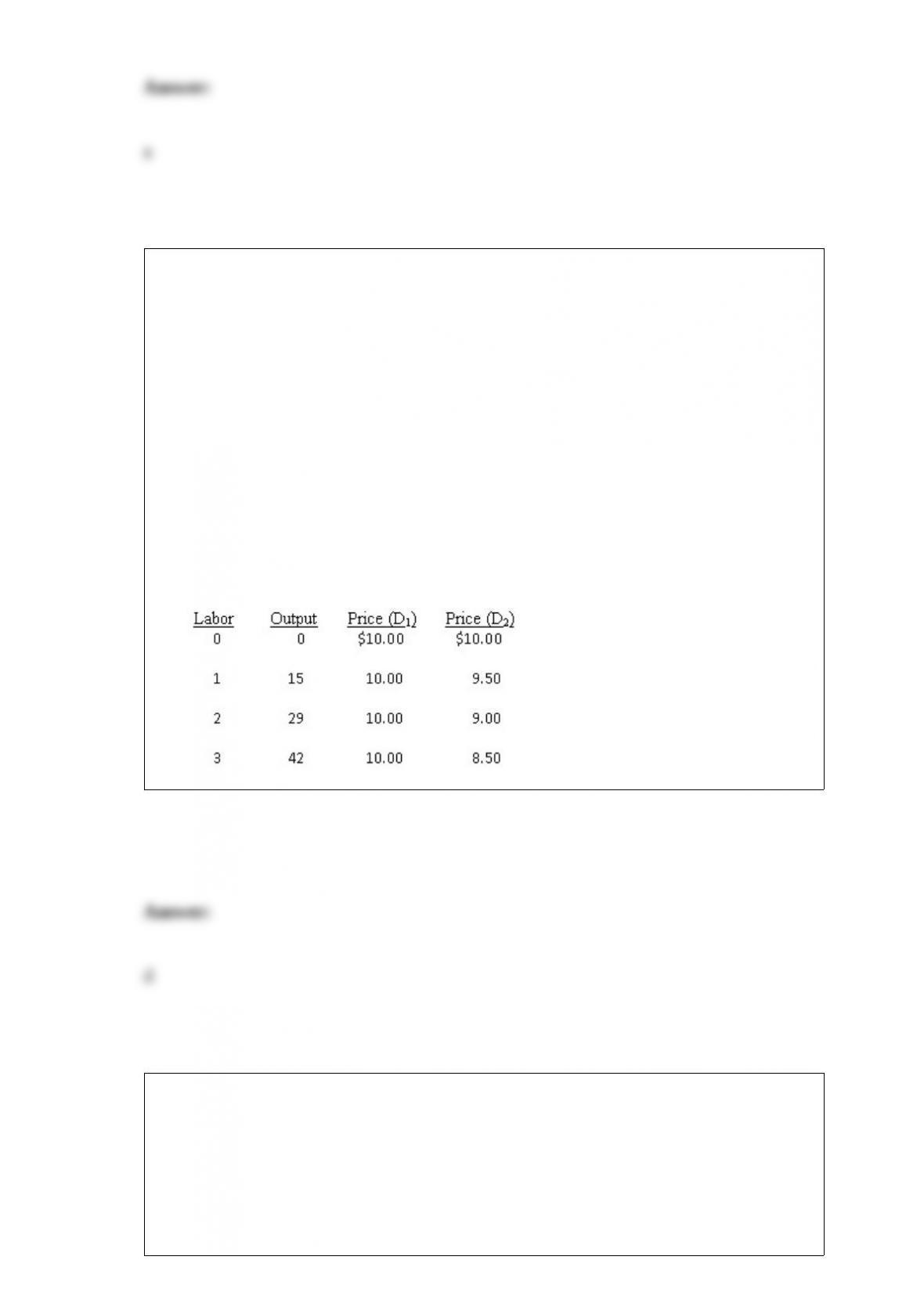
Suppose the firm’s product demand is given by the column labeled D1. If the wage rate
is $100, the firm will achieve maximum profit by hiring _____ workers.
(Assume that the labor market is perfectly competitive.)
a. 3
b. 4
c. 5
d. 6
The convex shape of a standard indifference curve reflects:
a. a diminishing marginal rate of substitution of leisure for income
b. an increasing marginal rate of substitution of leisure for income
c. a constant marginal rate of substitution of leisure for income

d. the wage rate
According to evidence reported by Jorgenson, Ho, and Stiroh, the most important
source of rising labor productivity over the period 1959 ” 2006 was:
a.increased efficiency with which inputs are combined
b.decreases in the rate of inflation
c.improvement in the average quality of the labor force
d.increases in the amount of capital goods employed with each worker hour of labor
Women are much less likely to be union members than men. This is:
a.because women are more likely to be in less-unionized industries and occupations
b.because women have fundamentally different attitudes about unions
c.because unions are legally allowed to discriminate against women
d.not true

A union leader told its membership that a wage increase, while resulting in some
layoffs, would nonetheless increase the total incomes of its membership. The firm
replied that a wage increase would reduce the total incomes of its membership. We can
conclude that:
a. both the firm and the union believe that labor demand is inelastic, but for different
reasons
b. both the firm and the union believe that labor demand is elastic, but for different
reasons
c. the union believes that labor demand is elastic while the firm believes it to be
inelastic
d. the union believes that labor demand is inelastic while the firm believes it to be
elastic
Which one of the following would indicate a profitable human capital investment?
a. The net present value is “$12,000
b. The interest rate on borrowed funds is 4% and the rate of return is 3%
c. The interest rate exceeds the net present value
d. The rate of return exceeds the interest rate on borrowed funds

Which of the following non-working individuals would be considered officially
unemployed by the Bureau of Labor Statistics?
a.John, who is beginning a 3-month vacation before reporting to his new job
b.Ronald, who two months ago gave up his job search in despair because he could not
attract a job offer
c.Martha, who has not been on the job for the past four weeks because she broke her leg
d.Hiroshi, who is waiting to be called back to his job from which he was laid off five
weeks ago
When deriving the market demand curve for a particular type of labor, one must:
a. hold the market price of the output constant
b. simply sum the labor demand curves of all employers of that type of labor
c. account for the variation in market price as industry output expands
d. hold constant the market price in competitive markets but allow the price to vary in
monopoly markets
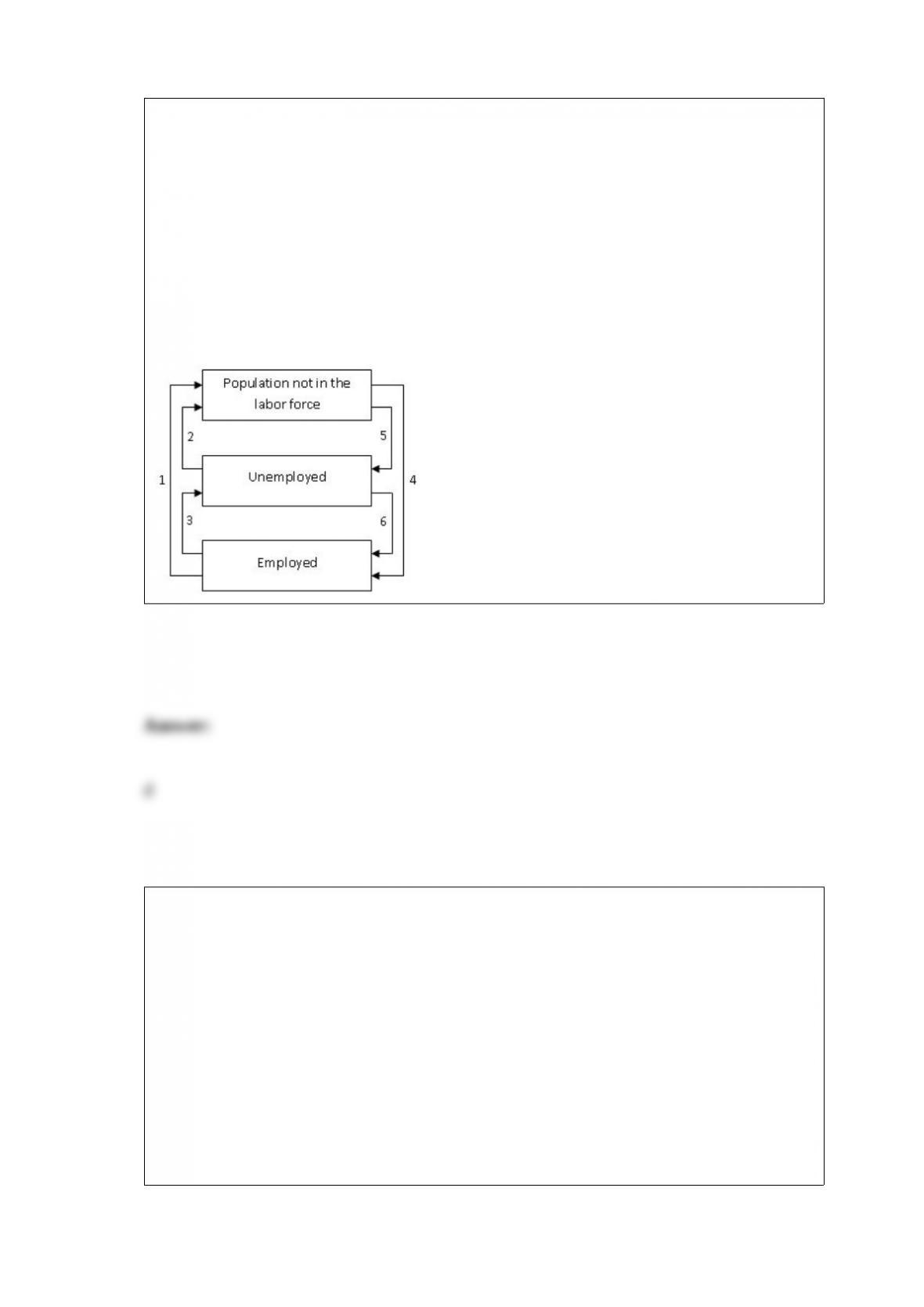
Which one of the following would reduce the unemployment rate while leaving the size
of the labor force unchanged?
a.An increase in flow 1
b.An increase in flow 2
c.An increase in flow 3
d.An increase in flow 6
Suppose demand conditions in industries X and Y are identical but that productivity
increases by 5% in industry X and 2% in industry Y. If economy-wide productivity and
the average wage each rise by 3%, we should expect that unit labor costs will:
a.increase by the same amount in both industries, in accord with the overall increase in
the average wage
b.increase in both industries, but more in industry X than industry Y
c.increase in industry X and decrease in industry Y
d.decrease in industry X and increase in industry Y

Suppose productivity increases by 5% in industry X and 2% in industry Y. Further
suppose the demand for X has fallen while the demand for Y has increased. If
economy-wide productivity and the average wage each rise by 3%, we should expect
that:
a.output and employment in X will increase relative to Y
b.output and employment in X and Y will not change relative to one another, since
wages will increase by 5% in X and 2% in Y
c.output and employment in Y will increase relative to X
d.no statement can be made concerning output and employment in either industry
without more information
Which of the following best describes the output effect of a wage increase?
a. The firm’s marginal cost increases, the firm desires to produce less output, and
therefore less labor is required
b. The cost of labor is relatively higher, causing the firm to use relatively less labor
c. The firm’s marginal cost falls, the firm desires to produce more output, and therefore
more labor is required
d. The firm’s labor demand curve becomes more inelastic, causing it to employ less
labor

Given the following data, what is the labor force participation rate?
Population 300 million
Non-institutionalized population, age 16 and over 250 million
Persons employed or seeking employment 200 million
Unemployed persons 10 million
a. 10%
b. 75%
c. 80%
d. 84%
According to Freeman, public-sector unions:
a.have great bargaining power owing to the government’s monopoly provision of
services
b.are unique because of the political nature of public-sector collective bargaining
c.have little bargaining power because they cannot legally strike
d.have great bargaining power because governments face binding tax and budget
constraints