
The inefficiencies of occupational segregation by gender arise because:
a. women are paid less than their values of marginal product
b. men are paid less than their values of marginal product
c. both women and men are paid less than their values of marginal product
d. women’s values of marginal product are less than men’s, even though they are equally
productive
All else equal, a worker is less likely to move:
a.if the worker has moved before
b.the greater the amount of specific training the worker has
c.the greater the worker’s educational attainment
d.the shorter the distance moved
Approximately what percentage of the U.S. population had completed four or more
years of college by the year 2010?
a. 8%
b. 14%

c. 29%
d. 35%
Empirical studies of the effect of competition on discrimination have shown all of the
following except:
a. increased international trade lowered the wage gap in less-competitive industries
b. bank deregulation narrowed the gap between men’s and women’s wages
c. among plants with high levels of market power, a greater proportion of women
employees raises firm profits
d. among plants in highly competitive industries, a greater proportion of women
employees raises firm profits
In the case of general training, the wage rate during the training period will be _____,
while the post-training wage will be _____. ( MRPu refers to the marginal revenue
product of an untrained worker, while MRPt refers to this worker’s marginal revenue
product as a result of a program of on-the-job training.)
a. W1; W3
b. W1; between W2 and W3

c. W2; between W2 and W3
d. W2; W2
Which of the following is affiliated with Change to Win?
a.Steelworkers
b.Postal workers
c.Firefighters
d.Teamsters

Suppose a state law is passed which prohibits the state liquor board from issuing any
new liquor licenses. (Such licenses are required to sell liquor.) The law would allow
prospective tavern operators to purchase an existing license on the open market from a
willing current owner of such a license. Which outcome would you expect to result
from this regulation?
a.A decrease in economic rent to current holders of liquor licenses
b.An increase in economic rent to current holders of liquor licenses
c.An increase in economic rent to prospective operators of taverns
d.No change in economic rent to prospective operators of taverns
Linda quit her job as a loan officer at First Detroit State Bank to accept a similar
position at First Minneapolis Savings Bank. This is an example of:
a.geographic mobility
b.occupational mobility
c.horizontal mobility
d.vertical mobility
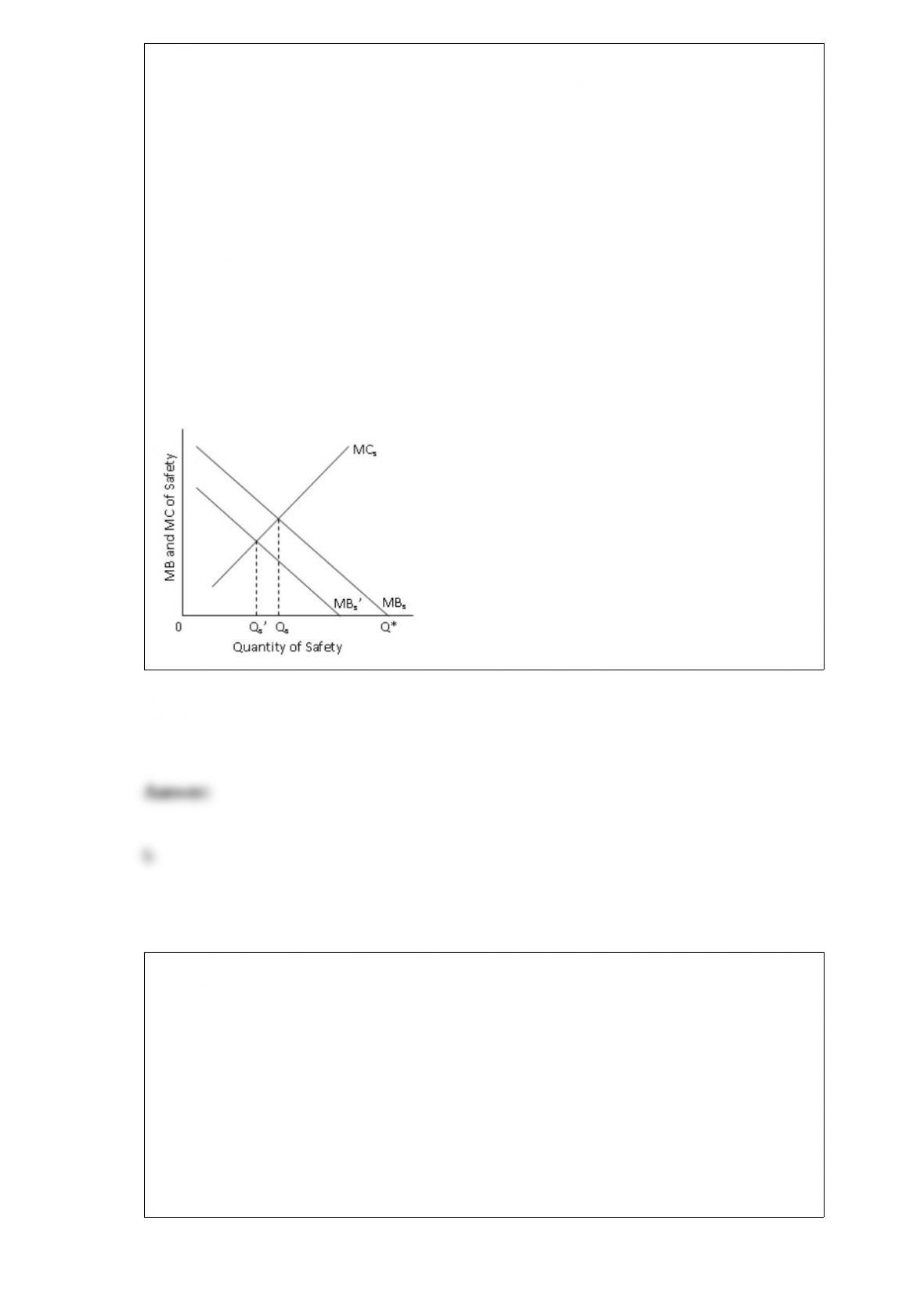
The firm’s profit-maximizing level of safety is: . (MCs is the firm’s marginal cost of
providing safety, while MBs is the marginal benefit to society of a one more unit of
safety. Because of imperfect information and costly worker mobility, MBs‘ is the firm’s
perceived marginal benefit of safety.):
a.0
b.Qs‘
c.Qs
d.Q*
Of the following, which one would most likely cause this person to supply H1 hours of
work at W3 rather than the current H3 hours?
a. This person’s spouse receives a substantial income increase
b. A decrease in this person’s marginal valuation of leisure time
c. Congress abolishes an income maintenance program
d. This person’s spouse suffers a substantial cut in income

According to empirical evidence, there is _____ life-cycle mobility within the earnings
distribution. Therefore, the distribution of annual earnings is _____ unequal than the
distribution of lifetime earnings.
a.little; more
b.little; less
c.substantial; more
d.substantial; less
The basic human capital model predicts that:
a.the greater are the differences in the quantity and quality of training, the greater is the

inequality of earnings.
b.the greater the length and quality of one’s formal training, the higher will be the
investment costs and the lower will be expected earnings
c.the earnings distribution will be symmetric
d.the Gini coefficient will eventually become zero
Which of the following best describes the impact of government transfers on human
capital investment decisions?
a.In-kind transfers reduce the incentive to invest in human capital, while cash transfers
increase it
b.Some transfers reduce the incentive to invest in human capital because higher wages
are accompanied by loss of benefits; other transfers increase investment by reducing the
cost of investing
c.Transfers have a negative impact on short-run investment decisions but no impact on
long-run investment decisions
d.Transfers have no impact on human capital investment decisions
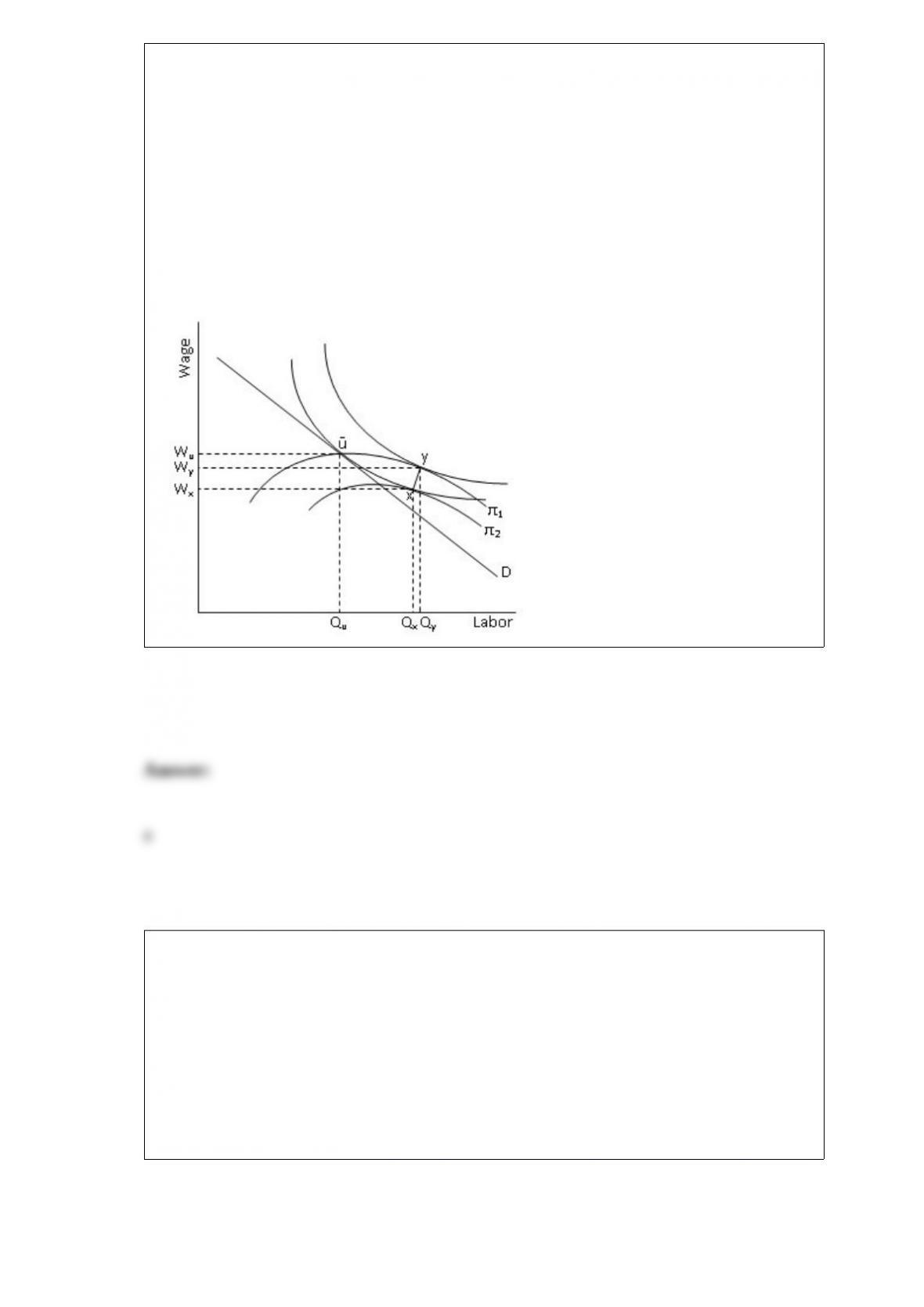
Which of the following is a true statement? The union is indifferent between outcomes:
(π1 and π2 are a firm’s isoprofit curves. The monopoly union outcome is given by point
ū.)
a.ū and x
b.ū and y
c.x and y
d.ū and any other outcome along the isoprofit line π1
The bulk of national income flows to:
a. land owners in the form of rent
b. capital owners in the form of interest
c. capital owners in the form of profit
d. workers in the form of wages and salaries

The official BLS unemployment rate may understate economic hardship because
a.all part-time workers are considered fully employed
b.the unemployed include persons whose minimum acceptable wages are artificially
high
c.some household members provide false information about search activity
d.the unemployed include semi-retired workers and teens who wish to work only
part-time
Labor productivity is best defined as:
a.real GDP divided by unit labor costs
b.nominal GDP divided by the number of worker hours
c.nominal GDP divided by labor costs
d.real GDP divided by the number of worker hours
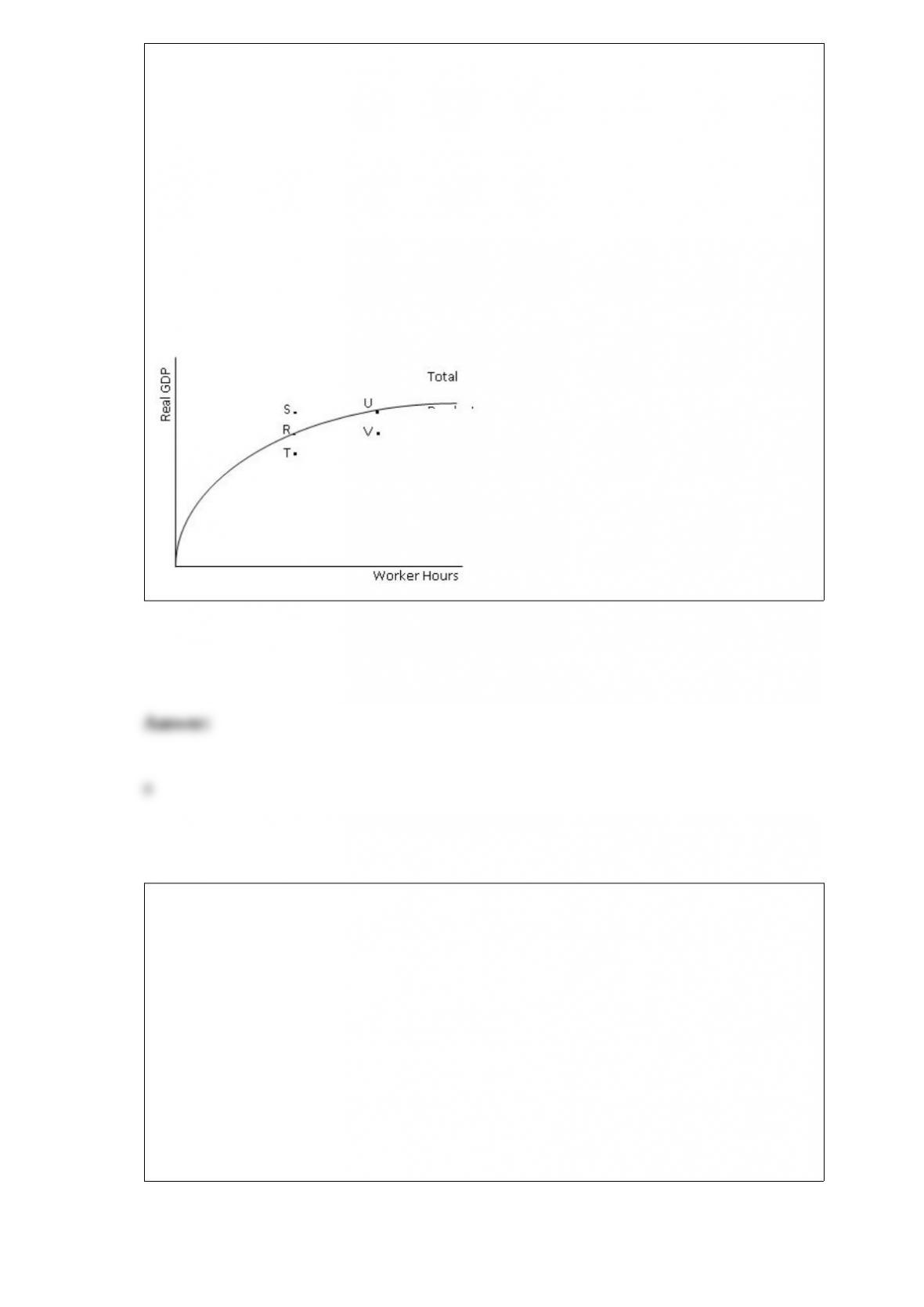
The aggregate production function of a hypothetical economy is shown in the diagram
at right. In year 1, production takes place at point R. Production at which of the
following points for year 2 would indicate an unambiguous increase in labor
productivity?
a.S
b.T
c.U
d.V
Which one of the following best explains the differences in the isoprofit curves of the
two firms?
a. X has lower profits than Y because X is paying higher wages
b. X has higher profits than Y because X’s high wages attract workers who are less
relaxed and thereby less likely to shirk on the job
c. X pays a higher cost than Y for providing additional informality
d. Y pays a higher cost than X for providing additional informality

Of the following occupational groups, 2011 average hourly earnings were greatest
among:
a. service workers
b. installation, maintenance, and repair workers
c. production workers
d. management, business, and financial workers
Which of the following factors does not help explain why the earnings distribution is
skewed to the right?

a.Family background
b.Discrimination
c.The impact of ability on human capital decisions
d.Churning within the distribution
Which one of the following statements is correct?
a. The added-worker effect and the discouraged-worker effect operate in the same
direction
b. The added-worker effect and the discouraged-worker effect operate in different
directions
c. The added-worker effect is relatively strong as the economy expands and wages rise
d. The discouraged-worker effect is relatively strong as the economy expands and
wages rise
Which of the following is not typically given as a reason for job search?
a.Workers are heterogeneous
b.Information is imperfect

c.Firms’ compensation packages differ from one another
d.Firms are homogeneous
In their study of “job lock,” Buchmueller and Valetta conclude:
a. there is no empirical relationship between health insurance coverage and job lock
b. health insurance coverage reduces job mobility for men but not for women
c. job lock is greatest among those who use health care the least
d. “continuation of coverage” mandates increase job mobility by approximately 10%
Compensation paid in proportion to the value of sales best describes:
a. piece rates
b. commissions
c. time rates
d. bonuses
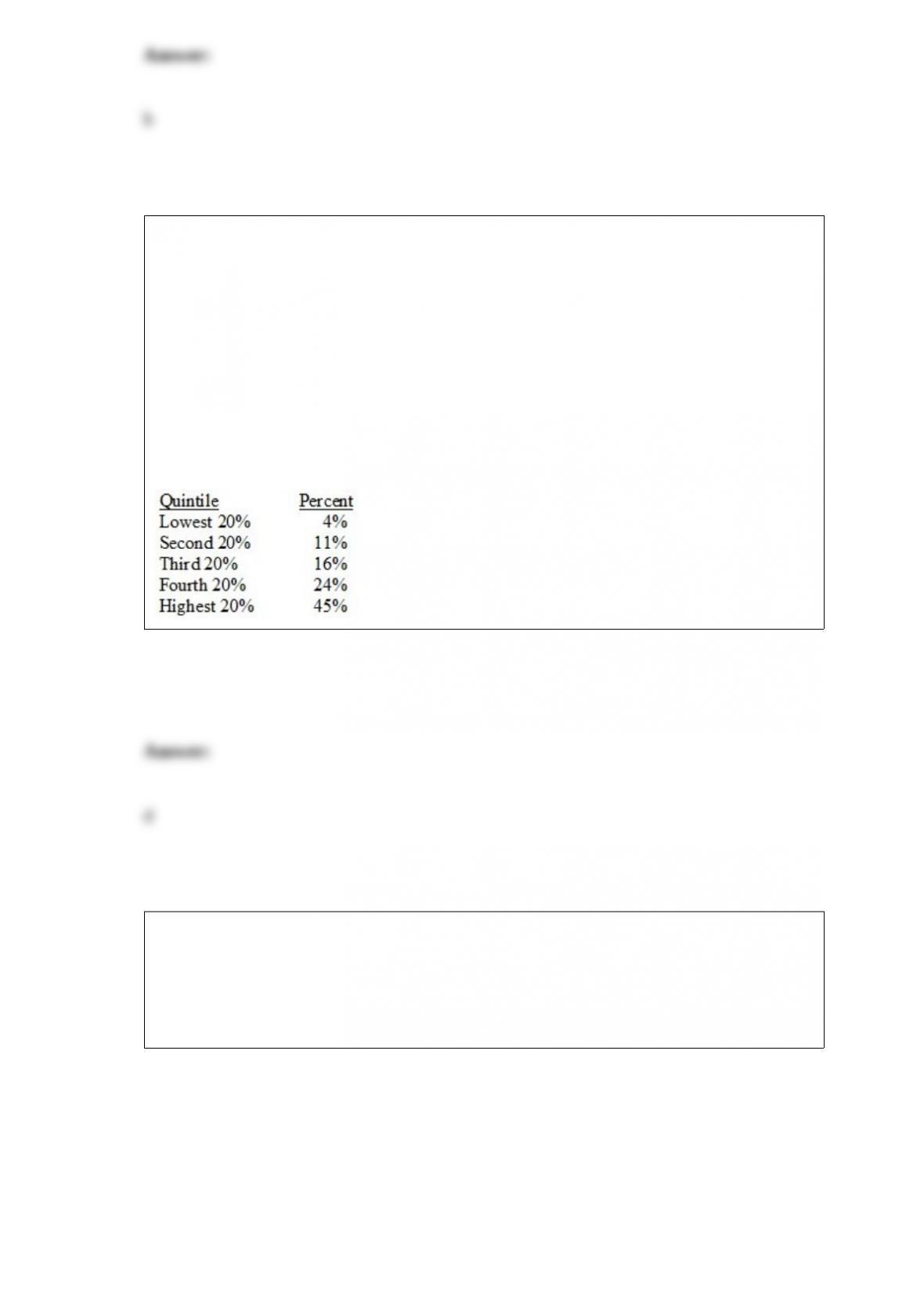
If one were to draw a Lorenz curve from the data, what point would be plotted
corresponding to “80%” on the horizontal axis? ( the following quintile earnings
distribution data):
a.11%
b.24%
c.45%
d.55%
The number of persons with annual earnings between $30,000 and $50,000 is:
a.7,000
b.8,000
c.14,000
d.20,000
•

Indifference curves are convex to the origin because:
a. at a lower income, a person is more willing to sacrifice income for additional leisure
b. at a lower income, a person is less willing to sacrifice income for additional leisure
c. at any income level, a person is willing to sacrifice the same amount of income for
additional leisure
d. the marginal rate of substitution of leisure for income is negative
The “old” view of labor economics stresses _____ while the “new” view focuses upon
_____.
a. analysis ; markets

c. description; institutions
b. description; analysis
d. institutions; description
According to the theory of individual labor supply, a reduction in income tax rates leads
to:
a.a reduction in hours worked, provided the income and substitution effects work in
opposing directions
b.an increase in hours worked, provided the income and substitution effects work in
opposing directions
c.no change in hours worked, because the income and substitution effects cancel each
other
d.an unpredictable change in hours worked, depending on the relative strengths of the
income and substitution effects