
With respect to workers’ compensation insurance, research by Moore and Viscusi
indicates that job fatalities are:
a.reduced because the positive incentive effect swamps the negative moral hazard effect
of the law
b.reduced because the negative moral hazard effect swamps the positive incentive effect
of the law
c.increased because the positive incentive effect swamps the negative moral hazard
effect of the law
d.increased because the negative moral hazard effect swarms the positive incentive
effect of the law
The distribution of earnings has become more unequal:
a.among women but not among men
b.in part due to the reduction in the college wage premium in the 1980s
c.in part due to greater import competition in the 1980s
d.in part due to a reduction in the number of young and inexperienced workers in the
1990s
Wage rates tend to change with national rather than with industry productivity because:

a.the minimum wage and other government controls prevent industry wage differentials
b.productivity differences result in product price differences, leaving real wages
unchanged
c.labor supply responses tend to prevent wages from diverging in the various industries
d.labor demand responses tend to prevent wages from diverging in the various
industries
Which one of the following is a true statement?
a.The earnings distribution for full-time workers is less skewed than the one for all
workers
b.When fringe benefits are included, the earnings distribution narrows
c.The distribution of income is no different from the distribution of earnings
d.The Lorenz curve shows the extent of personal mobility within the distribution of
earnings
When the economy is at full-employment:
a.the unemployment rate is zero

b.unemployment is at its natural rate
c.the actual rate of inflation is less than expected
d.there is neither voluntary nor involuntary unemployment
In the context of the basic work-leisure model, “leisure” time includes:
a. only time devoted to rest and relaxation
b. any time not devoted to either a paying job or household work
c. any time devoted to anything desirable
d. any time not devoted to a paying job
Approximately what percentage of U.S. workers were union members in 2011?
a.6%
b.11%
c.22%
d.31%

The index of occupational segregation by sex:
a. has fallen steadily since 1973
b. fell between 1958 and 1973 but has leveled off since then
c. has increased steadily since 1973
d. increased between 1958 and 1973 but has leveled off since then
The person has non-wage income of:
a. $0
b. $10
c. $192
d. $240
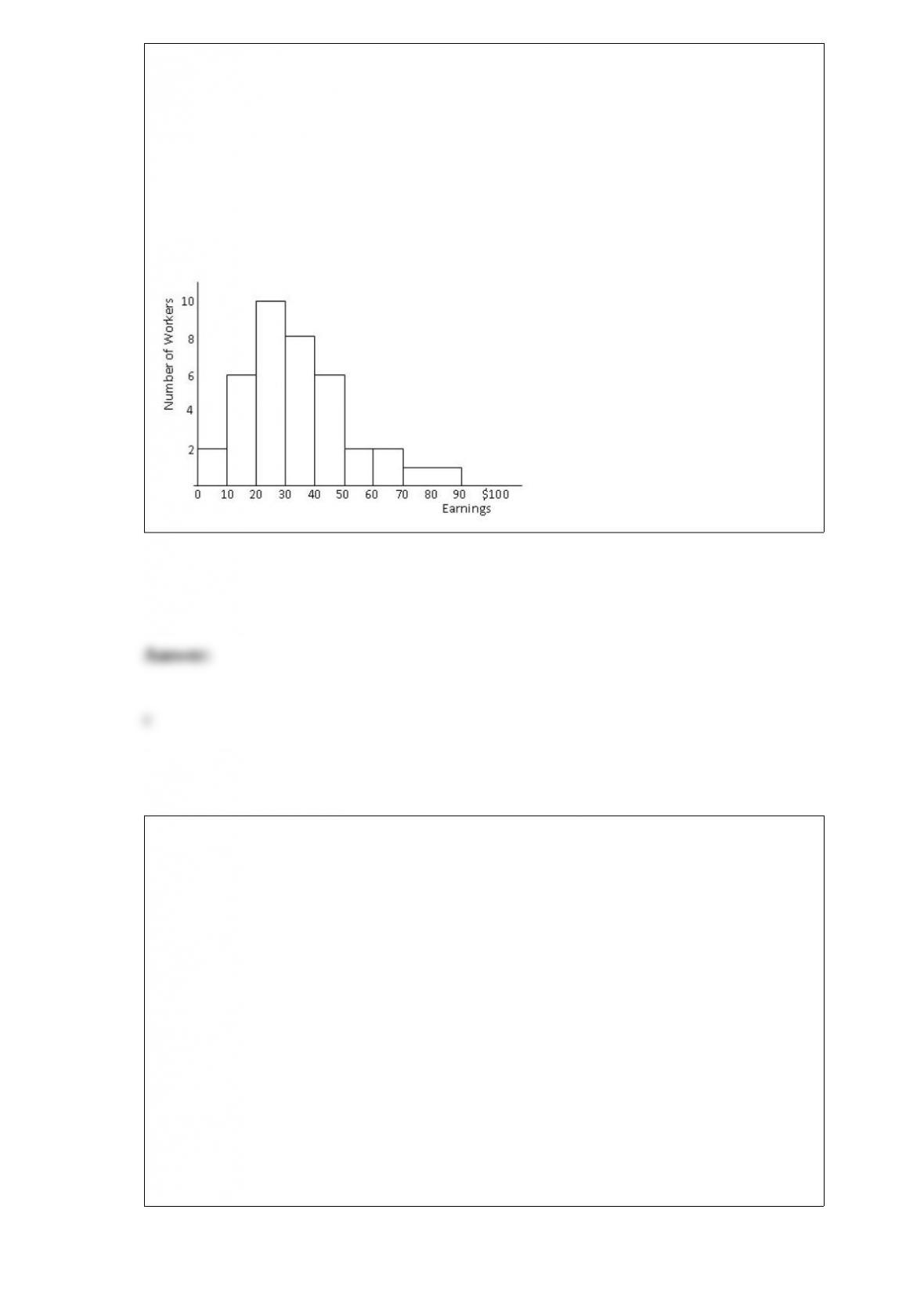
The mean of this distribution is:
a.10,000 workers
b.between $20,000 and $30,000
c.between $30,000 and $50,000
d.between $60,000 and $90,000
The spillover effect would be modeled by: (Wages in both the union and nonunion
sectors are initially $10. The union then negotiates a wage rate of $12. The
post-negotiation nonunion wage is not yet known.)
a.shifting the nonunion supply curve to the right, increasing the measured union wage
advantage
b.shifting the nonunion demand curve to the right, reducing the measured union wage
advantage
c.shifting the union demand curve to the right, increasing the measured union wage
advantage
d.raising the nonunion wage above its equilibrium level, reducing the true union wage
advantage

Allocative inefficiency in a labor market may be caused by:
a. monopoly power in the product market
b. monoposony power in the labor market
c. both a. and b. are correct
d. neither a. nor b. are correct
In 1914 Ford Motor Company doubled the wage it paid its employees, resulting in:
a. unusually high quit rates and absenteeism
b. no change in the number of job applicants, because the offer only applied to persons
employed at Ford more than six months

c. lower quit rates and less absenteeism but no change in worker productivity
d. an increase in worker productivity of more than 50%
In the mid-1950s, white males:
a. were more likely to participate in the labor force than were African-American males
b. were less likely to participate in the labor force than were African-American males
c. and African-American males were about equally likely to participate in the labor
force and that relationship still holds
d. and African-American males were about equally likely to participate in the labor
force but now white men have a higher participation rate
If OSHA were to become increasingly effective in reducing workplace hazards, then:
a.firms’ profits would be increased
b.wage differentials between safe and hazardous jobs would diminish
c.wage differentials between safe and hazardous jobs would increase
d.employment in safe jobs would increase and employment in hazardous jobs would
decrease

Discrimination in the form of access barriers to productivity-increasing opportunities is
termed:
a. wage discrimination
b. employment discrimination
c. occupational discrimination
d. human capital discrimination
Which of the following best describes the substitution effect of a wage decrease?
a. The firm’s marginal cost decreases, the firm desires to produce less output, and
therefore less labor is required
b. The cost of labor is relatively lower, causing the firm to use relatively more labor
c. The firm’s labor demand curve less elastic, causing it to employ less labor
d. The firm’s labor demand curve becomes more inelastic, causing it to employ less
labor

Because of the _____, the unemployment rate as measured by the Bureau of Labor
Statistics tends to understate the extent of unemployment during a recession.
a. counter-cyclical labor force participation rate
b. added-worker effect
c. decline in the average workweek
d. discouraged-worker effect
According to Becker’s “taste-for-discrimination” model:
a. a person is judged on the basis of the average characteristics of her or his
demographic group
b. the process of competition will cause discrimination-based wage differentials to
persist over long periods of time
c. there will be discrimination-based wage differentials because a firm with market
power distinguishes between different groups with different elasticities of labor supply
d. the process of competition should put discriminating employers at a competitive
disadvantage

Empirical estimates generally show that unions reduce:
a.both firm profitability and economic efficiency
b.firm profitability but improve economic efficiency
c.firm profitability but there is no consensus regarding their effects on economic
efficiency
d.economic efficiency but there is no consensus regarding their effects on firm
profitability
Among the countries listed below, relative public-sector employment is greatest in:
a.Japan
b.Canada
c.Germany
d.Denmark
Empirical studies of the job search model suggest that:
a.variations in acceptance rates explain most of the variation in unemployment duration

b.higher levels of unemployment benefits have little impact on unemployment duration
c.unemployment duration increases with age
d.longer eligibility limits on unemployment benefits have little impact on
unemployment duration
“The union wage advantage is understated because nonunion wages rise as consumer
demand shifts away from relatively higher priced union produced goods.” This
describes the:
a.product-market effect
b.spillover effect
c.superior-worker effect
d.threat effect
Which one of the following gives rise to a retirement-inducing substitution effect? As
workers approach retirement age:
a. Social Security benefits become available
b. wealth becomes sufficient to make retirement affordable

c. earnings potential decreases so that leisure becomes relatively more costly
d. earnings potential decreases so that leisure becomes relatively less costly
The adverse effects of a strike on other associated industries and consumers are likely to
be:
a.greater when it involves products rather than services
b.greater when it involves small firms rather than large firms
c.on the order of 5% of GDP each year
d.substantially less than the adverse effects of lockouts by management
Considering the two budget lines in the diagram, if the person’s optimal number of
hours worked is seven hours, then the wage rate must be:
a. $10
b. $192
c. $240
d. cannot be determined

The private rate of return on human capital may _____ the social rate because _____.
a. understate; schooling is subsidized
b. understate; schooling provides external benefits
c. overstate; schooling provides external benefits
d. overstate; schooling and ability are positively correlated
According to Carmichael, academic tenure has persisted because:
a. faculty have gained this fringe benefit through collective bargaining
b. college and university administrators see tenure as a way of discouraging their most
productive senior faculty from retiring early
c. college and university administrators see tenure as a way to keep their most
productive junior faculty from being recruited by rival schools
d. senior faculty can identify promising new faculty without fear of losing their jobs

Which of the following can be predicted to increase the demand for labor?
a. An increase in the price of a gross complement to labor
b. A decrease in the price of a gross substitute for labor
c. A decrease in the number of firms
d. An increase in product demand
A monopsonist is currently paying its 1,000 workers $5.00 per hour. However, its
marginal wage cost is $6.00 per hour. If the government sets a minimum wage of $5.50,
then:
a.employment at this firm will rise
b.employment at this firm will fall
c.employment at this firm will be unaffected
d.employment at this firm will rise but the firm’s total wage bill will fall
If the two isoquants represent profit maximizing levels of output for two different wage
rates, the output effect of a decrease in the wage rate is represented by the move from:
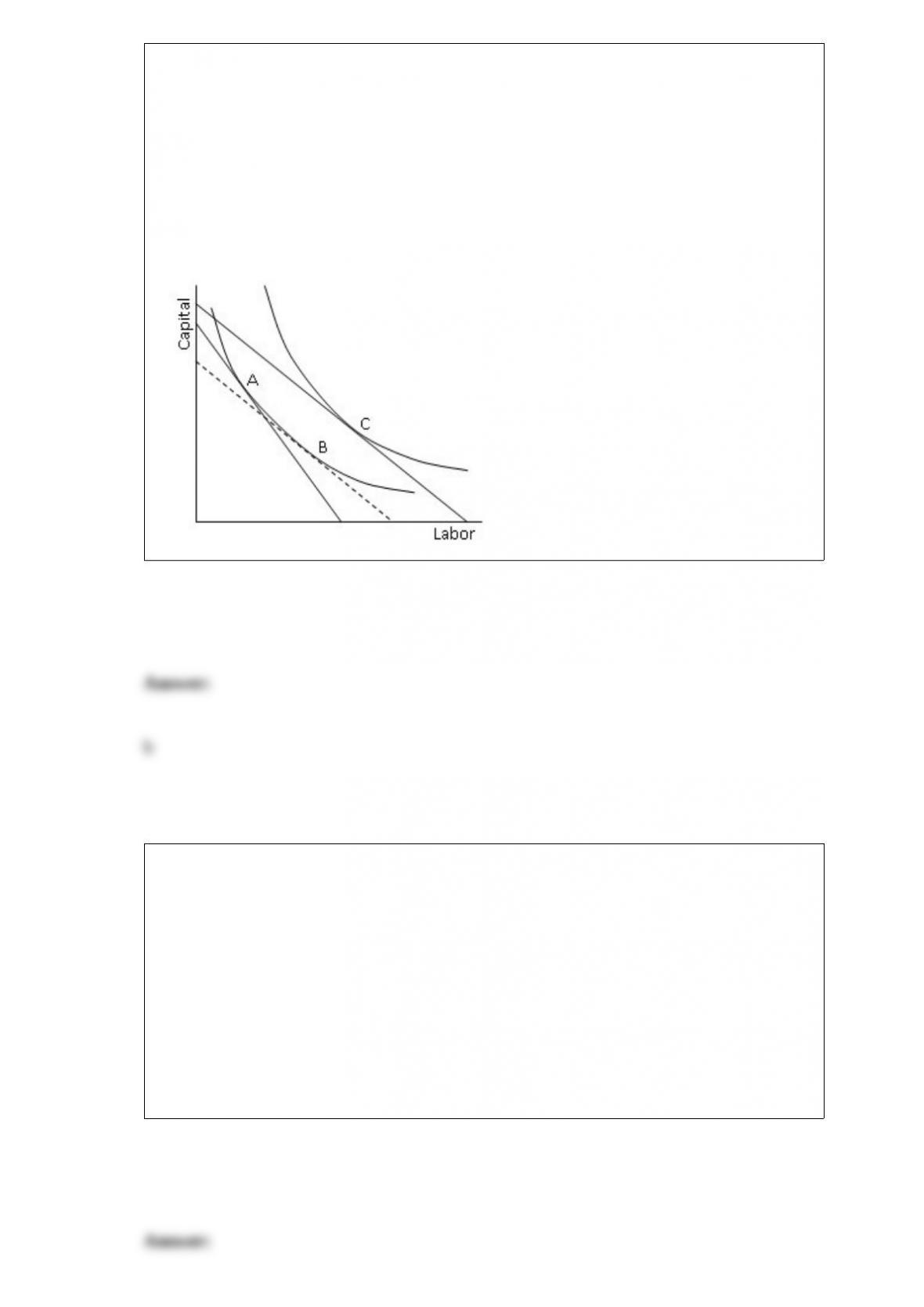
a. A to B
b. B to C
c. A to C
d. C to A
The Bureau of Labor Statistics Index of Labor Productivity:
a.probably understates the entire economy’s productivity growth
b.is calculated by dividing real GDP by the total number of worker hours
c.is calculated by dividing nominal private-sector GDP by the number of private-sector
worker hours
d.is calculated by dividing real private-sector GDP by the number of private-sector
worker hours