
Compared to a monopsonist that sells its output in a competitive product market, an
otherwise identical monopsonist with monopoly power in the product market will pay:
a. a lower wage
b. a higher wage
c. the same wage
d. more information is needed
In Littleville, which has 1000 residents, 400 people do not currently work. Of these 400
persons, 240 are under age 16, 10 are institutionalized, 25 have become discouraged
and quit seeking work, and 75 others are either full-time students or home-makers. Of
the 600 people who do work, 150 work part-time but wish to work full-time. The
number of officially employed persons in Littleville is:
a.450
b.525
c.600
d.675
Imperfect and costly labor market information will likely result in:
a. wages converging to a common rate
b. a distribution of wages around the mean for any occupation, independently of

compensating differentials
c. an inverse relationship between wages and the risk of injury on the job
d. instantaneous adjustment to equilibrium in response to short-run wage differentials
Which of the following is not a benefit to employers of an internal labor market?
a.A greater return from investments in specific training
b.A greater return from investment in general training
c.A solution to a principal-agent problem
d.Greater employee identification with the firm’s objectives
It is difficult to measure the pure union wage advantage because:
a.women constitute a greater proportion of the work force in strongly unionized
industries than in weakly unionized industries
b.unionized industries tend to have larger plants that may require greater worker
supervision, thus promoting union employers to seek out ‘superior” workers
c.unionized industries tend to employ production methods that are highly
labor-intensive and therefore require lower-paid unskilled workers
d.unions are more easily established in those industries that pay low wages, so that the
percentage wage gains are much smaller
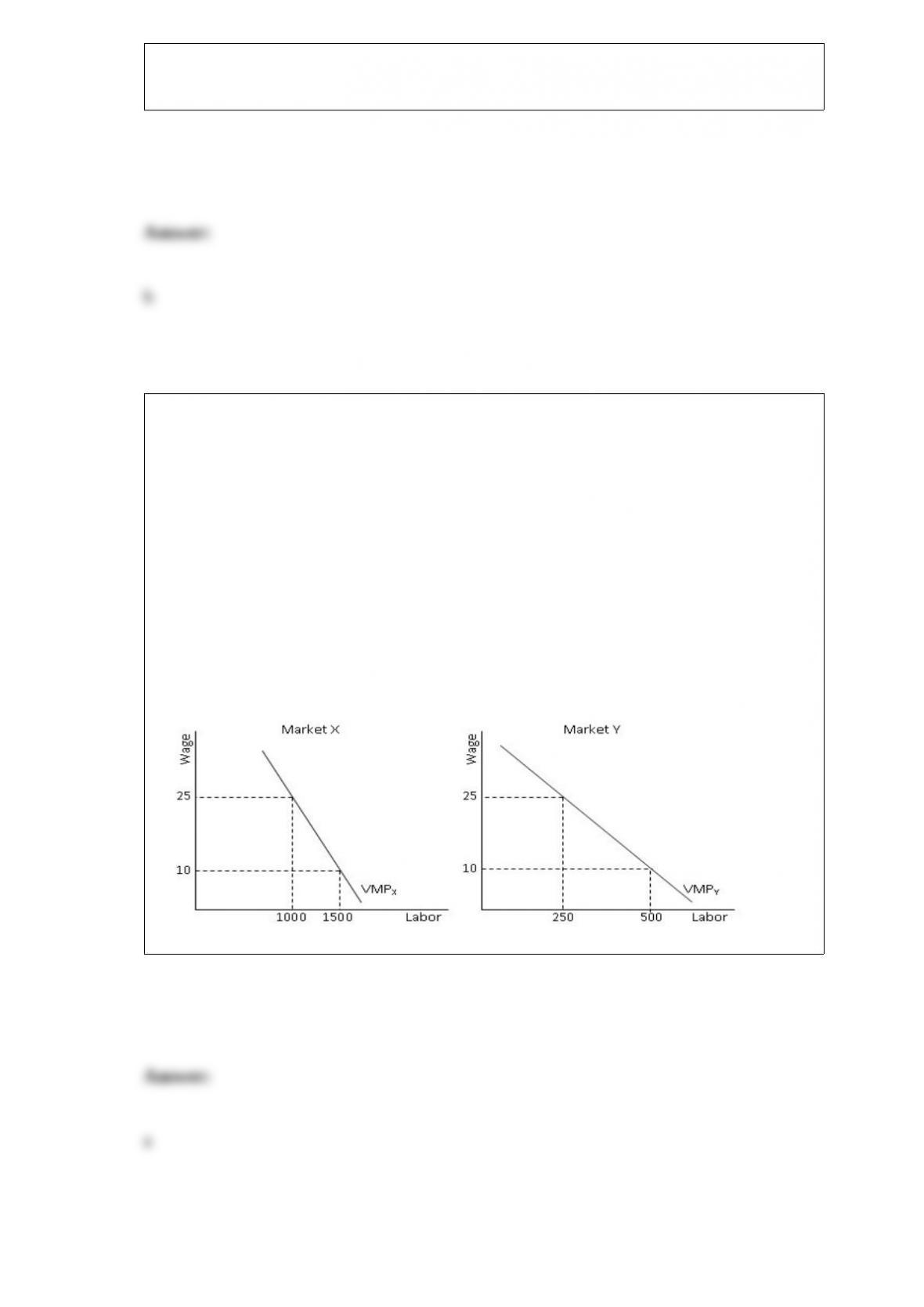
Assume there are initially 1000 workers in country X and 500 workers in country Y. As
workers beginto migrate, the total value of output will: (Assume all migration is
costless.)
a.increase in country X and decrease in country Y; the combined total will increase
b.increase in country X and decrease in country Y; the combined total will decrease
c.increase in country X and decrease in country Y; the combined total will not change
d.not change in either country
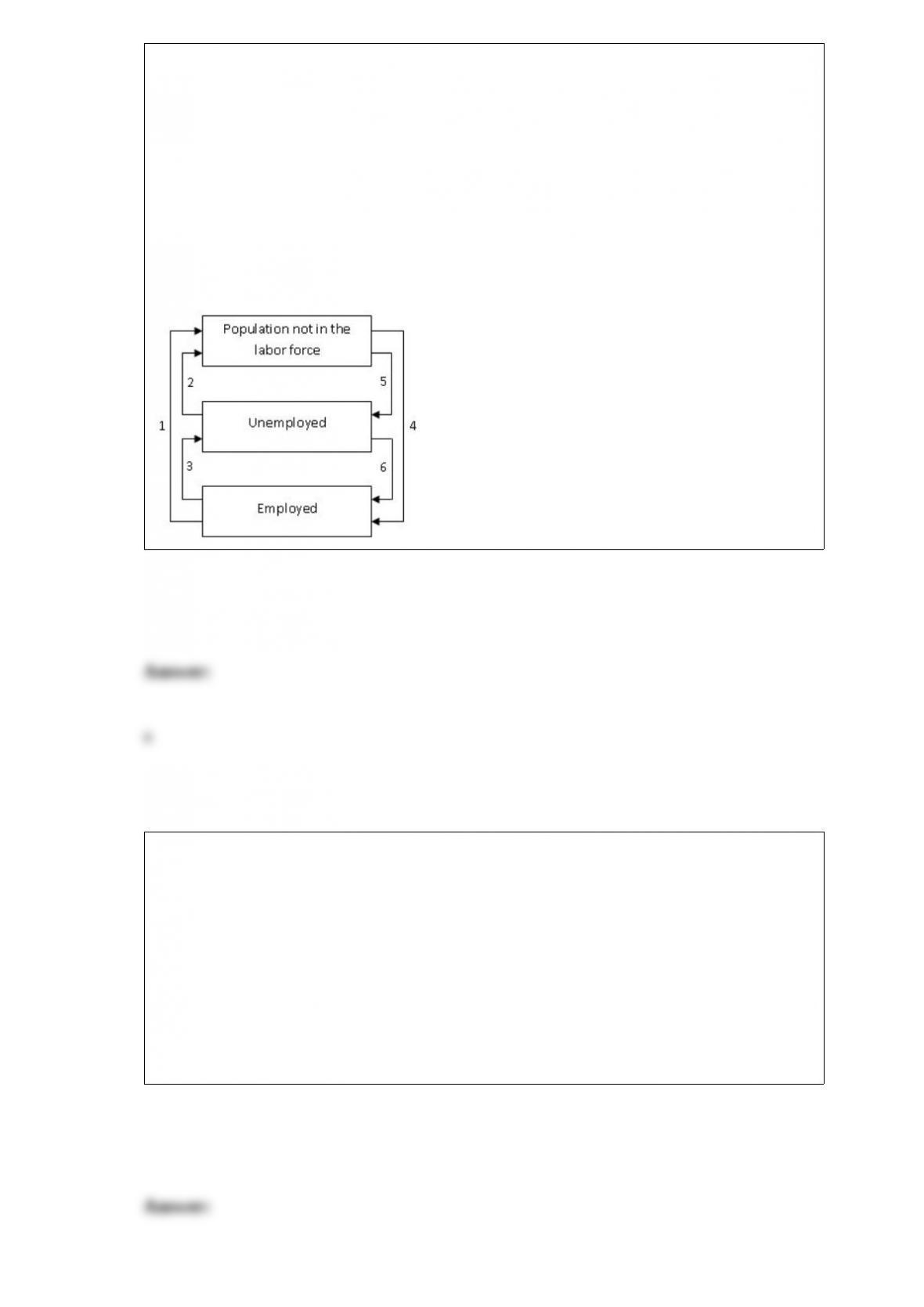
Which one of the following would reduce the unemployment rate while leaving the
number of unemployed persons unchanged?
a.An increase in flow 1
b.An increase in flow 2
c.An increase in flow 3
d.An increase in flow 6
Heterogeneous jobs are those that:
a. pay identical wages
b. have differing nonwage attributes
c. have identical nonwage attributes
d. require no special skill

At the profit maximizing level of employment for a monopsonist:
a. the wage exceeds the marginal wage cost
b. marginal revenue product equals the wage
c. the wage is less than marginal wage cost
d. marginal product equals marginal revenue product
Which of the following would be considered a real (as opposed to pecuniary)
externality associated with migration?
a.Capital owners in the origin will lose income as wages rise in response to reduced
labor supply
b.More public services will be required in the destination and there will be excess
capacity of public goods in the origin
c.Profits of capital owners at the origin will rise as migrants leave
d.Wages of destination workers will fall as migrants enter and add to labor supply
In a 1977 study that controlled for union status, education, and other characteristics,
Smith found that federal workers earned:

a.more than comparable private-sector workers
b.the same as comparable private-sector workers
c.less than comparable private-sector workers
d.more than comparable private-sector workers, but this finding was reversed if fringe
benefits were included
Which of the following actions might a union use to try to restrict the growth of labor
supply?
a.Increase product demand
b.Reduce the number of qualified workers
c.Enhance worker productivity
d.Reduce the wage for nonunion labor
A net increase in people’s preferences for work relative to leisure in a particular market
will:
a. increase labor supply, reducing the wage rate
b. decrease labor supply, increasing the wage rate
c. increase labor demand, increasing the wage rate
d. decrease labor demand, reducing the wage rate
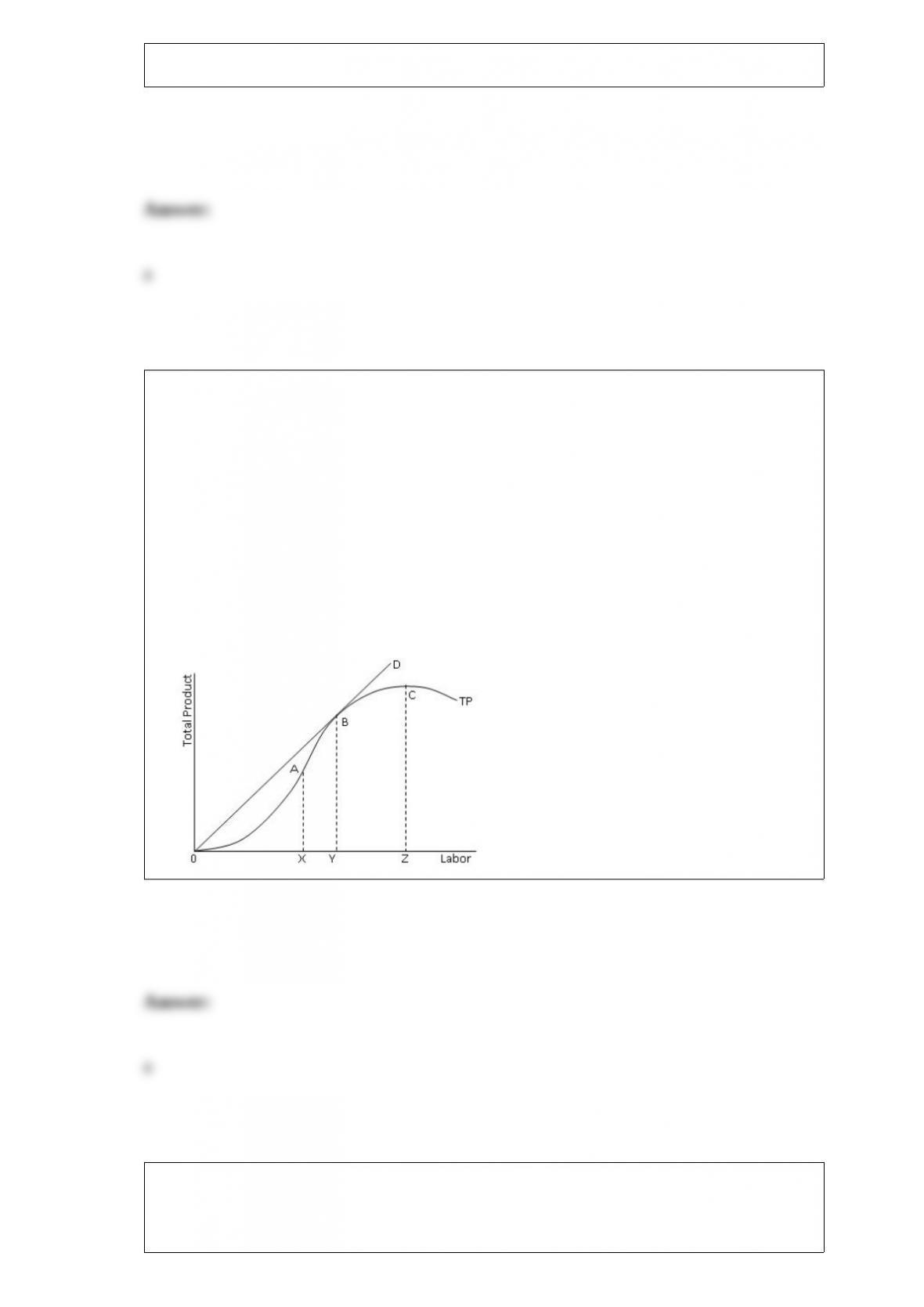
The slope of line segment 0D can be interpreted as the:
a. marginal product of labor at Y
b. total product of labor over the range 0Y
c. value of labor’s marginal product at Y
d. the greatest possible total product of labor
All of the following suggest that unions may improve productivity and efficiency
except:

a.unions provide workers a voice with which to communicate to management
b.union wage pressure may force management to adopt more efficient techniques to
maintain profitability
c.union workers protected by seniority rules are more likely to pass on knowledge to
new workers
d.unionization increases turnover rates, bringing in new workers with fresh ideas
A court order to prevent actions such as picketing, striking, and boycotting is called
a(n):
a.yellow-dog contract
b.blacklist
c.lockout
d.injunction
Suppose demand conditions in industries X and Y are identical but that productivity
increases by 5% in industry X and 2% in industry Y. If economy-wide productivity and
the average wage each rise by 3%, we should expect that:
a.output and employment in X will increase relative to Y

b.output and employment in X and Y will not change relative to one another, since
wages will increase by 5% in X and 2% in Y
c.output and employment in Y will increase relative to X
d.no statement can be made concerning output and employment in either industry
without more information
All else equal, the wage paid to steelworkers in Youngstown, Ohio will be lower if:
a. the cost of living in Youngstown is lower than elsewhere
b. working in the steel industry is louder and more dangerous than similar jobs
c. steelworkers have less control over their work environment than in similar jobs
d. there are fewer prospects for promotion among steelworkers than in similar jobs
“Expenditures on education and training can be treated as investment in human capital.”
This statement is:
a. truecurrent expenses are incurred with the expectation they will be more than
compensated for by greater future returns
b. trueeducation must be financed by borrowing money
c. falsethe market for college loans is too imperfect to be consistent with investment

models
d. falseeducation is purchased for its current (consumption) value, not its future
(investment) value
A stock option will have value to a worker if:
a. the firm’s stock price is expected to rise
b. the firm’s stock price is expected to fall
c. the “grant price” of the stock is expected to exceed its market price
d. none of the above
The resurgence of U. S. productivity growth in the last half of the 1990s:
a.corresponded to a resurgence in the growth of real compensation per hour
b.contributed to rising inflationary pressures
c.was unaccompanied by rising real compensation per hour
d.contributed to the rising unemployment rate at the beginning of the new millennium

Immigration to the United States:
a.peaked in the 1920s with a strong wave of northern Europeans
b.was less in 1980 than 1970
c.increased between 1980 and 1985 but then fell off in the later 1980s and early 1990s
d.surged in the early 1990s because of the amnesty provisions in the Immigration
Reform and Control Act
Research suggests that the wide-spread use of the birth control pill:
a. accounts for over half the increase in the labor force participation rate married
women since 1950
b. accounts for about one-third of the increase in the share of women in professional
occupations between 1970 and 1990
c. accounts for over two-thirds of the drop in the age of first marriage between 1970 and
1990
d. had no measurable impact on the labor force participation rate of women

Which of the following can be predicted to increase the demand for labor?
a. An increase in the price of a gross substitute for labor
b. An increase in the price of a pure complement to labor
c. A decrease in product demand
d. An increase in the price of another resource, provided the output effect exceeds the
substitution effect
If Sally correctly anticipates an increase in the rate of inflation, then:
a.both the acceptance wage and the entire distribution will shift to the left, thereby
leaving expected search duration unchanged
b.the acceptance wage will shift to the right, thereby reducing expected search duration
c.the entire distribution will shift to the right, but the acceptance wage will not, thereby
reducing expected search duration
d.both the acceptance wage and the entire distribution will shift to the right, thereby
leaving expected search duration unchanged

Which of the following best exemplifies the Becker substitution effect? An increase in
the market wage leads a household to:
a. eat more fast-food meals
b. play more golf together
c. have more children
d. take fewer, but longer vacations
One of the primary reasons for the decline in the labor force participation rate of teens
in the summer over the past 15 years is the:
a. below-average performance of the economy beginning in 1994
b. increased enrollment of teens in summer school programs
c. higher real wages available to teens since 1994
d. the slightly higher rate for whites and males coupled with a significantly lower rate
for African-Americans and females

If a worker’s wage rate rises:
a. household production will shift away from goods-intensive commodities towards
time-intensive commodities
b. household production will shift away from time-intensive commodities towards
goods-intensive commodities
c. more leisure time will be consumed
d. more leisure time will be consumed if the substitution effect outweighs the income
effect
The labor force consists of all persons age 16 years and over who are:
a. employed
b. employed or are actively seeking employment
c. employed, actively seeking employment, or have given up looking for employment
d. not institutionalized
Which of the following is not a cause of fringe benefit growth?

a. Tax advantages to the employer
b. Efficiency considerations
c. Economies of scale
d. Fringe benefits are income inelastic