
Evidence suggests that unions reduce firm profitability and discourage investment, so
that:
a.the dynamic efficiency loss from unionization is smaller than the static efficiency loss
b.the dynamic efficiency loss from unionization is greater than the static efficiency loss
c.turnover in union firms is greater because workers become bored with old technology
d.turnover in nonunion firms is greater because workers cannot keep up with new
technology
According to research by Kostiuk, ‘shift work”:
a. is relatively rare because such workers do not earn a compensating wage differential
b. is more common than generally understood because such workers do not earn a
compensating wage differential
c. provides a greater wage premium for highly educated workers than for less educated
workers
d. provides a greater wage premium for less educated workers than for highly educated
workers
Which of the following is a true statement?

a.Unemployment rates are greater for occupations requiring greater amounts of human
capital
b.Historically, the black unemployment rate has been about twice that for whites
c.Historically, unemployment rates are very similar for all skill levels
d.Historically, the unemployment rate for females has been twice that of males
Suppose the wage is currently W1and L1is the level of employment. If the firm sells its
output competitively, the value of the last worker’s additional output is _____ and the
opportunity cost of the last worker’s time is _____:
a. W1; W1
b. W1; W2
c. W1; W3
d. W2; W2

Empirical studies of the productivity of public capital indicate:
a.a consensus that public capital is approximately half as productive as private capital
b.a consensus that public capital is approximately twice as productive as private capital
c.high productivity when using national data, but low productivity using state and
regional data
d.high productivity when using state and regional data, but low productivity using
national data
If an African American woman is paid a lower wage than a similarly qualified and
experienced white man performing the same job at the same firm, then this is an
example of:
a. wage discrimination
b. employment discrimination
c. occupational discrimination
d. human capital discrimination

Market labor supply curves are generally:
a. upward sloping, as higher wages attract workers away from their next best
alternatives
b. backward-bending, as the substitution effect of higher wages outweighs the income
effect
c. vertical at any particular point in time
d. perfectly elastic at the market wage rate
Which of the following best explains why the market labor supply curve is upward
sloping, even though individual supply curves are normally backward bending?
a. The statement is not true: market labor supply curves are also backward bending
b. Market labor supply curves are “price-adjusted,” whereas individual supply curves
are not
c. Lower wages in a given market increase the demand for labor, so more labor must be
supplied to maintain labor market equilibrium
d. Higher wages in a given market attract more workers away from other activities,
more than compensating for any reduction in hours by individuals already in the market
According to the Taft-Hartley Act, which of the following is not an unfair labor practice
by unions?
a.Striking a company over a jurisdictional dispute with another union
b.Striking a company as a means of trying to obtain a collective bargaining agreement
with that firm

c.Striking a company to show sympathy for another union in obtaining employer
recognition
d.Setting excessive union dues
Discrimination that segregates qualified women into lower paying jobs is called:
a. wage discrimination
b. employment discrimination
c. occupational discrimination
d. human capital discrimination
Suppose the firm’s product demand is given by the column labeled D2. If the wage rate
rises from $100 to $130, the firm will reduce the quantity of labor employed by _____
unit(s). (Assume that the labor market is perfectly competitive.)
a. 0
b. 1
c. 2
d. 3

Which of the following best describes the output effect of a wage decrease?
a. The firm’s marginal cost increases, the firm desires to produce less output, and
therefore less labor is required
b. The cost of labor is relatively higher causing the firm to use relatively less labor
c. The firm’s marginal cost falls, the firm desires to produce more output, and therefore
more labor is required
d. The firm’s labor demand curve becomes more inelastic, causing it to employ less
labor
A partial explanation of the change in public-sector employment since 1950 is that:
a.the demand for public-sector goods is price elasticas their relative prices have fallen,
more public goods have been demanded.

b.the number or school-age children has declined which in turn has caused a marked
decrease in the demand for public school teachers
c.the demand for public-sector goods is income elasticas society’s real income has
grown, more public goods have been demanded
d.the federal government has been running larger budget deficits
Assuming workers and jobs are identical, if information is perfect and job search and
migration are costless, then:
a. labor may or may not flow among employers
b. labor will flow among employers until all wages are equal
c. labor will flow among employers until all economic profits are zero, but wages may
be unequal
d. all firms will hire the same number of workers in equilibrium and pay them all the
same wage
As of 2011, which of the following U.S. industries was less than 10% unionized?
a.transportation, information, and public utilities
b.public administration

c.wholesale and retail trade
d.construction
Consider the market depicted in the diagram. If all illegal aliens were deported: (Sd is
the supply curve of domestic labor, St is the total labor supply curve including the
supplies of illegal immigrant workers. L is measured in thousands of workers.)
a.70,000 domestic workers would replace the 70,000 deported workers in these jobs
b.the wage would rise to $10, attracting 30,000 domestic workers into these jobs
c.the wage would rise to $10, but there would be a shortage of 40,000 workers
d.the wage would remain at $6, and there would be a shortage of 40,000 workers

The proportion of total compensation paid out as fringe benefits tends to be larger in:
a. high-paid industries compared to low-paid industries
b. service industries compared to manufacturing industries
c. white-collar occupations compared to blue-collar occupations
d. retail trade compared to transportation and public utilities
The local union has primary responsibility for:
a.organizing workers in its craft or industry
b.negotiating collective bargaining agreements
c.handling grievance procedures
d.settling jurisdictional disputes
Studies of the rate of return on human capital must be interpreted with care because:
a. the social return may not equal the private return
b. past differences in earnings are no guarantee of future differences in earnings

c. a high average rate of return is no guarantee of a high personal rate of return
d. all of the above
Suppose this represents the market for U.S. autoworkers. If the government were to
pass legislation mandating that all vehicles sold in the U.S. contain at least 50%
domestically produced or assembled components, then:
a.supply would shift to the right, reducing economic rent to U.S. autoworkers
b.supply would shift to the left, reducing economic rent to U.S. autoworkers
c.demand would shift to the right, reducing economic rent to U.S. autoworkers
d.demand would shift to the right, increasing economic rent to U.S. autoworkers

Economists typically believe that the goal of a union is to:
a.maximize the total employment of its members
b.maximize the total wage income of its members
c.bargain for the highest wage possible
d.increase both the wages and employment of its members
According to research by Neumann and Rissman, many government programs provide
“union-like” services, which has contributed to the decline of unionization. Their
findings illustrate the:
a.managerial-opposition hypothesis
b.union-growth hypothesis
c.structural-change hypothesis
d.substitution hypothesis
The threat effect would be modeled by: (Wages in both the union and nonunion sectors
are initially $10. The union then negotiates a wage rate of $12. The post-negotiation
nonunion wage is not yet known.)
a.shifting the nonunion supply curve to the right, increasing the measured union wage
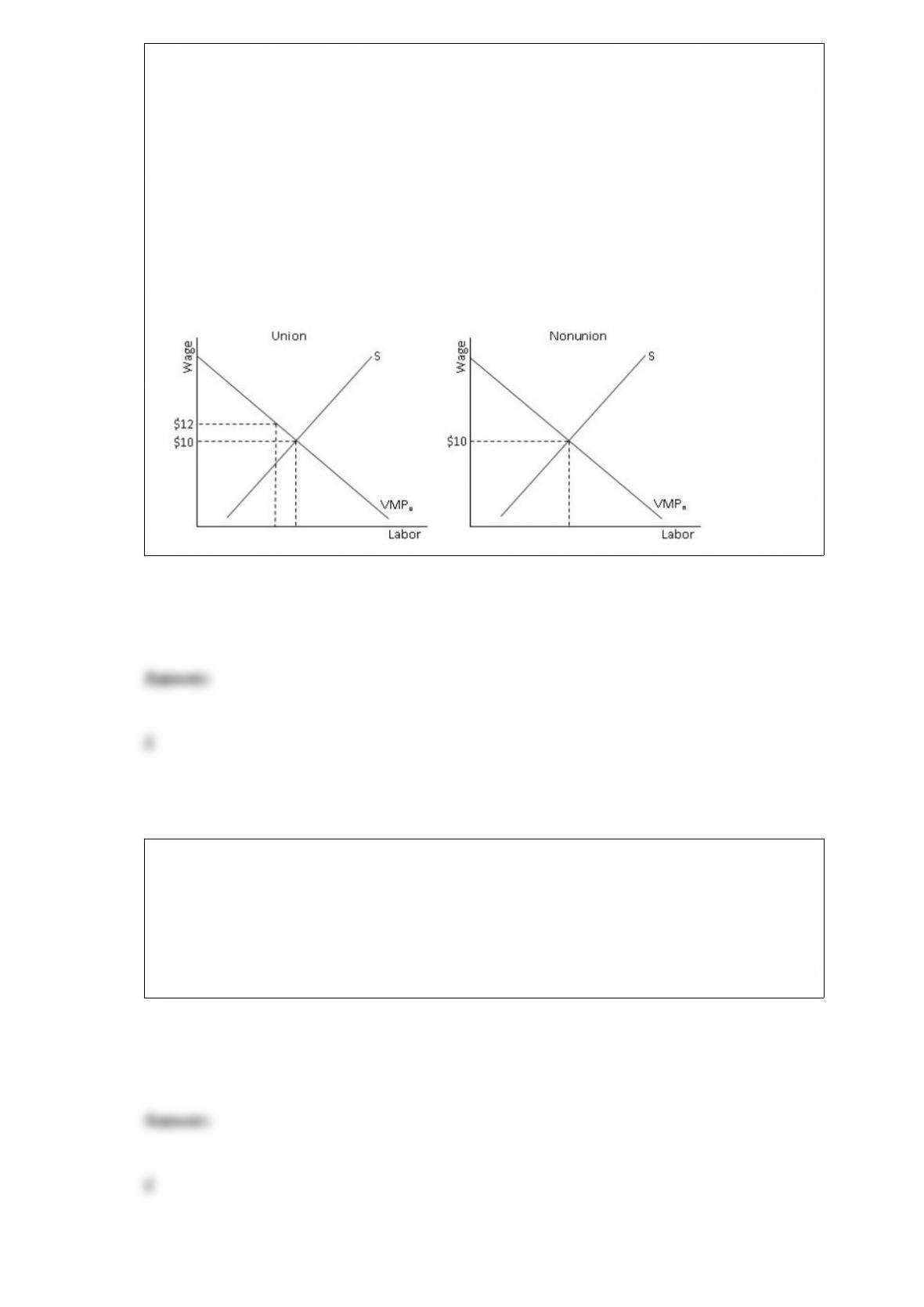
advantage
b.shifting the nonunion demand curve to the right, reducing the measured union wage
advantage
c.shifting the union demand curve to the right, increasing the measured union wage
advantage
d.raising the nonunion wage above its equilibrium level, decreasing the measured union
wage advantage
All profit-maximizing firms hire labor up to the point where:
a. price times marginal product equals the wage rate
b. marginal revenue times marginal product equals the wage rate
c. price times marginal product equals the marginal wage cost
d. marginal revenue times marginal product equals the marginal wage cost
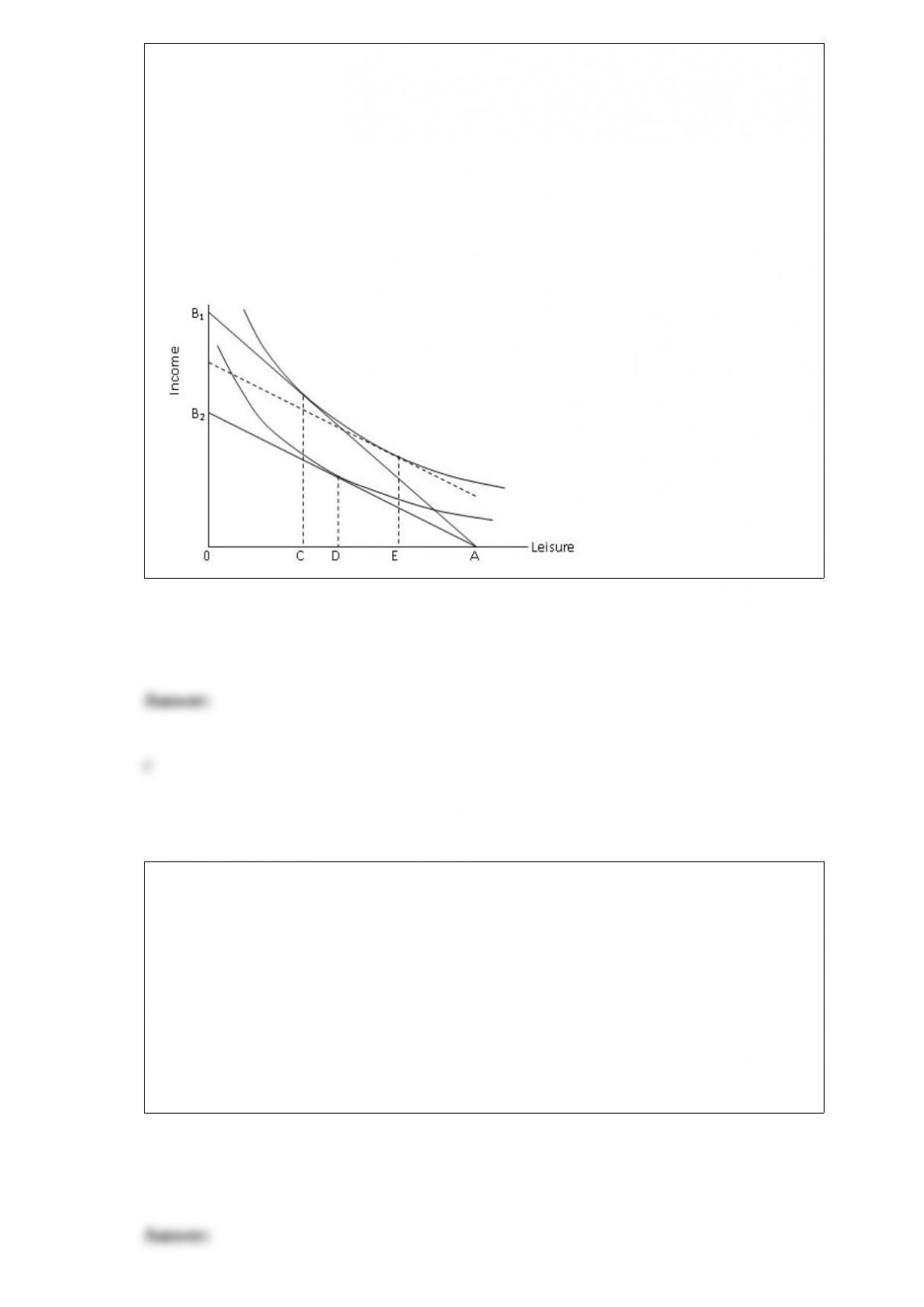
In the diagram, the substitution effect associated with a wage increase is shown by the
distance:
a. CD
b. DE
c. CE
d. 0C
Labor market efficiency requires that each worker be allocated to:
a. the job offering the highest wage available
b. the job offering the best fringe benefits available
c. his or her optimal job
d. his or her optimal job, and that each firm implements its optimal compensation
package

Which one of the following would be most likely to shift the labor supply curve to the
right?
a. A decrease in the wage rate
b. A change in the indifference map following deterioration of working conditions
c. A change in the indifference map following an improvement in working conditions
d. A significant increase in dividend and interest income
A fully anticipated reduction in the rate of inflation is expected to:
a.reduce the unemployment rate in the short run, but not in the long run
b.reduce the unemployment rate in the both the short run and the long run
c.increase the unemployment rate in the short run, but not in the long run
d.have little impact on the unemployment rate in either the short run or the long run

Which of the following best describes the real balances effect? As the price level rises,
the real value of dollar-denominated assets:
a.rises, which leads people to increase spending on normal goods and services
b.rises, which leads people to decrease spending on normal goods and services
c.falls, which leads people to increase spending on normal goods and services
d.falls, which leads people to decrease spending on normal goods and services
For a firm selling output in an imperfectly competitive market, its labor demand curve
will:
a. reflect the value of marginal product schedule, provided the firm is operating in the
zone of production
b. decline solely because of diminishing marginal productivity
c. decline because of diminishing marginal productivity and because product price
declines as output increases
d. be perfectly elastic if the firm is hiring labor competitively
If real GDP falls by 2% while work hours fall by 10%, then labor productivity:
a.falls

b.is unchanged
c.rises
d.might fall, but we cannot know without more information
According to research on the incidence of Social Security payroll taxes:
a.workers and firms bear the social security tax equally
b.workers bear a greater share of the social security tax burden than firms, because
firms “collect” some of the taxes for customers in the form of higher output prices
c.workers bear a greater share of the social security tax burden than firms, because
firms “collect” some of the taxes from workers in the form of reduced wages
d.firms bear a greater share of the social security tax burden than workers, because
workers “collect” some of the tax proceeds from firms in the form of increased wages