
Suppose an individual worker is on the backward-bending portion of her labor supply
curve. Then, for a wage increase, the:
a. income and substitution effects both increase desired work hours
b. income and substitution effects are equal
c. income effect is stronger than the substitution effect
d. substitution effect is stronger than the income effect
An individual whose MRS L,Y exceeds the wage at her current combination of leisure
and income could increase utility by:
a. working more hours
b. working fewer hours
c. increasing her income
d. none of the above; her utility is maximized
Consider a worker who faces a tradeoff between wages on the vertical axis and job
safety on the horizontal axis. The less averse a worker is to risk of injury on the job, the:

a. lower is the wage earned by the worker
b. steeper is this worker’s indifference curves
c. flatter is this worker’s indifference curves
d. lower are the profits of this worker’s employer
A “domestic content” law for automobiles would increase the economic rent of workers
in the U.S. automobile industry by:
a.decreasing the demand for autoworkers in the U.S.
b.decreasing the supply of U.S. autoworkers in the U.S.
c.allowing U.S. autoworkers to obtain higher wages even though employment falls in
the U.S. automobile industry
d.increasing the demand for autoworkers in the U.S. and pulling up their wages
One disadvantage of computer-assisted scheduling of more flexible work schedules for
retail workers is that:
a. stores are less likely to have enough personnel to meet customer demand
b. labor costs will likely rise

c. manager time devoted to scheduling will rise
d. unusual work shifts make childcare harder to schedule
If legislation set the minimum wage at W2, then employment: (the following diagram of
a monopsonistic labor market.)
a. would fall from its original monopsony level
b. would remain unchanged
c. would rise from its original monopsony level
d. may or may not change from its original monopsony level
Consider Becker’s “taste-for-discrimination” model. All else equal, the increase in

female labor supply over the past 40 years should have resulted in:
a. reduced employment opportunities for women
b. a lower relative wage for women
c. a higher relative wage for women
d. increased efficiency in the labor market
The major cost of continued job search is:
a.the cost of placing job-wanted advertisements in the newspaper
b.expenses paid to a job-placement agency
c.foregone wages of job offers not accepted
d.transportation expenses of going to job interviews
The secular decline in the birth rate:
a. has contributed to the increased labor force participation rate of women
b. may partly be caused by the increasing opportunity cost of children as women’s
wages have increased

c. both a. and b. are correct
d. neither a. nor b. are correct
Which of the following is not a source of persistent compensating wage differentials?
a. migration from lower paying jobs to higher paying jobs
b. fringe benefits
c. job status
d. different skill requirements
If a family has an earned income of $3000 per year, its subsidy payment will be:
( Assume under an income maintenance program that the basic benefit (income
guarantee) is $9000 and the benefit-reduction rate is 50%.)
a. $6000
b. $7500
c. $9000
d. $0

Since the end of World War II, the average weekly hours of work in manufacturing has
a. been steady, in part due to increased education
b. been steady, in part due to lower tax rates
c. fallen steadily
d. increased steadily
Of the following, which country experienced the fastest rate of productivity growth
over the period 2000 ” 2010?
a.United States
b.Sweden
c.France
d.Germany

All else equal, investment in education will be greater, the:
a. higher the interest rate
b. greater the direct cost of education
c. lower the expected retirement age
d. greater the earnings differential between more and less educated workers
Compared to a firm facing D1, a firm facing demand schedule D2 but paying the same
wage will hire: (Assume that the labor market is perfectly competitive.)
a. the same number of workers, since total product is the same in both instances
b. fewer workers, since product price declines as output increases
c. more workers, since product price declines as output increases
d. more information is required

Among the following industrial countries, income inequality is greatest in:
a.Germany
b.Italy
c.Canada
d.the U.S.
To determine the unemployment rate, each month the government:
a.collects data from a survey of about 60,000 households nationwide
b.collects data from a survey of about 500,000 firms nationwide
c.records the number of people receiving unemployment compensation
d.conducts a full count of the number of unemployed in each state
Other things equal, the lower the cost of a human capital investment:
a. the larger the net present value of the investment
b. the lower the rate of return on the investment

c. the fewer the number of people who will find the investment profitable
d. the lower the interest rate on funds borrowed to finance the investment
The 90-10 wage ratio for workers over the period 1973 ” present shows that:
a.inequality increased among both men and women
b.inequality increased among men but decreased among women
c.inequality increased among women but decreased among men
d.inequality decreased among both men and women
If part of the typical college graduates additional earnings is attributable to ability and
not to education:
a. the screening hypothesis must be false
b. estimated rates of return will overstate the actual rate of return
c. there will be less dispersion in the distribution of earnings than otherwise
d. the social rate of return will understate the private rate

Which one of the following laws most dramatically increased union bargaining power?
a.Sherman Act
b.Wagner Act
c.Taft-Hartley Act
d.Landrum-Griffin Act
Suppose a working mother is currently ineligible for any government assistance. If she
were then to become eligible for an income maintenance program that incorporates both
a basic benefit and a positive benefit-reduction rate:
a. both the income and substitution effect will cause her to increase her work effort
b. both the income and substitution effect will cause her to decrease her work effort
c. her work effort will increase if the substitution effect is stronger than the income
effect
d. her work effort will decrease if the substitution effect is stronger than the income
effect
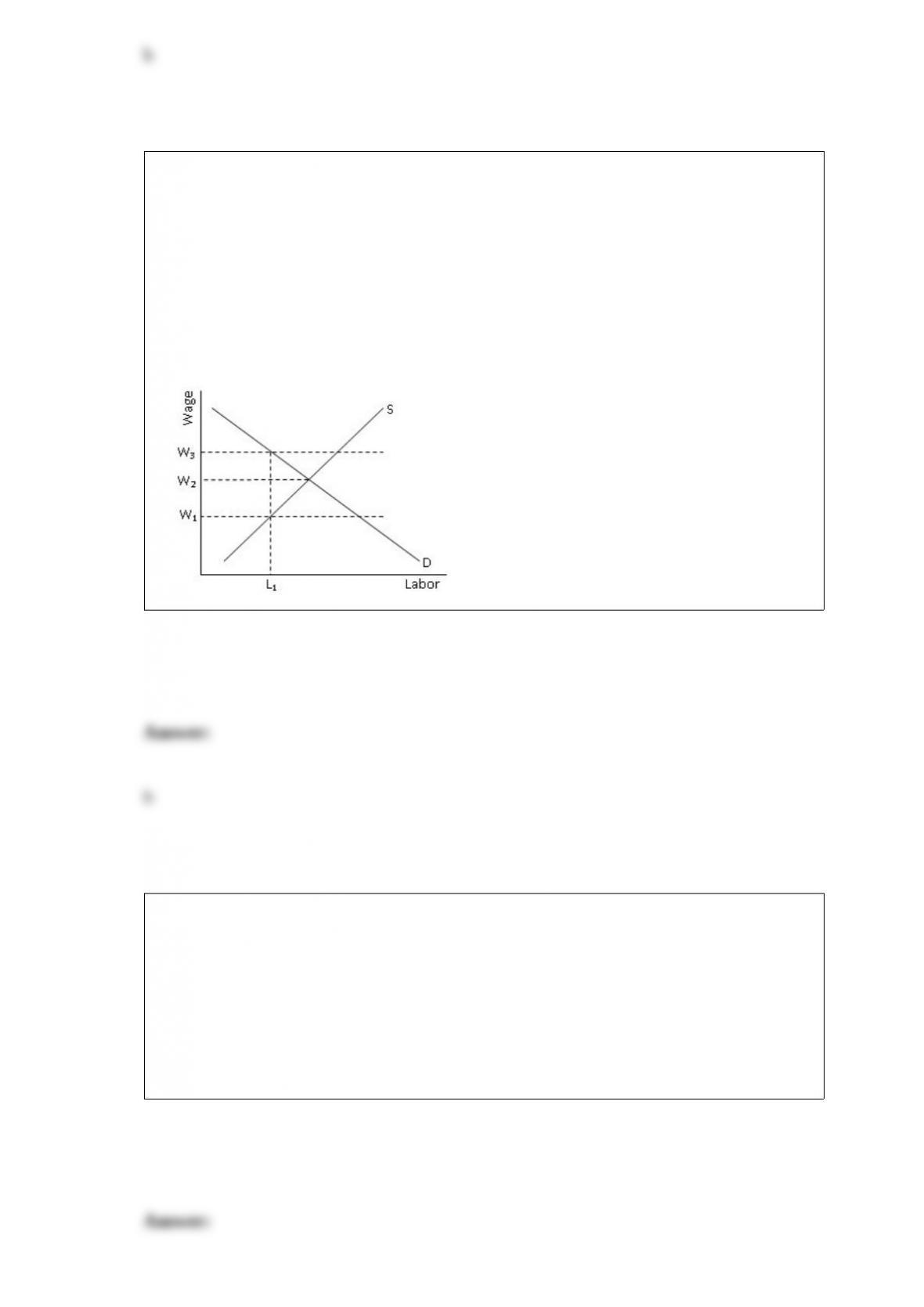
Suppose the wage is currently W1and L1is the level of employment. If this market is
characterized by delayed supply responses, in the immediate period the wage will:
a. rise and employment will rise
b. rise and employment will remain unchanged
c. remain unchanged and employment will rise
d. remain unchanged and employment will remain unchanged
All else equal, which of the following will increase the demand for labor in a particular
market?
a. A decrease in the wage paid to another occupation for which these workers are
qualified
b. A decrease in worker productivity
c. An improvement in the nonwage aspects of the job
d. An increase in the number of employers

Critics of the “rational choice” view contend that:
a. differences in earnings may be the result of freely-made schooling and occupational
choices
b. differences in schooling and occupational choices are caused by discrimination
c. wage differentials may be due to nondiscriminatory factors
d. sexual harassment and discrimination do not affect occupational choices
Human capital investment consists of:
a. any activity that enhances the quality of labor
b. expenditures for formal schooling only
c. expenditures for on-the-job training only
d. any activity that leads to the substitution of physical capital for labor

Which of the following is a true statement?
a.Unions accelerate the evolution of internal labor markets
b.Internal labor markets invite unionization
c.Both a. and b. are correct
d.Neither a. nor b. is correct
In 2011 the occupational distribution was:
a. uneven by gender and by race
b. uneven by race but not by gender
c. uneven by gender but not by race
d. even by gender and by race
Assuming that labor supply is S2, imposing an income tax on this market will:
a.raise the market wage rate but reduce the net (after-tax) wage rate
b.reduce the market wage rate and reduce the net (after-tax) wage rate
c.raise the market wage rate but have no impact on the net (after-tax) wage rate

d.have no impact on the market wage rate but reduce the net (after-tax) wage rate
Refer to the diagram. If D1 is this individual’s investment demand curve, then the
optimal amount of education:
a. is E1 from society’s standpoint
b. is E2 from society’s standpoint
c. is E1 from this individual’s standpoint
d. cannot be determined without further information
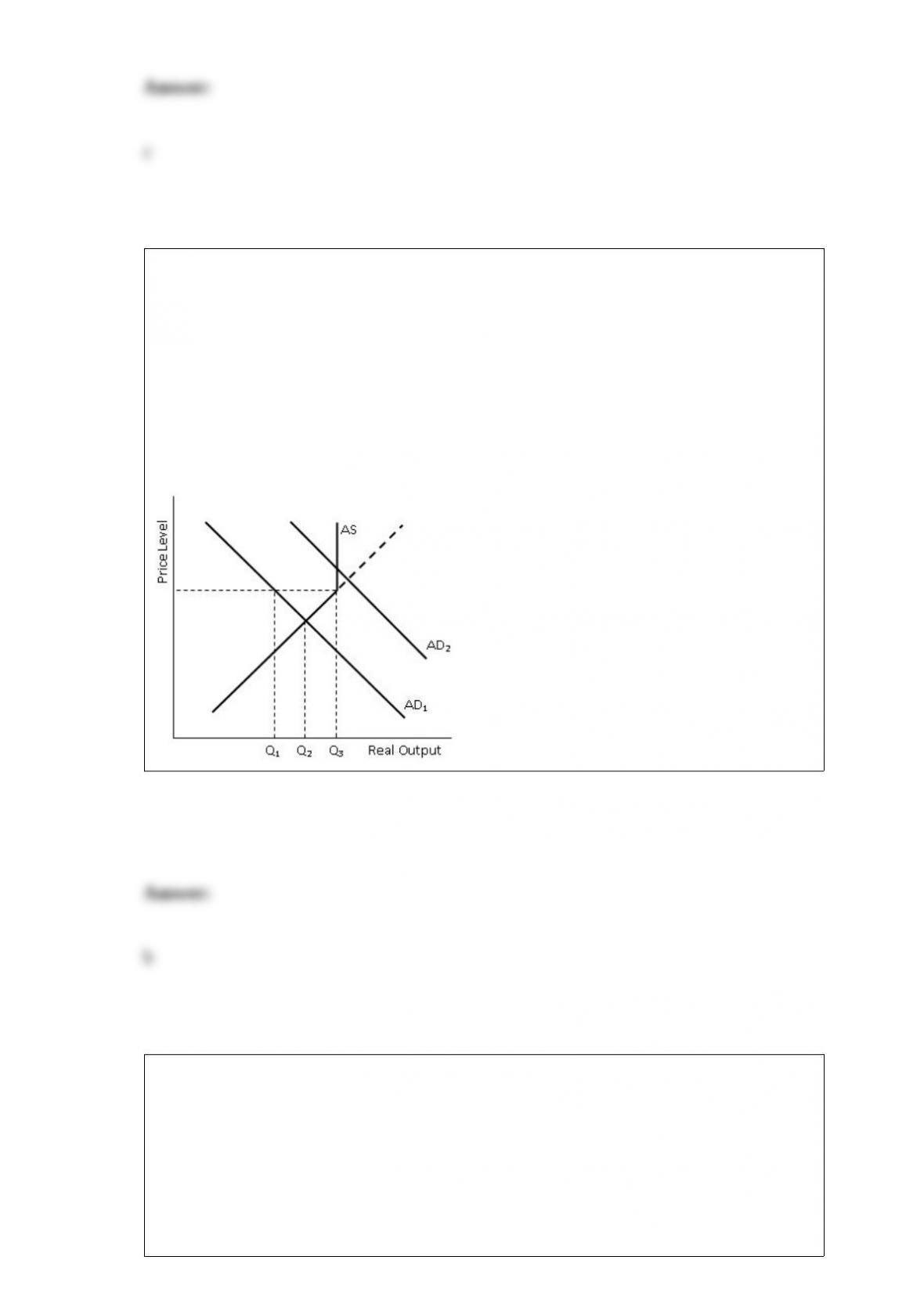
If aggregate demand is given by AD1, the economy will:
a.achieve the full-employment level of output
b.fall short of the full-employment level of output
c.exceed the full-employment level of output
d.experience frictional unemployment but not cyclical unemployment
From society’s standpoint, the optimal level of safety is: . (MCs is the firm’s marginal
cost of providing safety, while MBs is the marginal benefit to society of a one more unit
of safety. Because of imperfect information and costly worker mobility, MBs‘ is the
firm’s perceived marginal benefit of safety.):
a.0
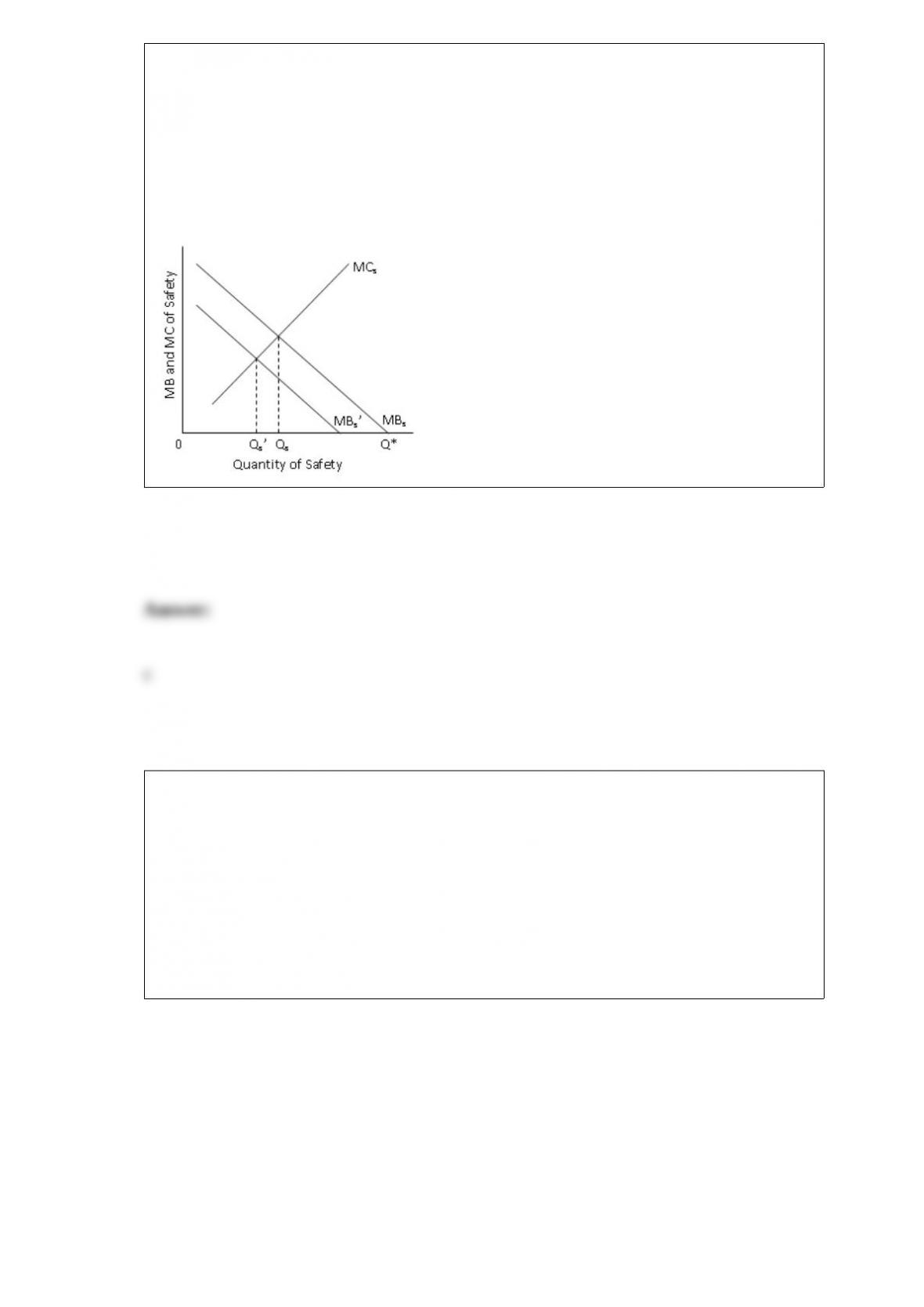
b.Qs‘
c.Qs
d.Q*
In deciding whether or not to go to college, one would compare the discounted value of:
a. area 3 to the discounted value of area 1
b. area 3 to the discounted value of area 2
c. area 3 to the discounted value of areas 1 and 2
d. areas 2 and 3 to the discounted value of area 1

Because scarcity forces people to make purposeful choices, labor market participants:
a. work as many hours as possible
b. respond to changes in perceived costs and benefits
c. make choices that cannot be predicted
d. must have perfect information
Compared to other industrial countries such as Canada, France, Italy, and the United
Kingdom, the incidence of strikes in the United States is:
a.approximately the samec.significantly lower

b.slightly higherd.significantly higher