
The profit-maximizing level of job safety is a probability level of: (MBs and MCs are
the marginal benefit and marginal cost of safety, respectively. Ps is the probability that a
worker will not suffer an injury on the job during a one year period, and is thus a
measure of job safety.):
a.0.65
b.0.75
c.0.80
d.0.85
The overall index of occupational segregation _____ from 1980 to the present; at the
same time, the presence of women in selected professions such as dentistry, law,
medicine and the clergy _____.
a. decreased; increased
b. decreased; decreased
c. increased; increased
d. increased; decreased

Empirical estimates of the extent of discrimination may be downwardly biased if:
a. certain variables which have a positive effect on productivity are omitted from the
study
b. certain variables which have a negative effect on productivity are omitted from the
study
c. many of the control variables (such as education or occupation) reflect personal
choices
d. all of the above
According to empirical evidence, most of the burden of the payroll tax appears to fall
on workers, even though about half is supposedly “paid” by their employers. This
observation is attributed to the finding that:
a.many workers are self-employed and must pay the full amount of a payroll tax
b.the aggregate supply of labor tends to be relatively inelastic
c.the aggregate demand for labor tends to be relatively inelastic
d.employers have much stronger bargaining power than workers since only a tiny
fraction of the labor force is unionized

Compared to the private sector, the public sector earnings distribution tends to be:
a.more unequal because government workers tend to be employed in service
occupations
b.more unequal because government pay scales are generally higher
c.less unequal because of the relatively large number of management positions in
government
d.less unequal because blue-collar employees are generally paid more and white-collar
employees are generally paid less than their private-sector counterparts
Estimates by the U.S. Bureau of the Census suggest that since 1992, total legal and
illegal immigration to the U.S. each year has averaged approximately:
a.300,000 persons
b.850,000 persons
c.4,000,000 persons
d.12,000,000 persons
Productivity growth:

a.falls below its trend rate in a recession and rises above it in an expansion
b.rises above its trend rate in a recession and falls below it in an expansion
c.is counter-cyclical
d.is independent of the business cycle
Suppose the firm’s product demand is given by the column labeled D1. The value of the
marginal product of the fourth worker is:
(Assume that the labor market is perfectly competitive.)
a. $10
b. $54
c. $120
d. $540

In the short run, the aggregate quantity supplied may exceed the full-employment level
of output. This is because as the price level rises:
a.firms mistake lower real wage rates for lower money wage rates and therefore
increase employment beyond the profit-maximizing level
b.firms mistake lower money wage rates for lower real wage rates and therefore
increase employment beyond the profit-maximizing level
c.workers respond to falling real wage rates by working more hours, since the income
effect outweighs the substitution effect
d.unemployed workers mistake higher nominal wage rates for higher real wage rates,
causing employment and output to rise as they accept job offers more quickly
The wage/employment combination given by Wb/Q2 is: (Wc is the competitive wage
and Ic is the union’s utility level at the competitive wage and employment level.)
a.efficient
b.inefficient in that a slightly lower wage and slightly more employment would leave
both the firm and the union better off
c.inefficient in that a slightly higher wage and slightly less employment would leave
both the firm and the union better off
d.inefficient in that firm profits are lower than they would be at Wc/Qc

The “monopoly union” model assumes that the union:
a.faces a wage-employment tradeoff, given as the firm’s demand for labor curve
b.will be able to increase both the wages and employment of its members
c.will attempt to negotiate an “efficient contract” with the firm
d.attempts to maximize the wage rate
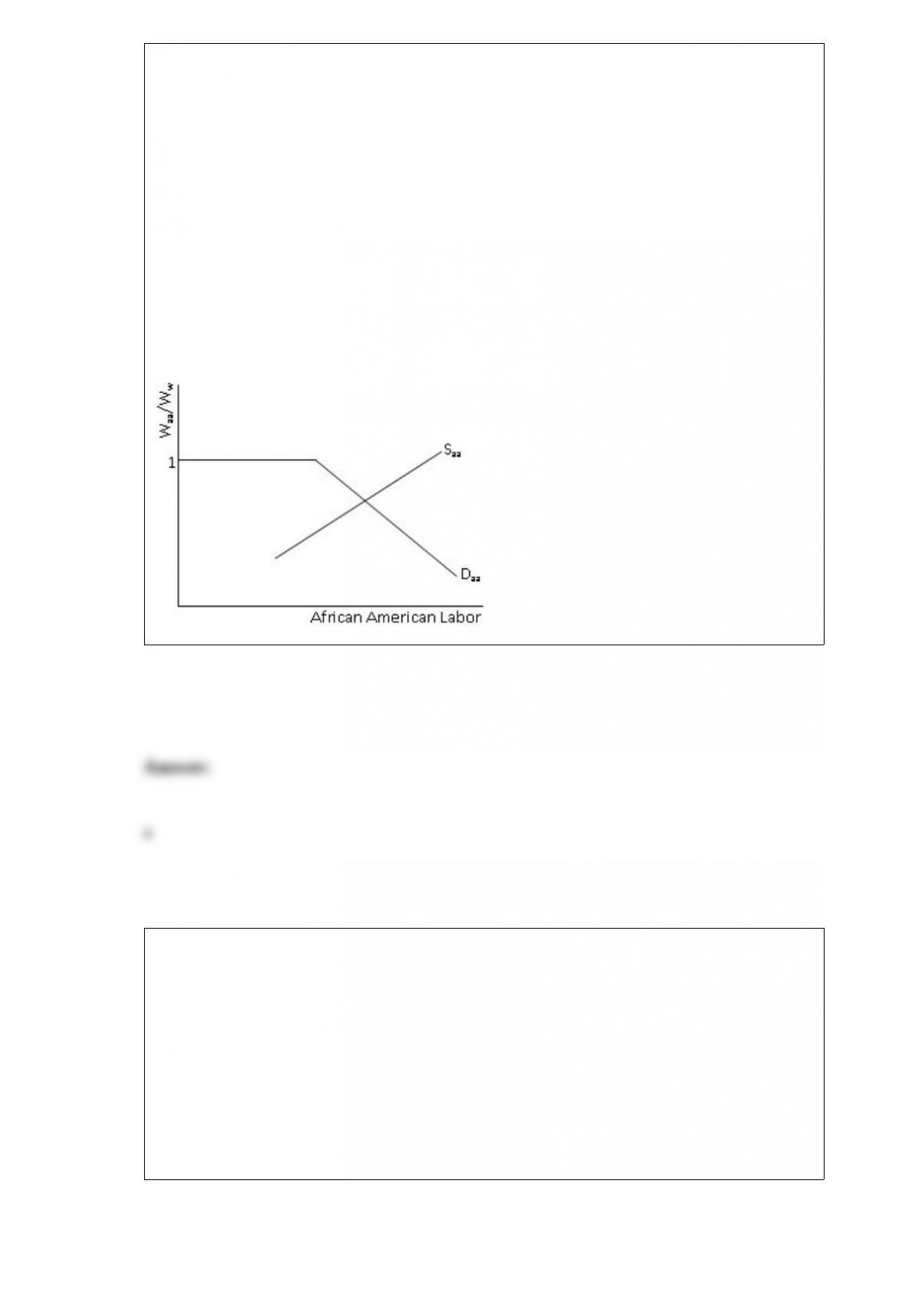
The demand curve in the diagram eventually slopes downward because: (Waa/Ww is the
ratio of the African American wage rate to the white wage rate):
a. as the African American-white wage ratio falls, more firms find it “too costly” to
indulge their tastes for discrimination
b. as the African American-white wage ratio rises, more firms find it “too costly” to
indulge their tastes for discrimination
c. as the African American-white wage ratio falls, firms will raise their discrimination
coefficients
d. as the African American-white wage ratio falls, firms will reduce their discrimination
coefficients
If a drop in aggregate demand causes a recession, then over this range of real output the
aggregate supply curve is:
a.vertical
b.downward sloping
c.upward sloping
d.inelastic

In the context of the basic work-leisure model, “work” is defined as:
a. time devoted to a paying job or household work
b. time devoted to a paying job
c. time devoted to any “undesirable” activity
d. all time not devoted to rest and relaxation
Which of the following contributes to a higher unemployment rate of African American
youths compared to white youths?
a.Both wage offer distributions and acceptance wages are lower for African American
youths
b.The African American wage offer distribution is to the right of the white distribution
c.White youths have a higher acceptance wage than African American youths
d.African American youths have a higher acceptance wage than white youths

The mean annual earnings in 2010 for full-time workers in the U. S. was
approximately:
a.$31,000
b.$35,000
c.$46,000
d.$54,000
Of the following, union membership is highest in:
a.Florida
b.Michigan
c.Colorado
d.Arkansas
If a firm can offer fringe benefits worth more than one dollar for a one dollar reduction
in wages:
a. the wage-fringe isoprofit line will be upward-sloping

b. the wage-fringe isoprofit line will have a slope less than one in absolute value
c. the marginal rate of substitution between wages and fringe benefits will be greater
than one at the wage-fringe optimum
d. as a proportion of total compensation, fringe benefits will likely exceed one half
Because migration typically involves present sacrifice in order to obtain a greater
stream of future earnings, many economists consider migration to be:
a.an investment in human capital
b.undertaken only by those who have very low discount rates
c.motivated strictly by monetary considerations
d.an impediment to economic efficiency
Suppose the firm’s product demand is given by the column labeled D2. If the wage rate
is $100, the firm will achieve maximum profit by hiring _____ workers
(Assume that the labor market is perfectly competitive.)
a. 2
b. 3

c. 4
d. 5
Which one of the following is not predicted to increase the labor force participation rate
of married women?
a. Rising wage rates for husbands
b. Rising productivity in the household
c. Declining birthrates
d. Attempts to maintain living standards
As a percentage of total work-time, the average amount of work-time lost because of
strikes annually is typically:
a.less than 1%c.9%-10%
b.4%-5%d.greater than 15%
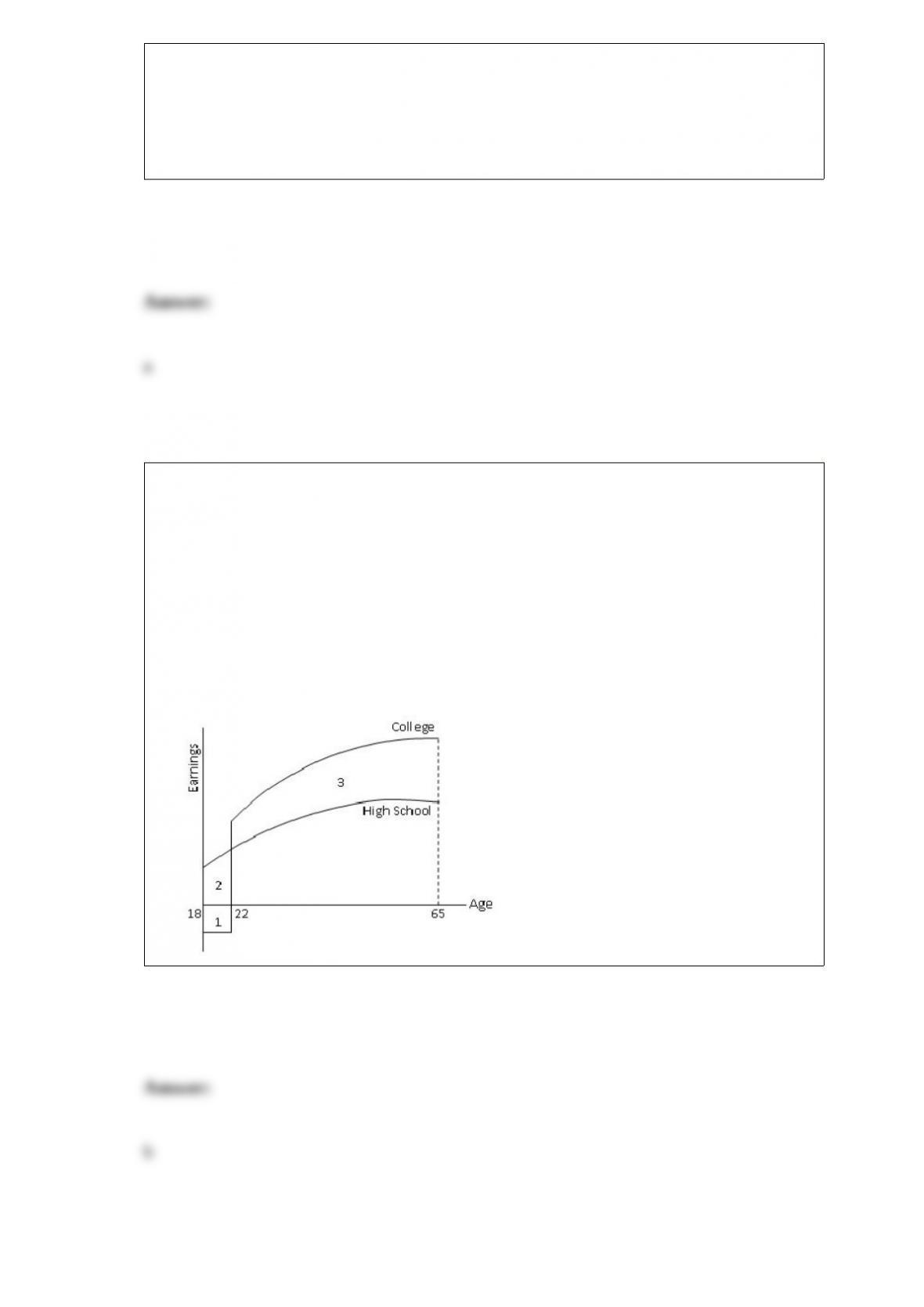
According to human capital theory, areas 1, 2, and 3 represent respectively:
a. indirect costs, direct costs, and incremental earnings
b. direct costs, indirect costs, and incremental earnings
c. indirect costs, direct costs, and total earnings
d. direct costs, indirect costs, and total earnings
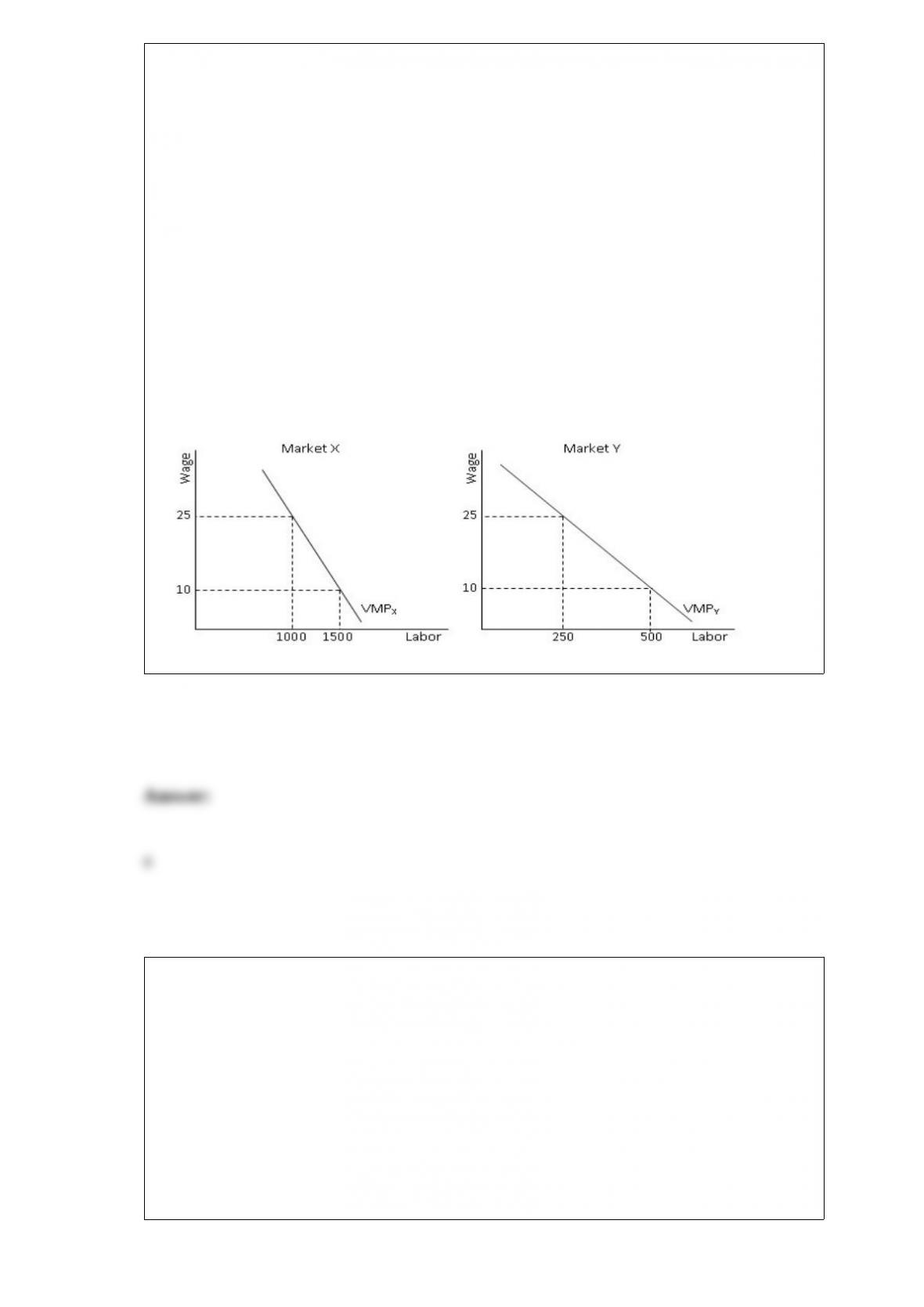
If wages are initially $10 in country X and $25 in country Y, then we should expect a
relative price advantage in country: (Assume all migration is costless.)
a.X, eventually resulting in greater export sales to Y and thus greater derived demand
for labor in X
b.Y, eventually resulting in greater export sales to X and thus greater derived demand
for labor in Y
c.X, eventually resulting in greater imports from Y thus greater derived demand for
labor in X
d.Y, eventually resulting in greater imports from X and thus greater derived demand for
labor in Y
The allocatively efficient level of employment for this firm is given by: (the following
diagram that shows the labor demand for a monopolistic firm hiring labor from a
competitive labor market.)
a. Q1
b. Q2
c. some amount between Q1and Q2
d. some amount greater than Q2
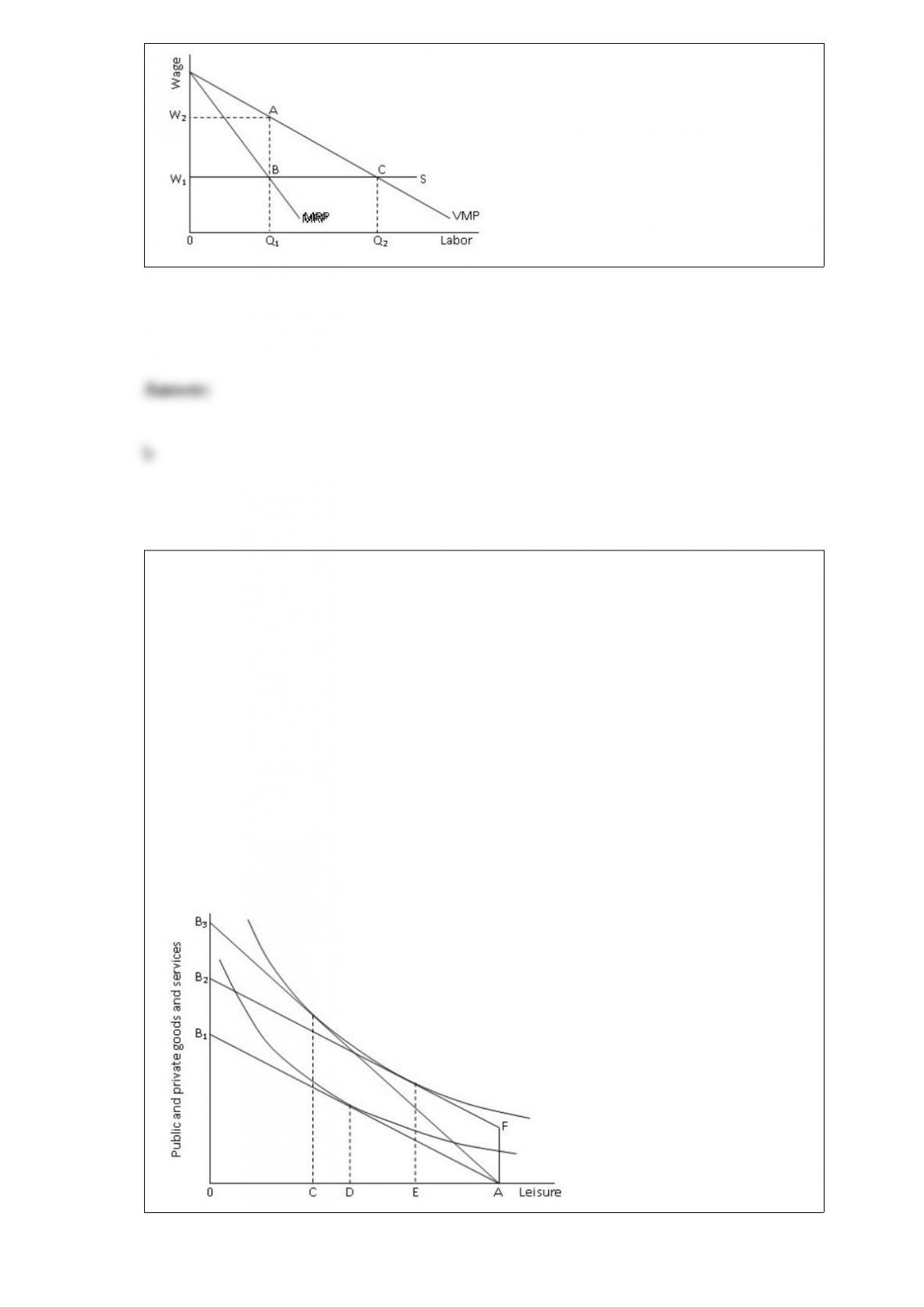
The provision of a public good is best modeled by the shift to budget line: ( the
following labor-leisure diagram (The worker’s current budget line is given by line AB1
and she is working AD hours.)
a.AB3 and the subsequent increase in work hours to AC
b.AB3 and the subsequent decrease in work hours to AE
c.AFB2 and the subsequent increase in work hours to AC
d.AFB2 and the subsequent decrease in work hours to AE
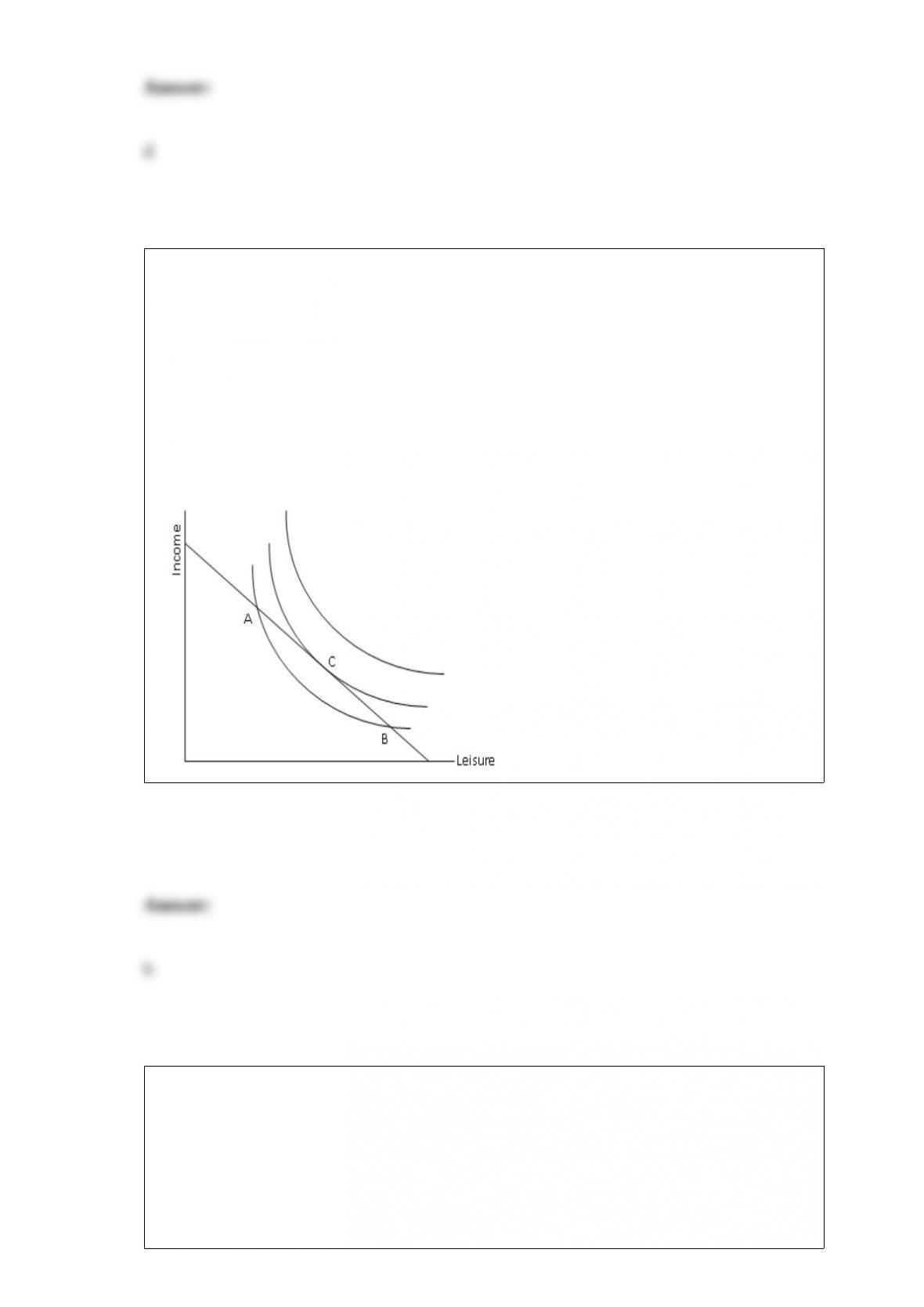
At point A, Larry’s marginal rate of substitution of leisure for income:
a. exceeds the wage and Larry would like to work more hours
b. exceeds the wage and Larry would like to work fewer hours
c. is less than the wage and Larry would like to work more hours
d. is less than the wage and Larry would like to work fewer hours
Which of the following best exemplifies a piece-rate compensation scheme?
a. Jose’s pay is proportional to the number of wiring harnesses he assembles each day
b. Carla’s pay is proportional to the value of her sales at the dress shop each month
c. Stan’s pay is proportional to the number of his textbooks sold each year

d. Louise’s pay is proportional to the number of hours she works each month
Most rate-of-return studies of education indicate that:
a. social rates of return generally exceed private rates of return
b. private rates of return are about 2.5% ” 7%
c. private rates of return are about 10% ” 15%
d. private rates of return have held steady over the 1956 ” 2008 period
The effectiveness of profit-sharing plans may be diminished because:
a. potential free-rider problems render such plans ineffective in all but the largest firms
b. profit-sharing is a type of deferred payment scheme
c.* the plans are tied to group performance, so the link between profit-sharing and
worker productivity is not always clear-cut
d. there is no means by which greater work effort can be translated into greater
compensation for a worker
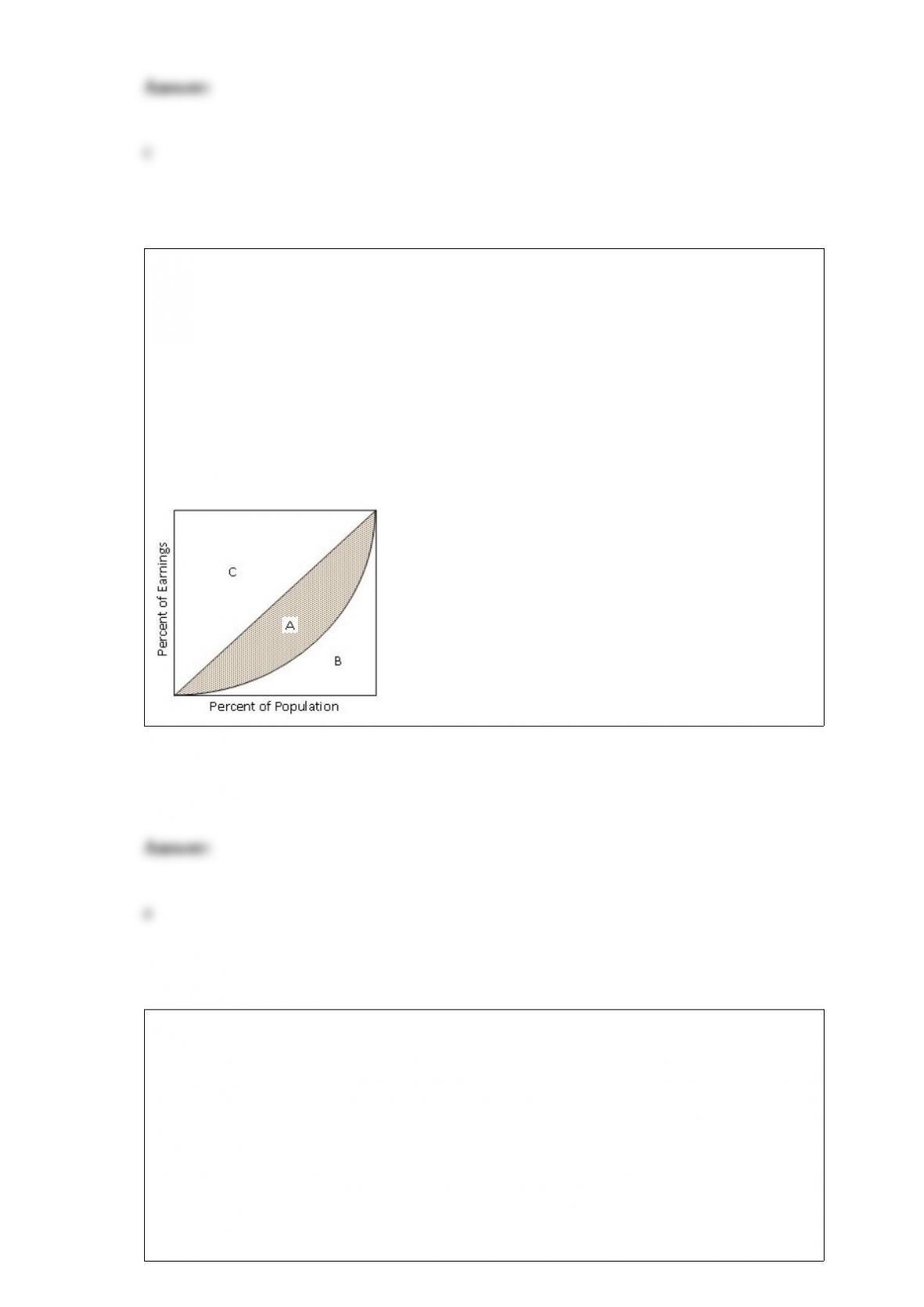
Consider the Lorenz curve at right. The Gini coefficient is found as:
a.area A divided by area A + B
b.area A divided by area B
c.area A divided by area A + B + C
d.area B divided by area A + B
In comparing two otherwise identical industries X and Y, an economist finds that labor
demand is more elastic in industry X. Which of the following would support this
finding?
a. Capital and labor are less easily substituted for one another in X than in Y
b. Labor costs as a percentage of total costs are relatively lower in X than in Y
c. Product demand elasticity is higher in X than in Y

d. Substitute resources have a less elastic supply in X than in Y
How many workers will this firm hire if the wage is $10? (the following table that
shows the short-run production relationship and the product demand schedule for a
firm.)
a. 3
b. 4
c. 5
d. 6