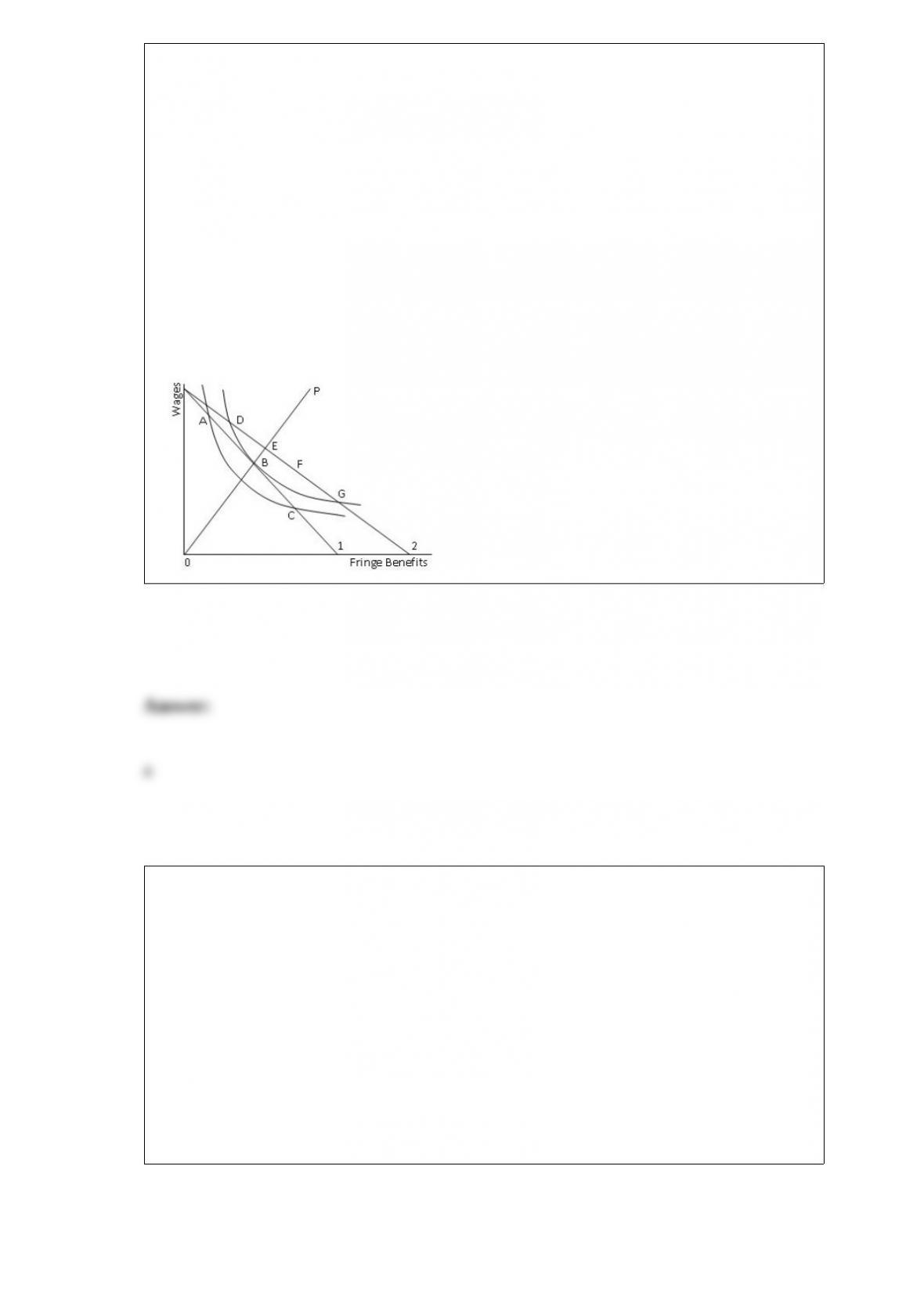
The shape of the indifference curves reflects: (All points along the ray 0P reflect a
constant proportion of wages to fringe benefits.)
a. a diminishing marginal rate of substitution of fringe benefits for wages
b. increased utility as fringe benefits are substituted for wages along an indifference
curve
c. increased utility as wages are substituted for fringe benefits along an indifference
curve
d. an increasing marginal rate of substitution of fringe benefits for wages
In Becker’s “taste-for-discrimination” model, an employer who is prejudiced against
African Americans:
a. refuses to hire African Americans regardless of the wage differential
b. may have an integrated work force if the wage differential is less than his
discrimination coefficient
c. will hire only African Americans if the wage differential exceeds his discrimination
coefficient
d. will hire only whites if the white wage is equal to his discrimination coefficient

Which one of the following is a true statement?
a. Female unemployment rates are approximately twice that of males, while the
unemployment rates of African Americans and whites are quite similar
b. African American unemployment rates are approximately twice that of whites, while
the unemployment rates of men and women are quite similar
c. African American unemployment rates are approximately twice that of whites and
female unemployment rates are approximately twice that of males
d. The unemployment rates of African Americans and whites are quite similar, as are
the unemployment rates of males and females
Assume that information is perfect, mobility between jobs is costless, and that all
nonwage aspects of the two are identical. The outcome shown in the diagram:
(which represents a local labor market consisting of two submarkets. All workers are
assumed to be identical.):
a. represents an equilibrium
b. does not represent an equilibrium. The demand for labor in market A will shift
rightward, and that in market B will shift leftward until wage rates equalize
c. does not represent an equilibrium. The supply of labor in market A will shift leftward,
and that in market B will shift rightward until the wage rates equalize
d. does not represent an equilibrium. The supply of labor in market B will shift
leftward, and that in market A will shift rightward until the wage rates equalize

Assuming competitive markets, migration in response to wage differentials will likely
result in:
a.an increase in the total value of output, but reduced economic efficiency
b.a decrease in both the value of output and economic efficiency
c.an increase in both the value of output and economic efficiency
d.an increase in the size of the wage differential
According to the text, the current consensus estimate of the natural rate of
unemployment is approximately:
a.2% ” 3%

b.3% ” 4%
c.4% ” 5%
d.5% ” 6%
Given the following data, what is the labor force participation rate?
Population 100 million
Non-institutionalized population, age 16 and over 75 million
Persons employed or seeking employment 50 million
Unemployed persons 5 million
a. 50%
b. 67%
c. 75%
d. 80%
If the rate of inflation increases but Sally mistakenly believes it has not, then:
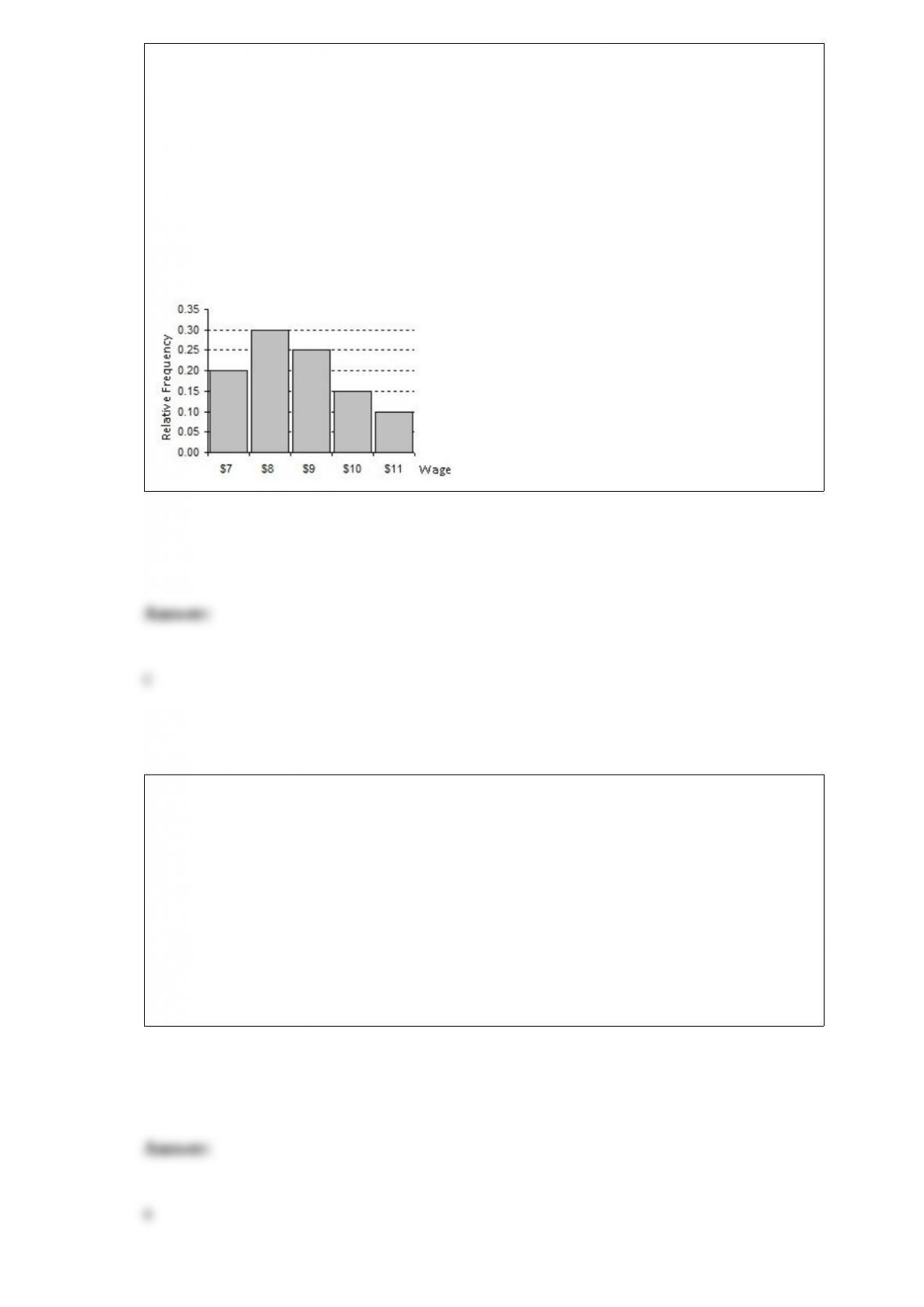
a.both the acceptance wage and the entire distribution will shift to the left, thereby
leaving expected search duration unchanged
b.the acceptance wage will shift to the right, thereby reducing excepted search duration
c.the entire distribution will shift to the right, but the acceptance wage will not, thereby
reducing expected search duration
d.both the acceptance wage and the entire distribution will shift to the right, thereby
leaving expected search duration unchanged
Regarding unions and productivity, empirical results show that:
a.the impact of unionization on productivity is not clear cut
b.unionization reduces productivity generally
c.unionization improves productivity generally
d.unionization improves productivity most in industries where union and management
are most adversarial

Edlund and Korn suggest that prostitutes are highly paid primarily because:
a. there is a wage differential to compensate for the risks of getting caught or acquiring
a disease
b. there is a wage differential to compensate for doing without wage and earnings
growth
c. most of their earnings goes to their “pimp” or “madam”
d. there is a wage differential to compensate for doing without the benefits of marriage
In 2010, the bottom 20% of all full-time workers in the U.S. received _____ of total
earnings, while the top 20% received _____.
a.2%, 61%
b.3%, 74%
c.7%, 45%
d.12%, 37%
Which of the following gave states the option to pass so-called “right-to-work” laws?

a.Fair Labor Standards Act
b.Wagner Act
c.Taft-Hartley Act
d.Landrum-Griffin Act
The added-worker effect suggests that:
a. higher wages will attract more persons into the labor market during market
expansions
b. when one family member loses a job, other family members may enter the labor
force
c. the measured unemployment rate probably understates the true economic hardship
associated with unemployment
d. the labor force participation rate will fall as the unemployment rate rises
There is a general consensus among economists that:
a.unions reduce unemployment
b.unions increase unemployment

c.unions have increased labor’s share of national income
d.union wage determination is not a serious cause of inflation in the United States
Which one of the following will tend to increase the likelihood of participation in the
labor force for a current non-participant?
a. A decrease in the spouse’s wage
b. An increase in the spouse’s wage
c. An increase in family size
d. Falling productivity in household production of commodities
A firm will obtain its profit maximizing level of employment where:
a. marginal revenue product equals value of marginal product
b. marginal revenue product equals marginal wage cost
c. value of marginal product equals marginal wage cost
d. marginal product equals marginal revenue product

If the wage is $20.00, how many workers will this profit-maximizing firm choose to
employ? (Assume that the labor market is perfectly competitive.)
a. 2
b. 3.
c. 4
d. 5
The “zone of production” consists of labor inputs over the range of:
a. 0X
b. YZ
c. 0Y
d. XZ

In Littleville, which has 1000 residents, 400 people do not currently work. Of these 400
persons, 240 are under age 16, 10 are institutionalized, 25 have become discouraged
and quit seeking work, and 75 others are either full-time students or home-makers. Of
the 600 people who do work, 150 work part-time but wish to work full-time. What is
the official unemployment rate in Littleville?
a.400/1000
b.50/650
c.50/600
d.65/650
Compared to the 1960s, the natural rate of unemployment in the 1970s and 1980s was:
a.higher, because of changes in the composition of the labor force
b.higher, because of the failure of public policies to reduce it
c.lower, because of changes in the composition of the labor force
d.lower, because of the success of public policies to reduce it
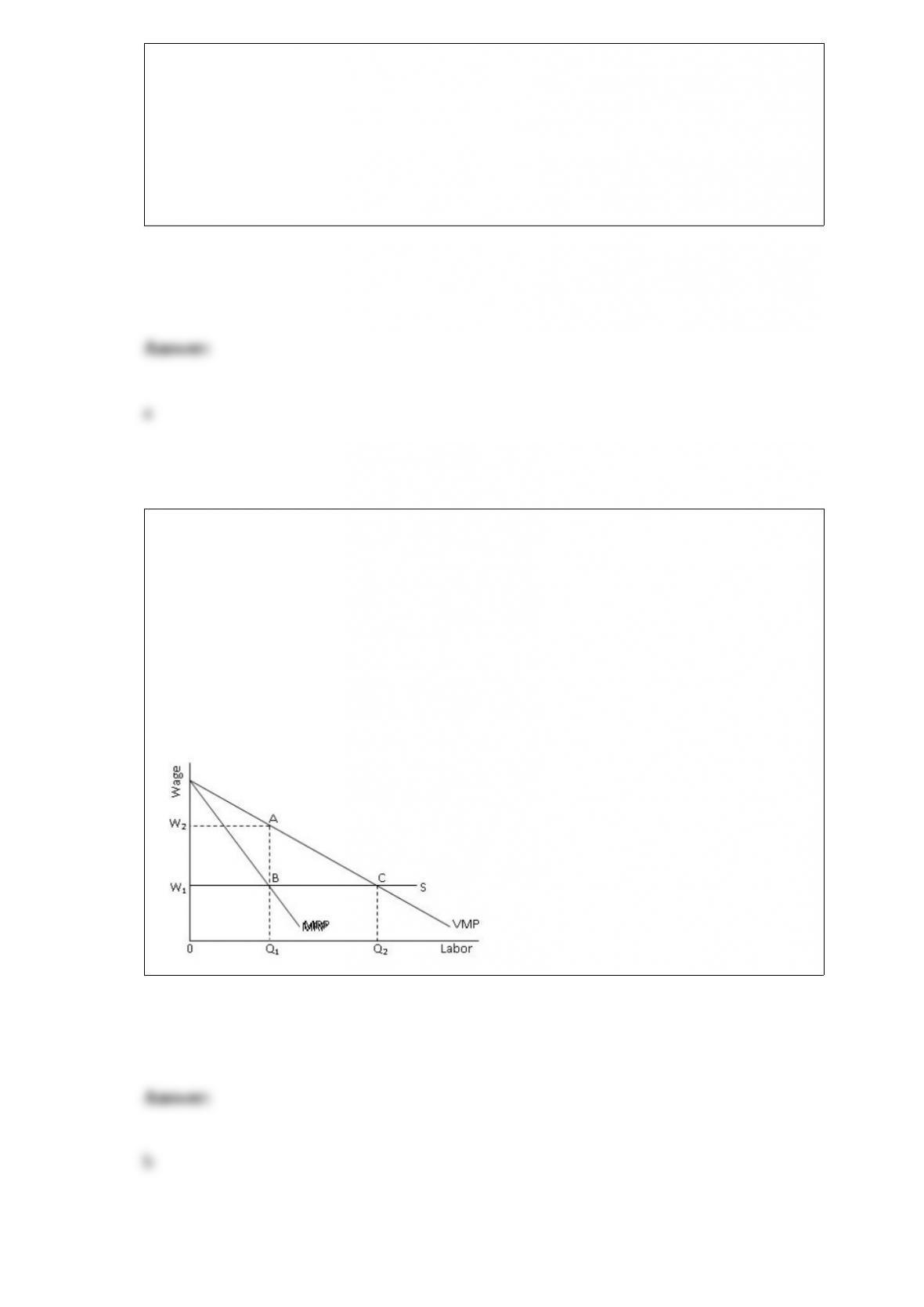
The efficiency loss associated with the profit maximizing wage and employment level
is given by area: (the following diagram that shows the labor demand for a
monopolistic firm hiring labor from a competitive labor market.)
a. Q1ACQ2
b. BAC
c. 0W2AQ1
d. W1W2AC

If jobless persons who had given up searching suddenly resumed active searches for
paying jobsbut had not yet found anythe unemployment rate would:
a.rise
b.fall
c.stay the same
d.more information is needed
Research by Hamermesh and Lee suggests that:
a. high income earners would be happier if they earned less
b. less than 10% of U.S. married couples report feeling stressed for time
c. although Germans work fewer hours than the Japanese, they report more time stress
d. all else constant, higher earnings lead to greater time stress
Data on unemployment rates consistently show that the unemployment rate of:
a. females of all races exceeds that of males of all races
b. African Americans of both sexes exceeds that of whites of both sexes

c. white females exceeds that of white males, but African American males exceeds that
of African American females
d. African American females exceeds that of African American males, but white males
exceeds that of white females
The Landrum-Griffin Act:
a.established unfair labor practices by employers
b.declared yellow-dog contracts unenforceable
c.outlawed the closed shop
d.required regularly scheduled elections of union officers
Suppose productivity stood at 5.00 in year 1, and 5.25 in year 2. If year 1 is the base
year, the productivity index for year 2 is:
a.0.25
b.5
c.105
d.125
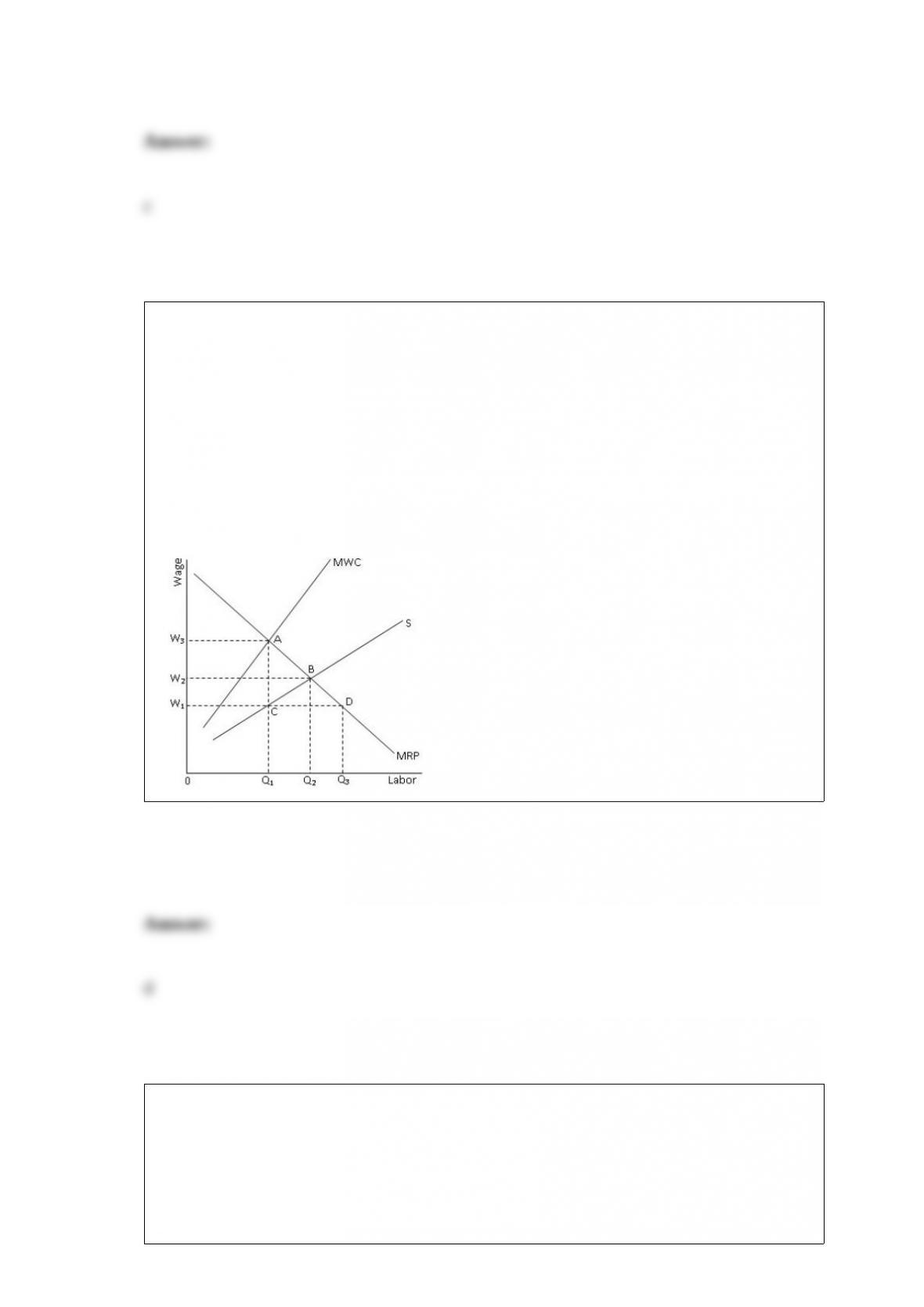
If this firm sells its output in a competitive market (so that MRP = VMP), the allocative
efficiency loss in the labor market is given by area: (the following diagram of a
monopsonistic labor market.)
a. W3ACW1
b. Q1ABQ2
c. CAD
d. CAB
The relatively low labor force participation rate of African-American males may be
partly explained by:
a. the relatively higher participation rate of African-American females
b. the increased availability of public income maintenance programs

c. lower average wages and job prospects available to African-American males
d. all of the above
Wages may be inflexible downward during a period of cyclical unemployment because:
a.insiders may fear harassment from outsiders who ‘stole” their jobs
b.outsiders may fear harassment from insiders and are thus unwilling to work for lower
wages
c.firms believe that outsiders will withhold cooperation from insiders who ‘stole” their
jobs
d.both insiders and outsiders will withhold cooperation from management if
management reduces wages
Negotiating a contract with a firm and using that contract as a basis for demands made
of other employers is an example of:
a.pattern bargaining
b.collective bargaining
c.coercive bargaining

d.multiemployer bargaining
As of 2011, which of the following U.S. industries was more than 30% unionized?
a.mining
b.construction
c.wholesale and retail trade
d.public administration
The optimal work-leisure position is achieved where:
a. the MRS L,Y is equal to the wage rate
b. the difference between the MRS L,Y and the wage is greatest
c. the wage rate is greatest
d. the MRS L,Y is greatest

Which one of the following is a true statement?
a.Less than 3% of workers change occupations in a given year
b.Most individuals who change occupations in a given year are over 50 years old
c.Over 3 million employees are transferred by their employers each year
d.About 30% of geographic job-related moves are accompanied by a change in
occupation