
The probability of accepting the next wage offer is:
a.higher, the higher is the acceptance wage
b.lower, the lower is the acceptance wage
c.lower, the higher is the acceptance wage
d.higher, the higher is unemployment compensation
The aggregate labor force participation rate in the U. S. is currently about:
a. one-fourth
b. one-half
c. two-thirds
d. three-fourths
The full-employment level of output is given by:
a.Q1
b.Q2
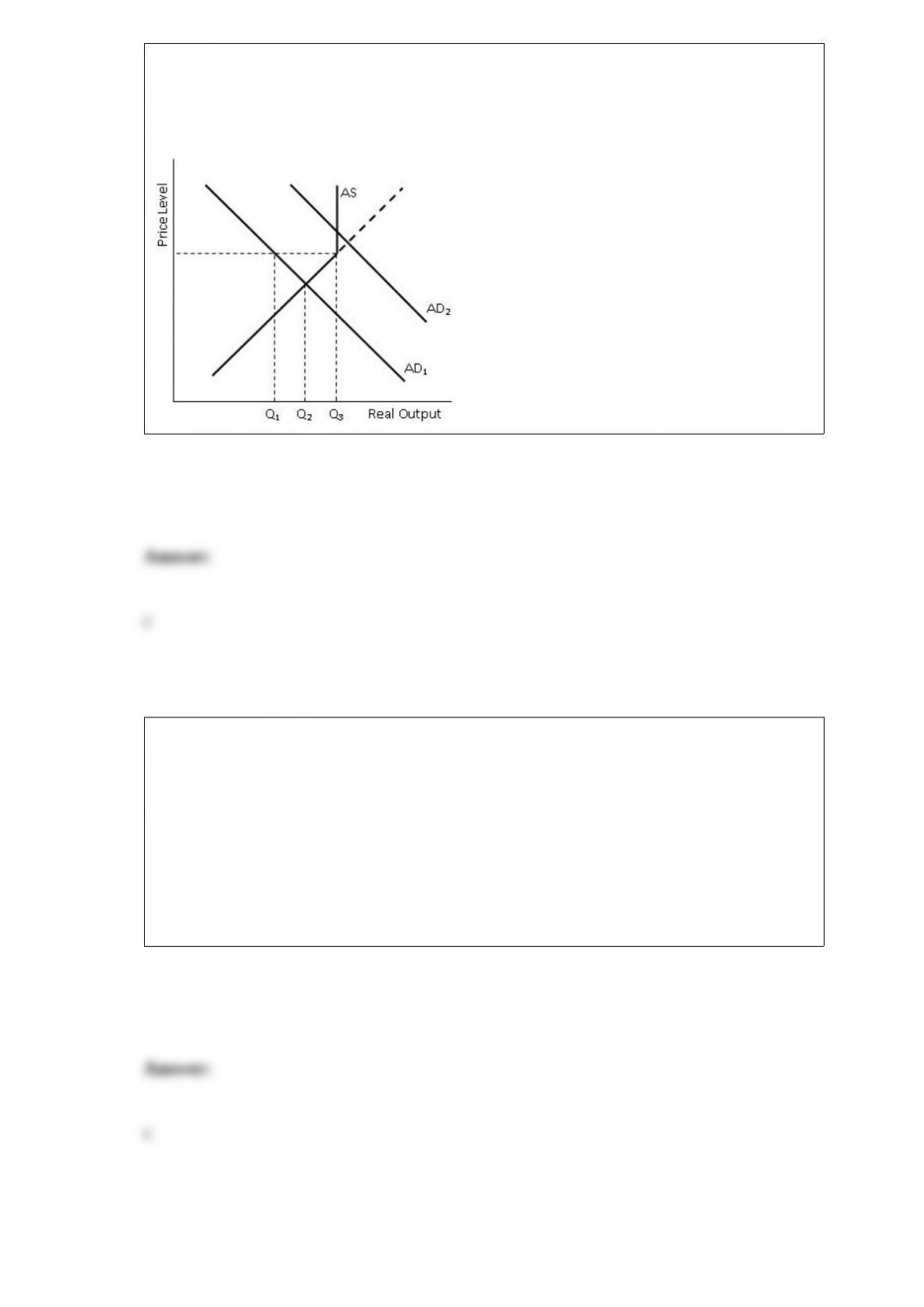
c.Q3
d.Q3 ” Q1
The multifactor explanation of the distribution of earnings typically excludes:
a.innate ability
b.family background
c.non-monetary returns to training
d.risk-taking and chance

Which one of the following topics is most suited to macroeconomic analysis?
a. Labor supply decisions of married women
b. Short-run labor demand in a particular industry
c. The individual decision on how much education to obtain
d. The impact of a recession on the country’s unemployment rate
The “twin rights” of labor (self-organization and collective bargaining) were guaranteed
by the:
a.Fair Labor Standards Act
b.Wagner Act
c.Taft-Hartley Act
d.Landrum-Griffin Act
Which of the following best describes the interest rate effect? As the price level rises:
a.more money is demanded, interest rates rise, and investment spending falls
b.less money is demanded, so consumption spending must fall to maintain equality of
investment and saving

cthe value of assets rises, increasing bank profits and total lending
d.the Fed raises interest rates and investment spending rises
Most studies conclude that aggregate labor supply is very:
a.elastic, so that income taxes are borne mainly by workers
b.inelastic, so that income taxes are borne mainly by workers
c.elastic, so that income taxes are borne mainly by employers
d.inelastic, so that income taxes are borne mainly by employers
Independent of taxes raised to finance it, the provision of a public good most likely:
a.reduces labor supply because of the income effect
b.reduces labor supply because of the substitution effect
c.increases labor supply if the public good is a close substitute for goods consumers
otherwise would have bought
d.has no impact on labor supply decisions

An employer whose discrimination coefficient approaches infinity:
a. refuses to hire any women or minorities regardless of the wage differential
b. does not discriminate against women or minorities
c. discriminates against women but not minorities
d. discriminates in favor of women and minorities
A firm can hire 20 workers for $10 per hour, but finds it must raise the wage to $11 to
attract another worker. If it must pay all its workers the same wage, the marginal wage
cost of the 21stworker is:
a. $10
b. $11
c. $21
d. $31

Sam left his job as an auto mechanic to accept a position in his local Sears store as an
auto parts salesman. This is an example of:
a.geographic mobility
b.occupational mobility
c.horizontal mobility
d.vertical mobility
“The industry mix of national output has changed from manufacturing to services.” This
fact is most consistent with the:
a.managerial-opposition hypothesis
b.union-growth hypothesis
c.structural-change hypothesis
d.substitution hypothesis
If $9.50 is the acceptance wage, what is the probability of Sally finding her next wage
offer unacceptable? (which shows the probability distribution of wage offers for Sally,
who is currently unemployed and searching for a job):
a..25

b..30
c..50
d..75
Which one of the following is not an explanation for the growth of public employment?
a.Urban growth and sprawl increased the demand for state and local government
services
b.Income growth increased the demand for income elastic government services
c.Population growth spurred demand for public school teachers
d.The demise of many public-sector unions reduced public-sector wages
“Living wage” laws:

a.apply minimum wage laws to workers who would not otherwise be covered by the
federal minimum wage
b.generally apply to employers who are under contract or receiving financial assistance
from local government
c.typically require covered employers to pay a wage more than three times the
minimum wage
d.have had negligible effects on employment or poverty status of covered employees
For employers, the chief advantage of royalties and commissions is that these pay
policies:
a. promote teamwork and cooperation
b. increase turnover
c. reduce shirking where work effort is costly to observe
d. reduce income variability
Raises and promotions are used by employers as a device to:
a. reduce shirking by salaried workers

b. transform labor from a quasi-fixed to a variable resource
c. reduce turnover by hourly workers
d. reduce free-riding by teams of workers
“Any worker for whom the present value of lifetime earnings will increase by migration
will choose to move.” This statement is:
a.true
b.false; migration depends on undiscounted earnings gains
c.false; there may be psychic costs of moving that deter migration
d.false; empirical evidence indicates that migration decisions have little to do with
financial gains or losses
Based on standardized test scores for students in the following countries, which has the
highest measured schooling quality?
a. France
b. India
c. U.S.
d. Japan
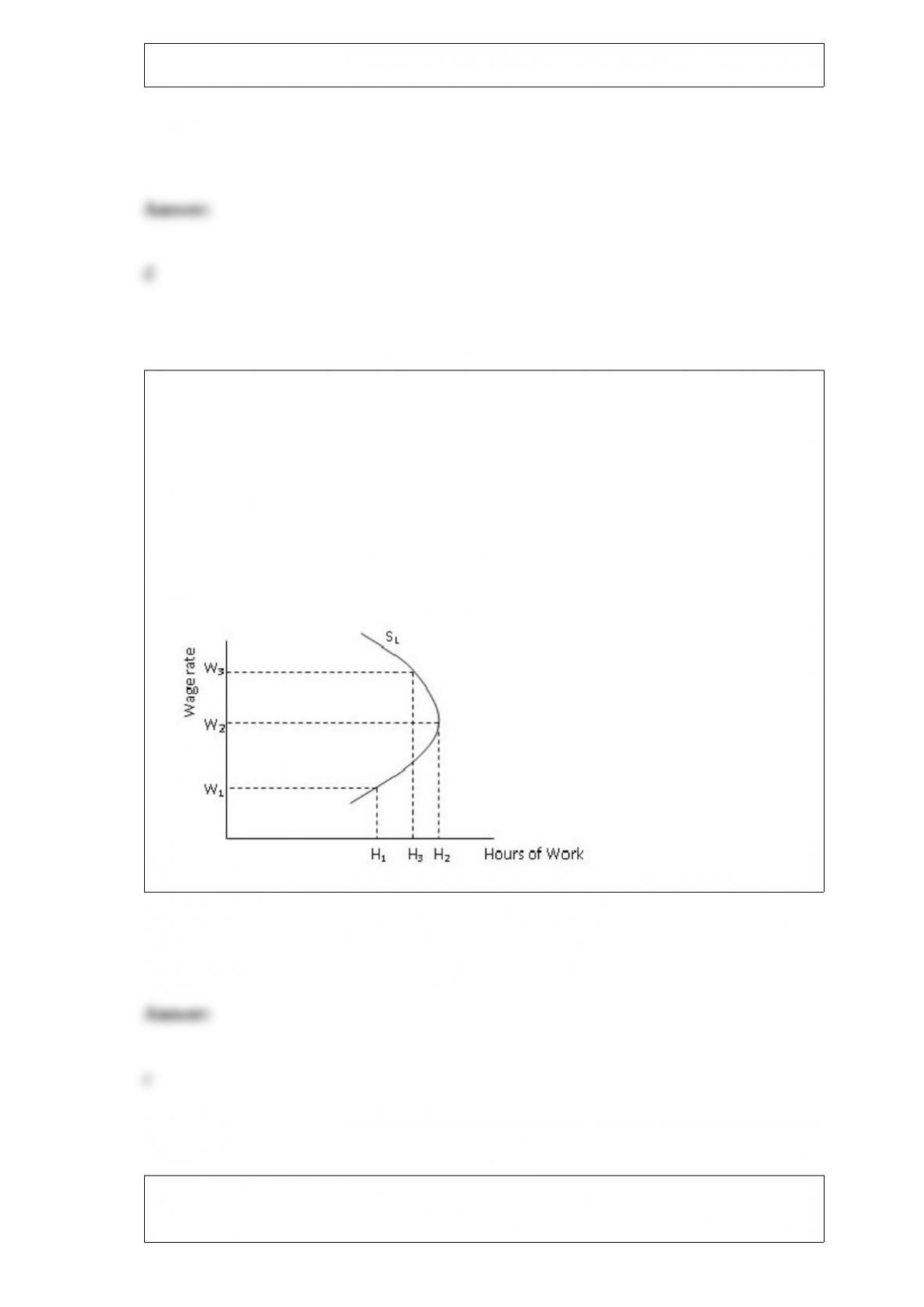
If the wage rises from W1 to W2 we may conclude that:
a. the income effect is stronger than the substitution effect
b. the income effect and substitution effects are equal
c. the substitution effect is stronger than the income effect
d. labor supply is perfectly inelastic
Which of the following is a true statement?

a. In 2008, 41% more females than males graduated from college
b. Research by Goldin, Katz, and Kuziemko attribute most of the increase in female
college attendance rates to lower birth rates among teenagers
c. Women achieved college attendance parity with males by the early 1960s
d. Since 1970, High school girls have reduced the amount of math and science classes
taken to concentrate instead on the humanities classes they will likely take in college
A worker who has obtained specific training is:
a. more likely to establish a long-term association with an employer because the worker
has made an investment he does not wish to lose
b. more likely to establish a long-term association with an employer because the
employer has made an investment she does not wish to lose
c. both a. and b. are correct
d. neither a. nor b. is correct
Of the following industries, 2011 average hourly earnings were greatest in:
a. public administration
b. services

c. mining
d. construction
Which one of the following is associated with an internal labor market?
a.Port of entry disconnected from an external labor market
b.Port of entry at the top of the job ladder
c.Port of entry at the bottom of the job ladder
d.The absence of a job hierarchy
Empirical evidence suggests that:
a. Gender differences in earnings explain most of the gender wage gap
b. Most training is specific rather than general
c. Training appears to have little impact on wages
d. Training lengthens employment durations

Which one of the following is a true statement?
a.Higher levels of education are associated with higher levels of structural
unemployment
b.During a recession, cyclical unemployment rises but structural unemployment falls
c.Historically, technological change has created more jobs than it has made obsolete
d.During a recession, most unemployment is structural unemployment
A perfectly competitive labor market may be characterized by all of the following
except:
a. neither firms nor workers have any control over the market wage
b. a few firms that dominate hiring in the market
c. numerous equally qualified workers
d. perfect information

If earnings inequality continues to increase, the Lorenz curve will shift:
a.away from the diagonal and the Gini coefficient will rise
b.away from the diagonal and the Gini coefficient will fall
c.toward the diagonal and the Gini coefficient will rise
d.towards the diagonal and the Gini coefficient will fall
A union will most likely attempt to restrict the growth of labor supply if:
a.the labor supply curve is very inelastic
b.the labor demand curve is very inelastic
c.there is a very slow rate of growth of labor demand
d.there is a very elastic supply of a production substitute for union labor
The diagram suggests that family background and discrimination:
a.have only an indirect influence on annual earnings
b.influence annual earnings indirectly through their impact on ability
c.have only a direct influence on annual earnings

d.influence annual earnings directly and also indirectly through their influence on
education and training
Assume that all workers are equally productive, but that male wages are $14 and female
wages are $10. An employer who employs only male workers has a discrimination
coefficient of:
a. at most 0.4
b. at least $4
c. at most $4
d. at least 10/14

Which of the following statements about on-the-job training is most supported by
empirical evidence?
a. A greater percentage of men than women receive on-the-job training
b. Job training is more common at smaller firms than larger ones
c. Workers with more formal education also tend to receive more on-the-job training
d. Training does not lead to higher job performance ratings
Suppose a management team assigns 100 points to the job of clerk/typist and 75 points
to a job on the loading dock. If the wage paid to a clerk/typist is $8.00 per hour, then the
hourly wage paid to a worker on the loading dock would be:
a.$2
b.$6
c.$8
d.$10