
What is the value of the third worker’s marginal product? (the following table that
shows the short-run production relationship and the product demand schedule for a
firm.)
a. $18
b. $57
c. $72
d. $342
Salaried workers can be considered “quasi-fixed resources” in that:
a. production is largely independent of the firm’s use of salaried workers
b. federal work rules limit the ability of firms to fire salaried workers
c. their work hours typically are fixed
d. raises or promotions may be used to reduce shirking

Because there is a _______ marginal rate of substitution of fringe benefits for wages, a
worker’s wage-fringe indifference curves are typically _______:
a. diminishing; convex to the origin
b. constant; straight lines
c. diminishing; concave to the origin
d. negative; straight lines
The total net private gain from migration to migrants and their employers:
a.is the increase in annual wages resulting from migration
b.overstates the social gain if there are real external benefits associated with the move
c.overstates the social gain if there are real external costs associated with the move
d.understates the social gain if there are pecuniary external costs associated with the
move
For Jenny, the income effect of a wage increase dominates the substitution effect.
Jenny’s wage elasticity of labor supply is:
a. elastic

b. unit elastic
c. inelastic
d. negative
Which one of the following required unions to hold regularly scheduled elections of
union officers?
a.Norris-LaGuardia Act
b.Taft-Hartley Act
c.Wagner Act
d.Landrum-Griffin Act
“Yellow-dog contracts”:
a.were used by employers to restrict union membership
b.require workers to join a union as a condition of continued employment
c.were upheld by the Taft-Hartley Act
d.were outlawed by the Landrum-Griffin Act

For the U.S. earnings distribution, the:
a.mode is less than the median
b.median is greater than the mean
c.mean is less than the median
d.mode is greater than the mean
Evidence indicates that, on balance, union wage policies tend to:
a.lead to greater overall inequality in the distribution of earnings
b.assign wages to individual workers, whereas nonunion firms tend to assign wages to
jobs
c.decrease the wage gap between unskilled and skilled workers by seeking equal
absolute wage increases for all workers rather than equal relative wage increases
d.raise wage rates at only the largest firms in an industry, thereby increasing wage
dispersion within the industry

Compared to an otherwise identical competitive firm, a firm with monopoly power will
hire:
a. fewer workers, reflecting its decision to produce less output
b. more workers because the higher price charged by the monopoly raises its MRP
c. fewer workers because workers are less productive in a monopoly setting
d. more workers because monopolies have higher profits and can pay higher wages
Fringe benefit packages differ substantially from one firm to the next because:
a. labor market information is costless
b. adjustment periods tend to be short
c. worker mobility costs are low
d. firms may structure their fringe benefit packages to attract specific types of workers

With respect to family earnings, on the average, family migration initially:
a.raises the earnings of the primary mover but reduces the earnings of the “trailing”
spouse
b.raises the earnings of wives but reduces the earnings of husbands
c.raises the earnings of both husbands and wives
d.reduces the earnings of both husbands and wives
The long-run response to a drop in the wage exceeds the short-run response for all of
the following reasons except:
a. it is more difficult to substitute capital for labor in the long run than the short run
b. an increase in labor makes capital more productive, leading to more capital and
therefore higher labor productivity
c. the demand for the firm’s output is more elastic in the long run
d. technology may change in the long run
In calculating the social rate of return on a human capital investment one would:
a. deduct taxes from incremental earnings

b. treat public subsidies to education as a part of the costs
c. exclude any external benefits associated with the investment
d. treat public subsidies to training as part of the benefits
In the public sector:
a.workers tend to receive more of their total compensation in the form of fringe benefits
than their private-sector counterparts
b.workers tend to receive less of their total compensation in the form of fringe benefits
than their private-sector counterparts
c.overall wage dispersion is much greater than in the private sector
d.quit rates are higher than in the private sector
In the textile industry, industrial robots and assembly line workers are gross substitutes.
Accordingly, the drop in the price of robots has:
a. decreased the demand for robots
b. increased the demand for assembly line workers
c. decreased the demand for assembly line workers

d. increased assembly line workers’ wages
Research by Krueger and Allen suggests that a substantial proportion of the increase in
the college wage premium in the 1980s and 1990s can be explained by:
a. increased college enrollment by men
b. increased college enrollment by women
c. increased immigration rates
d. skill-biased technological change
Raises and promotions may be viewed as a form of:
a. profit-sharing
b. commissions and royalties
c. piece rate pay
d. tournament pay
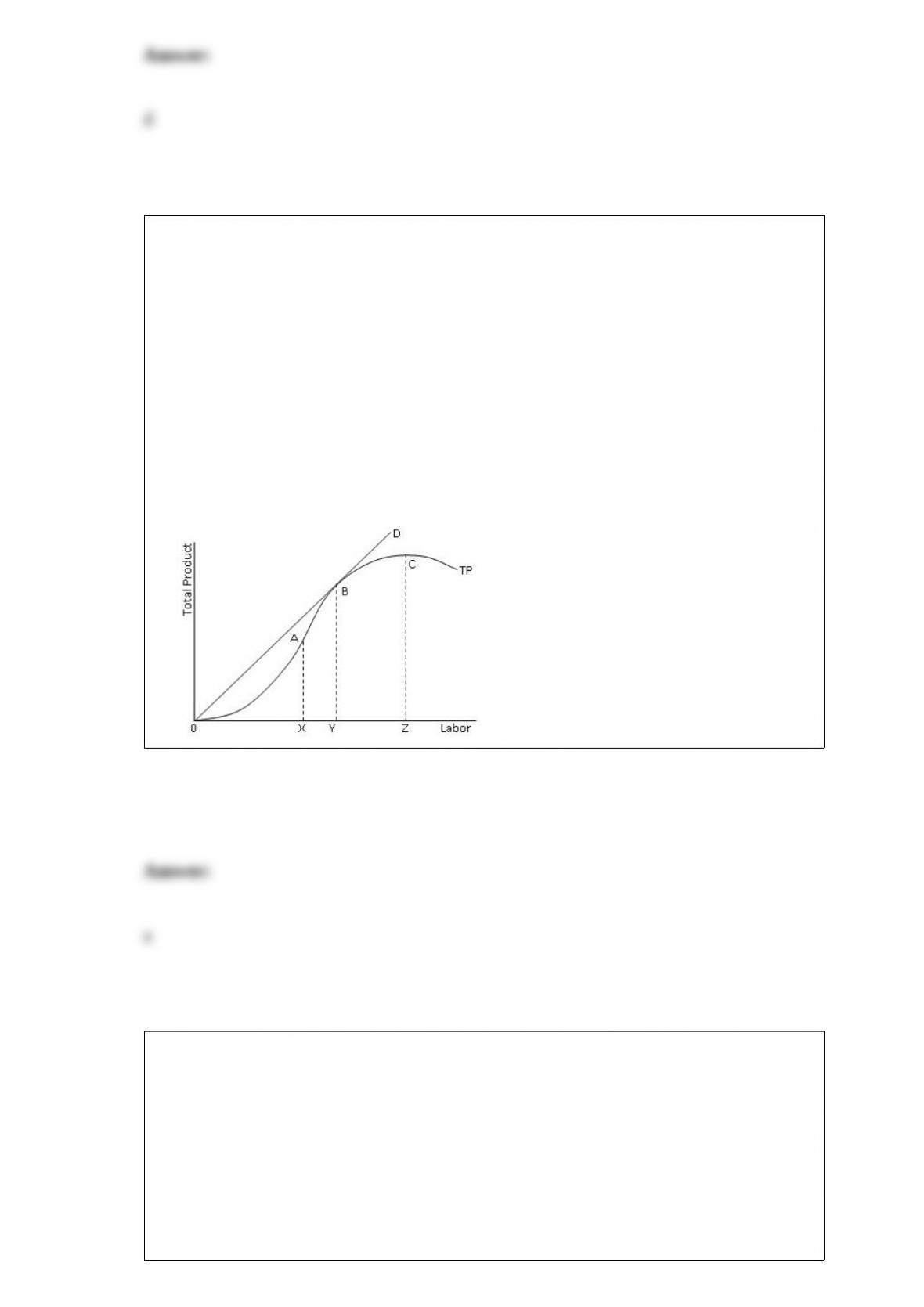
For labor input levels between X and Y:
a. the marginal product of labor is falling, but is greater than the average product of
labor
b. both the marginal product and the average product of labor are falling
c. the marginal product of labor is rising and the average product of labor is falling
d. both the marginal product and the average product of labor are rising
Which one of the following claims concerning the minimum wage is generally
supported by empirical evidence?
a.The minimum wage has only a minor impact on the overall degree of income
inequality
b.The minimum wage has increased teenage employment as a result of the shock effect
c.Union members suffer the greatest negative impacts of the minimum wage

d.The reduction in teen employment due to the minimum wage is less than the increase
in unemployment
Negotiating a contract with a group of firms in an industry is an example of:
a.pattern bargaining
b.collective bargaining
c.persuasive bargaining
d.multiemployer bargaining
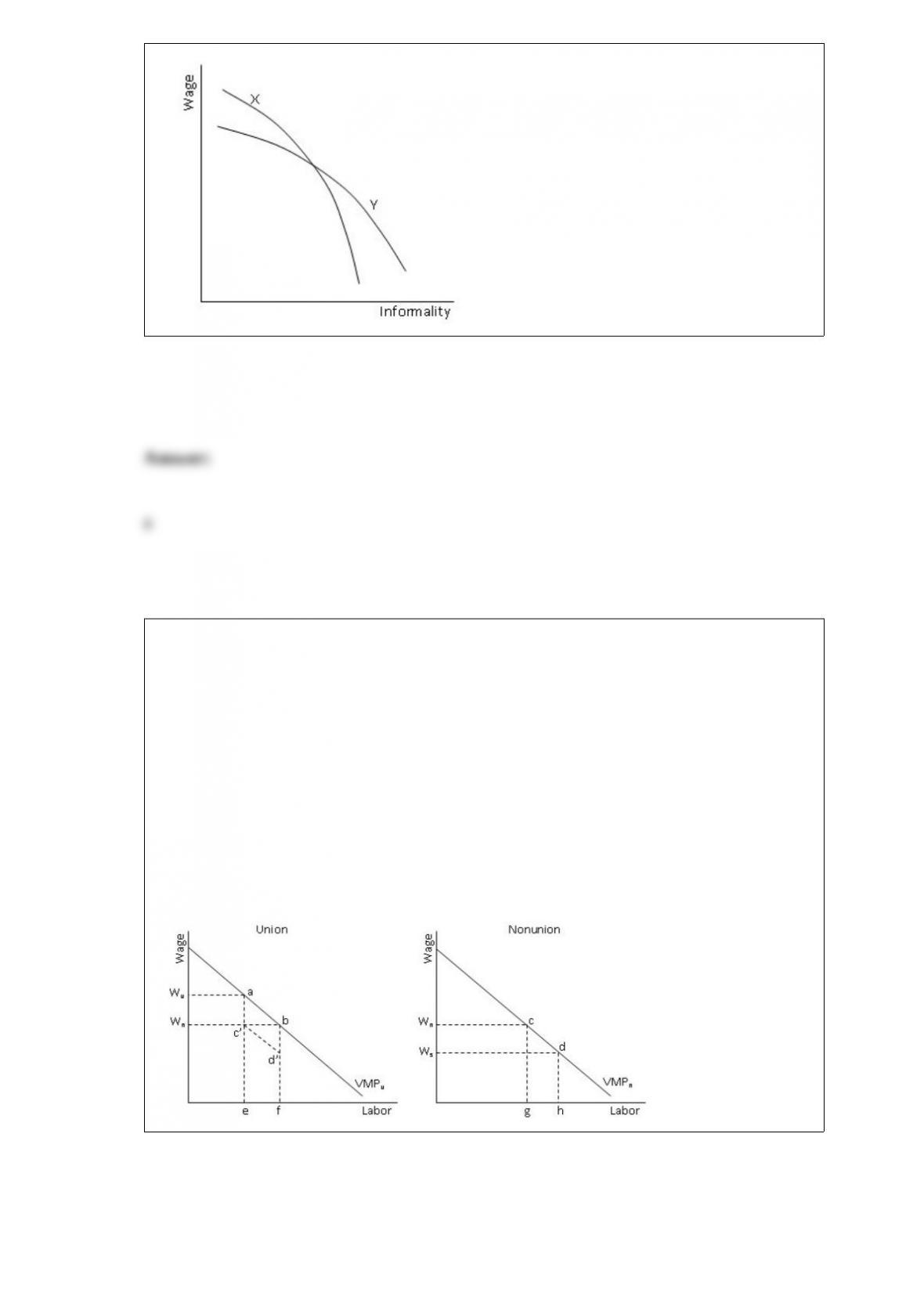
Consider a worker who faces a trade-off between higher wages and a more relaxed
work environment as shown in the diagram. A worker whose indifference curves are
relatively steep:
a. places a relatively high value on additional informality on the job
b. will tend to work at a firm with a relatively informal environment, like firm X
c. will not willingly sacrifice informality for higher wages
d. does not place a relatively high value on additional informality on the job
The allocative efficiency loss implied by the diagram is a static, short-run loss.
Compared to the static loss, the dynamic, long-run loss is probably: (all product markets
are assumed to be competitive.)
a.greater, because unions reduce firm profitability and thereby inhibit investment
b.greater, because unemployment is greater in the long run
c.greater, as firms have a greater opportunity to exercise their monopsony power
d.smaller, because the decline in nonunion wages increases the extent of poverty
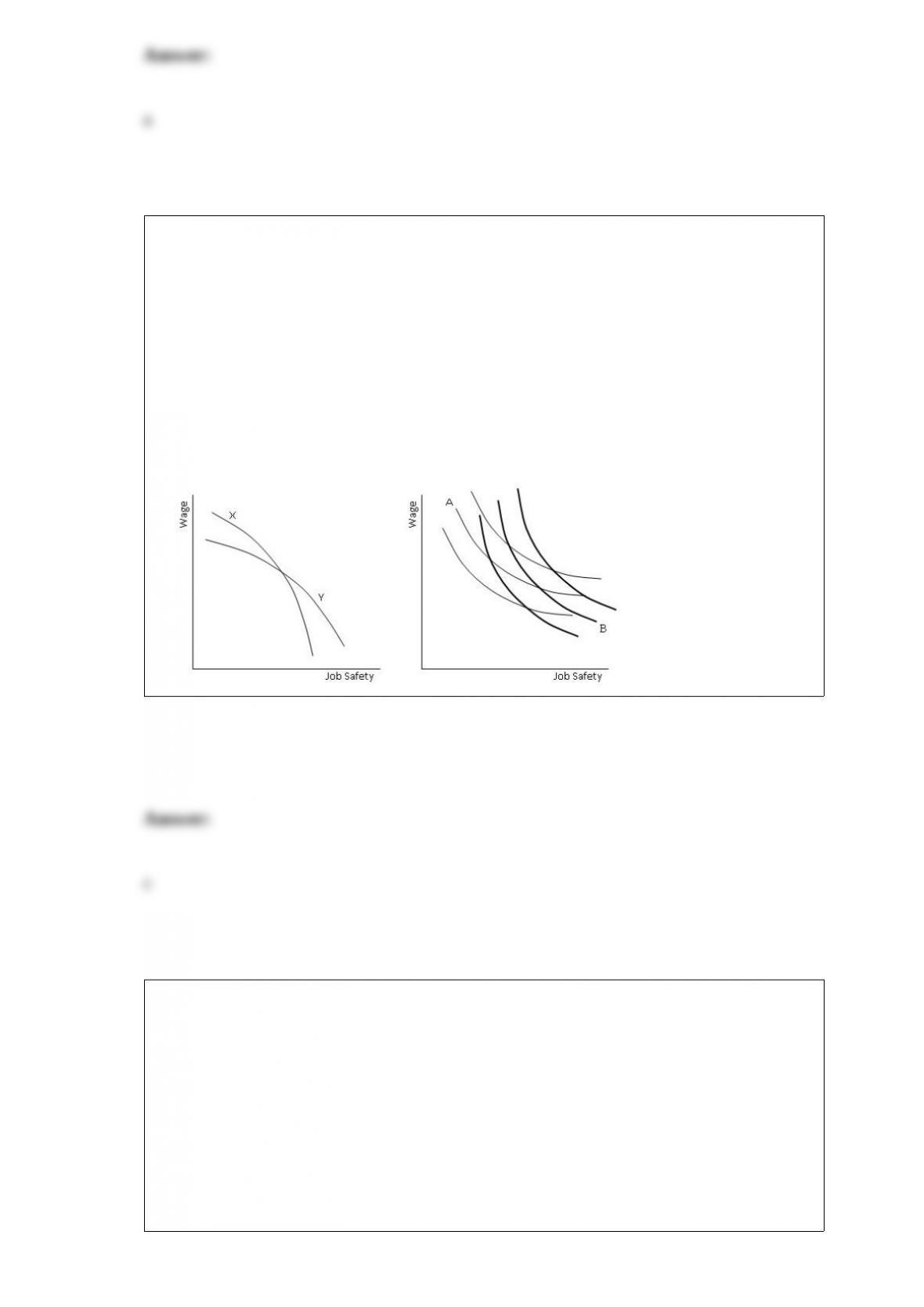
From the indifference curves, we can infer that worker A:
a. has a stronger taste for job safety relative to income than worker B
b. has the same taste for job safety relative to income than worker B
c. has a stronger taste for income relative to job safety than worker B
d. has a lower skill level than worker B
If labor supply is perfectly inelastic, the economic incidence of the payroll tax:
a.is the same as the statutory incidence of the tax
b.is split equally between workers and consumers, because firms pass on their share in
the form of higher prices
c.falls entirely on firms
d.falls entirely on workers

Suppose the payroll tax is increased. For any given labor demand, the greater the
elasticity of labor supply:
a.the greater the decline in both the net (after-tax) wage rate and employment
b.the less the decline in both the net wage rate and employment
c.the greater the decline in the net wage rate and the less the decline in employment
d.the less the decline in the net wage rate and the greater the decline in employment
Which one of the following is not typically offered as an explanation for efficiency
wages?
a. An employer will not pay a wage that exceeds the market rate
b. A higher wage may reduce turnover
c. A higher wage may allow lower income workers to afford better nutrition that
increases their stamina
d. The higher wage may be perceived by workers as raising the opportunity cost of
shirking

All else equal, a worker is less likely to move:
a.if he or she has moved before
b.the more unionized the worker’s occupation
c.the greater the worker’s educational attainment
d.if the worker is single
Suppose the federal government builds a new flood control project that takes thousands
of acres of land out of agricultural production. Which of the following is most likely to
occur as a result?
a.The demand for fertilizer will rise, thereby increasing employment in that industry
b.Wages and employment of workers who build farm equipment will rise
c.The demand for farm workers will increase
d.The wages of farm workers will decline

If labor unions are successful in their lobbying efforts to have the WTO include labor
and environmental standards in future agreements:
a.world-wide labor costs would fall and reduce inflation, thereby increasing real wages
b.foreign labor and product costs would rise, thereby increasing the demand for
unionized workers in the U. S.
c.living conditions would improve in developing countries, thereby increasing their
rates of economic growth
d.labor and production costs would decrease in developing nations, thereby improving
prospects for unions to win certification votes in those countries
If there are many employers in a localized market, multiemployer bargaining:
a.benefits firms but not unions
b.benefits unions but not firms
c.benefits both firms and unions
d.benefits neither firms nor unions
An increase in government demand for output is a tool that would most likely be used
to combat:

a.demand-deficient unemployment
b.search unemployment
c.structural unemployment
d.wait unemployment
Approximately what percent of the U.S. population changes residences each year?
a.Less than 5%
b.5% ” 10%
c.15% ” 20%
d.More than 25%
The substitution effect is:
a. the combination of leisure and wage rate that maximizes one’s income
b. the part of the total change in desired work hours that is due to the change in real
income resulting from a change in the wage rate
c. the part of the total change in desired work hours that is due to a change in the wage
rate, with real income or utility constant

d. always dominated by the income effect