
Which of the following required equal treatment for all persons in hiring, firing,
promotion and compensation decisions without regard to race, color, religion, sex, or
nationality?
a. Equal Pay Act of 1963
b. Civil Rights Act of 1964
c. A 1968 Executive Order
d. Landrum-Griffin Act of 1959
Which one of the following is a true statement?
a.Although theory suggests the decline of unionization should have increased income
inequality, empirical research suggests that the opposite occurred
b.Although theory suggests the decline in unionization should have reduced income
inequality, empirical research suggests that the opposite occurred
c.In theory, the decline in unionization may either reduce or increase income inequality,
however empirical research suggests it has increased it, particularly among males
d.In theory, the decline in unionization may either reduce or increase income inequality,
however empirical research suggests it has reduced it, particularly among females
Suppose that, as a result of an increase in the market supply of labor, the wage rate has

fallen 10%. After adjusting its employment levels, a firm finds its total wage bill has
decreased. This occurrence indicates that the firm’s labor demand:
a. is inelastic over this range of wages
b. is elastic over this range of wages
c. is unit elastic over this range of wages
d. was inelastic at the old wage, but is elastic at the new, lower wage
Union membership as a percentage of the labor force in the U.S.:
a.peaked in the 1920s
b.has fallen since the 1960s, although the absolute number of union members has
continuously increased
c.has fallen since the 1960s, including a decline in the absolute number of union
members since 1980
d.increased steadily since the 1880s
The firm’s wage-fringe isoprofit curve typically has a slope less than 1 (absolute value)
because:
a. fringe benefits confer tax advantages on workers

b. on average, it costs firms more to purchase fringe benefits than workers
c. the composition of fringe benefits may increase worker productivity
d. increasing the proportion of compensation received as fringe benefits reduces a firm’s
profit level
Since 1950, government employment has grown:
a.more quickly at the federal level than the state and local level
b.more quickly at the state and local level than the federal level
c.as quickly at the federal level as the state and local level
d.at the same rate as total U.S. employment
Labor economics is studied as a distinct subfield of economics because:
a. the bulk of national income is received by labor
b. the concepts of supply and demand must be revised somewhat when applied to labor
markets
c. labor economics can be used to analyze major socioeconomic trends such as the
surge in the number of women workers

d. all of the above
In response to declines in membership, unions have recently:
a.avoided labor organization mergers
b.intensified attempts to organize blue-collar workers as opposed to white-collar
workers
c.given increased priority to wage increases and put less emphasis on non-wage issues
d.substituted work slowdowns for strikes as a way of preventing replacement by
permanent strikebreakers
If $8.50 is the acceptance wage, what is the probability of Sally finding her next wage
offer acceptable?
(which shows the probability distribution of wage offers for Sally, who is currently
unemployed and searching for a job):
a..25
b..30
c..50

d..70
Another name for demand-deficient unemployment is:
a.cyclical unemployment
b.recurring unemployment
c.structural unemployment
d.contractionary unemployment
Which of the following is not a characteristic of an internal labor market?
a.A port of entry, at which workers gain access to the bottom of the job ladder
b.A hierarchy of jobs constituting the job ladder
c.A set of rules and procedures governing the wage structure

d.Equal access by internal and external workers to jobs at all skill levels
Union workers receive more compensation than otherwise similar nonunion workers.
This fact:
a.is proof that unions raise the wages of their members relative to nonunion workers
b.could be explained by the fact that women workers are a larger proportion of weakly
unionized industries
c.could be explained by the fact that unionized industries are less capital intensive
d.could be explained by the fact that unionized firms are typically smaller
If the various elements of innate ability are positively correlated and interact with one
another multiplicatively rather than additively to determine earnings, then:
a.the distribution of earnings will tend to be more skewed to the right
b.the distribution of earnings will tend to be more skewed to the left
c.the distribution of earnings will shift to the left
d.the total demand for training will tend to fall

Econometric studies that hold other factors constant show that:
a.there is a positive relationship between education and earnings
b.there is no relationship between education and earnings
c.there is no relationship between the quality of education and earnings
d.formal schooling explains most of the differences in individual earnings
A recent tax reform made all unemployment compensation benefits subject to the
federal income tax. Since unemployment compensation was tax free prior to the reform,
this policy change likely:
a.reduced average job search duration and increased the unemployment rate
b.increased average job search duration and increased the unemployment rate
c.increased acceptance wages and decreased the unemployment rate
d.reduced acceptance wages and decreased the unemployment rate

An implication of the crowding model of segregation is that:
a. labor must be efficiently allocated since all workers are employed
b. the value of national output is unaffected by the segregation
c. men’s and women’s wages would both rise if segregation were reduced
d. the value of national output is reduced by the segregation
Which of the following is a correct statement?
a. At A, Larry’s marginal valuation of leisure is higher than the market wage
b. At B, Larry’s marginal valuation of leisure is higher than the market wage
c. At C, Larry’s marginal valuation of leisure is lower than the market wage
d. At B, Larry values leisure the same amount as at A

The hedonic theory of wages predicts that:
a. workers and firms will be matched randomly, but in equilibrium firms will be
maximizing profits and workers will be maximizing utility
b. other things equal, workers who value job safety least will tend to work for firms that
have the lowest cost of providing safe jobs
c. other things equal, workers who value job safety least will tend to work for firms that
have the highest cost of providing safe jobs
d. other things equal, workers who value job safety most will tend to work for firms that
have the highest cost of providing safe jobs
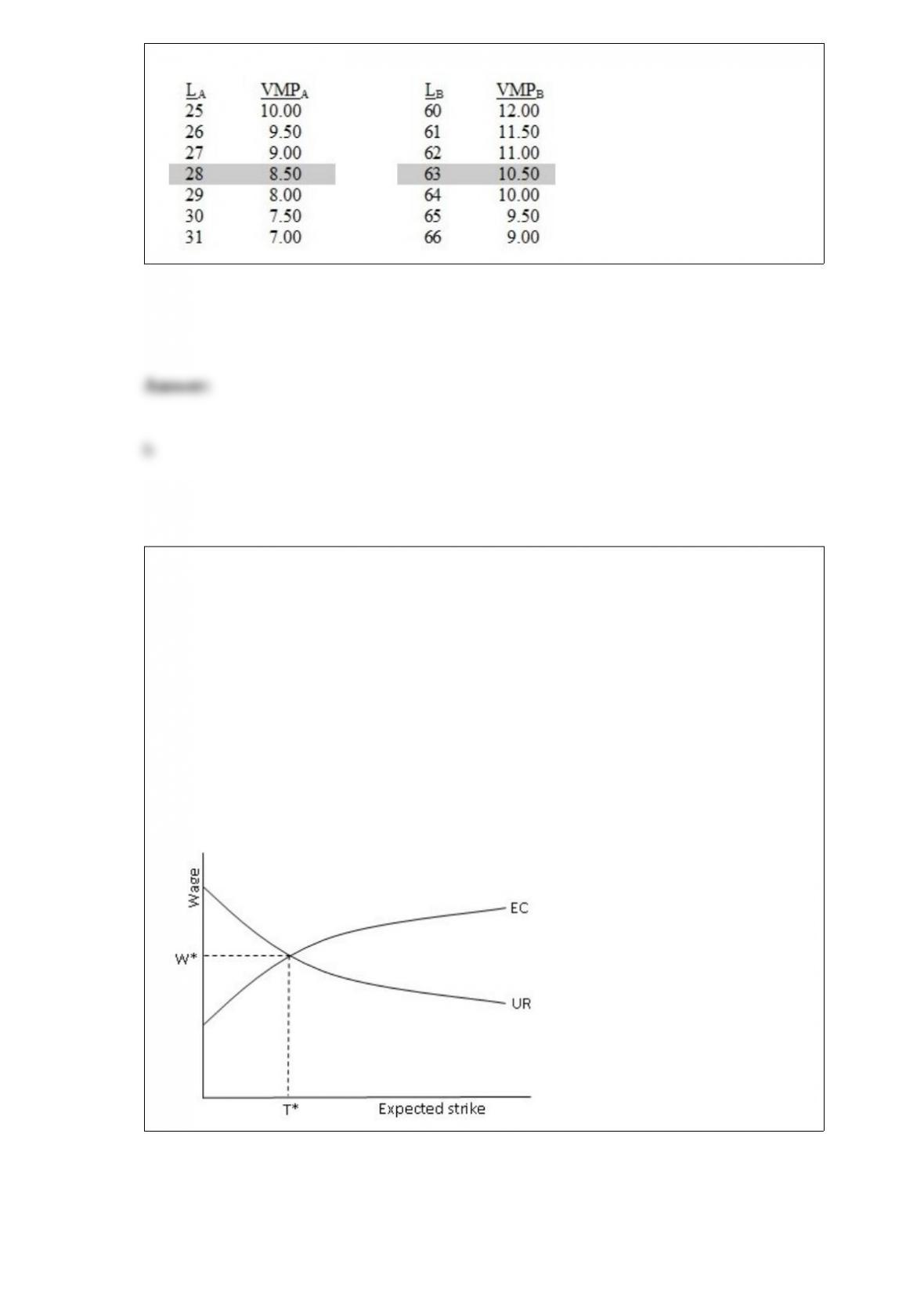
After all adjustments to equilibrium take place in this market, the equilibrium wage rate
in markets A and B, respectively, are: (There are initially 28 workers in market A and 63
workers in market B as indicated by the shaded cells. All markets are assumed
competitive and there is perfect information and costless migration; jobs in markets A
and B are identical in all nonwage aspects.)
a.$8.50; $10.50
b.$9.50; $9.50
c.$10.00; $10.00
d.$$9.50; $11.50
The UR curve will shift up if the expected costs of a strike to the: (EC is the employer
concession curve and UR is the union resistance curve.)
a.union are reduced
b.union are increased
c.firm are reduced
d.firm are increased

The income effect is:
a. the combination of leisure and wage rate that maximizes one’s income
b. the part of the total change in desired work hours that is due to the change in real
income resulting from a change in the wage rate
c. the part of the total change in desired work hours that is due to a change in the wage
rate, with real income or utility constant
d. always dominated by the substitution effect
A competitive firm will never choose to operate in stage(s):
a. I or II
b. I or III
c. II or III
d. III only

Empirical evidence indicates that affirmative action programs in the 1970s improved
employment opportunities for:
a. minorities but not women
b. women but not minorities
c. both minorities and women
d. neither minorities nor women
One implication of Becker’s “taste-for-discrimination” model is that:
a. firms that discriminate will have lower costs than non-discriminating firms
b. the existence of competitive market forces will cause discrimination to diminish and
eventually disappear
c. an increase in the supply of African American workers will cause the equilibrium
African American-white wage ratio to rise
d. non-discriminating firms will be put at a competitive disadvantage because they
employ victims of discrimination
The model assumes that, as the expected length of a strike increases: (EC is the
employer concession curve and UR is the union resistance curve.)
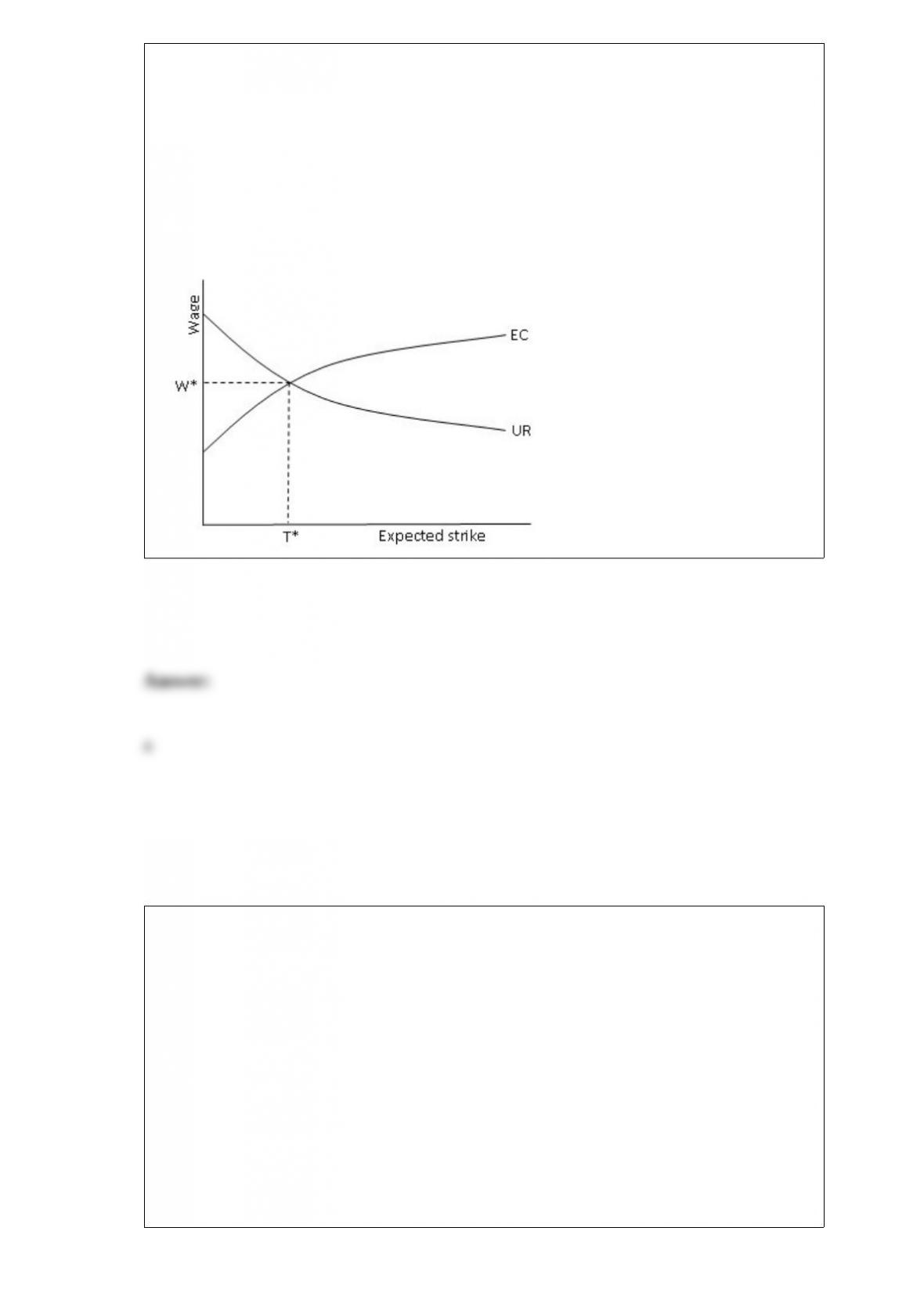
a.union wage demands fall and firm wage concessions increase
b.union wage demands increase and firm wage concessions decrease
c.uncertainty about the union’s resistance and the employer’s concessions increases
b.uncertainty about the union’s resistance and the employer’s concessions decreases
Evidence on the occupational distribution suggests that:
a. women are disproportionately represented in lower-paying occupations, but African
Americans are not
b. African Americans are disproportionately represented in lower-paying occupations,
but women are not
c. neither women nor African Americans are disproportionately represented in
lower-paying occupations
d. both women and African Americans are disproportionately represented in
lower-paying occupations

Consider an individual who will invest a total of $10,000 in direct and indirect costs for
training in order to increase earnings by $12,500 for the next year. Suppose the interest
rate is 8%. If this person plans to retire the following year, the net present value of this
investment is closest to:
a. zero
b. $1600
c. $2500
d. $11,600
Since passage of NAFTA , trade between the U.S., Canada, and Mexico has:
a. increased, but the effects on employment have been modest
b. increased, causing substantial loss of U.S. manufacturing jobs
c. increased, causing substantial loss of U.S. service-sector jobs
d. not changed, but there has been a substantial loss in U.S. manufacturing jobs

“The high psychic costs of leaving friends and family deter migration in response to
wage differentials.” This statement reflects the existence of:
a. geographic immobilities
b. sociological immobilities
c. institutional immobilities
d. wage immobilities
Suppose there is an increase in immigration rates of unskilled, illegal aliens. Which of
the following is not likely to result?
a.Unskilled workers would lose if they are gross substitutes with illegal immigrants
b.Skilled workers would benefit if they are gross complements with unskilled workers
c.The wages of unskilled workers would fall in those markets not protected by
minimum wages
d.For each immigrant who receives a job there would be one less job available for a
native worker