
Relative to their monopsony levels, both the wage and the level of employment would
increase in this market if a wage-setting union negotiates a wage:
(the following diagram of a monopsonistic labor market.)
a. anywhere between W1and W3
b. anywhere between W2and W3
c. anywhere between W1and W2
d. equal to W2only
“The extra output, measured in dollars, that accrues to society when an additional unit
of labor is employed” best describes:
a. marginal product
b. marginal revenue product
c. value of marginal product
d. total revenue product

All else equal, a worker is more likely to move if:
a.his or her spouse is also a labor force participant
b.there are school-age children in the family
c.his or her spouse has accumulated very little job tenure
d.he or she is married
The highest level of utility the worker can possibly achieve is:
a. I1, if P is a normal-profit isoprofit curve
b. I2, if P is a normal-profit isoprofit curve
c. I1, if P represents a positive economic profit
d. I3, if P is a normal-profit isoprofit curve

Unions are most prevalent in the:
a.urban north
b.nonindustrial southwest
c.urban south
d.suburban east
If there are initially 1000 workers in country X and 500 workers in country Y, then we
should expect: (Assume all migration is costless.)

a.net migration from country X to country Y
b.net migration from country Y to country X
c.There will be no migration of workers
d.A migration pattern cannot be determined from the information
On an indifference map reflecting the tradeoff between income and leisure, higher
levels of utility are achieved by moving:
a. from left to right along a given indifference curve
b. from right to left along a given indifference curve
c. to an indifference curve further from the origin
d. to an indifference curve closer to the origin

If workers underestimate the actual amount of risk associated with the job because of
imperfect information, the values in the: (MBs and MCs are the marginal benefit and
marginal cost of safety, respectively. Ps is the probability that a worker will not suffer
an injury on the job during a one year period, and is thus a measure of job safety.):
a.MBs column will understate the true marginal benefit and the profit-maximizing level
of job safety will be less than the optimal level
b.MBs column will overstate the true marginal benefit and profit-maximizing level of
job safety will exceed the optimal level
c.MCs column will overstate the true marginal cost and the profit-maximizing level of
job safety will exceed the optimal level
d.MCs column will understate the true marginal cost and the profit-maximizing level of
job safety will exceed the optimal level
Value of marginal product (VMP) differs from marginal revenue product (MRP) in that:
a. MRP measures the value society places on the next worker’s output while VMP
measures the value the firm places on the next worker’s output
b. VMP measures the value society places on the next worker’s output while MRP
measures the value the firm places on the next worker’s output
c. MRP always exceeds VMP

d. VMP always exceeds MRP
The slope of a standard budget constraint reflects:
a. a diminishing marginal rate of substitution of leisure for income
b. an increasing marginal rate of substitution of leisure for income
c. a constant marginal rate of substitution of leisure for income
d. the wage rate
The long-run labor demand curve incorporates:
a. the substitution effect only
b. the output effect only
c. neither the substitution effect nor the output effect
d. both the substitution effect and the output effect

The average economic rate of return to migration is estimated to be:
a.negative
b.less than 5%
c.between 10% and 15%
d.greater than 20%
A simple income-leisure model might predict that salaried workers would work fewer
hours than hourly workers. In fact the opposite seems to be true, in part because:
a. raises and promotions are “won” on the basis of productivity rankings
b. firms typically offer raises and promotions solely on the basis of seniority
c. of the principle-agent problem
d. salaried work is an example of a deferred compensation scheme

Public sector union growth was most encouraged by:
a.the Wagner Act
b.the Taft-Hartley Act
c.The Landrum-Griffin Act
d.a series of executive orders and state laws recognizing the rights of public sector
workers to organize
Fallick and Hassett suggest that the tendency of union firms to merge with union firms
can be explained by their finding that:
a.union certification elections increase firms’ research and development spending
b.union firms are subject to a lower rate of corporate taxation
c.union firms pay a smaller proportion of compensation in the form of fringe benefits
d.union certification elections reduce firms’ rates of investment in physical capital
Research by Moulton and by Gittleman and Pierce found that:
a.public-sector wage differentials have increased in recent years
b.public-sector wage differentials have diminished in recent years

c.application rates for federal jobs were significantly less than for private-sector jobs
d.individual workers who moved from the private sector to the public sector
experienced a wage gain of approximately 33 percent
Empirical evidence indicates that inheritances _____ labor force participation; further,
persons receiving inheritances tend to be _____ likely to work in the years preceding
the inheritance.
a. have no impact on; less
b. reduce; more
c. reduce; equally
d. reduce; less
According to a newspaper account from Washington State, lottery winners in that state:
a. usually continued to work when prizes were $1 million or less and usually quit work
when prizes exceeded $4 million
b. usually continued to work, no matter how large the prize
c. usually quit work, no matter how large the prize
d. were less likely to quit work the larger was the prize
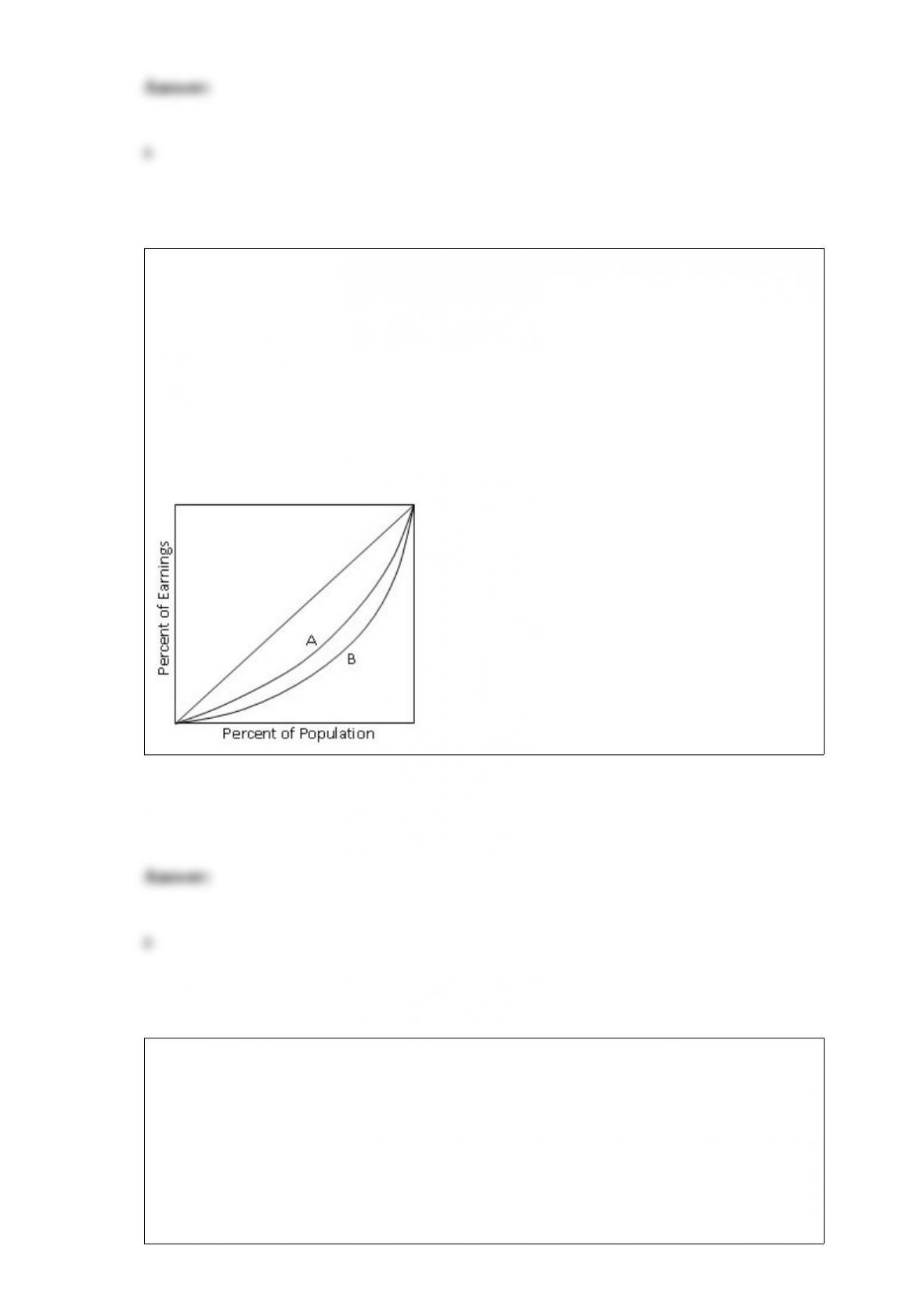
An increase in earnings inequality would be shown by a:
a.shift from line A to line B
b.shift from lime B to line A
c.movement up to the right along line A
d.movement down to the left along line A
Which of the following established unfair labor practices by unions?
a.Norris-LaGuardia Act
b.Taft-Hartley Act
c.Wagner Act

d.Landrum-Griffin Act
Which of the following is not predicted by the hedonic theory of wages, all else
constant?
a. workers that have strong preferences for particular nonwage amenities will be
matched with firms that can provide them most cheaply
b. firms that pay lower wages but offer more amenities have higher than average profits
c. jobs that offer high levels of safety will pay less than those in which working
conditions are less safe
d. firms will tend to offer those nonwage amenities that they can provide most cheaply
The recent drop in the proportion of worker holding long-term jobs can be partially
explained by:
a.the shift from defined contribution to defined benefit pension systems
b.the shift from services to manufacturing
c.the decline in technological progress and productivity
d.the increase in women’s labor force attachment

Suppose the wage is currently W3and L1is the level of employment. Then we should
expect the wage to:
a. rise and employment to rise
b. rise and employment to fall
c. fall and employment to rise
d. fall and employment to fall
The slope of an indifference curve at any point reflects the:
a. rate at which a person is willing to substitute leisure for income
b. wage rate
c. income effect
d. substitution effect

Suppose workers in labor market X are qualified to work in an alternative competitive
labor market Y, and vice versa. An increase in the demand for labor in market Y will:
a. increase labor supply in X and drive its wage down
b. decrease labor supply in X and drive its wage up
c. reduce labor supply in Y and drive its wage down
d. have no impact at all in X
In the case of specific training, the wage rate during the training period will be _____,
while the post-training wage will be _____. ( MRPu refers to the marginal revenue
product of an untrained worker, while MRPt refers to this worker’s marginal revenue
product as a result of a program of on-the-job training.)
a. W1; W3
b. W1; between W2 and W3
c. W2; between W2 and W3
d. W2; W2

In comparing two otherwise identical industries X and Y, an economist finds that labor
demand is less elastic in industry X. Which of the following would support this finding?
a. Capital and labor are less easily substituted for one another in X than in Y
b. Labor costs as a percentage of total costs are relatively higher in X than in Y
c. Product demand elasticity is higher in X than in Y
d. Substitute resources have a more elastic supply in X than in Y
Assuming workers and jobs are identical, if information is perfect but job search and

migration are costly, then:
a. labor may or may not flow among employers
b. labor will flow among employers until all wages are equal
c. labor will flow among employers until all economic profits are zero, but wages may
be unequal
d. all firms will hire the same number of workers in equilibrium and pay them all the
same wage
This firm’s efficiency wage rate is: (Suppose a “fully effective” worker can produce 20
units per hour in a particular firm. The firm’s wage-productivity relationship is given by
the table below):
a. $7.00
b. $8.00
c. $9.00
d. $10.00
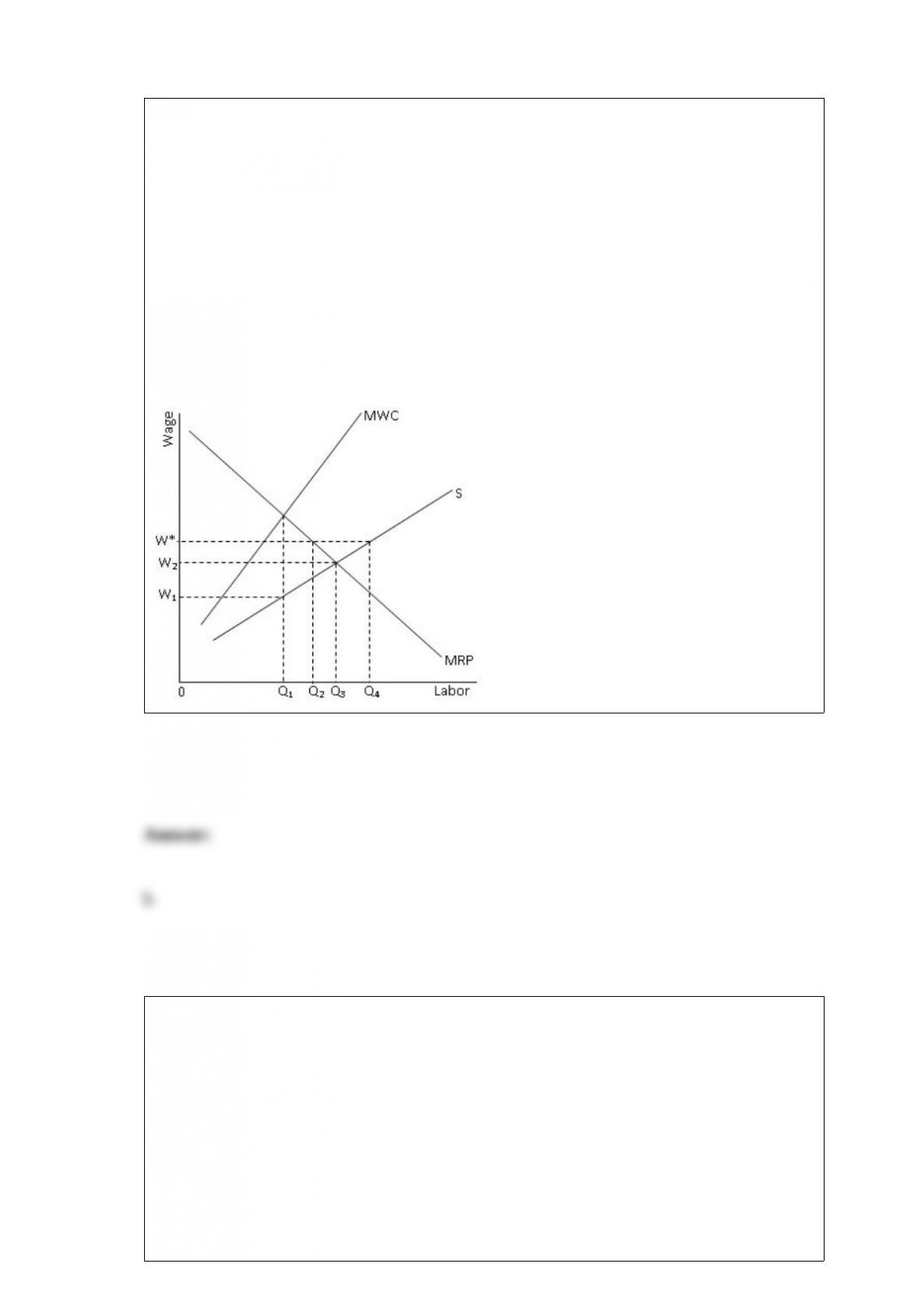
Suppose this labor market is competitive, so that the wage rate is W2 and employment
is Q3. If W* is imposed as the minimum wage, then employment in this market:
a.will rise
b.will fall
c.will remain the same
d.may or may not change; more information is required
Consider the market depicted in the diagram. Supporters of illegal immigrants claim
that no domestic workers are willing to do this type of work. Their claims are: (Sd is the
supply curve of domestic labor, St is the total labor supply curve including the supplies
of illegal immigrant workers. L is measured in thousands of workers.)
a.untrue; 30,000 domestic workers are currently performing this work
b.untrue; 40,000 workers are currently performing this work
c.misleading; although no domestic workers are currently performing this work, some

domestic workers would take these jobs at wages above $7
d.true