
Compared to their counterparts in other developed countries, CEOs in the U. S. are
paid:
a. considerably less
b. about the same
c. considerably more
d. a greater percentage of their compensation in the form of straight salary
After all adjustments to equilibrium take place in this market, we expect to find that:
(There are initially 28 workers in market A and 63 workers in market B as indicated by
the shaded cells. All markets are assumed competitive and there is perfect information
and costless migration; jobs in markets A and B are identical in all nonwage aspects.)
a.the total value of output is increased, but economic efficiency is reduced
b.both the total value of output and economic efficiency are increased
c.both the total value of output and economic efficiency are reduced
d.changes in the total value of output and economic efficiency cannot be determined
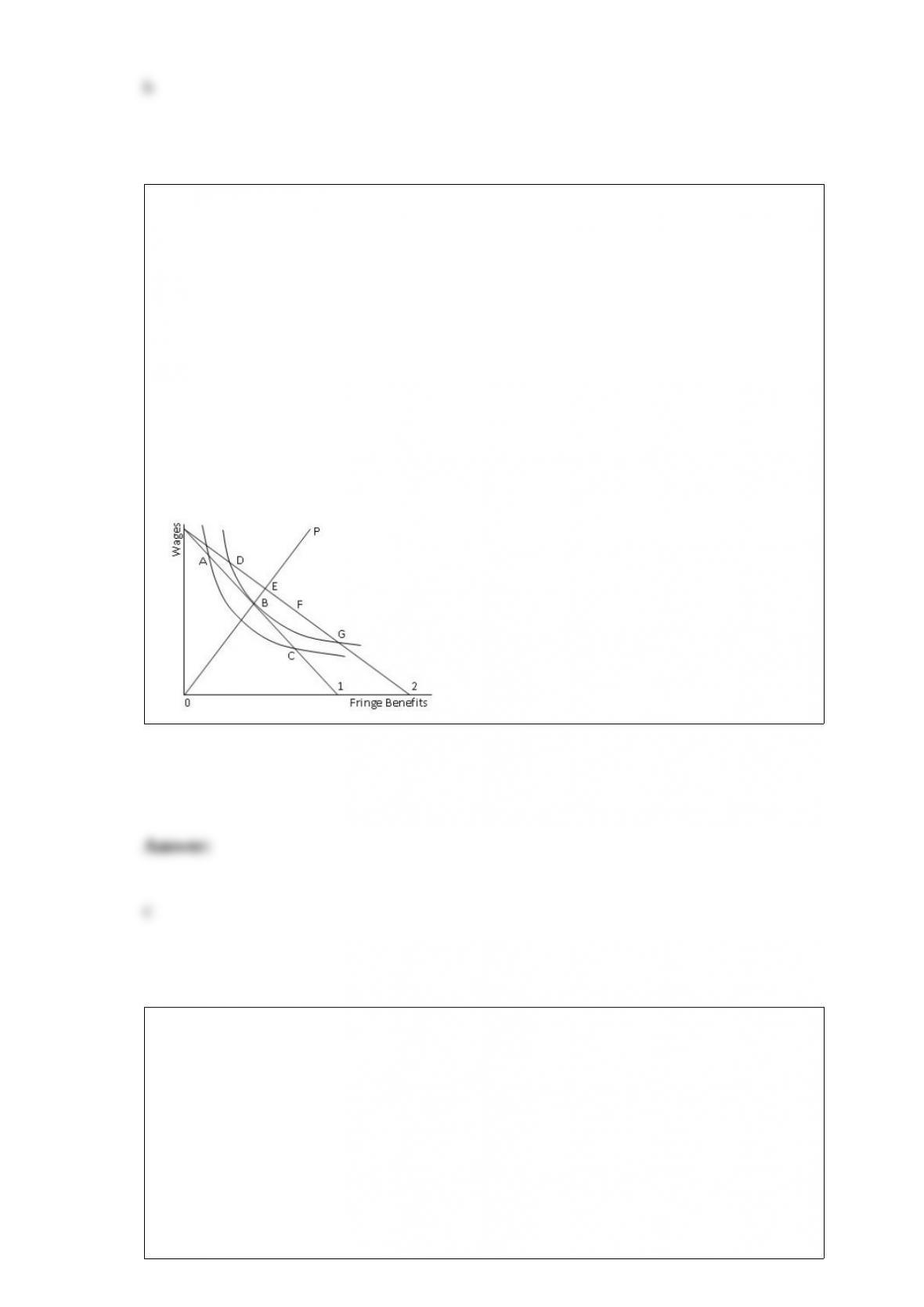
If the isoprofit line shifts from line 1 to line 2, then: (All points along the ray 0P reflect
a constant proportion of wages to fringe benefits.)
a. to maintain profit level 2, the firm must provide more fringe benefits and reduce
wages
b. to maintain profit level 2, the firm must reduce fringe benefits and raise wages
c. as the firm moves from line 1 to line 2, it could provide more fringe benefits while
paying the same wage rate
d. providing more fringe benefits would reduce the firm’s profit
Lower-paid workers potentially have more to gain from unionization. This fact explains
why:
a.women are more likely to be unionized than men
b.Southerners are more likely to be unionized than Northerners
c.Public-sector workers are more likely to be unionized than private-sector workers
d.African Americans are more likely to be unionized than whites

Including fringe benefits with earnings, the Lorenz curve moves:
a.away from the diagonal and the Gini coefficient rises
b.away from the diagonal and the Gini coefficient falls
c.toward the diagonal and the Gini coefficient rises
d.toward the diagonal and the Gini coefficient falls
The increase in the college wage premium during the 1980s was most likely caused by:
a. increased demand for college graduates due to changes in the structure of the
economy
b. increased supply of college graduates from the large “baby boom” generation
c. changes in technology that reduced the relative supply of college-trained workers
d. increased demand for high school graduates, particularly males

Personal differences in demand for human capital curves can be explained by
differences in all of the following, except:
a. ability
b. access to investment funds
c. discrimination
d. discount rates
The primary indirect cost of going to college is:
a. earnings given up by not entering the labor market directly after high school
b. an enhanced future flow of earnings
c. the value of room and board that would have been provided at home
d. tuition expenses
In the years following enactment of welfare reform in 1996, welfare case loads:
a. dropped slightly

b. increased slightly
c. dropped by more than 50%
d. increased by almost 50%
In year 1, an economy used 200 worker hours to produce 500 units of output. In year 2,
the economy used 240 worker hours to produce 660 units of output. The rate of
productivity growth from year 1 to year 2 is:
a.1%
b.2%
c.3.2%
d.10%
The slope of line segment OD can be interpreted as the:
a. total product of labor at Y
b. average product of labor at Y
c. value of labor’s marginal product at Y
d. greatest possible marginal product of labor

The level of union organization that is most likely to “organize the unorganized” is the:
a.federation
b.national union
c.state union
d.local union
The marginal revenue product schedule:
a. measures the increase in total revenue that results from the production of one more
unit

b. measures the decline in product price that a firm must accept in order to sell the extra
output of one more worker
c. is the same whether the firm is selling in a purely competitive or imperfectly
competitive market
d. is the firm’s labor demand schedule, provided the firm is operating in the zone of
production
Suppose workers currently receiving unemployment compensation were given a
financial reward contingent on finding a job quickly. For example, Washington state at
one time provided $562 for workers who became reemployed within 13 weeks.
Economic theory suggests that such a “reward” scheme should:
a.reduce job search duration by shifting the wage offer distribution to the left
b.reduce job search duration by decreasing the acceptance wage and intensifying job
search
c.reduce job search duration by shifting the wage offer distribution to the right
d.have no effect on job search duration, as the acceptance wage will decrease to offset
the effect of the shifting wage offer distribution
Which one of the following is generally not associated with relatively high levels of
unionization?
a.Services
b.Public administration
c.African Americans
d.Blue-collar workers
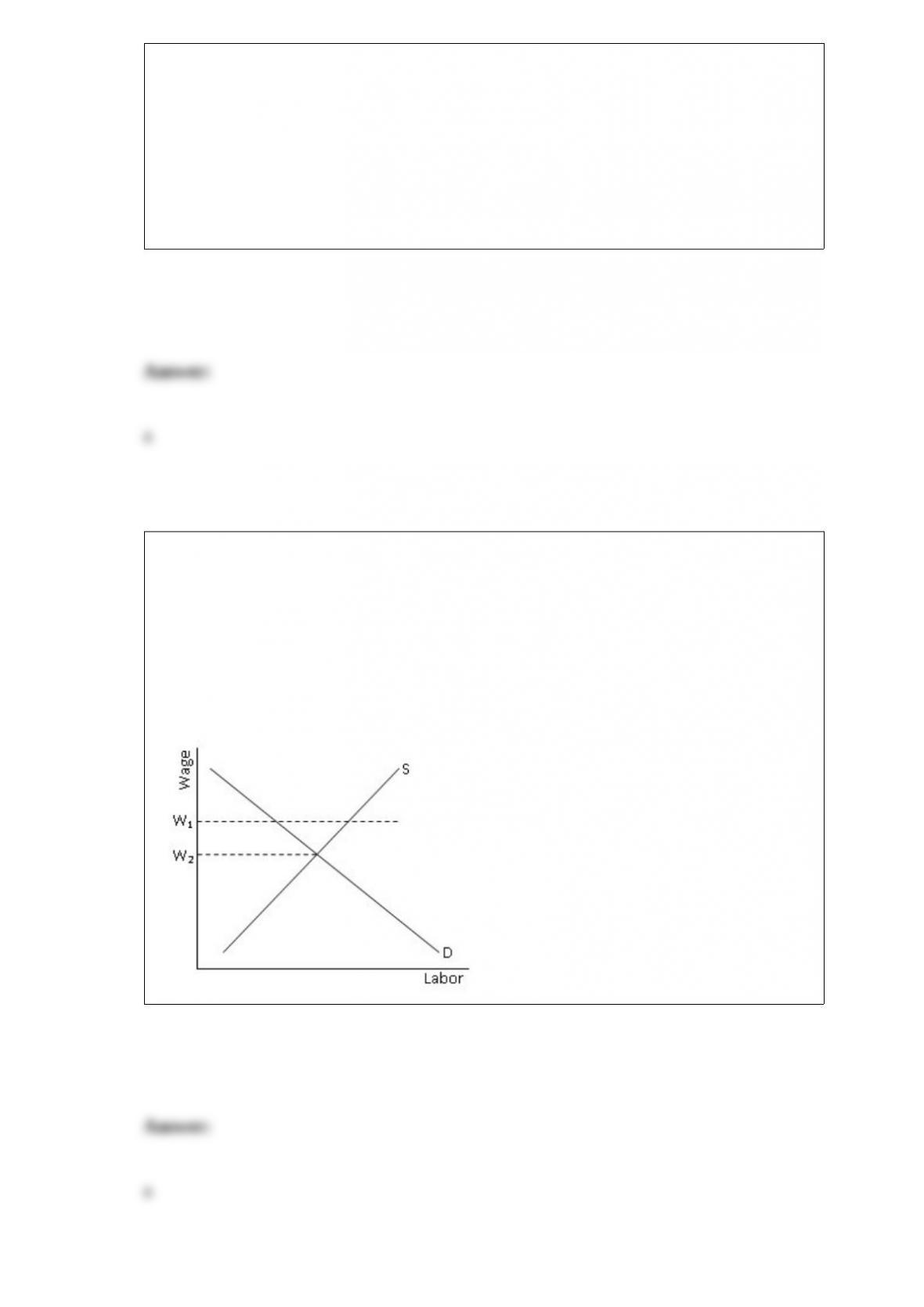
At wage rate W1there is an:
a. excess supply of labor and the wage rate will fall
b. excess supply of labor and the wage rate will rise
c. excess demand for labor and the wage rate will fall
d. excess demand for labor and the wage rate will rise

The union wage advantage tends to:
a.decrease during recessions
b. be smaller among lower-educated workers
c.be smaller among African Americans
d.be larger among craft unions
The income effect of the illustrated wage decrease causes this individual to work:
a. one less hour
b. one more hour
c. two less hours
d. two more hours
Suppose that the wage in B is higher because workers perceive disutility of $2
associated with this job relative to A. Assuming that information is perfect and mobility
between jobs is costless, we can conclude that: (which represents a local labor market
consisting of two submarkets. All workers are assumed to be identical.):
a. the wage differential between jobs A and B is an equilibrium differential
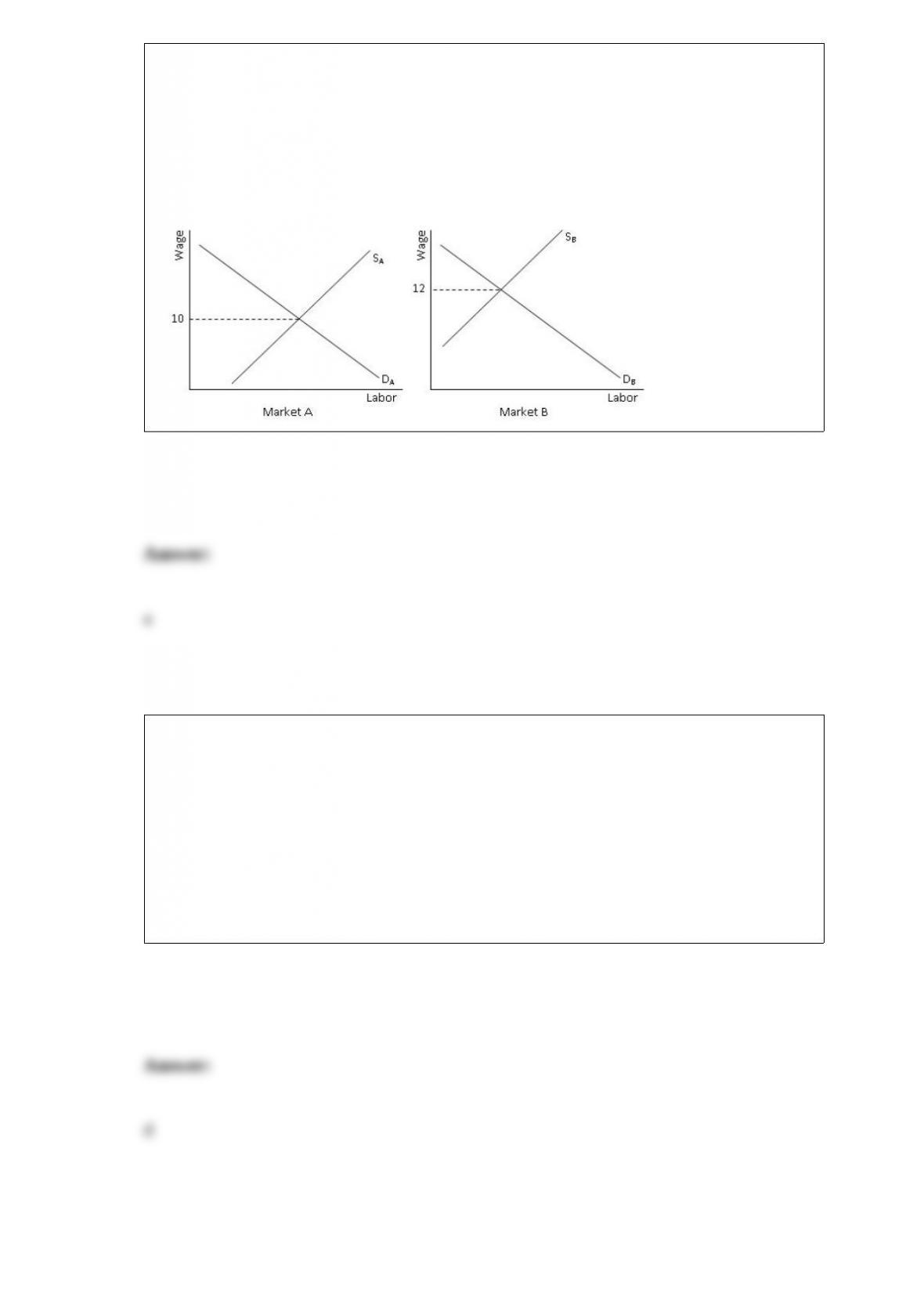
b. workers will flow from job A to job B
c. workers will flow from job B to job A
d. the demand for labor in B will fall and the demand for labor in A will rise
If job X pays more than identical job Y, then the wage rates will:
a. remain different if mobility is costless
b. remain different if information is perfect
c. equalize because labor will migrate from X to Y
d. equalize if information is perfect and mobility is costless

Following the downturn in air travel following the September 11, 2001 terrorist attacks,
several thousand highly paid Seattle-based union workers were laid off from airplane
manufacturer Boeing. Many of these workers left the Seattle area to accept jobs paying
less than their Boeing jobs. What can we conclude from their actions?
a.They would have been better off if they had remained in the Seattle area
b.They believed that their salaries in the new areas would eventually surpass the wage
they were making at Boeing
c.The jobs they accepted must have been non-union
d.They believed that they would be better off than if they had remained in Seattle
Suppose that an economy’s real wages and its average productivity are both increasing
at a 2% annual rate. Further assume that productivity in industry X is growing at a 4%
annual rate. Under what conditions might output and employment in industry X fall?
a.Price-elastic product demand
b.Price-inelastic product demand
c.The output of industry X is an inferior good
d.The output of industry X is a normal good
Hirsch and Macpherson estimate the overall union wage advantage to be

approximately:
a.4%
b.9%
c.15%
d.28%
Productivity declines may worsen recessions by causing unit labor costs to:
a.rise, thereby resulting in falling profits and lower investment spending
b.rise, thereby resulting in greater retained earnings by firms
c.fall, thereby creating incentives for government intervention
d.fall, thereby reducing consumer spending power
Internal labor markets benefit senior employees by:
a.forcing the firm to pay all of the expenses associated with general training
b.providing them with greater freedom through the informal work rules associated with
such markets

c.providing them with increased protection from job layoff
d.protecting them from pay cuts when they leave the firm for other jobs
Which of the following is a true statement?
a. Monopolists employ too many labor resources, because the value of the marginal
product exceeds the marginal opportunity cost of labor
b. For a monopolist, the marginal revenue product of labor exceeds marginal wage at
the profit maximizing level of employment
c. Monopolists pay a lower wage than competitors for the same type of labor
d. The monopolist’s demand for labor curve is less elastic than if it were a competitor in
the sale of its output.
The labor force participation rate:
a. is the fraction of a given population that is classified as employed
b. has been rising for males and declining for females
c. tends to increase during a recession
d. is the fraction of a given population that is classified either as employed or
unemployed

At the optimal amount of education, the internal rate of return on education is:
a. maximized
b. higher than the market rate of interest
c. lower than the market rate of interest
d. equal to the market rate of interest
Suppose the firm’s product demand is given by the column labeled D1. If the wage rate
rises from $100 to $130, the firm will reduce the quantity of labor employed by _____
unit(s) (Assume that the labor market is perfectly competitive.)
a. 0
b. 1
c. 2
d. 3
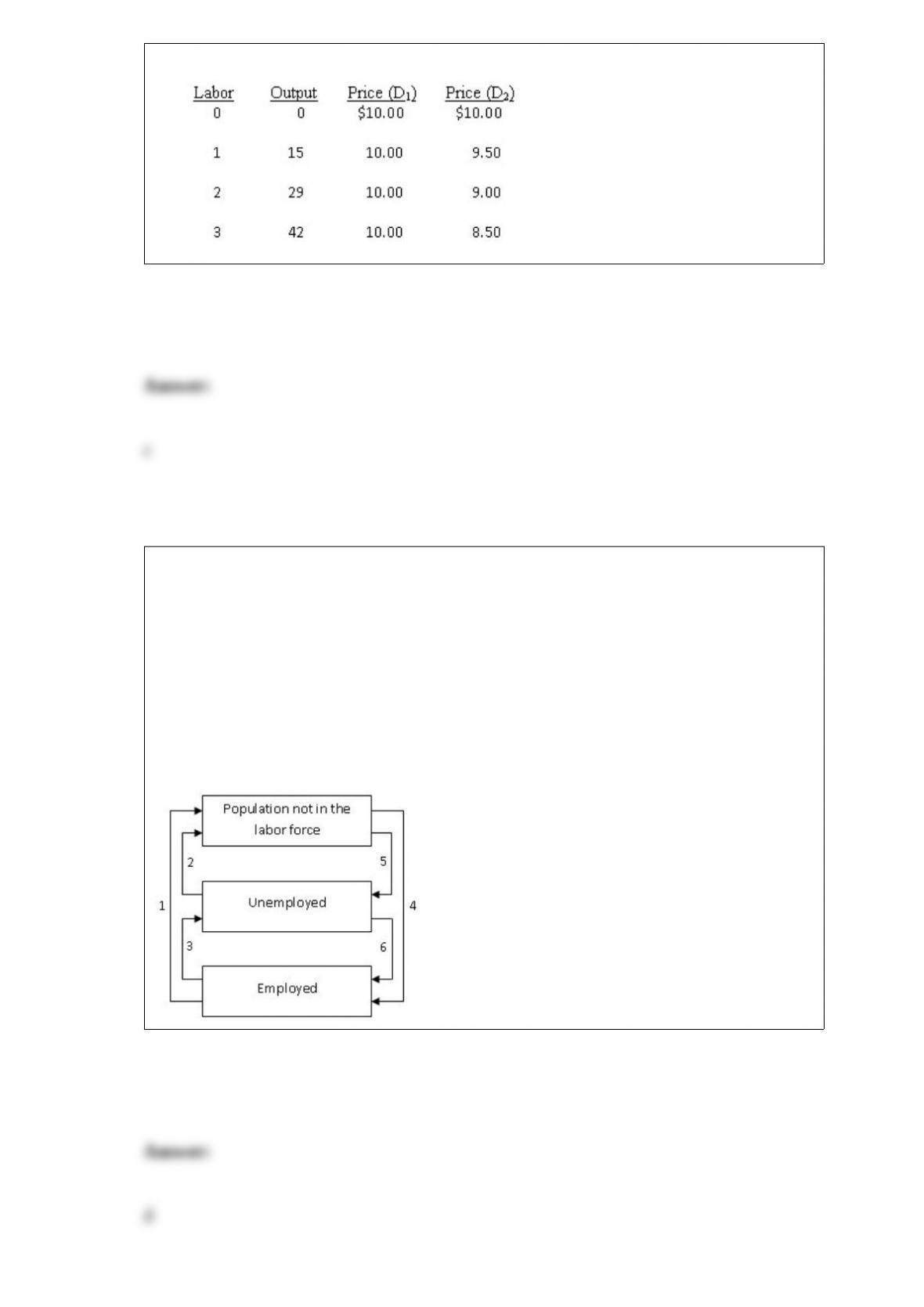
Flow 3 includes all of the following except:
a.discharges
b.layoffs
c.quits
d.retirements
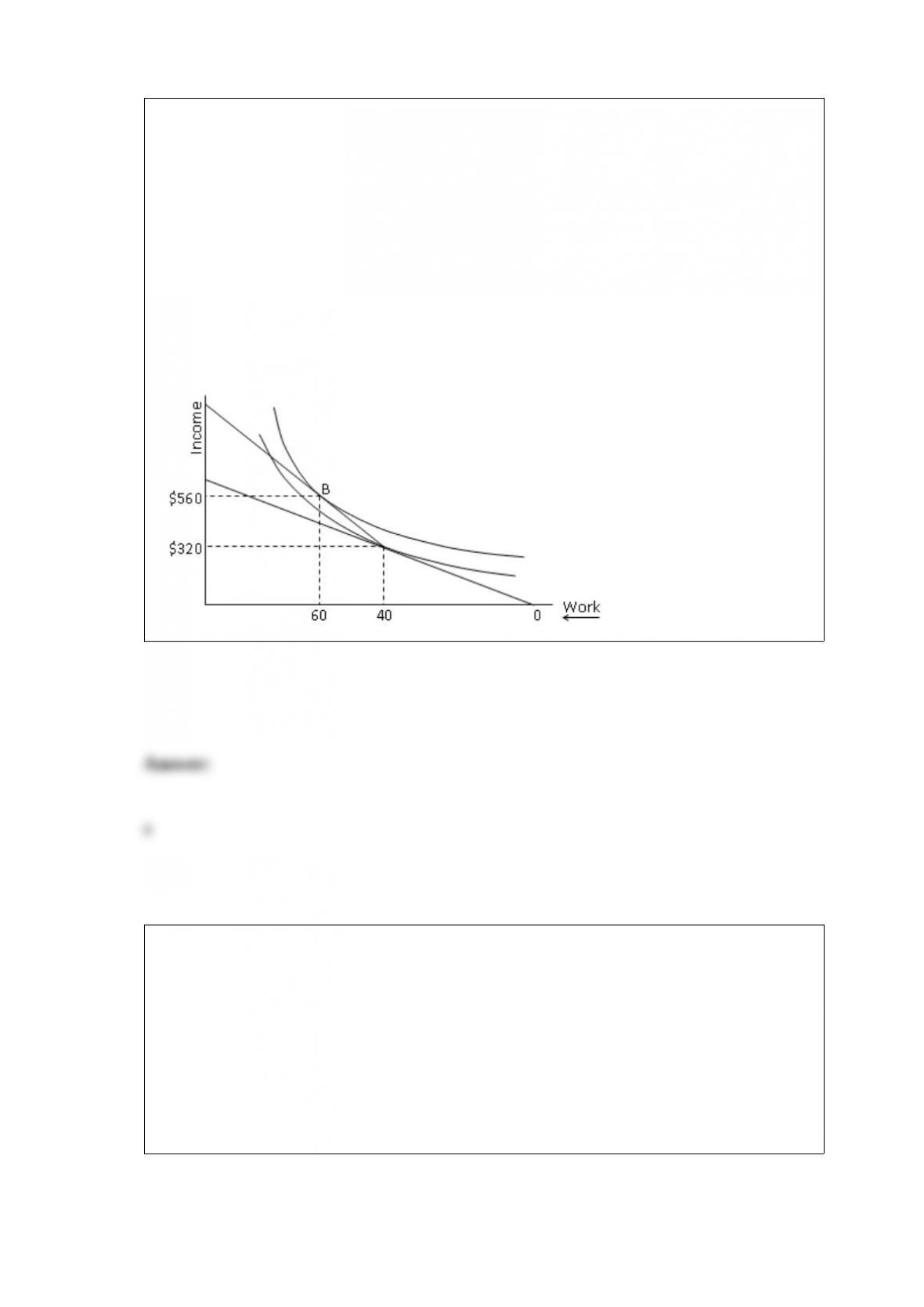
Suppose this worker is currently working 40 hours per week and earning $8 per hour.
Which one of the following would cause a move to point B, and the subsequent
increase in work hours to 60?
a. The availability of overtime work at $12 per hour
b. The availability of a moonlighting job that pays $6 per hour
c. An increase in the straight-time wage to $9.33 per hour
d. An increase in non-wage income of $240
For any given individual, an increase in the income tax rate will:
a.increase work effort
b.decrease work effort
c.decrease work effort if the income effect outweighs the substitution effect
d.increase work effort if the income effect outweighs the substitution effect

Fringe benefits currently account for approximately what percentage of total
compensation?
a. 5% ” 10%
b. 15% ” 20%
c. 25% ” 30%
d. 35% ” 40%