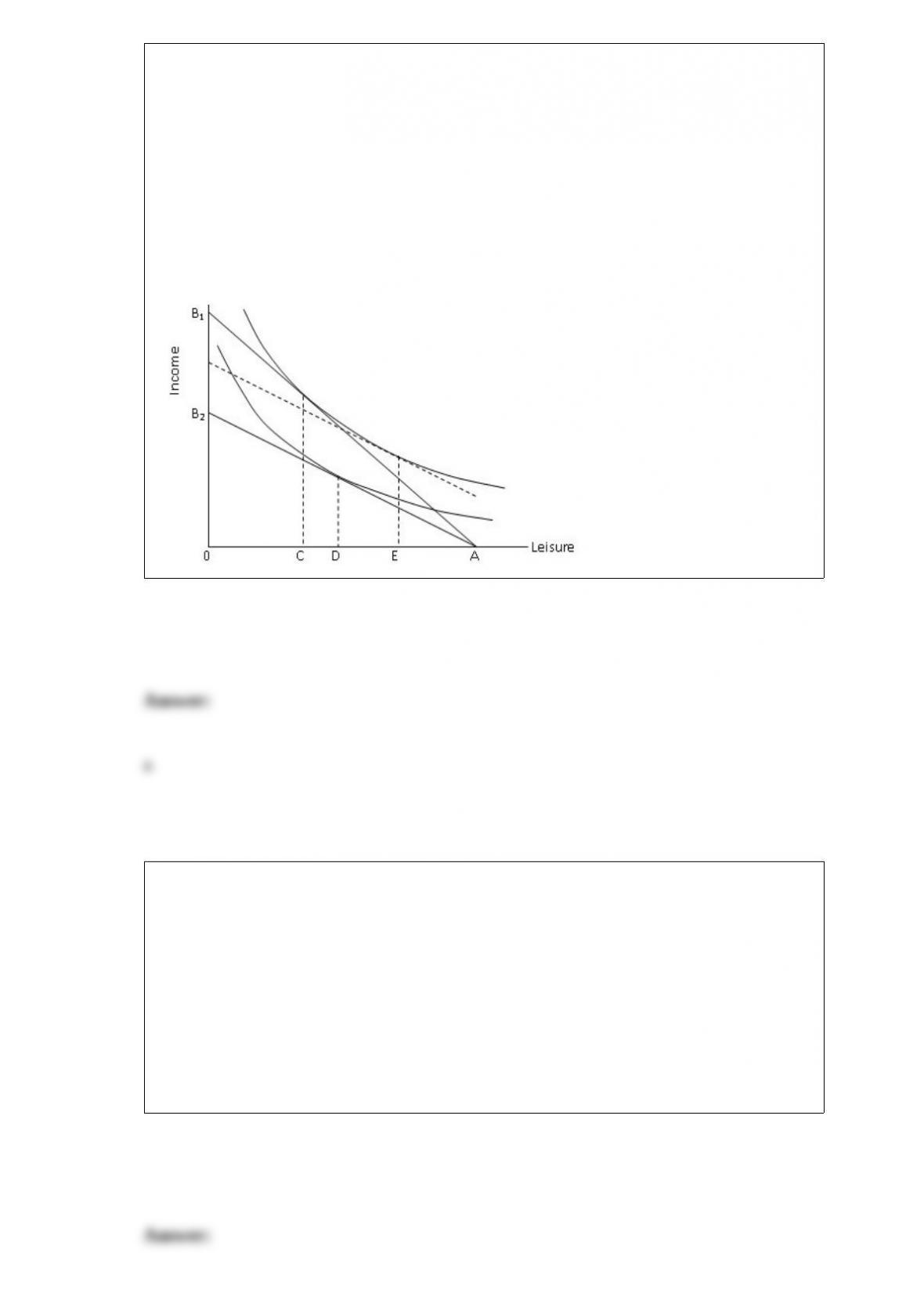
The equilibrium positions shown imply that in the relevant wage range, this person is:
a. on the upsloping segment of the individual labor supply curve
b. on the backward-bending segment of the individual labor supply curve
c. at the point on the individual labor supply curve where the income and substitution
effects are equal
d. being offered a wage less than the reservation wage
At the least-cost combination of capital and labor:
a. the marginal rate of technical substitution of labor for capital equals the ratio of the
price of labor to the price of capital
b. the isocost line cuts the isoquant at its lowest point
c. the capital-labor ratio is equal to the ratio of the price of labor to the price of capital
d. the isoquant cuts the isocost line at its lowest point

Internal labor markets are more likely to occur when:
a.principal-agent problems are absent
b.firms expect a high rate of turnover and low hiring costs
c.workers at a particular firm require general training
d.workers at a particular firm require specific training
If flow 2 increases, then the unemployment rate will go _____; if flow 6 decreases, then
the unemployment rate will go _____.
a.up; up
b.up; down
c.down; up
d.down; down

The declining college wage premium in the 1970s is generally attributed to the:
a. growing demand for college graduates in that period
b. shrinking supply of college graduates in that period
c. growing supply of college graduates in that period
d. shift of employment from manufacturing to services
The share of fringe benefits in total employee compensation:
a. grew steadily in the 1960s and 1970s but has fallen since 1980
b. was unchanged in the 1960s and 1970s and has fallen since 1980
c. shrank in the 1960s and 1970s and has remained constant since then
d. grew steadily from 1960 through the mid-1990s

Charley’s employer is considering him for a general training program that will cost $3
per hour. His current marginal revenue product is $15 per hour and will rise to $20 upon
completion of the program. Of the following, Charley’s training and post-training wage,
respectively, will most likely be:
a. $15; $20
b. $15; $17
c. $12; $15
d. $12; $20
According to empirical estimates, approximately what proportion of the observed
female-male earnings gap and African American-white earnings gap can be explained
by nondiscriminatory factors?
a. none
b. no more than half
c. more than half
d. virtually all
Compared to the long-run labor demand curve, the firm’s short-run curve is typically:
a. less elastic
b. the same
c. more elastic
d. more elastic only if labor and capital are gross complements
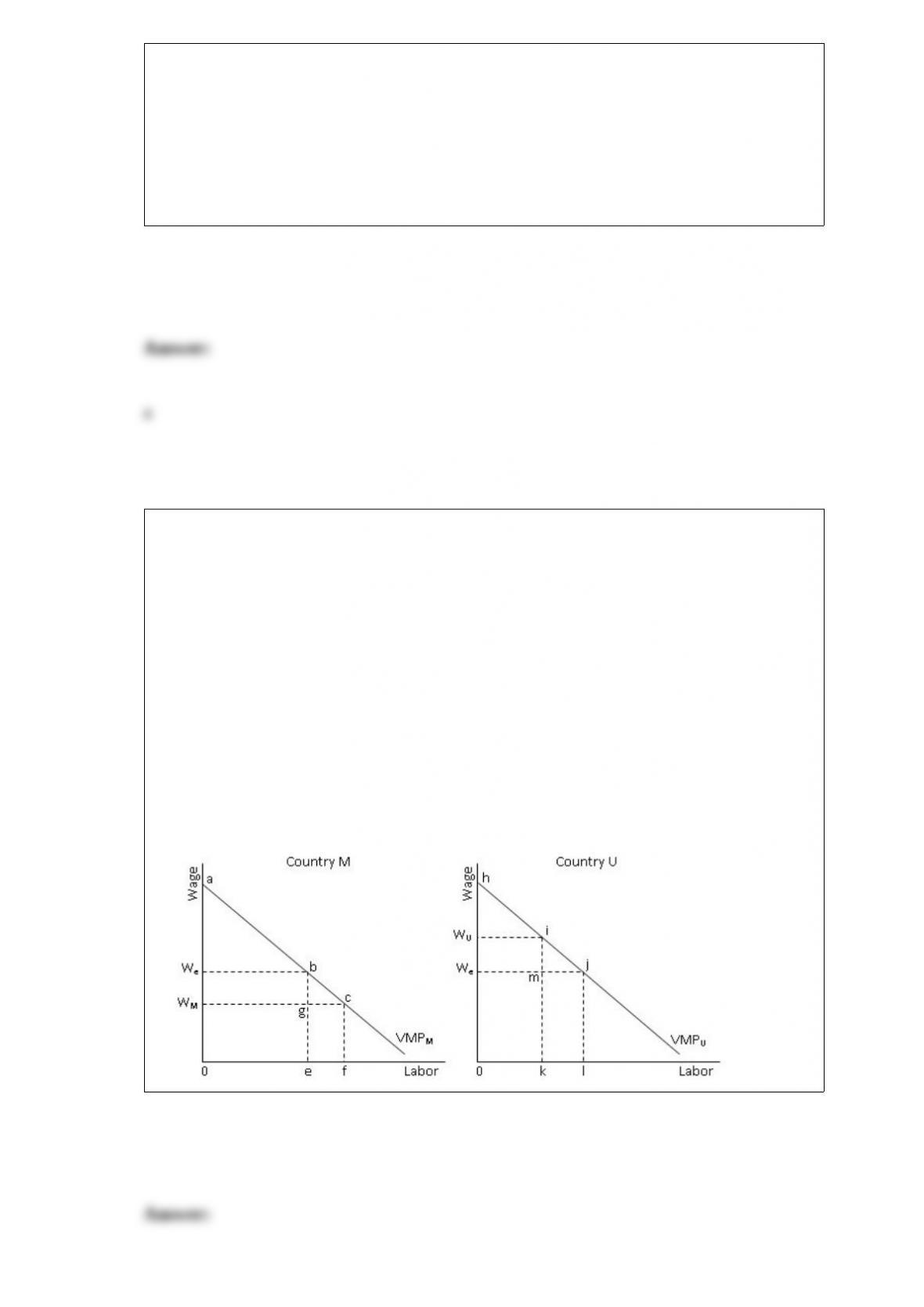
For native Country U workers, migration causes a collective loss equal to area: .
( Initially, wage rates are WM in Country M and WU in Country U. Subsequent
migration results in an equalization of wage rates.)
a.imj
b.kijl
c.WUimWe
d.WUijWe

Which one of the following helps to explain the observed relationship between age and
mobility?
a.Older workers tend to have more specific human capital and on-the-job training
b.Older workers tend to have more general training
c.Younger workers have less time to recoup their investment costs
d.Both direct and psychic costs of moving tend to decrease with age.
The Trafficking Victims Protection Act of 2000:
a.grants U.S. refugee status to the roughly 600,000 victims of worldwide trafficking
each year
b.grants unconditional permanent U.S. residency to any victim of international
trafficking
c.authorizes permanent U.S. residency to any trafficking victim upon successful
prosecution and conviction of the trafficker
d.authorizes temporary U.S. visas to up to 5000 trafficking victims per year, provided
the victims help the government prosecute the traffickers

A majority of the workers earning the minimum wage:
a.are males
b.are females
c.work full-time
d.are teenagers
The ratio of African American to white hourly wages:
a. rose steadily from 1979 to the present
b. dropped steadily from 1979 to the present
c. was relatively constant from 1979 to 1985, but has increased steadily since then
d. has changed little in the past three decades