
Compared to a conscripted military, an all-volunteer military:
a.is likely to substitute labor for capital
b.is likely to substitute capital for labor
c.has a lower nominal cost and a lower real cost
d.has a higher nominal cost and a higher real cost
Skilled labor will benefit from an increase in the wage rate paid to unskilled labor if:
a. the substitution effect outweighs the output effect
b. the output effect outweighs the substitution effect
c. the output effect and substitution effect work in opposite directions
d. skilled labor and unskilled labor are gross complements
The total economic cost of formal education typically does not include:
a. expenditures for tuition, books, and fees
b. earnings foregone by choosing not to enter the labor force
c. expenditures for room and board
d. transportation expenses to and from college
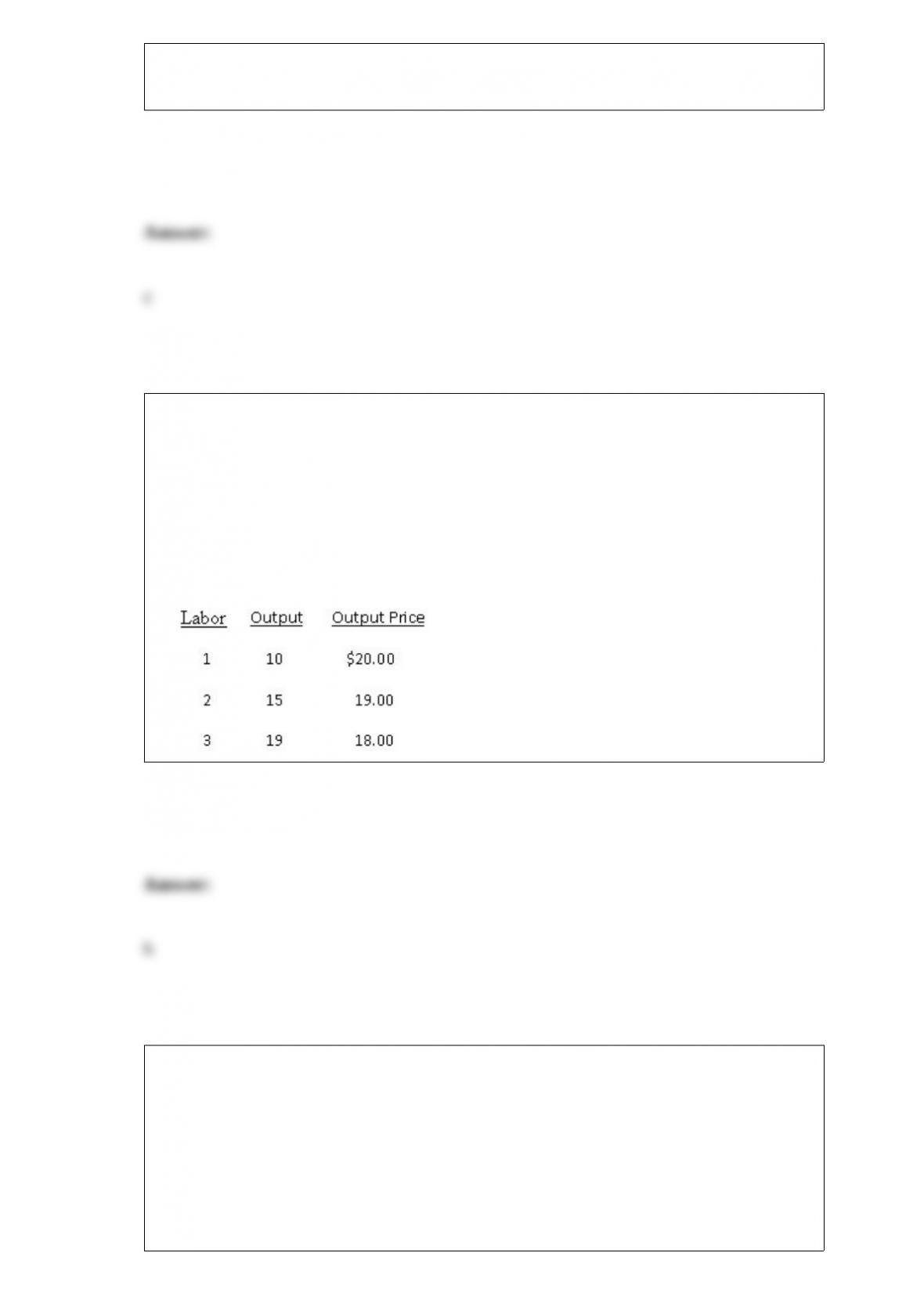
The table indicates that: (the following table that shows the short-run production
relationship and the product demand schedule for a firm.)
a. the firm sells output in a perfectly competitive market
b. the firm is a monopolist
c. the firm hires labor in a perfectly competitive market
d. the firm is a monopsonist
The free-rider problem is most likely to arise in:
a. small groups
b. firms that tie bonuses to individual performance
c. a profit-sharing plan

d. firms that use piece rates
In year 1, an economy used 200 worker hours to produce 500 units of output. In year 2,
the economy used 240 worker hours to produce 660 units of output. If year 1 is the base
year, the productivity index for year 2 is:
a..10
b.1.10
c.1.25
d.1.32
According to the diagram, which of the following has only a direct impact on annual
earnings?
a.Chance
b.Family background
c.Ability
d.Discrimination

According to the theory of statistical discrimination:
a. the process of competition should put discriminating employers at a competitive
disadvantage
b. the discrimination coefficient is a measure of prejudice in the labor market
c. there will be discriminatory wage differentials because a firm with market power
distinguishes between different groups with different elasticities of labor supply
d. a person is judged on the basis of the average characteristics of her or his
demographic group
In their study of the Bridgestone/Firestone tire recalls, Krueger and Mas find that:

a.decreases in product quality at the Illinois plant were caused by management
replacing workers with low quality robots
b.tire defects were highest in factories where unionization rates were lowest
c.labor strife at the Illinois plant resulted in lower product quality
d.there were no differences in product defects at the struck Illinois plant and others
where there was no labor strife
Increases in the minimum wage tend to:
a.increase both formal schooling and general on-the-job training
b.increase formal schooling and reduce general on-the-job training
c.reduce formal schooling and increase general on-the-job training
d.reduce both formal schooling and general on-the-job training
Historically, immigrants in the U.S.:
a.have been less likely than the native-born population to receive welfare benefits and
welfare participation by immigrants has not changed in recent years
b.have been less likely than the native-born population to receive welfare benefits but
welfare participation by immigrants has increased in recent years

c.have been more likely than the native-born population to receive welfare benefits and
welfare participation by immigrants has not changed in recent years
d.have been more likely than the native-born population to receive welfare benefits but
welfare participation by immigrants has decreased in recent years
The statistical discrimination model and Becker’s “taste-for-discrimination” model:
a. are alike in that both predict discriminating firms will have higher profits
b. are alike in that both predict discriminating firms will have lower profits
c. differ in that the former results in potentially increased profits; firms with a taste for
discrimination will have lower profits
d. differ in that the former results in lower profits; firms with a taste for discrimination
will have higher profits
An employer who is willing to pay a wage premium to avoid employing persons from
some particular group is engaging in:
a. a taste for discrimination
b. occupational segregation
c. statistical discrimination

d. human capital discrimination
The three basic characteristics of the economic perspective are:
a. Relative scarcity, purposeful behavior, and adaptability
b. Supply, demand, and equilibrium
c. Description, institutions, and facts
d. Prices, quantities, and incomes
The discouraged-worker effect indicates that:
a. married women will enter the labor force to maintain household living standards after
their husbands’ wages have fallen
b. some unemployed persons in the labor force actively seek employment
c. some unemployed workers will decide to withdraw from the labor force as the
unemployment rate increases
d. the labor force participation rate varies directly with the unemployment rate

The union wage advantage:
a.peaked in the mid-1970sc.peaked in the mid-1990s
b.has fallen consistently since 1965d.has risen consistently since 1965
Suppose all workers are identical but working for Ajax is more pleasant than working
for Acme. In all other nonwage respects the two firms offer the same job characteristics.
In equilibrium:
a. the wage at Ajax will be higher than at Acme
b. the wage at Ajax will be lower than at Acme
c. workers will have lower net utility at Acme
d. employment will be higher at Ajax if demand is the same in both markets

Which of the following outlawed company unions?
a.Fair Labor Standards Act
b.Wagner Act
c.Taft-Hartley Act
d.Landrum-Griffin Act
Fiscal policy to combat demand-deficient unemployment is an attempt to:
a.increase aggregate demand so that it intersects aggregate supply at the
full-employment level of output
b.decrease aggregate demand so that it intersects aggregate supply at the
full-employment level of output
c.increase the money supply by a constant 4% annual rate
d.decrease aggregate supply such that it intersects aggregate demand at the
full-employment level of output
In Becker’s model of time allocation, the difference between “goods” and
“commodities” is that commodities are produced:
a. in markets whereas goods are produced in households

b. only with housework
c. by combining goods with time
d. in the market, whereas goods are produced in the home
In 2011 the ratio of female to male hourly wages was approximately:
a. 45%-55%
b. 60%-70%
c. 75%-85%
d. 90%-100%
Which one of the following observations supports the argument that unions increase
productivity?
a.Turnover in union firms is lower than in nonunion firms
b.Unions alter the allocation of labor between union and nonunion firms
c.Training at union firms is lower than at nonunion firms
d.Unions provide an “exit” option whereas nonunion workers only have a “voice”
option
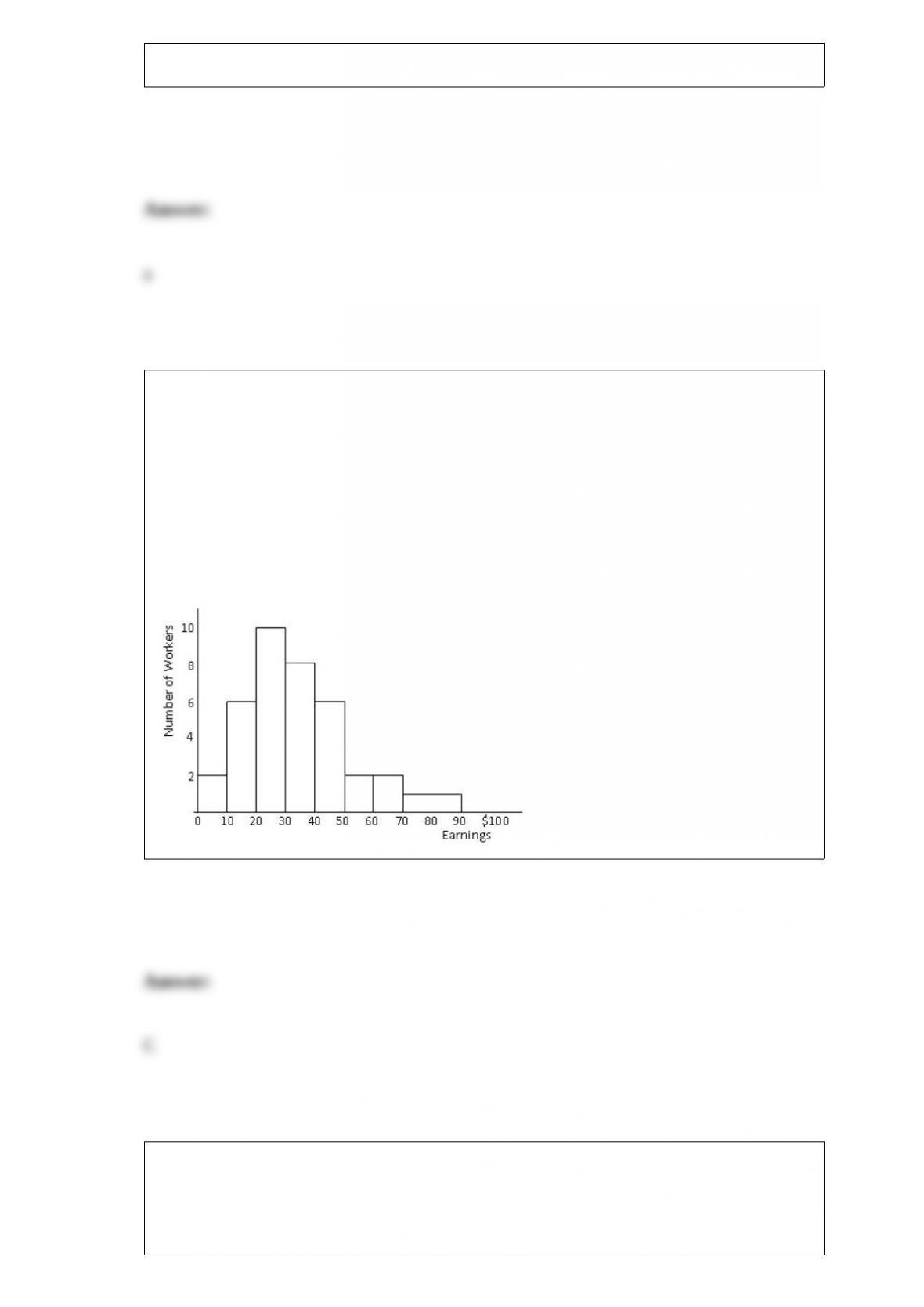
The number of persons with annual earnings between $50,000 and $70,000 is:
a.1,000
b.2,000
c.4,000
d.10,000
The U.S. earnings distribution is:
a.skewed toward lower earnings
b.skewed toward higher earnings
c.symmetrical
d.uniform
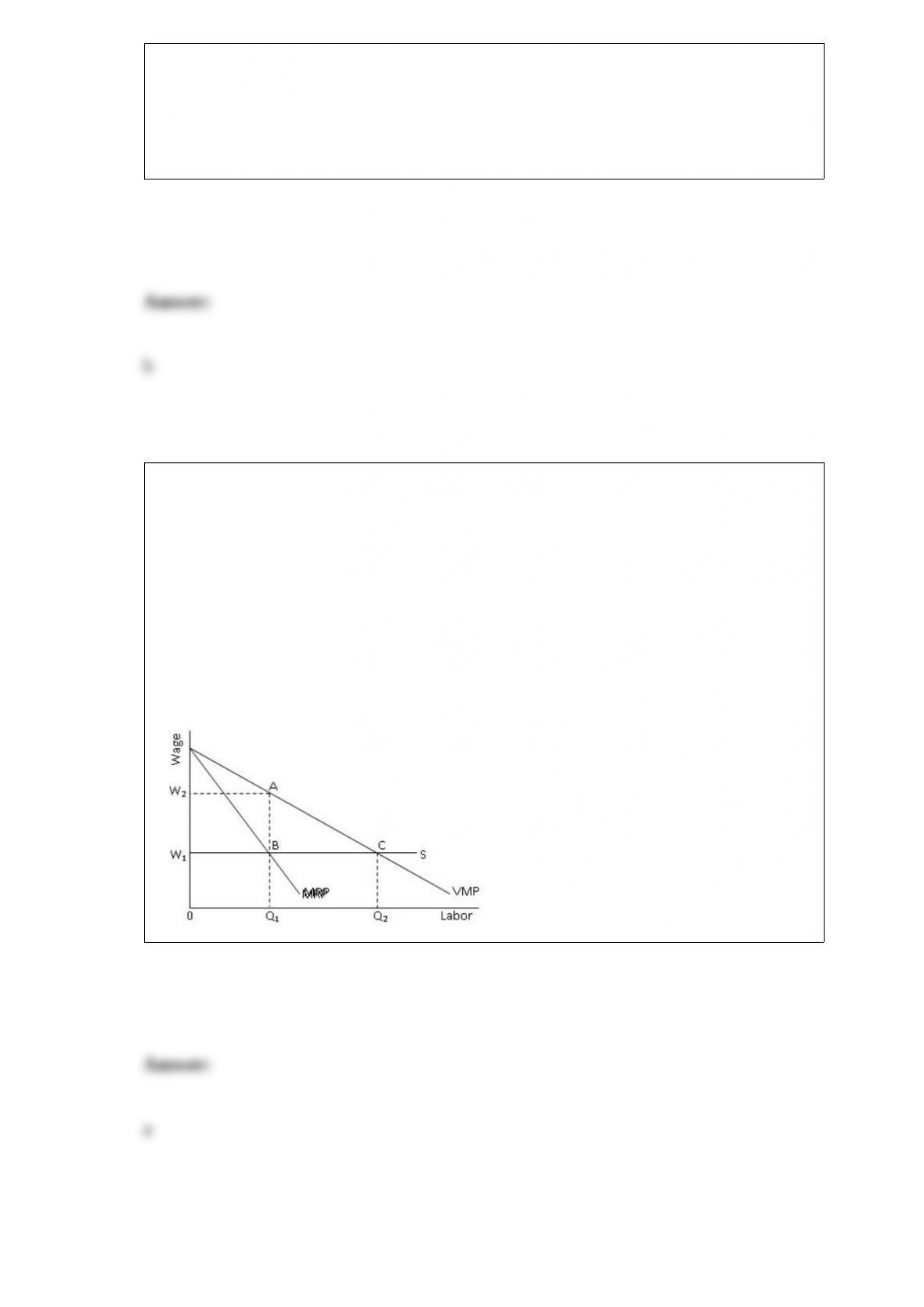
At the profit maximizing level of employment, the wage rate is _____ and the level of
employment is _____: (the following diagram that shows the labor demand for a
monopolistic firm hiring labor from a competitive labor market.)
a. W1; Q1
b. W1; Q2
c. W2; Q1
d. W2; Q2

Discrimination that results in the payment of a lower wage rate to a female relative to
an equally productive male is termed:
a. wage discrimination
b. employment discrimination
c. occupational discrimination
d. human capital discrimination
An employer whose discrimination coefficient is zero:
a. refuses to hire any women or minorities regardless of the wage differential
b. does not discriminate for or against women or minorities
c. discriminates against women and minorities
d. discriminates in favor of women and minorities
Suppose a firm decides to raise pay as a way to reduce worker turnover. The resulting
pay differential:
a. is a transitional differential
b. will reduce labor supply to the firm

c. will normally be offset by other pay differentials, leaving the policy ineffective
d. is an equilibrium differential
An internal labor market is:
a.conducive to unionization because high levels of specific training endow workers
with substantial bargaining power
b.conducive to unionization because unions are highly demanded by workers in firms
characterized by high turnover
c.at odds with unionization because unions find it difficult to organize workers in firms
characterized by high turnover
d.at odds with unionization because workers and firms with such markets form a
symbiotic relationship without the need for unions
Evidence suggests that, during recessions, the college enrollment rate:
a. rises, because the benefit of attending college rises
b. rises, because the effect of reduced ability to pay is swamped by the effect of lower
opportunity costs
c. rises, because the effect of reduced ability to pay is swamped by the effect of
increased state funding to counter the recession
d. falls, because the effect of lower opportunity cost is swamped by the effect of
reduced ability to pay
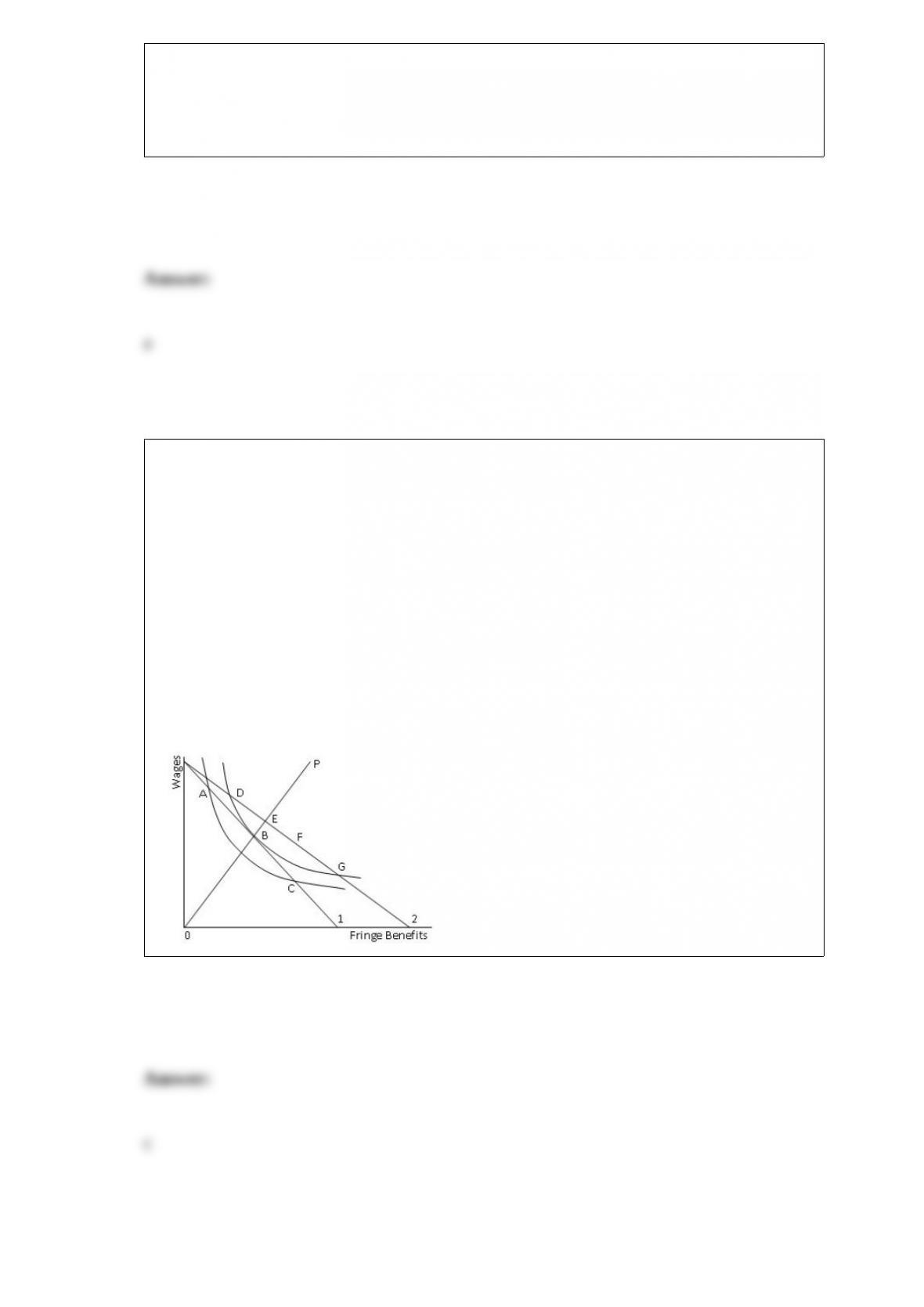
Which one of the following events could not have caused a shift from isoprofit line 1 to
line 2? (All points along the ray 0P reflect a constant proportion of wages to fringe
benefits.)
a. The employer’s share of the payroll tax rate has increased and the limits expanded
b. Firms structured fringe benefits so as to increase worker productivity
c. The government began to subject some fringe benefits to the personal income tax
d. Insurance companies offered group discounts for medical and disability coverage

Studies by Blau and Kahn report that productivity differences “explain” approximately:
a. two-thirds of the wage difference for women and nine-tenths for African Americans
b. half of the wage difference for both women and African Americans
c. one-third of the wage difference for women and one-tenth for African Americans
d. one-quarter of the wage difference for women and half for African Americans
Compared to a high-wage worker, a low-wage worker will tend to:
a. pursue more goods-intensive activities
b. pursue more time-intensive activities
c. pursue fewer time-intensive activities
d. sacrifice time-intensive activities in favor of goods-intensive activities
Compared to a firm that sells its output competitively, an otherwise identical
monopolist operating in the same labor market will:
a. pay a lower wage
b. pay the same wage
c. pay a higher wage
d. may pay either a higher or lower wage

Which of the following is a form of frictional unemployment?
a.Wait unemployment
b.Structural unemployment
c.Cyclical unemployment
d.Displaced workers