
Fringe benefits will tend to be a greater proportion of total compensation, the:
a. more income elastic are fringe benefits
b. more they increase worker turnover
c. lower the employer’s share of the Social Security tax
d. less there are economies of scale in purchasing fringe benefits
Of the countries listed in the text, union membership as a percent of the labor force in
2010 was greatest in:
a.the United States
b.Japan
c.Canada
d.Sweden
The job search model implies that:
a.the longer the expected job tenure, the lower the acceptance wage
b.the higher the acceptance wage, the shorter the expected search duration

c.expected search duration is longer during a recession
d.if job searchers perceive that a recession is temporary, they will reduce their
acceptance wages
Internal labor markets benefit workers in that such markets:
a.provide job security and opportunities for advancement
b.allow wage rates to adapt quickly to changing economic conditions
c.provide increased mobility from one firm to another as a method of career
advancement
d.pay for workers’ general training
Since 1980, the number of jobs in manufacturing has:
a. increased, reversing a downward trend that had started in 1950
b. decreased, reflecting in part the reduced productivity of manufacturing workers
c. decreased, reflecting in part the reduction in the labor force participation rate of older
males and the drop in their real wages
d. decreased, reflecting in part the increased reliance of manufacturing on workers from
temporary help agencies
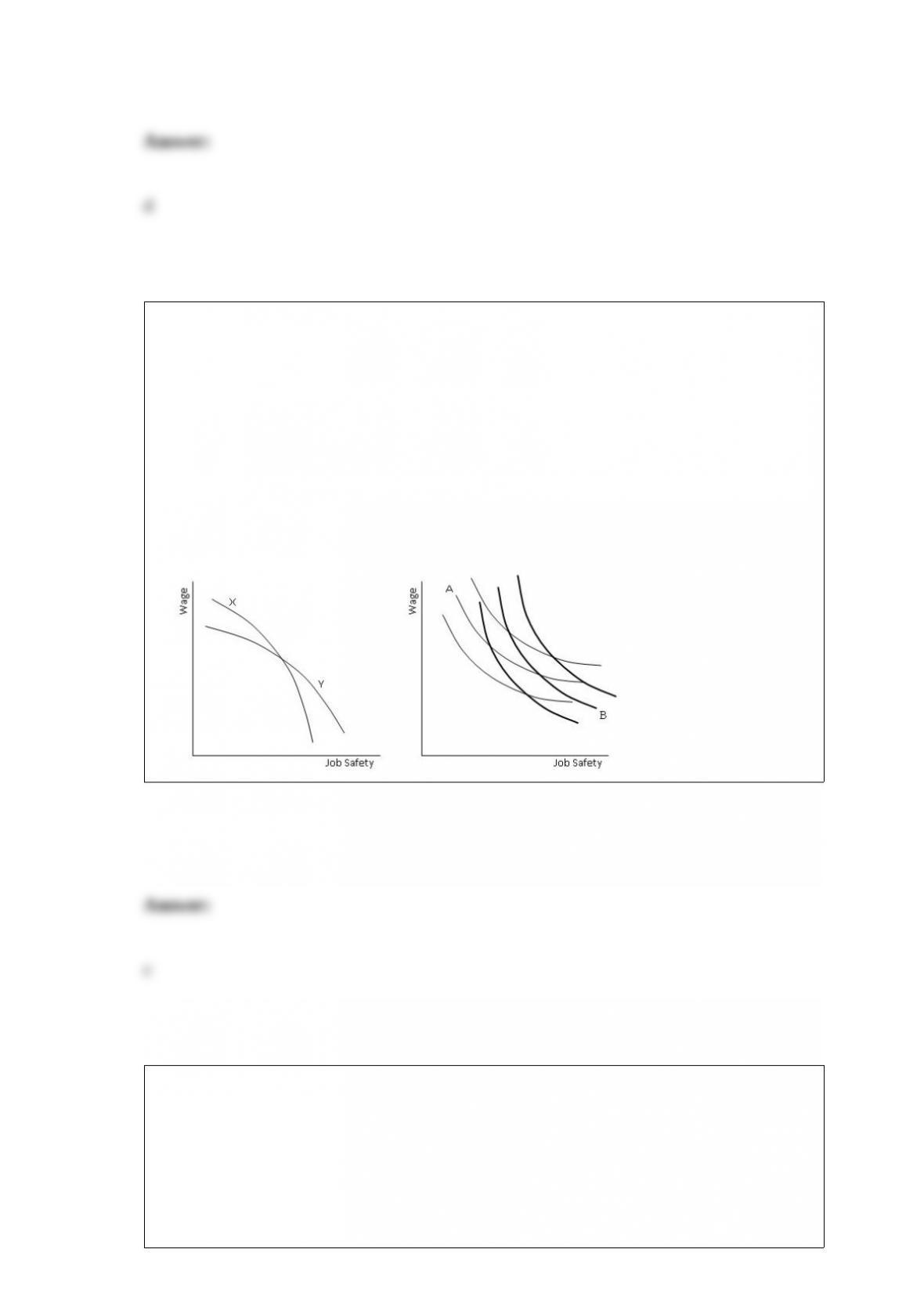
As a result of the matching between workers and firms, firm X will pay:
a. a lower wage and provide less job safety than firm Y
b. a lower wage and provide more job safety than firm Y
c. a higher wage and provide less job safety than firm Y
d. a higher wage and provide more job safety than firm Y
One implication of efficiency wage models is that:
a. firms pay wages below the market-clearing rate
b. an excess supply of labor may be created
c. an excess demand for labor may be created

d. CEO contracts will contain golden parachute clauses
Compared to their private-sector counterparts, government workers:
a.have greater labor turnover
b.have lower quit rates
c.have higher and more variable rates of unemployment
d.receive a smaller percentage of their compensation in the form of fringe benefits
Examining evidence on the impacts of increases in state minimum wages in New Jersey
and California, Card and Krueger found:
a.substantial reductions in employment, particularly among teens
b.no increases in wages of low-wage workers, because employers flouted the law
c.no evidence of reductions in employment
d.poor quality of the data collected by Neumark and Wascher
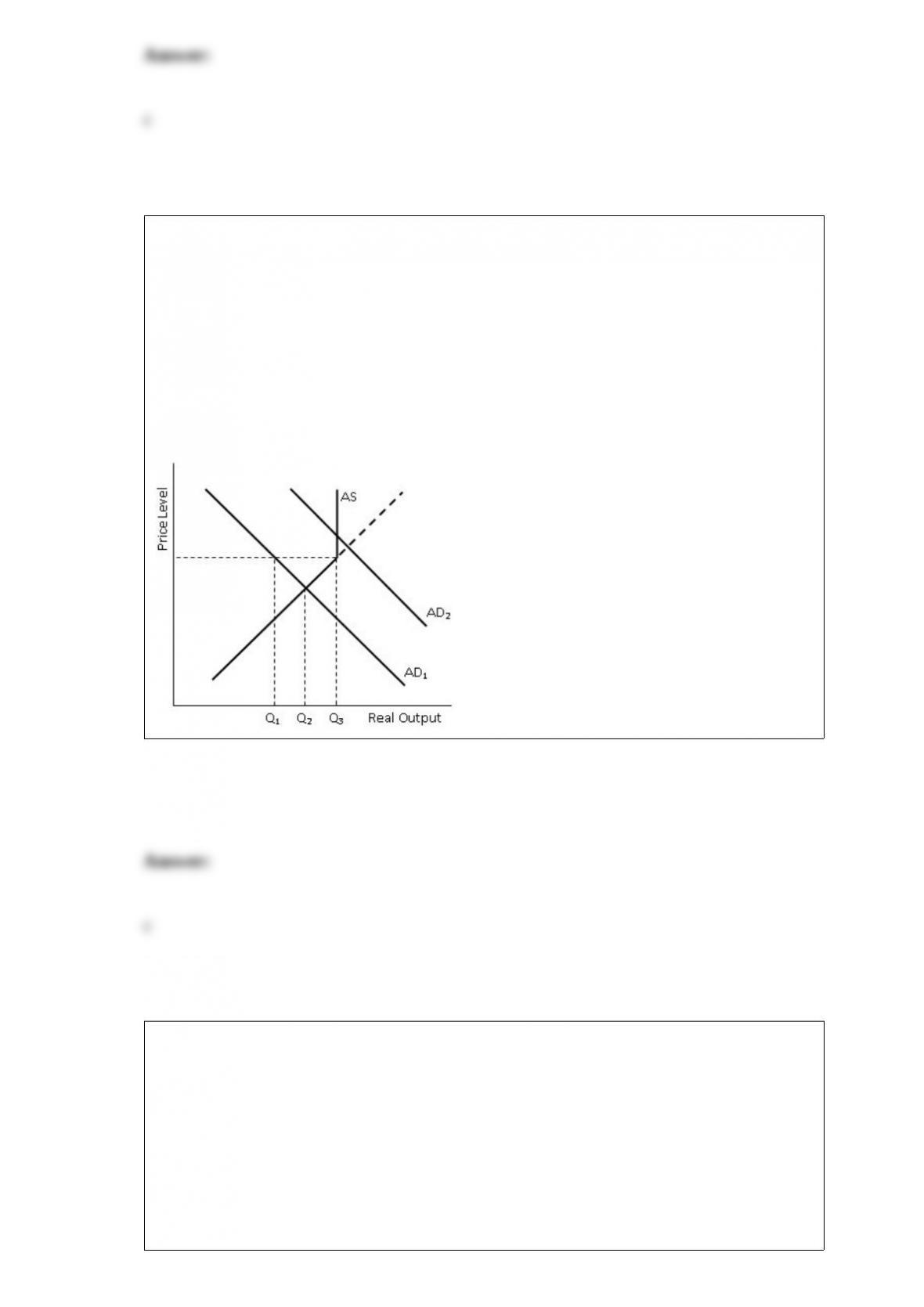
If aggregate demand is given by AD2, the economy will:
a.achieve the full-employment level of output in the short run
b.fall short of the full-employment level of output
c.exceed the full-employment level of output in the short run
d.experience frictional unemployment but not cyclical unemployment
If the wage is $11.00, how many workers will this profit-maximizing firm choose to
employ? (Assume that the labor market is perfectly competitive.)
a. 2
b. 3
c. 4

d. 5
If union workers in a given occupation are paid $20 per hour while nonunion workers
receive $16 per hour, the measured union wage advantage is:
a.20%
b.25%
c.80%
d.more information is required
Which of the following is an example of an exhaustive government expenditure?
a.Government payroll expenditures

b.Government transfer payments
c.Government subsidies
d.U.S. government loans to foreign buyers of U.S. exports
The short run is defined as a period in which:
a. the firm cannot change its output level
b. all inputs are variable but technology is fixed
c. input prices are fixed
d. at least one resource is fixed
Which one of the following most closely corresponds to the average annual rate of
productivity growth in the U.S. for the period 1973 ” 1995?
a.0-1%
b.1-2%
c.3-4%
d.5-8%

Which of the following best describes the substitution effect of a wage increase?
a. The firm’s marginal cost increases, the firm desires to produce less output, and
therefore less labor is required
b. The cost of labor is relatively higher, causing the firm to use relatively less labor
c. The firm’s labor demand curve becomes less elastic, causing it to employ less labor
d. The firm’s labor demand curve becomes more elastic, causing it to employ less labor
Assuming workers must work TS hours or not work at all, worker A will:
a. not participate in the labor force
b. be at an optimum at TS hours of work
c. work the standard workweek but will feel overemployed
d. work the standard workweek but will feel underemployed

TS represents the standard 40-hour workweek. Indifference curves labeled with
subscripts “a” and “b” are for individuals A and B, respectively.
Which of the following would not cause an increase in the BLS Index of Labor
Productivity?
a.An increase in labor quality
b.An improvement in production technology
c.An increase in output per worker in the public sector
d.An increase in the quantity of physical capital
Suppose the union wage rate rises. The ‘spillover effect” suggests that the nonunion

wage rate should _____; the “threat effect” suggests that the nonunion wage rate should
_____.
a.fall, fall
b.rise, fall
c.fall, rise
d.rise, rise
In an income-leisure diagram, the wage rate is graphically represented by the:
a. slope of the indifference curves
b. curvature of the indifference curves
c. slope of the budget line
d. tangency of the budget line with an indifference curve
If energy and unskilled labor are gross complements, an increase in the price of energy
will:
a. increase the supply of unskilled labor, decreasing the unskilled wage
b. increase the demand for unskilled labor, raising the unskilled wage

c. decrease the demand for unskilled labor, decreasing the unskilled wage
d. either increase or decrease the demand for unskilled labor, depending on the relative
strengths of the output effect and the substitution effect
Unions may increase productivity by:
a.providing a “voice mechanism”
b.providing an “exit mechanism”
c.reducing the capital/labor ratio
d.increasing worker turnover, particularly among younger workers so that only the best
employees survive
Consider the two labor markets shown in the diagram above. The wage rates shown
represent:
a. long run equilibrium
b. long run equilibrium if all nonwage aspects of the jobs are identical
c. long run equilibrium provided the workers are in noncompeting groups
d. long run equilibrium if information is perfect and costless

The market wage increases from $9 to $11and the firm responds by reducing its labor
force by 16%. The wage elasticity coefficient is:
a. 8, indicating elastic demand
b. 0.8, indicating inelastic demand
c. 1.2, indicating elastic demand
d. 1.6, indicating elastic demand
All else equal, a worker is more likely to move:
a.the smaller the wage differential between the destination and the origin
b.the greater the direct costs of moving

c.the larger the worker’s family size
d.the lower the discount rate
Because workers in internal labor markets are promoted on the basis of seniority:
a.such markets are allocatively inefficient because seniority takes precedence over
ability
b.dynamic efficiency is enhanced by removing a disincentive for older workers to pass
along skills to younger workers
c.static efficiency is enhanced by allocating the most able workers to each job
d.some other scheme must be introduced, such as tournament pay, to improve efficiency
in such markets
The college wage premium:
a. rose during the 1980s, but fell in the 1960s and again from 1990 to the present
b. fell during the 1970s but has risen consistently since then
c. rose during the 1970s and 1980s, but has fallen consistently since then
d. has risen consistently since 1960
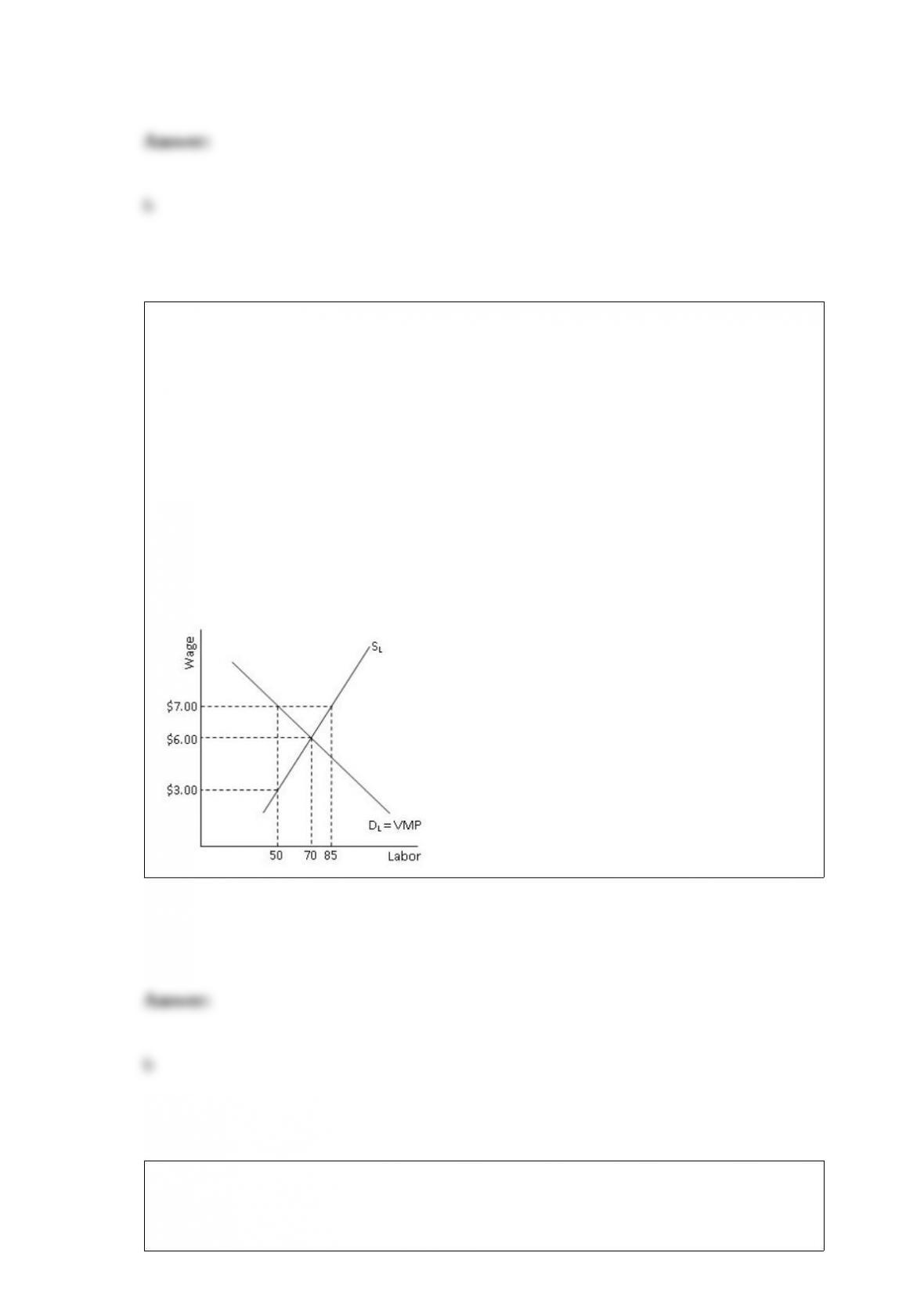
Consider the diagram. Suppose the government establishes a minimum wage of $7.00
in this market. Employment would decline by _____ workers and unemployment would
increase by _____ workers. (which shows a competitive low-wage labor market):
a.20, 20
b.20, 35
c.35, 20
d.35, 35
There will be a shortage of labor in a particular market if:
a. labor supply increases and demand decreases

b. the current wage is above the wage that would clear the market
c. there is a decrease in the price of a substitute resource
d. the current wage is below the wage that would clear the market
Which one of the following best represents the principal-agent problem in the
employer-employee relationship?
a. An employee works during a paid lunch hour in order to leave work one hour early
b. An employer fails to provide safety goggles to a worker as required by occupational
safety and health legislation
c. a worker leaves work early without permission
d. A worker opts for early retirement in response to the firm’s incentive plan
Suppose the government uses a voluntary system. Its demand for labor is Dv and it
wishes to attract H workers at a wage of $B. Which of the following best describes the
distribution of costs that will result? (the following graph of the demand for and supply
of armed forces personnel).
a.Taxpayers pay 0BEH, enlistees receive ABEI
b.Taxpayers pay 0BEH, enlistees pay ABEI
c.Taxpayers pay 0AIH, enlistees pay ABEI
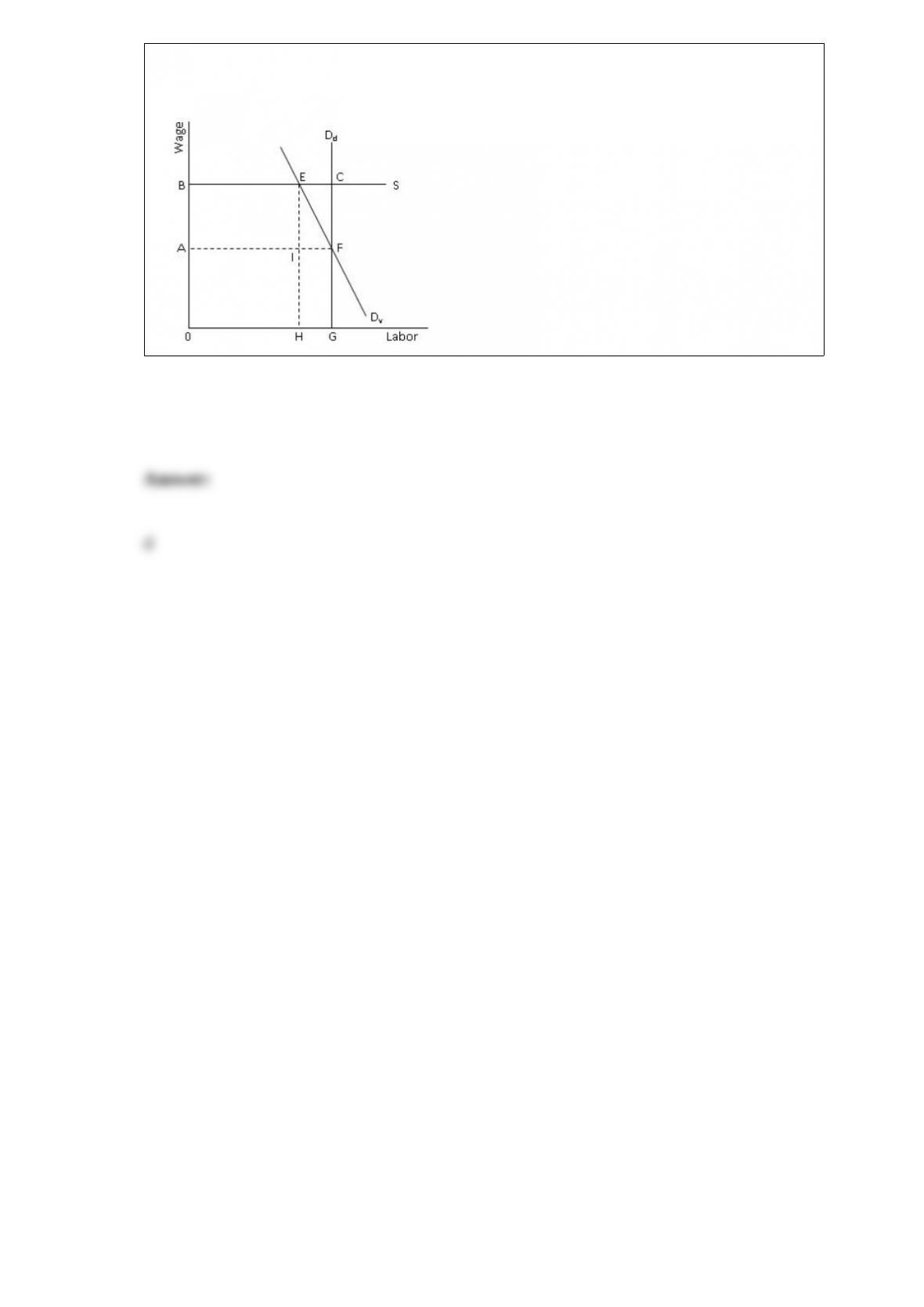
d.Taxpayers pay 0BEH; enlistees receive an amount equal to their opportunity costs