
The short-run labor demand curve of a competitive firm is:
a. its average revenue product curve
b. its marginal revenue product curve, provided marginal product is below average
product
c. its marginal product curve
d. stage II of the total product curve
Evidence indicates that most of the growth in earnings inequality since 1970 is:
a.within each age group and within each industry
b.within each age group and between industries
c.between age groups and within each industry
d.between age groups and between industries
Which one of the following is a true statement?
a.The union wage advantage is smaller if fringe benefits are included
b.The union wage advantage is greater if fringe benefits are included

c.Inclusion of fringe benefits has no measurable impact on the union wage advantage
d.Because fringe benefit levels are prescribed by law, the impact of these benefits on the
union wage advantage is negligible
All else equal, the social rate of return to education will be lower than the private return
if:
a. there are external benefits to education
b. the social return correctly calculates benefits using after-tax values
c. the social return correctly calculates costs by including education subsidies
d. more educated workers have lower crime rates and unemployment rates
A union might attempt to raise both the wage rate and employment of its members by:
a.lobbying for state licensing requirements for union jobs
b.arguing for easing of immigration restrictions
c.increasing the demand for the good or service that the union produces
d.attempting to raise the price of complementary inputs

The acceptance wage is the wage that:
a.equates the expected marginal benefit and expected marginal cost of continued job
search
b.minimizes the expected cost of continued job search
c.maximizes the expected benefit of continued job search
d.equates the expected average benefit and expected average cost of continued job
search
The slope of a wage-fringe isoprofit curve reflects:
a. the overall profitability of the firm
b. a worker’s willingness to give up an extra dollar of wages in exchange for an extra
dollar of fringe benefits
c. the relative “price” of fringe benefits compared to wages
d. an increasing marginal rate of substitution of fringe benefits for cash
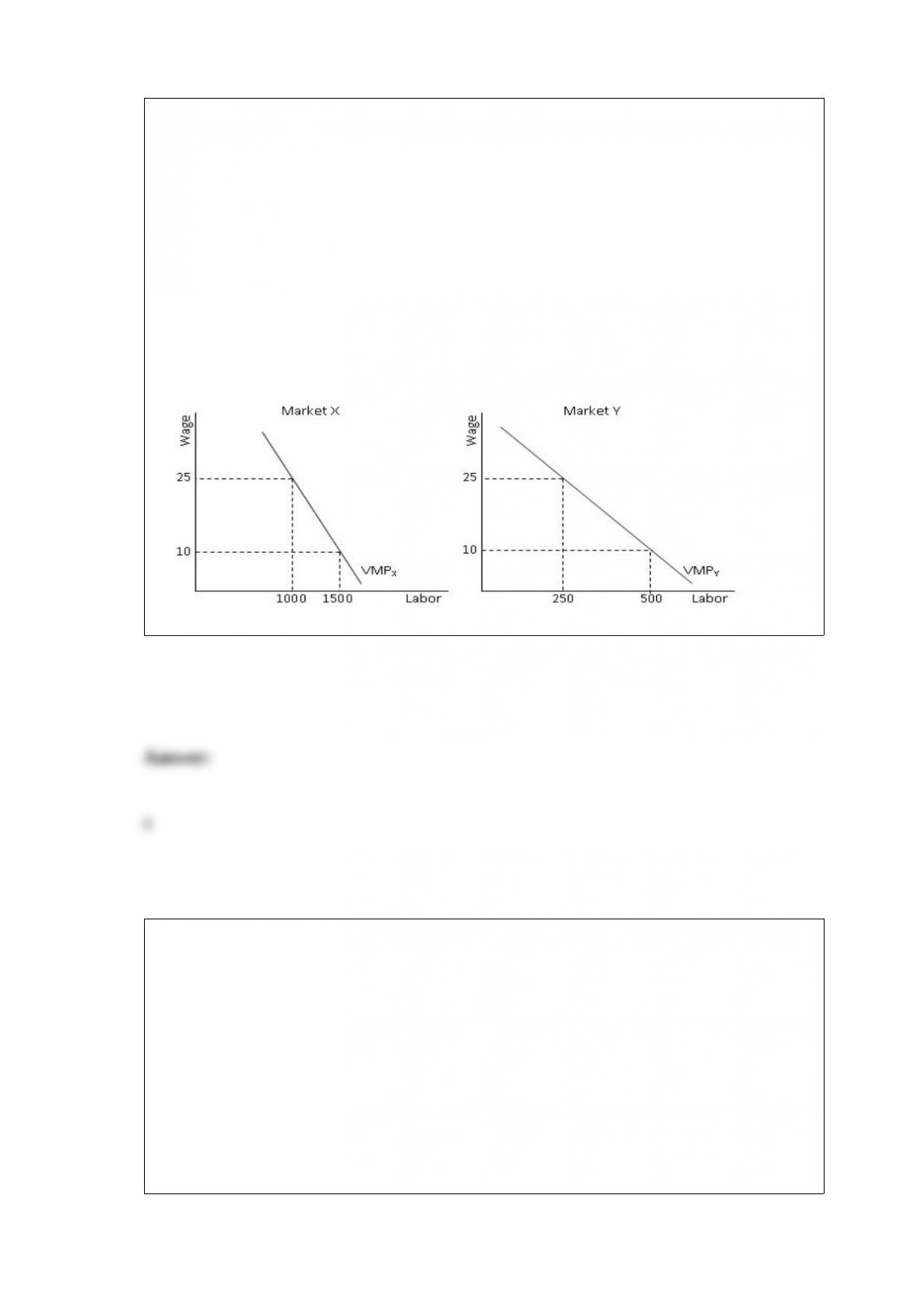
If wages are initially $10 in country X and $25 in country Y, then we should expect
higher rates of capital investment in: (Assume all migration is costless.)
a.X relative to Y, eventually resulting in increased labor demand in X
b.X relative to Y, eventually resulting in reduced labor demand in X
c.Y relative to X, eventually resulting in increased labor demand in X
d.Y relative to X, eventually resulting in reduced labor demand in X
An example of a sociological immobility is:
a. ties to family and friends prevent workers from moving to a region with relatively
high wages
b. craft unions limit the access of nonunion workers to apprenticeship positions
c. state governments require workers in many jobs to obtain a license
d. the so-called “glass ceiling” (a form of discrimination) prevents women from moving
into certain high-paying managerial jobs

Assuming competitive labor markets, occupational segregation by sex:
a. increases the profits of firms that discriminate
b. is beneficial from society’s standpoint, because the gains to male employees
outweigh the losses to female employees
c. results in an inefficient allocation of labor and diminished output
d. cannot persist, as employers will find it in their best interest to hire only female
employees
Which of the following established unfair labor practices by employers?
a.Norris-LaGuardia Act
b.Taft-Hartley Act
c.Wagner Act
d.Landrum-Griffin Act

The small town of East MacNeil has 1000 residents age 16 or older. During the survey
week, 200 adult residents did not work20 workers were home sick from their jobs, 10
shopkeepers were unable to open their stores due to bad weather, 50 were actively
seeking work, 25 others had previously given up actively looking, and the others were
either full-time students or home-makers. Of the 800 at work, 80 worked part-time but
would have preferred full-time work.
The official unemployment rate in East MacNeil is:
a.50/800
b.80/800
c.50/880
d.50/1000
Comparing the experiences of African Americans and women, evidence suggests that
African Americans are more likely to be subject to:
a. occupational discrimination, while women are more likely to be subject to wage
discrimination
b. employment discrimination, while women are more likely to be subject to human
capital discrimination
c. wage discrimination, while women are more likely to be subject to employment
discrimination
d. employment discrimination, while women are more likely to be subject to
occupational discrimination

Most of the variations in U.S. population growth have resulted from changes in:
a. birthrates and net migration
b. birthrates and death rates
c. net migration and death rates
d. birthrates and technological change
As illustrated, this public good is likely: ( the following labor-leisure diagram (The
worker’s current budget line is given by line AB1 and she is working AD hours.)
a.complementary with leisure
b.complementary with work
c.financed by a tax on payroll
d.financed by a tax on income

Labor productivity in the base year was 20. The following year, the productivity index
stood at 10 Labor productivity in the second year was:
a.5
b.20
c.21
d.105
In the equation for the net present value of migration,

the term “C” refers to:
a.the net psychic costs of moving
b.the direct and indirect monetary costs of moving
c.earnings from the new job
d.the discount rate
Those persons with greater amounts of formal education tend to have:
a.less on-the-job training, which increases the skewness of the earnings distribution
b.less on-the-job training, which decreases the skewness of the earnings distribution
c.more on-the-job training, which increases the skewness of the earnings distribution
d.more on-the-job training, which decreases the skewness of the earnings distribution
The contingent work force:
a. has grown about 4 times as fast as the rest of the work force over the last two decades
b. includes only temporary workers

c. includes only workers who are involuntarily employed part-time
d. has shrunk relative to the “core” labor force
Suppose income tax rates are reduced. As a result, Smith works more hours per week
while Jones works fewer hours per week. We can conclude that:
a.Smith and Jones are in different tax brackets
b.for Smith, the substitution effect exceeds the income effect; the opposite is true for
Jones
c.for Jones, the substitution effect exceeds the income effect; the opposite is true for
Smith
d.Jones conforms to the economic model of labor supply but Smith does not
Which one of the following is generally considered a characteristic of a perfectly
competitive labor market?
a. A few workers of varying skills and capabilities
b. Wage-setting behavior by firms
c. Numerous firms hiring labor from the same pool of qualified workers
d. Costly information

The secular increase in real wages resulted from increases in labor productivity:
a.that have increased the demand for labor faster than the supply of labor
b.that have increased the supply of labor faster than the demand for labor
c.that have decreased the demand for labor faster than the supply of labor
d.made possible by increased public sector output
Which of the following is given as a justification of the health and safety standards
established by OSHA?
a.Workers overestimate the amount of risk associated with jobs, resulting in a larger
than optimal wage premium for hazardous jobs
b.Workers underestimate the amount of risk associated with jobs, resulting in a larger
than optimal wage premium for hazardous jobs
c.Firm overestimate the amount of risk associated with jobs, resulting in a smaller than
optimal wage premium for hazardous jobs
d.Information and occupational mobility are imperfect, so that the wage premium for
job safety provides inadequate incentive for firms to provide safety

Available evidence indicates that:
a. age-earnings profiles vary with education, but not with age
b. age-earnings profiles vary with age, but not with education
c. age-earnings profiles of workers with more education tend to be flatter, but higher,
than those with less education
d. differences in earnings between workers who have more education and those who
have less education generally widen with age
Overall, unions have generally:
a.increased labor’s share by increasing the productivity of labor
b.reduced labor’s share by reducing the wages of nonunion labor
c.reduced labor’s share by raising prices to consumers
d.had a negligible effect on labor’s share

An isoquant shows all combinations of:
a. wage rates and per unit costs of capital that yield the same total profit
b. labor and capital that yield the same total profit
c. labor and capital that yield the same total cost
d. labor and capital that yield the same total output
Which one of the following circumstances would most likely lead to increased
investment in education by women?
a. An increase in the likelihood of interrupted labor market careers
b. Improved employment opportunities for women
c. Higher discount rates for women than men
d. Persistent discrimination against women
Statistical discrimination is:
a. the use of some observable characteristic by employers as a screening device in the
hiring process
b. comparing the marginal productivities of job applicants to determine who is most

suitable for the job
c. not based on accumulated factual evidence about different groups
d. malicious treatment aimed at persons with observable demographic characteristics
The height of the supply curve (S) measures: (the following graph of the demand for
and supply of armed forces personnel).
a.the cost to taxpayers of drafting a worker
b.the value to the military of drafting a worker
c.the difference between the cost to the taxpayer and the cost to the military of drafting
a worker
d.the opportunity cost of a potential draftee

Which of the following would tend to increase labor supply to a particular job?
a. The employer cuts back the scope and coverage of the medical plan
b. Vesting in the firm’s pension plan is pushed back from 1 year to 5 years
c. The crime rate rises in the city where the job is located
d. The perceived status of the job improves