
Which of the following is not typically given as a reason the aggregate demand curve
slopes downward and to the right?
a.The real balances effect
b.The foreign purchases effect
c.The interest rate effect
d.The substitution effect
Compared to present-oriented people, individuals who are more future-oriented tend to
have _______ discount rates and consequently tend to obtain _______ education and
earnings:
a. lower; more
b. lower; less
c. higher; more
d. higher; less
The more elastic the demand for labor, the: (EC is the employer concession curve and
UR is the union resistance curve.)
a.higher the UR curve
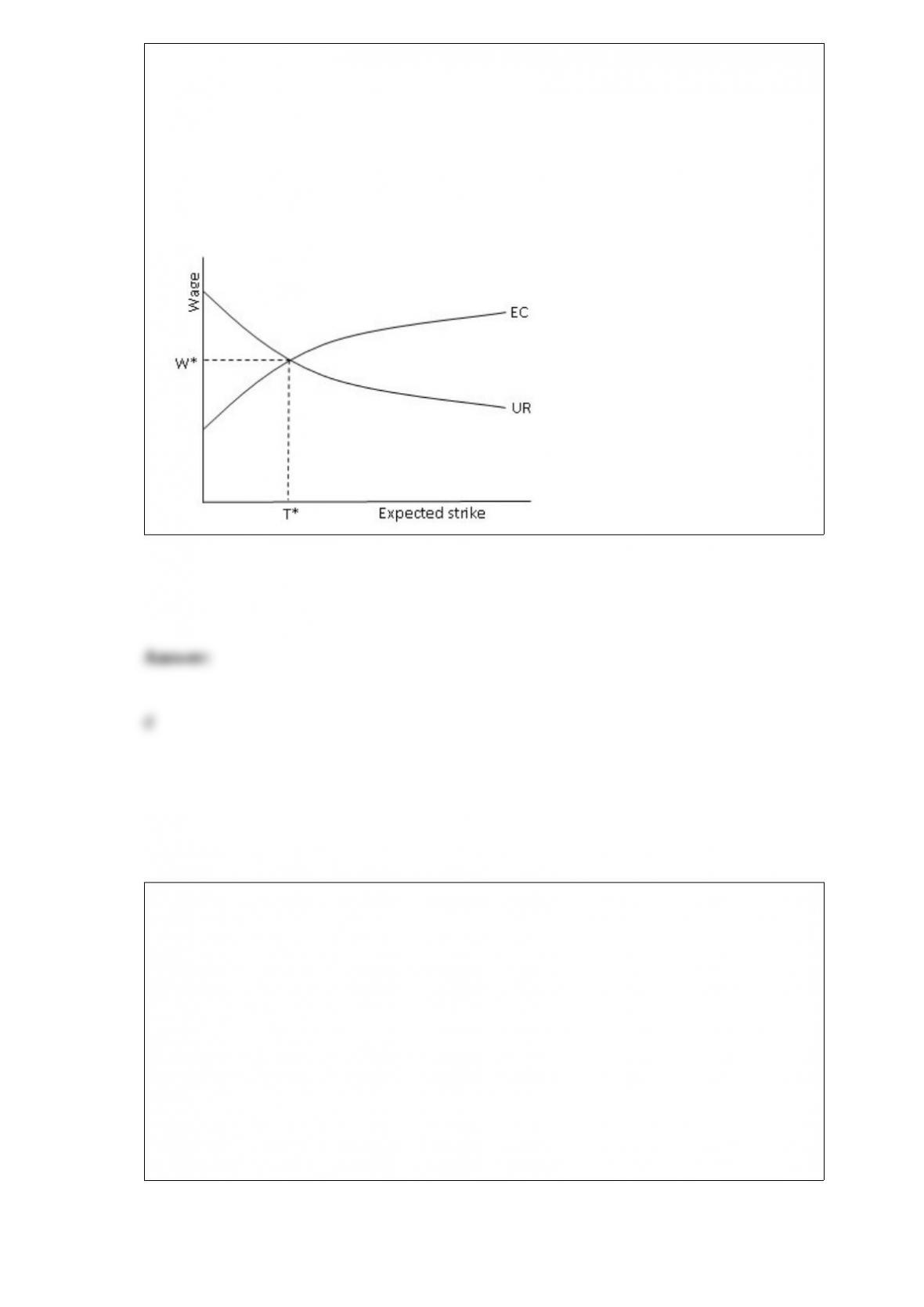
b.lower the UR curve
c.higher the EC curve
d.lower the EC curve
Consider the diagram. Suppose the government establishes a minimum wage of $7.00
in this market. Which of the following is a true statement? (which shows a competitive
low-wage labor market):
a.Demand is elastic over the relevant range, so that total wage income rises
b.*Demand is elastic over the relevant range, so that total wage income falls
c.Demand is inelastic over the relevant range, so that total wage income rises
d.Demand is inelastic over the relevant range, so that total wage income falls

From 1980 to the present, the college wage premium:
a. rose for women but fell for men
b. rose for men but fell for women
c. fell for both women and men
d. rose for both women and men
If an increase in the minimum wage increases the earnings of low-income individuals
relative to high-income individuals, this will cause the Lorenz curve of earnings to shift
from:
a.A to B and the Gini coefficient will rise

b.A to B and the Gini coefficient will fall
c.B to A and the Gini coefficient will rise
d.B to A and the Gini coefficient will fall
Which of the following is a true statement? If the firm pays: (π1 and π2 are a firm’s
isoprofit curves. The monopoly union outcome is given by point ū.)
a.Wx and employs Qx workers, its profit will be lower than at ū
b.Wx and employs Qx workers, its profit will be higher than at ū
c.Wy and employs Qy workers, its profit will be lower than at ū
d.Wx and employs Qx workers, its profit will be lower than if it pays Wy and employs
Qy workers

“Total compensation” includes:
a. Wages and salaries and all fringe benefits
b. Wages and salaries and public (legally mandated) fringe benefits only
c. Wages and salaries and private (nonmandatory) fringe benefits only
d. Wages and salaries and all fringe benefits net of all personal taxes
If U represents the number of unemployed persons, E the number of unemployed

persons, and N the number in the potential labor force that are neither unemployed nor
employed, the labor force participation rate can be found as:
a. U + E
b. E/(U + E)
c. (U + E)/(E + N)
d. (U + E)/(U + E + N)
Compared to the 1950s, current union membership as a percent of the labor force in the
U.S. is:
a.the same in the private sector and higher in the public sector
b.lower in the private sector and higher in the public sector
c.the same in the private sector and lower in the public sector
d.lower in the private sector and lower in the public sector
Which one of the following is a true statement?
a. Workers can never move from one noncompeting group to another
b. Wage differentials caused by the existence of noncompeting groups can persist over

time
c. The concept of noncompeting groups applies only to workers in different
geographical locations; it does not apply to productivity differences among workers
d. The concept of noncompeting groups explains why wage rates do not fall in a
recession
Which of the following is not a source of downward wage rigidity?
a.Unions appear to prefer layoffs to wage reductions, as the former affects only workers
without seniority, while the latter would affect all workers
b.Firms appear to prefer layoffs to wage reductions, as the former allows the firm to
“hoard” workers in whom they have invested specific training
c.Implicit contracts between employers and their workers
d.Layoffs are discouraged due to the method used to finance unemployment
compensation insurance
In his comparison of over 100 studies of labor demand, Hamermesh concludes the
overall long-run elasticity of labor demand in the United States to be:
a. .4
b. 1.0

c. “2.0
d. 1.4
The African American-white hourly wage ratio is currently about:
a. 59%
b. 67%
c. 74%
d. 80%
Compared to the private sector, empirical research suggests that the union wage
advantage in the public sector is approximately:
a.5 percentage points lowerc.10 percentage points lower
b.5 percentage points higherd.the same

Suppose the firm’s product demand is given by the column labeled D2. The extra
revenue generated by the fourth worker is:
(Assume that the labor market is perfectly competitive.)
a. $1
b. $12
c. $48
d. $405
All else equal, the imperfectly competitive seller’s labor demand curve is:
a. greater than that of a perfectly competitive seller
b. more elastic than that of a perfectly competitive seller
c. less elastic than that of a perfectly competitive seller
d. the same as than that of a perfectly competitive seller

If employers are prohibited form hiring permanent strikebreakers:
a.union bargaining power will likely fall
b.management bargaining power will likely increase
c.firms will have only one alternative under labor lawto fire strikers
d.the length of strikes will likely decrease
Unions may reduce economic efficiency by:
a.providing an “exit” mechanism
b.insisting promotions be based on ability rather than seniority
c.imposing restrictive work rules
d.reducing worker turnover

Studies by Farber and by Freeman suggest that:
a.managerial opposition has been steady over the years, and has not contributed to the
decline of unionization
b.about 40% of unions’ decline can be explained by structural changes in the economy
c.shrinking union wage premiums have made it easy for firms to employ anti-union
tactics
d.recent NLRB rulings have been increasingly favorable to unions and should stop the
decline in their membership
The higher the individual’s wage rate:
a. the steeper the budget constraint
b. the lower the marginal rate of substitution of leisure for income
c. the greater the desired number of hours of work
d. the greater the desired number of hours of leisure
Which of the following best describes the relationship between productivity changes
and investment during a recession?

a.Unit labor costs rise, plant and equipment are utilized more, investment rises
b.Unit labor costs fall, plant and equipment are utilized more, investment rises
c.Unit labor costs fall, plant and equipment are utilized less, investment rises
d.Unit labor costs rise, plant and equipment are utilized less, investment falls
In a perfectly competitive environment, the height of the market labor supply curve at
any given number of labor hours indicates:
a. the total cost of employing that number of hours in the given occupation
b. the marginal cost of employing the first hour of labor
c. the value of the alternative activity in which the marginal hour might otherwise be
used
d. the maximum wage employers would be willing to pay to attract additional labor
Which one of the following does not help to explain why union workers receive more
fringe benefits than nonunion workers?
a.The unionized firm is willing to pay both higher wages and fringe benefits to avoid
the costs of a strike
b.The higher incomes of union workers allow them to “purchase” more fringe benefits
c.Unions are primarily composed of younger workers who have more to gain from

long-term compensation such as the kind provided by union pension plans
d.As collective voice institutions, unions may better formulate fringe benefit proposals,
inform their membership of their worth, and communicate these desires to the firm
Implicit contracts suggest that:
a.firms may lay off workers in return for granting then an “insurance policy” against
wage reductions
b.firms may pay workers a lower wage in return for granting them an “insurance
policy” against layoff
c.firms have a higher wage bill in recessions than during periods of economic
expansion
d.firms have an incentive to contract with workers to pay them the going market wage
The ratio of female to male hourly wages:
a. has risen steadily from 1979 to the present
b. dropped steadily from 1979 to the present
c. rose substantially from 1979 to the mid 1990s but has increased only slightly since
then

d. rose steadily from 1979 to 1986, but has remained relatively constant since then
Suppose that all other nonwage aspects of the jobs in these two markets are identical.
We would expect labor supply in B to increase if:
a. the probability of job loss rises in B
b. earnings are more variable in A
c. job safety improves in A
d. there are better prospects for advancement in A
The level of union organization that is most likely to lobby congress for legislation that
prohibits the hiring of permanent strikebreakers is the:
a.federation

b.state union
c.national union
d.local union
Which of the following circumstances will increase the likelihood of an individual
being a non-participant in the labor market?
a. High earnings capacity in the labor market
b. The absence of non-wage income
c. A potential market wage that exceeds the individual’s reservation wage
d Availability of substantial non-wage income
Which of the following statements is supported by empirical evidence?
a.Lower productivity growth for unionized firms is primarily due to these firms being in
industries with slow productivity growth
b.The negative impact of unions on productivity is greatest in industries that are most
competitive
c.The positive impact of unions on productivity is greatest in industries where the union

wage advantage is smallest
d.Unions indirectly improve productivity growth by increasing the rate of investment in
physical capital
An increase in the wage rate will increase desired hours of work if:
a. the income effect and substitution effect cancel one another
b. the income effect dominates the substitution effect
c. the substitution effect dominates the income effect
d. accompanied by an increase in nonwage income
One shortcoming of the Bureau of Labor Statistics Index of Labor Productivity is that
it:
a.overstates the importance of capital investments
b.fails to include part-time workers
c.double counts public sector output
d.ignores changes in the quality of output

Refer to the diagram. Compared to D1, a person whose demand curve is given by D2
will likely obtain:
a. more education and receive higher earnings
b. more education and receive lower earnings
c. less education and receive higher earnings
d. less education and receive lower earnings
Firms will reduce job safety as long as:
a.potential cost savings are at least as great as wage increases that might have to be paid
to attract labor into risky jobs
b.potential cost savings are less than wage increases that might have to be paid to attract
labor into risky jobs

c.the marginal cost of safety is positive
d.the marginal benefit of safety to the firm is very large