
The employer’s share of the Social Security and Medicare components of the payroll tax
has increased, from 6.13% in 1980 to its current rate of 7.65%. Because employers pay
no payroll tax on many fringe benefits, this change in tax rates has effectively:
a. reduced the “price” of fringe benefits, increasing the slope of the wage-fringe
isoprofit line
b. increased the “price” of fringe benefits, increasing the slope of the wage-fringe
isoprofit line
c. reduced the “price” of fringe benefits, reducing the slope of the wage-fringe isoprofit
line
d. increased the “price” of fringe benefits, reducing the slope of the wage-fringe
isoprofit line
Which one of the following most closely approximates pure specific training?
a. Learning tax accounting
b. Learning a management information system that is unique to your firm
c. Majoring in management information systems at a major university
d. Learning a widely-used spreadsheet program that is used at your firm
Which of the following would unambiguously predict a decrease in desired hours of

work?
a. The substitution effect of a wage decrease
b. The income effect of a wage decrease
c. A wage increase
d. The substitution effect of a decline in income tax rates
Which one of the following observations would tend to widen the dispersion of
earnings?
a. Banks charge higher interest rates on educational loans to those individuals most
likely to face discrimination on the job
b. Those with higher ability face higher costs of investment funds
c. Human capital investment demand and supply curves are negatively correlated
d. Poor families pay a larger proportion of family income on education than rich
families
For Country M capital owners, migration causes a collective loss equal to area: .
( Initially, wage rates are WM in Country M and WU in Country U. Subsequent
migration results in an equalization of wage rates.)
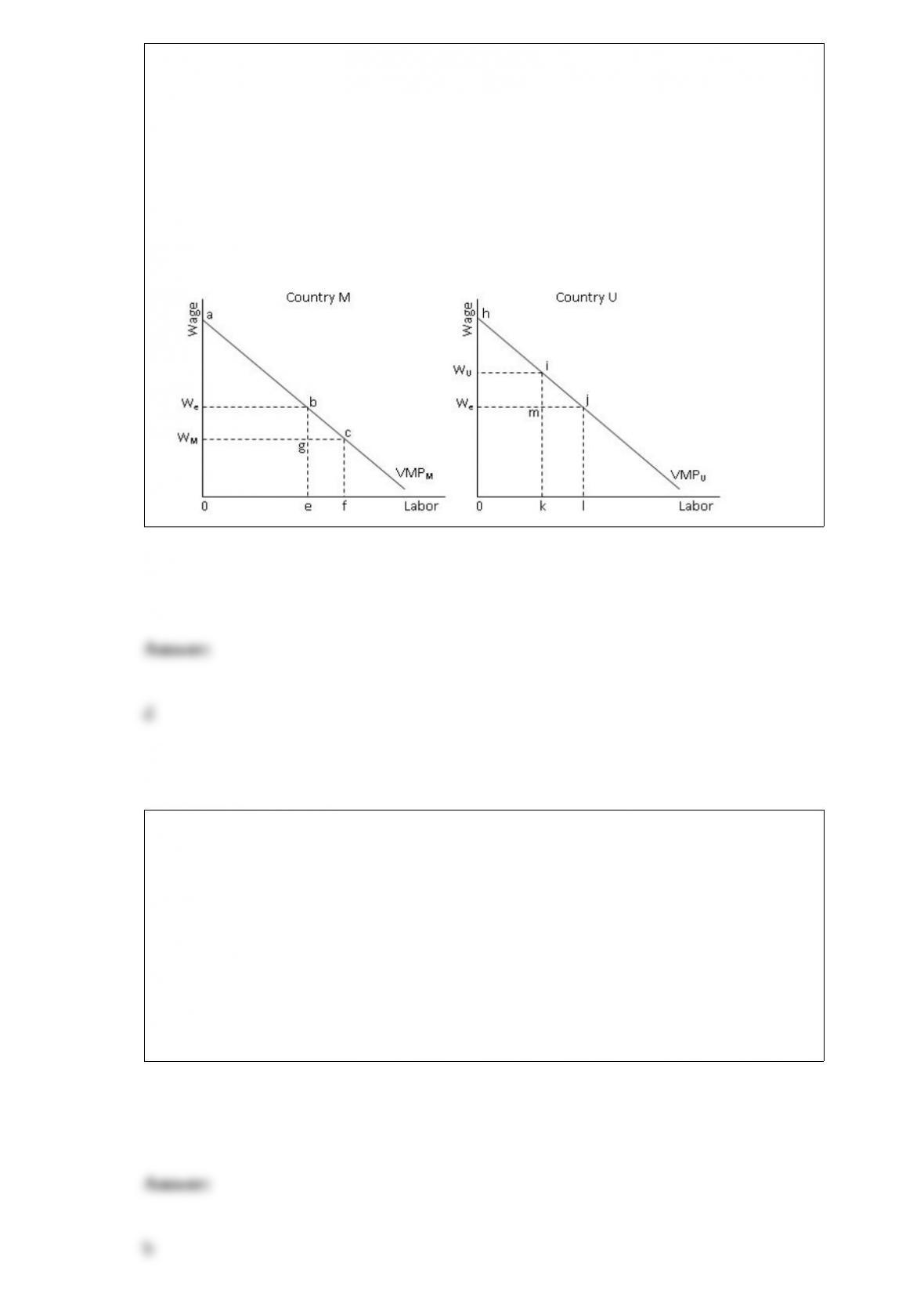
a.bgc
b.ebcf
c.0Webe
d.WebcWM
Compared to the 1948 ” 1973 period, the annual rate of productivity growth from 1974
” 1995 was approximately:
a.one fourth as much
b.one half as much
c.the same
d.twice as much

A ‘supply side” explanation of the lower participation rate of African-American males
compared to white males is that:
a. African-Americans command lower wage rates and are usually last-hired and
first-fired
b. African-American workers are located in the inner city while jobs are in the suburbs
c. African-American women’s labor force participation rate is lower than that of white
women
d. opportunities outside the labor market, such as Social Security and public assistance,
afford comparatively more attractive alternatives to African-Americans
Which one of the following government policies would most likely be used to reduce
structural unemployment?
a.Job matching programs
b.Expansionary fiscal policy
c.Job training and retraining programs
d.Expansionary monetary policy
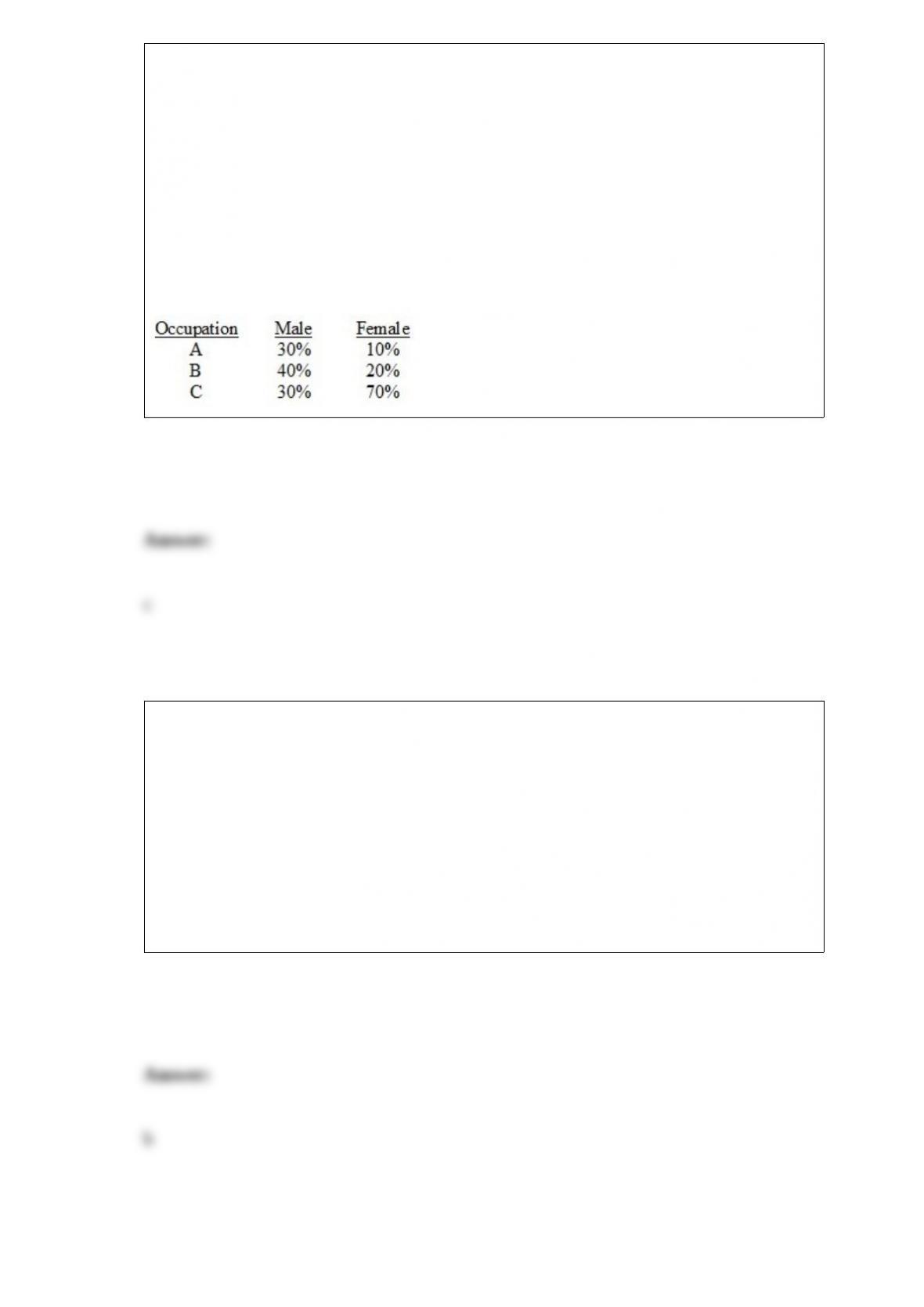
The index of segregation for this economy is: (the following labor market data showing
the distribution of males and females within the three occupations (labeled A, B, and C)
of a hypothetical economy.):
a. .20
b. .30
c. .40
d. .70
Consider the effects of a government transfer payment that falls as income rises (such
as food stamps). Economic theory predicts that:
a.work effort falls because the substitution effect outweighs the income effect
b.both the income and substitution effects tend to reduce work effort
c.work effort rises because the substitution effect outweighs the income effect
d.work effort falls because the income and substitution effects offset each other

As distinct from product market transactions, labor market transactions are unique in
that:
a. to the seller, the nonmonetary characteristics of the sale can be as important as the
price
b. labor demand curves slope upward
c. the price of labor is not determined by supply and demand factors
d. they are less complex
Which one of the following is a true statement?
a.The union wage advantage narrows during recessions
b.There is no union wage advantage for African American males
c.Unions achieve bigger wage gains for clerical workers than workers in crafts
d.The union wage advantage is bigger for workers with less education than for workers
with more education
The nonunion wage rate may rise as the result of a union wage increase because of the:
a.spillover effect

b.superior-worker effect
c.threat effect
d.compensating wage differential effect
International trade:
a. increases labor demand in some industries and reduces it in others
b. reduces the overall demand for labor
c. increases the overall demand for labor
d. has no impact on labor demand at all
If one were to draw a Lorenz curve from the data, what point would be plotted
corresponding to “40%” on the horizontal axis? ( the following quintile earnings
distribution data):
a.11%
b.15%
c.40%
d.60%

Which one of the following is not a plausible explanation of the observed change in the
participation rate of males age 65 and older since World War II?
a. Growth in the percentage of the labor force covered by private pensions
b. Cutbacks in Social Security benefits
c. The long-term growth of average real incomes and wealth
d. The increased generosity of the disability component of Social Security
In the long run, the substitution effect of a lower wage:
a. increases the quantity of labor demanded, while the output effect reduces it
b. decreases the quantity of labor demanded, while the output effect increases it
c. and the output effect both increase the quantity of labor demanded
d. and the output effect both reduce the quantity of labor demanded

Which one of the following wage-productivity combinations will place the greatest
upward pressure on the price level?
a.Nominal wage increase of 5%, productivity increase of 5%
b.Nominal wage increase of 4%, productivity increase of 2%
c.Nominal wage decrease of 5%, productivity increase of 5%
d.Nominal wage increase of 2%, productivity increase of 4%
The median annual earnings in 2010 for full-time workers in the U. S. was
approximately:
a.$35,000
b.$39,000
c.$42,000
d.$61,000

If education is undertaken as consumption as well as investment:
a. researchers will understate the private rate of return on human capital investment
b. researchers will overstate the social rate of return on human capital investment
c. the investment costs of education will be understated
d. the benefits of education will be overstated
Assuming that labor supply is S1, imposing an income tax on this market will:
a.raise the market wage rate but reduce the net (after-tax) wage rate
b.reduce the market rate and reduce the net (after-tax) wage rate
c.raise the market wage rate but have no impact on the net (after-tax) wage rate
d.have no impact on the market wage rate but reduce the net (after-tax) wage rate

The unemployment rate for:
a.blue-collar workers is substantially higher than for white-collar workers
b.females is about double that for males
c.teenagers is about 25% higher than for those age 20 and over
d.African Americans is about four times that of whites
The concept of noncompeting groups suggests that workers in different groups:
a. are legally prevented from competing with one another
b. are imperfect substitutes for one another
c. have comparable characteristics but work for firms in different industries
d. have identical stocks of human capital but differing preferences for nonwage job
characteristics

If the marginal rate of technical substitution of labor for capital is greater than the price
of labor relative to the price of capital, then the firm can produce the same level of
output at lower total cost by using:
a. more capital and less labor
b. less capital and more labor
c. more capital and more labor
d. less capital and less labor
The provision of job safety is generally subject to the law of diminishing returns, which
implies that:
a.the marginal benefit of safety is downward sloping
b.the marginal benefit of safety is upward sloping
c.the marginal cost of safety is downward sloping
d.the marginal cost of safety is upward sloping
In industry A, all displaced workers remain in the union sector waiting to be recalled. In
industry B, all displaced workers seek work in the nonunion sector. All else constant,
the:

a.allocative efficiency loss is greater in industry A
b.allocative efficiency loss is greater in industry B
c.allocative efficiency loss is the same in A and B
d.dynamic efficiency loss is greater in industry A
If the current wage rate results in a budget constraint of AB1, the individual will choose:
a. 0C hours of work and AC hours of leisure
b. AD hours of work and 0D hours of leisure
c. 0D hours of work and AD hours of leisure
d. AC hours of work and 0C hours of leisure
Which of the following best describes the amount of job safety?
a.Firms have no incentive to provide a safe environment, so there is too little safety
b.Only unionized firms can negotiate for a safe environment, so they have safe jobs
while nonunion workers must work in unsafe environments
c.Firms have some incentive to provide safety, but imperfect information and labor
immobility cause safety to be over-provided
d.Firms have some incentive to provide safety, but imperfect information and labor
immobility cause safety to be under-provided
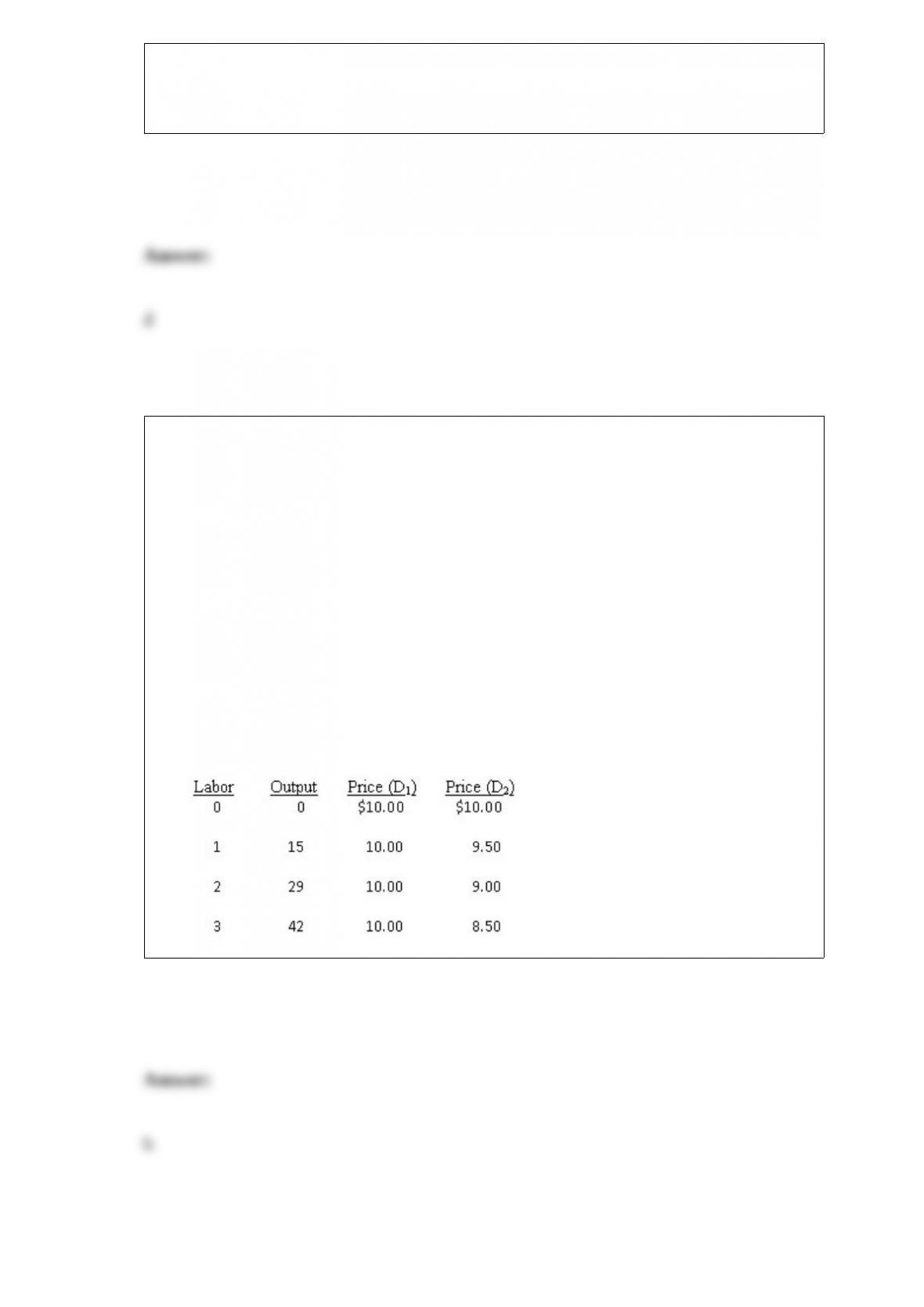
Suppose the firm’s product demand is given by the column labeled D1. If the wage rate
is $120, the firm will achieve maximum profit by hiring _____ workers.
(Assume that the labor market is perfectly competitive.)
a. 3
b. 4
c. 5
d. 6

According to the Wagner Act, which of the following is not an unfair labor practice by
employers?
a.Firing an employee who joins or sympathizes with a union
b.Establishing a company union
c.Interfering with union organizing activity
d.Failing to reach a collective bargaining agreement after bargaining in good faith
A monopsonist’s marginal wage cost curve is positively sloped because:
a. it “discriminates” by paying each worker a different wage according to his or her
opportunity cost
b. it must charge a lower price for each additional unit of output, and it must charge this
lower price for all units sold
c. it pays its workers lower wages, so that the supply of labor to the market is restricted
d. it must pay a higher wage to attract additional workers and it must pay this higher
wage to all workers
A household will tend to substitute goods for time in the production of commodities if:
a. a household member’s market wage increases
b. a household member’s market wage decreases

c. the substitution effect of a wage decrease exceeds the income effect
d. the household’s total income decreases
Shanita is required by her employer to work a standard eight-hour workday. Suppose
her marginal rate of substitution of leisure for income is less than the wage rate at this
level of work effort. We can conclude that Shanita will:
a feel underemployed
b. probably have a higher than average absenteeism rate
c. feel overemployed
d. prefer to work part-time, if such a job is available at the same wage rate
If the two isoquants represent profit maximizing levels of output for two different wage
rates, the move from point A to point B represents the:
a. output effect of a reduction in the wage
b. output effect of an increase in the wage
c. substitution effect of a reduction in the wage
d. substitution effect of an increase in the wage

Sammy is required by her employer to work a standard eight-hour workday. Suppose
her marginal rate of substitution of leisure for income exceeds the wage rate at this level
of work effort. We can conclude that Sammy will:
a feel underemployed
b. desire to find a second job
c. feel overemployed
d. desire to work voluntary overtime