Archives: Quiz
ECB 51338
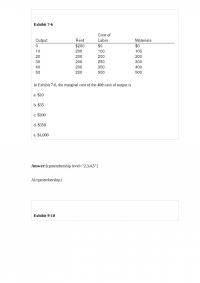
Exhibit 7-6 In Exhibit 7-6, the marginal cost of the 40th unit of output is a. $20 b. $35 c. $200 d. $350 e. $1,000 Exhibit 9-10 Answer: A What output would maximize the profit of the nondiscriminating monopolist in […]
ECB 23529
The midpoint quantity between 100 and 300 units is a. 100 units b. 200 units c. 300 units d. 150 units e. 20,000 units Darryl graduated with honors from college. However, he obtained his outstanding grades by cheating on every […]
ECON E 18226
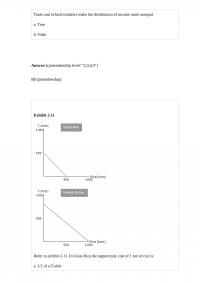
Taxes and in-kind transfers make the distribution of income more unequal. a. True b. False Exhibit 2-11 Refer to exhibit 2-11. In Costa Rica the opportunity cost of 1 ton of rice is: a. 1/2 of a T-shirt Answer: B […]
ECON 64506
The law of demand states that a. quantity demanded is inversely related to price b. quantity demanded is directly related to income c. marginal utility is inversely related to quantity consumed d. total revenue is directly related to price e. […]
ECON 37178
People make mistakes in allocating their time a. only when leisure time is an inferior good b. because expectations are not always fulfilled c. more often when the cost of making a mistake is high d. only when economists remove […]
ECB 84960
A service like CARFAX, which provides a used car buyer with the complete history of a used car, is profitable because of the problem of moral hazard. a. True b. False A leftward shift of a supply curve represents a […]
ECB 42053
In the range of increasing marginal returns, total product is a. increasing at a constant rate b. increasing at an increasing rate c. increasing at a decreasing rate d. decreasing at an increasing rate e. decreasing at a decreasing rate […]
ECON 30742
Suppose a perfectly competitive increasing-cost industry is in long-run equilibrium when market demand suddenly decreases. What happens to the industry in the long run? a. It experiences no change from the original equilibrium b. It experiences a higher equilibrium price […]
BUS 45824
The quantity of labor an individual supplies to any market a. always increases as the market wage rate rises b. is contingent upon the wage rates offered in other labor markets c. always decreases as the market wage rate rises […]
Economics 28300
The change in total revenue that results from a one-unit change in the amount of a variable resource used is a. average resource cost b. marginal resource cost c. marginal product d. marginal revenue product e. average revenue product Goods […]
ECON E 62263
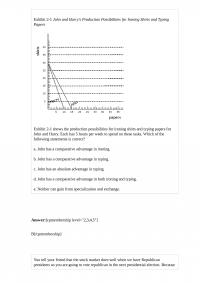
Exhibit 2-1 John and Harry’s Production Possibilities for Ironing Shirts and Typing Papers Exhibit 2-1 shows the production possibilities for ironing shirts and typing papers for John and Harry. Each has 5 hours per week to spend on these tasks. […]
ECON E 44818
If an employment situation is characterized by adverse selection, a. there are too many applicants for each job b. there are too few applicants for each job c. there are exactly the right number of applicants for each job d. […]
ECON A 88764
Which of the following is true of public goods? a. The market mechanism helps to signal the quantity that is demanded by the public. b. Payment for consumption is efficiently provided by market prices. c. Consumption by one person does […]
Economics 90792
Perfectly elastic demand curves are a. downward sloping b. upward sloping c. vertical d. horizontal e. steep The dean of your college is considering hiring another economics professor. If the additional revenue that the college can earn from employing the […]
MicroEconomic 46451
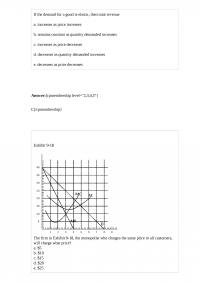
If the demand for a good is elastic, then total revenue a. increases as price increases b. remains constant as quantity demanded increases c. increases as price decreases d. decreases as quantity demanded increases e. decreases as price decreases Exhibit […]
ECON E 38058
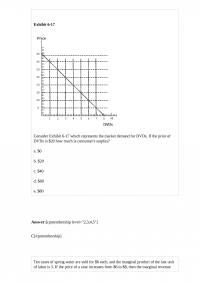
Exhibit 6-17 Consider Exhibit 6-17 which represents the market demand for DVDs. If the price of DVDs is $20 how much is consumer’s surplus? a. $0 b. $20 c. $40 d. $60 e. $80 Ten cases of spring water are […]
BUS 87592
Demand is unit elastic whenever a. price elasticity has an absolute value of 1 b. price elasticity has an absolute value greater than 1 c. price elasticity has an absolute value less than 1 d. price elasticity is negative e. […]
MicroEconomic 33865
How much of U.S. garbage is disposed of in landfills? a. 25 percent b. 40 percent c. 60 percent d. 70 percent e. 100 percent If an increase in the price of a product from $100 to $200 per unit […]
ECB 29802
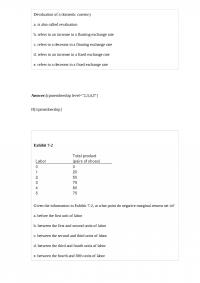
Devaluation of a domestic currency a. is also called revaluation b. refers to an increase in a floating exchange rate c. refers to a decrease in a floating exchange rate d. refers to an increase in a fixed exchange rate […]
Economics 91388
As the price of land decreases along its demand curve, the relative price of land a. increases because the prices of other resources have also decreased b. decreases because the prices of other resources have also decreased c. increases because […]
ECON 62419
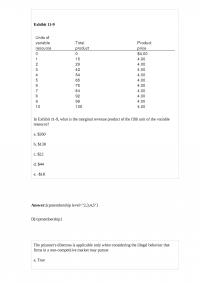
Exhibit 11-9 In Exhibit 11-9, what is the marginal revenue product of the fifth unit of the variable resource? a. $260 b. $130 c. $22 d. $44 e. -$18 The prisoner’s dilemma is applicable only when considering the illegal behavior […]
ECON A 96196
A lump-sum tax per unit on imports is known as a. a specific tariff b. an effective tariff c. a specific quota d. an effective quota e. anad valorem quota Two reasons why a few individuals earn very high pay […]
BUS 79500
To a firm facing constant input prices, increasing marginal returns a. means that each additional unit of output costs more to produce than the previous unit b. means that the marginal product of the variable input decreases as more of […]
ECB 96420
If a consumer moves from point a to point b on the indifference curve shown in Exhibit 6-22, a. the marginal rate of substitution between books and movies falls b. the marginal rate of substitution between books and movies stays […]
ECON A 83844
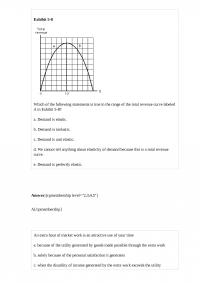
Exhibit 5-8 Which of the following statements is true in the range of the total revenue curve labeled A in Exhibit 5-8? a. Demand is elastic. b. Demand is inelastic. c. Demand is unit elastic. d. We cannot tell anything […]
ECON A 20819
The optimal level of water and air quality a. is zero, which is a pollution-free environment b. occurs when the marginal private cost of air quality equals its marginal social cost c. is greater if the marginal social cost curve […]
BUS 66667
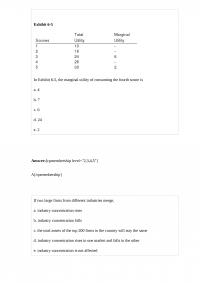
Exhibit 6-5 In Exhibit 6-5, the marginal utility of consuming the fourth scone is a. 4 b. 7 c. 6 d. 24 e. 2 If two large firms from different industries merge, a. industry concentration rises b. industry concentration falls […]
MicroEconomic 24769
The demand curve facing a firm will be more elastic, a. the fewer the number of competing firms b. the more differentiated the product c. the more substitutes there are for its product d. the greater the firm’s ability to […]
BUS 74317
An increase in the number of producers of a good will a. increase the market supply because the price will rise b. increase the market supply only if market demand increases too c. increase the market supply because market supply […]
ECON 47765
Government regulation of the prices and entry conditions in an industry is an example of a. safety regulation b. economic regulation c. Herfindahl regulation d. antitrust regulation e. Social Security legislation A profit-maximizing firm will hire units of an input […]
ECON A 75466
Under which of the following market conditions is it most difficult to maintain a cartel agreement? a. There are many firms in the industry and these firms have similar costs. b. There are many firms in the industry and these […]
Economics 59691
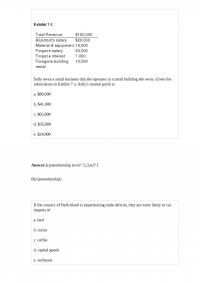
Exhibit 7-1 Sally owns a small business that she operates in a small building she owns. Given the information in Exhibit 7-1, Sally’s normal profit is a. $80,000 b. $41,000 c. $65,000 d. $35,000 e. $24,000 If the country of […]
ECON 15716
In every age group, average income in the United States increases with education. a. True b. False If, as a firm increases its rate of output, total cost increases as well, a. profit cannot be maximized b. revenue cannot be […]
Economics 99129
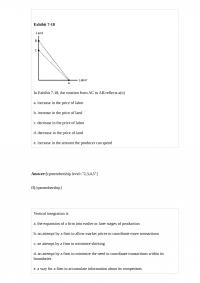
Exhibit 7-18 In Exhibit 7-18, the rotation from AC to AB reflects a(n) a. increase in the price of labor b. increase in the price of land c. decrease in the price of labor d. decrease in the price of […]
MicroEconomic 34809
Resources are efficiently allocated when production occurs at that point at which a. marginal cost intersects average variable cost b. price is equal to average revenue c. price is equal to marginal cost d. marginal revenue equals marginal cost e. […]
ECON 18743
If the price of a resource falls, other things constant, a. demand for the product it produces will increase b. demand for a substitute product will increase c. demand for a substitute resource will fall d. supply of that resource […]
ECON E 93671
In the short run, a perfectly competitive firm will always shut down if, at all output levels above zero, a. price is less than average total cost b. total revenue is less than total cost c. they cannot pay variable […]
ECON A 91555
If you are planning to visit wildlife preserves in Kenya, you hope the U.S. dollar appreciates against Kenya’s currency. a. True b. False The tendency for the poorest risks to buy health insurance and the tendency of the insured to […]
ECON E 87235
If the government breaks up a constant-cost, nondiscriminating monopoly into a perfectly competitive industry, what would we expect with regard to output and price? a. Output and price will decrease. b. Output will increase and price will decrease. c. Output […]
ECB 35785
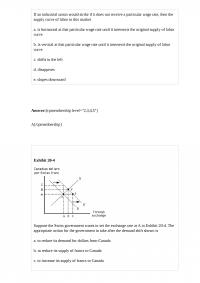
If an industrial union would strike if it does not receive a particular wage rate, then the supply curve of labor in this market a. is horizontal at that particular wage rate until it intersects the original supply of labor […]
MicroEconomic 54834
Marginal utility is defined as the a. average amount of satisfaction gained from consuming a product b. total amount of satisfaction gained from consuming a product c. additional satisfaction gained from consuming one more unit of a product d. total […]
ECON 13765
Resources are divided into the following broad categories: a. people, money, and machines b. saving, spending, investment, and capital c. human, technological, and government d. natural resources, labor, capital, and entrepreneurial ability e. free, scarce, abundant, and unlimited The chances […]
Economics 18983
In less developed economies, the distribution of income is a. more concentrated (i.e., distributed less evenly) than in developed economies b. less concentrated than in developed economies c. such that the bottom 20 percent of households define the poverty threshold […]
ECON E 23031
If the marginal resource cost of the tenth worker hired by a firm is $4 and the wage of the tenth worker is $3, the firm will hire ten workers if the marginal revenue product of the tenth worker is […]
ECON E 26411
Oil is an example of a renewable resource. a. True b. False Suppose a firm is a price searcher in the product market and hires labor in a perfectly competitive labor market. If the wage rate is $20, the marginal […]
ECON A 22220
Compared to the short run, the long-run market supply curve is a. less elastic b. equally elastic c. more elastic d. always negatively sloped e. None of the answers is correct. Which pair of groups benefits from an import quota […]
BUS 19340
Suppose, as a result of a long-run adjustment in a perfectly competitive industry to a change in demand, price and output both fell. Therefore, demand must have __________ in this __________ industry. a. fallen; increasing cost b. fallen; decreasing cost […]
ECON 88684
The explanation for the law of demand begins with a. a small number of wants satisfied by scarce resources b. finite wants satisfied by infinite resources c. unlimited wants confronting scarce resources d. unlimited wants matching up with unlimited resources […]
ECON A 51205
Monopolistic competition is best described as a. many firms with some control over price, and some product differentiation b. many firms with no control over price, producing identical products c. a few firms with some control over price, producing highly […]
Economics 85738
When government regulations force a natural monopoly to produce where price equals average total cost, social welfare is a. maximized b. less than it would be without regulation c. greater than it would be without regulation, but it is not […]